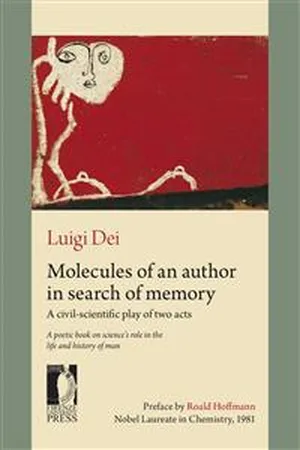
Loosely based on Primo Levi's The Periodic Table, the play has a Fahrenheit 451 setting. In a world without books or memory appears a common man, the Man in the street, with some heets of writing that he cannot make out. With the help of the narrator, Science, Technology and Nature, and of two actors who remain offstage for a long while – Primo and his friend Alberto – this man is able to reconstruct the events of the chapter entitled Cerium. In this way, and thanks to this act of remembrance, lost identity – our history – is recreated. Luigi Dei is a scholar of international renown in Materials Chemistry at the «Ugo Schiff» Department of Chemistry at the University of Florence, where he teaches chemistry in the Science School. The author of numerous scientific articles to have appeared in international journals, he also dedicates himself to the popularisation of science, and to the relationship between science, art and literature. A shining example of this is his recent lecture-performance, Science reveals Ravel's Bolero.
- English
- ePUB (mobile friendly)
- Available on iOS & Android
eBook - ePub
About this book
Information
Subtopic
TeatroAct One
Scene One
A simple, sparse setting, in semi-darkness. Toward the front of the stage: a coat stand with an overcoat, hat and scarf; a desk with a computer, a few scattered sheets of paper, pens and pencils; several bookcases with no books, only ornaments and vases of flowers, and three television sets of varying size on the shelves; armchairs and sofas.
Characters: Narrator, Man in the street, Primo.
Narrator (Alone on the stage, pacing up and down. Appears sad, but also rather agitated; angry with himself and with the world in general) – What kind of world is this in which we live only for images, for the present, for unbridled hedonism and consumerism, with no memory of anything anymore? (Man in the street enters timidly, taken aback by the force of the Narrator’s outburst. He looks around and positions himself in a corner, unnoticed by the Narrator) Look at the men of today, all professionals of forgetfulness: (sarcastically) what wonderful schools where one is taught to forget, how marvellous our national «Oblivion» award, that everyone is so desperate to win!
Man in the street (Having been slightly hidden now steps into view and addresses the Narrator, with neither fear nor awe) But what on earth do you mean? That’s a bit far-fetched if you ask me! As long as they are willing, people can read and not forget anything at all.
Narrator Oh, so in your opinion people can read can they? Come on! You know perfectly well that history books no longer exist, and that it’s forbidden to ask people «who were you?» or «who have you been?». What is it all our politicians say nowadays, no matter what party they may belong to? «Whatever you may ask me about my past, know this: I never existed». Books that people could read if they so wish you say? What planet are you living on? Books have become museum pieces, antiques, relics of a time gone by – obsolete like archaeological remains. Don’t you know that it’s nearly impossible to find a bookshop nowadays? Do you see bookcases in people’s houses? (With irony) Just look at some furniture catalogues – you’ll soon see how many beautiful bookcases there are to buy: (articulates very clearly) they don’t make them anymore! It’s sad but true.
Man in the street It’s not true what you’re saying: as long as we have memories, we can write them down and pass them on to others. I think you’re being a bit too pessimistic!
Narrator You think I’m a pessimist? Well I say your optimism is unfounded – open your eyes! It doesn’t make sense to remember anymore; the new laws forbid you even to keep what you write: word processing software won’t let you save your documents. It’s got nothing to do with pessimism, I’m simply being realistic. It’s ill-fated, this world that has no further need of its past (The narrator moves over to the coat on the stand and reaches into one of its two pockets).
Man in the street Why do you say that? I feel a very strong need for our past, I want memory, and hate forgetfulness.
Narrator So you say. Fine, listen then as I read this extract – a few words, found in the pocket of this old coat: (opens and reads from a scrap of paper) «In the art of forgetting, the Italian intellect is without rival: it is unequalled, sublime». Do you know who coined this great phrase? An Italian writer, at the end of the second millennium. What truth, what prophetic potency, what a sense of foreboding!
Man in the street You may be right. I too have a few torn pages which I found in my grandparents’ cellar however, and it seems to me they contain writings that do recount things that have taken place, tragic events: they speak of hunger, of stealing, of receptacles, of lighter flints, of cigarette lighters, of death, life and cerium. Rather than getting so worked up in vain over your old world that no longer exists, why not help me to understand, to piece together this jigsaw of paper and ink? Let’s go back in time together and reclaim these lost memories.
Narrator (Challenging tone) How presumptuous you are! Who are you that dares to challenge the inevitable course of human affairs, which feed only on the present and the cult of the image?
Man in the street (Looking the narrator straight in the eyes) I may be a man of the street, a common citizen, not particularly well-educated and lacking in memory – as you rightly say – but curiosity still gnaws away at me: I am the man that wants to understand, that wants to know who man was, what man has been, why man did this and why he did that... I want to understand the meaning of the dark marks written on these yellowing scraps of paper. Help me, I’m begging you: don’t be so high and mighty. From what you say it seems that you know a great deal about our past.
Narrator (Almost frightened by such a display of fortitude) You scare me, man in the street. And do you know why? Because you don’t know what might lie in store. Behind those words hunger, theft, receptacles, flints, life, death and cerium, you might discover a truly dark and awful side of yourself, a glimmer of something true, that «has happened and therefore can happen again». Think carefully: the blissful peace of an unaware mind could suddenly be replaced with the agitated suffering of reason and knowledge.
Man in the street My mind’s made up. I’ll die if I don’t know what these twenty-eight ink-stained sheets conceal: my ‘blissful peace’ has already become the anxious suffering of reason that is unable to see clearly. If you’ll enlighten me, reason and knowledge could instead alleviate the mental torment that has troubled me since I found these sheets.
Narrator (With changed attitude, as if with renewed faith in the future, or at least in the possibility of carrying out an important endeavour) Very well then, I will try to guide you from the shadows into the light, but on one condition: once the mystery is resolved, you must dedicate the entire rest of your life to ceaselessly writing it down an infinite number of times in all the languages of the world, without respite, to the point of exhaustion, with this ink and on this paper (from a drawer in the desk pulls out a ream of paper and a pot of dark ink). They are made from an unusual substance which is indestructible and bears the gift of eternal life: it’s the product of a miraculous alchemy to which I have dedicated my whole life. And one more thing – on our journey from darkness into light, you must never ask anything about the human characters that we meet.
Man in the street (With conviction) I accept the condition: I swear and promise that if, with your assistance, I’m able to understand entirely the meaning of what is written on the pieces of paper, not a minute will pass from the moment of comprehension onwards that I don’t dedicate to the ancient task of the scribe, with these magical implements, your paper and ink. You should know however that if my endeavour proves to be excessively demanding, and I die of exhaustion, then so too will yours be similarly demanding. I am a common man, in an era – as you say – of oblivion, and the absence of books and reading. Your didactic abilities will need to draw on untold resources. The rock face we have to climb will be (thinks for a moment as if to find the best phrase with which to make an impact; then, all of a sudden, almost trance-like, as if inspired by some mysterious force, declaims in a resounding tone) «an idle and ignorant adversary, inimical as human ignorance is inimical, and strong – as such ignorance is wont to be – by dint of its passive obtuseness».
Primo (Offstage, enunciates the four words clearly, one by one) I know those words.
Man in the street Who was that? Where did that voice come from?
Narrator (Trying to gloss over the verbal intrusion of the mysterious character in the wings) Don’t pay any attention. Listen to me and concentrate on what I’m saying instead. I’m not intimidated by such an undertaking. I’m too excited by the prospect of a climb, which – if we should reach the summit – might change this wretched world! Just be aware that in leading you toward the light of dawn I’ll need to introduce some strange and mysterious characters to you – some of them in flesh and blood, others in a more unusual materialisation, lacking corporal features, but nonetheless vivid as only those of the animal and plant kingdom know how to be.
Man in the street (Pulls from his pocket a well-ordered collection of papers, held together by an elastic band, from which he extracts the first, delicately replacing the rest in his pocket) Here is the first sheet. I can only make out four words – the rest are extremely faded – perhaps I can hazard a guess, but I can’t see how they make sense as a whole, the meaning escapes me.
Narrator Go on, read me the four words in order.
Man in the street (Enunciates very clearly, without seeming to read any meaning in the phrase) «Alternated», «at», «a», «rate»: what does that mean, «alternated»? How is this rate able to alternate?
Narrator (Worried) My dear man in the street, we’re off to...
Table of contents
- Preface
- Introduction
- Characters in order of appearance
- Act One
- Act Two
Trusted by 375,005 students
Access to over 1.5 million titles for a fair monthly price.
Study more efficiently using our study tools.
Frequently asked questions
Yes, you can cancel anytime from the Subscription tab in your account settings on the Perlego website. Your subscription will stay active until the end of your current billing period. Learn how to cancel your subscription
No, books cannot be downloaded as external files, such as PDFs, for use outside of Perlego. However, you can download books within the Perlego app for offline reading on mobile or tablet. Learn how to download books offline
Perlego offers two plans: Essential and Complete
- Essential is ideal for learners and professionals who enjoy exploring a wide range of subjects. Access the Essential Library with 800,000+ trusted titles and best-sellers across business, personal growth, and the humanities. Includes unlimited reading time and Standard Read Aloud voice.
- Complete: Perfect for advanced learners and researchers needing full, unrestricted access. Unlock 1.5M+ books across hundreds of subjects, including academic and specialized titles. The Complete Plan also includes advanced features like Premium Read Aloud and Research Assistant.
We are an online textbook subscription service, where you can get access to an entire online library for less than the price of a single book per month. With over 1.5 million books across 990+ topics, we’ve got you covered! Learn about our mission
Look out for the read-aloud symbol on your next book to see if you can listen to it. The read-aloud tool reads text aloud for you, highlighting the text as it is being read. You can pause it, speed it up and slow it down. Learn more about Read Aloud
Yes! You can use the Perlego app on both iOS and Android devices to read anytime, anywhere — even offline. Perfect for commutes or when you’re on the go.
Please note we cannot support devices running on iOS 13 and Android 7 or earlier. Learn more about using the app
Please note we cannot support devices running on iOS 13 and Android 7 or earlier. Learn more about using the app
Yes, you can access Molecules of an author in search of memory by Dei, Luigi in PDF and/or ePUB format, as well as other popular books in Mezzi di comunicazione e arti performative & Teatro. We have over 1.5 million books available in our catalogue for you to explore.