Come parte integrante del corso di Teoria e Tecnica della Traduzione Inglese, si prevede lo svolgimento di una traduzione dall'inglese all'italiano accompagnato da un commento alla traduzione stessa.
Tradurre, come appreso durante il corso, non è un procedimento lineare e, non esistendo sinonimia assoluta tra due lingue, la traduzione di uno stesso testo da parte di persone diverse porta a risultati spesso molto differenti. Redigere un commento alla traduzione pertanto è uno strumento molto utile non solo per effettuare un'analisi del testo (che è sempre indispensabile) ma anche per spiegare al lettore del testo tradotto alcune scelte che sono state fatte, soprattutto quelle meno ovvie.
I testi che verranno presi in considerazione per le esercitazioni sono principalmente testi letterari che presentano molte delle problematiche traduttive che ogni giorno un traduttore si trova ad affrontare. Sono stati scelti vari sottogeneri afferenti al testo letterario così da avere una panoramica, seppur limitata, di vari generi testuali per riflettere sulle scelte traduttive che questi comportano.
Durante le 10 ore di esercitazioni del corso si svolgeranno esercizi in aula, di volta in volta verranno assegnati compiti da svolgere a casa per la lezione successiva. Di questi compiti uno verrà consegnato per una correzione senza valutazione (servirà per fare il punto della situazione a metà circa del ciclo di esercitazioni) e un altro sarà invece valutato e andrà a costituire un primo voto per la costruzione del voto finale complessivo del corso. Tratto dall'introduzione dell'Autrice
- English
- ePUB (mobile friendly)
- Available on iOS & Android
eBook - ePub
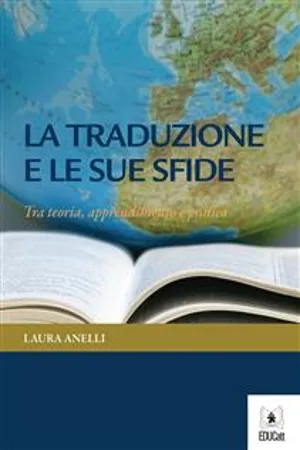
La traduzione e le sue sfide
About this book
Information
Testo 1 – Il romanzo fantasy
This happened in 1932, when the state penitentiary was still at Cold Mountain. And the electric chair was there, too, of course.
The inmates made jokes about the chair, the way people always make jokes about things that frighten them but can’t be gotten away from. They called it Old Sparky, or the Big Juicy. They made cracks about the power bill, and how Warden Moores would cook his Thanksgiving dinner that fall, with his wife, Melinda, too sick to cook.
But for the ones who actually had to sit down in that chair, the humor went out of the situation in a hurry. I presided over seventy-eight executions during my time at Cold Mountain (that’s one figure I’ve never be confused about; I’ll remember it on my deathbed), and I think that, for most of those men, the truth of what was happening to them finally hit all the way home when their ankles were being clamped to the stout oak of “Old Sparky’s” legs. The realization came then (you would see it rising in their eyes, a kind of cold dismay) that their own legs had finished their careers. The blood still ran in them, the muscles were still strong, but they were finished, all the same; they were never going to walk another country mile or dance with a girl at a barn-raising. Old Sparky’s clients came to a knowledge of their deaths from the ankles up. There was a black silk bag that went over their heads after they had finished their rambling and mostly disjointed last remarks. It was supposed to be for them, but I always thought it was really for us, to keep us from seeing the awful tide of dismay in their eyes as they realized they were going to die with their knees bent.
There was no death row at Cold Mountain, only E Block, set apart from the other four and about a quarter size, brick instead of wood, with a horrible bare metal roof that glared in the summer sun like a delirious eyeball. Six cells inside, three on each side of a wide center aisle, each almost twice as the cells in the other four blocks. Singles, too. Great accommodations for a prison (especially in the thirties), but the inmates would have traded for cells in any of the other four. Believe me, they would have treated.
There was never a time during my years as block superintendent when all six cells were occupied at one time – thank God for small favors. Four was the most, mixed black and white (at Cold Mountain, there was no segregation among the walking dead), and that was a little piece of hell. One was a woman, Beverly McCall. She was black as the ace of spades and as beautiful as the sin you never had nerve enough to commit.
(Stephen King, The Green Mile, Pocket Books, 1996)
Testo 2 – Il racconto per l’infanzia
High on a hill in an enchanted garden, enclosed by tall walls and protected by strong magic, flowed the Fountain of Fair Fortune.
Once a year, between the hours of sunrise and sunset on the longest day, a single unfortunate was given the chance to fight their way to the Fountain, bathe in its waters and receive Fair Fortune for evermore.
On the appointed day, hundreds of people travelled from all over the kingdom to reach the garden walls before dawn. Male and female, rich and poor, young and old, of magical means and without, they gathered in the darkness, each hoping that they would be the one to gain entrance to the garden.
Three witches, each with her burden of woe, met on the outskirts of the crowd, and told one another their sorrows as they waited for sunrise.
The first, by name Asha, was sick of a malady no Healer could cure. She hoped that the Fountain would banish her symptoms and grant her a long and happy life.
The second, by name Athleda, had been robbed of her home, her gold and her wand by an evil sorcerer. She hoped that the Fountain might relieve her of powerlessness and poverty.
The third, by name Amata, had been deserted by a man whom she loved dearly, and she thought her heart would never mend. She hoped that the Fountain would relieve her of her grief and longing.
Pitying each other, the three women agreed that, should the chance befall them, they would unite and try to reach the Fountain together.
The sky was rent with the first ray of sun, and a chink in the wall opened. The crowd surged forward, each of them shrieking their claim for the Fountain’s benison. Creepers from the garden beyond snaked through the pressing mass, and twisted themselves around the first witch, Asha. She grasped the wrist of the second witch, Athleda, who seized tight upon the robes of the third witch, Amata.
And Amata became caught upon the armour of a dismal-looking knight who was seated on a bone-thin horse.
The creepers tugged the three witches thro...
Table of contents
- Sommario
- Introduzione
- Didattica e traduzione: quale rapporto?
- Redigere il commento alla traduzione Per la stesura di questo paragrafo si sono seguite le linee guida messe a disposizione da Margherita Ulrych e Simona Anselmi
- Glossario
- Testo 1 – Il romanzo fantasy
- Testo 2 – Il racconto per l’infanzia
- Testo 3 – Letteratura post-apocalittica
- Testo 4 – La short story
- Testo 5 – La chick-lit
Trusted by 375,005 students
Access to over 1.5 million titles for a fair monthly price.
Study more efficiently using our study tools.
Frequently asked questions
Yes, you can cancel anytime from the Subscription tab in your account settings on the Perlego website. Your subscription will stay active until the end of your current billing period. Learn how to cancel your subscription
No, books cannot be downloaded as external files, such as PDFs, for use outside of Perlego. However, you can download books within the Perlego app for offline reading on mobile or tablet. Learn how to download books offline
Perlego offers two plans: Essential and Complete
- Essential is ideal for learners and professionals who enjoy exploring a wide range of subjects. Access the Essential Library with 800,000+ trusted titles and best-sellers across business, personal growth, and the humanities. Includes unlimited reading time and Standard Read Aloud voice.
- Complete: Perfect for advanced learners and researchers needing full, unrestricted access. Unlock 1.5M+ books across hundreds of subjects, including academic and specialized titles. The Complete Plan also includes advanced features like Premium Read Aloud and Research Assistant.
We are an online textbook subscription service, where you can get access to an entire online library for less than the price of a single book per month. With over 1.5 million books across 990+ topics, we’ve got you covered! Learn about our mission
Look out for the read-aloud symbol on your next book to see if you can listen to it. The read-aloud tool reads text aloud for you, highlighting the text as it is being read. You can pause it, speed it up and slow it down. Learn more about Read Aloud
Yes! You can use the Perlego app on both iOS and Android devices to read anytime, anywhere — even offline. Perfect for commutes or when you’re on the go.
Please note we cannot support devices running on iOS 13 and Android 7 or earlier. Learn more about using the app
Please note we cannot support devices running on iOS 13 and Android 7 or earlier. Learn more about using the app
Yes, you can access La traduzione e le sue sfide by Anelli Laura in PDF and/or ePUB format, as well as other popular books in Languages & Linguistics & Translating & Interpreting. We have over 1.5 million books available in our catalogue for you to explore.