Railroads, tourism, and government bureaucracy combined to create modern religion in the American West, argues David Walker in this innovative study of Mormonism’s ascendency in the railroad era. The center of his story is Corinne, Utah—an end-of-the-track, hell-on-wheels railroad town founded by anti-Mormon businessmen. In the disputes over this town’s frontier survival, Walker discovers intense efforts by a variety of theological, political, and economic interest groups to challenge or secure Mormonism’s standing in the West. Though Corinne’s founders hoped to leverage industrial capital to overthrow Mormon theocracy, the town became the site of a very different dream.
Economic and political victory in the West required the production of knowledge about different religious groups settling in its lands. As ordinary Americans advanced their own theories about Mormondom, they contributed to the rise of religion itself as a category of popular and scholarly imagination. At the same time, new and advantageous railroad-related alliances catalyzed LDS Church officials to build increasingly dynamic religious institutions. Through scrupulous research and wide-ranging theoretical engagement, Walker shows that western railroads did not eradicate or diminish Mormon power. To the contrary, railroad promoters helped establish Mormonism as a normative American religion.
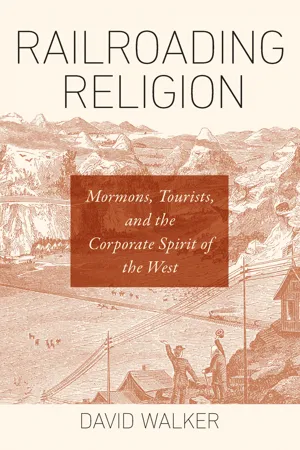
eBook - ePub
Railroading Religion
Mormons, Tourists, and the Corporate Spirit of the West
- 352 pages
- English
- ePUB (mobile friendly)
- Available on iOS & Android
eBook - ePub
About this book
Information
Topic
Theologie & ReligionSubtopic
Nordamerikanische GeschichteCHAPTER ONE

Corinnethians and the Death Knell Thesis

“THE FIRST WHISTLE of the locomotive in the Salt Lake Valley will sound the knell of Mormonism.”1 This notion — articulated here by a western travel writer in 1868 — became a refrain of sorts, and it echoed in anti-Mormon discourses throughout the country. From congressional halls to newspaper columns to church pulpits, nineteenth-century Americans postulated the demise of Mormonism during the railroad age. Some wrote laws and underwrote companies accordingly. And others, as in Corinne, Utah, chartered new towns.
The ‘death knell thesis’ (as I will call it here) was keyed to several interlocking, popular theories about religion, economics, politics, law, and sex in modernity. By its terms, railroads would add economic stakes to extant ‘human interests’ in Utah, even as they provided better means through which to pursue those interests. Corporate success and national integration simultaneously required and constituted local stability, it said. And stability, in turn, entailed humanistic understanding and humanitarian work — including the diagnosis of barbarism and the fight against theocracy — which would be facilitated by intergroup contact and commerce along railroads. One reporter articulated the looping logic in this way: railroads, having increased Americans’ “commercial interest” in Utah, and having combined it with humanitarian and political ones, “will as surely as truth is truth, and right is right, crush out the vile thing” called Mormonism and “rid the country of the foul blot.”2 The death knell thesis thus recapped — sometimes through economic argument, and often through the accretion of railroad puns — the assumption that Mormonism could not withstand the arrival of ministers, miners, traders, businessmen, and legislators in Utah, as each of these would bring “contact with our more enlightened civilization” in their own particular ways.3 Brigham Young would lose control over the social, economic, and political affairs of the territory, it said. The period of Utah’s isolation and estrangement would come to an end; men would become familiar with new thoughts and new vocations; women would be exposed to eligible bachelors and enticing fashions; outdated sensibilities and superstitions would wither; and freedom would reign.
“Mormonism may henceforth be considered on the down grade,” announced an Illinois reporter in May 1869, ten days after the completion of the transcontinental railroad. “The last spike in the Pacific railroad was the first nail in the coffin of Mormonism.” A congressman from Nevada largely agreed with the sentiment: “Every locomotive bell resounding through the gorges of the Wahsatch mountains is sounding [polygamy’s] death knell.” So too did a prominent Mormon apostate agree: “The construction of the Pacific Railroad” will deliver “the death-blow to Polygamy” and enable people’s escape from church oppressions.4 The ubiquity of the death knell thesis, the diversity of its proponents, and the stability of its terms is enough to imply substance as well as veneer, but it is the historian’s task to unpack this circular notion and to situate its interlocking aspects in time and place. Only thus can we understand why it was that, when one group of anti-Mormons attempted to plant a town in the midst of all that rhetoric, politicking, enterprising, and sectarianism, they found little traction. Corinnethians discovered that there was no there, there.
The Anti-Bigamy Act and the Business of Religious Legislation
Speeches by Justin S. Morrill — Vermont representative and namesake of the first federal anti-Mormon legislation, the Morrill Anti-Bigamy Act of 1862 — provide introductions to the premises of anti-Mormon industrial theory. They are a fitting place to begin this story of Corinnethian aspirations and railroad knells for other reasons, too. Discussions of the Anti-Bigamy Act drew certain themes in colorful directions, and railroad companies were later imagined as implementing partners for the act’s initiatives. In such conversations and contract language we may identify the circulation of influential theories of religion and important concerns of religious comparison.
Five years before the passage of the act, Morrill outlined its concerns before Congress. Mormonism was un-American in several respects, he said. Most glaringly, it was religious and political in manners unbefitting the modernity embodied and advanced in America. Mormonism was monarchic rather than democratic, affording little to no opportunity for dissent or freedom of thought; likewise, it was barbaric rather than enlightened. LDS leaders were “as hostile to the republican form of government as they are to the usual form of Christianity,” he said. According to Morrill, Mormons adopted “kingly government, in order to make their patriarchal institutions more homogenous,” and they assumed the rhetoric and “guise of religion” to similar intended effect.5
Among the congressional concerns of the 1850s was the putative monopoly of Utahn resources by a handful of Mormon ‘patriarchs.’ Wood, water, and real estate were “monopolized not only by the Mormons,” Morrill reported, “but by a few Mormons — the Governor [Brigham Young] and his apostles.” So too were obstacles to overland travel and national expansion considered unacceptable: “The Governor and the leading elders … extort considerable tribute from the emigrant travel passing through to California.” Revenue from bridge and ferry tolls, combined with membership tithes, funded other initiatives by which Mormondom placed itself at odds with American values and expansion: the development of independent legal structures, the expansion of leaders’ domestic dominions, and the maintenance of a church militia. This was what theocracy looked like, Morrill thought. LDS leaders had yoked together the interests and offices of religion and statism.6
A military expedition in 1857–58 lessened certain but not all congressional concerns. President James Buchanan then ordered some 2,500 troops across country to investigate claims of Mormon barbarism and sedition, and they removed Brigham Young from the governorship of Utah Territory — a position he had held since 1851 — and established a military camp outside Salt Lake City. But the ‘Utah War’ arguably resulted in little more than the excitement of Mormon militiamen, who hastily constructed fortifications in the Wasatch Mountains’ Echo Canyon in case of armed confrontation, and a boon to Mormon merchants, who sold expensive provisions to soldiers during their stay and then purchased their supplies cheaply when they left. The U.S. military failed to persuade Mormons of the moral benefits of monogamy, in any case. Opposition to polygamy — or, rather, to polygynous marriage between one man and plural women, a practice publicly adopted by the LDS Church in 1852 — thus remained the flagship of anti-Mormon activism well after 1858, even as it continued to catch other interests and initiatives in its wake. Polygamy was argued to be both catalyst and fruition of Mormon patriarchy and religious primitivism, the seed and shell of aberrant sensualities. On these grounds Congress attacked it: Mormonism developed its rhetorical strategies and bureaucratic infrastructures in order to beget and defend a kind of basic, hedonistic, sensual polygamy.7
Talk of polygamous patriarchy served anti-Mormon initiatives in two principal respects. First, it evoked sexual and gender politics in a limited way, that is, without necessarily challenging sexism operative elsewhere in American systems of enfranchisement, employment, property holding, and violent crime. Such talk implicitly contrasted such sexism with presumably worse Mormon instantiations instead.8 Polygamous Mormonism threatened white womanhood and insulted women’s “known virtue,” according to Morrill, his activist compatriots, and countless novelists and newspapermen. It made literal slaves of women within LDS domestic labor camps. Mormon “harems” thus upended the natural order of the home, the very microcosm and seedbed of virtue, and they denied women the joyful achievement of simple, direct maternalism. A woman’s place was in the sphere of the home, and that sphere should be monogamous.9
No less dangerous than Mormonism’s attempt to reshape domestic spheres were its claims to religious antiquity, warrant, and worldliness. To speak of patriarchy and polygamy together was to evoke the father figures of the Hebrew Bible and, thus, to force reconsideration of the genealogy of Western religious cultures. Mormons were well aware of the evocation and its challenge, and they deployed the category with provocative intent. Why shouldn’t professed descendants of Israel reclaim the marital practices of Israelites, or ‘the blessings of Abraham,’ even as they claimed Christianity and the blessings of Jesus? In order to negotiate Mormon assertions of ancient religious lineage and sociopolitical warrant — and in order to meet Mormons’ challenges to principles of biblical sufficiency, textual interpretation, church-state separation, and marital sanctity — concerned American policy makers necessarily theorized religion. They did so by rethinking their personal and national relations to Christian and Jewish origins, and by comparing Mormonism to different world religions.10
Congressmen’s theories of religion were interwoven with their concerns about Mormonism, and the standard model identified Islam as Mormonism’s best point of comparison. This association deflected the Mormon provocation to specific genealogical consideration, in a way, albeit through evocative concessions necessitating certain clarifications. On the one hand, the Mormons-to-Muslims comparison avoided judgments regarding the state of Mormon Jewishness and Jewish religious legitimacy, thus allowing congressional sidestepping of one familiar yet impolitic option: an acceptance of LDS claims to Jewish roots fueled by basic anti-Semitism, pursued in order that both traditions might be singly distanced from a Christian religious norm. Similarly, it avoided a second impolitic possibility: the substitution, via congressional adaptations of popular anti-Catholicism, of a Catholic comparate for a Jewish one.11 At the same time, broadening the comparative pool beyond Jewish and Christian exempla entailed additional burdens of religious classification, and it conceded also Mormonism’s relevance to global religious politics.
Morrill said that Mormons — with their “seraglios,” “despotic” leaders, and “fanatical” adherents — were American “Turks” not American Jews, let alone American Christians.12 This was not an atypical rhetorical move. Early American reports on Mormonism had long likened it to Islam, and vice versa; since at least 1831 charges of ‘American Mohammedanism’ had echoed in various contexts and to multiple effect, with spikes in use predictably preceding the 1857 Utah War and the 1862 Anti-Bigamy Act. For most the comparison of Mormons and Muslims consisted in evocations of a putatively shared militarism, theocracy, polygamy, or sensuality and in references to their novel scriptures similarly devised by postbiblical and countercultural prophets. Anti-Muslim stereotypes had little relation to Islam as practiced by most Muslims, of course, and they bespoke an ignorance of America’s own Muslim populations. But the purpose of the comparison was to signal Mormonism’s alarming western installation of the same Oriental barbarisms that had supposedly threatened Christianity throughout the Middle East, Africa, and Asia. It “symbolically aligned” the “oriental and occidental frontiers,” to quote historian Timothy Marr, thus “discrediting both religions through the association of their mutual distance from palatable Protestant practice.” Indeed talk of American Muslims and American Turks evoked ‘otherness’ of distastefully religious and racial sorts, thereby mobilizing against Utahn Mormons (a predominantly Anglo population) racist and cultural stereotypes without necessarily claiming religious equivalence or ethnic descent. This is true equally in literary and political instances. In both, Mormon-to-Muslim comparisons used easy, ready-to-hand, and often superficial templates and similarities to pursue projects of deep, enduring cultural importance.13
Elaborately reductive in practice if not always intent, the putative Muslim connection invited new conversations while short-circuiting others, in any case rendering Mormonism more intelligible, less American, less white, and less biblical by making Mormons differently exotic and noteworthy. In this particular congressional instance, the Islamic reference accompanied noteworthy articulations of religious modernity and sincerity (as differentiated from barbarism and imposture), American Christianity, appropriate church-state relations, and the legal criteria for intervention in putatively religious institutions.
With respect to American church-state law, Morrill argued that First Amendment protections did not apply to polygamy because it was not an institution of religion. Polygamy was a crime — an offense to modern law and morality alike — and “the fullest latitude of toleration in the exercise of religion could not be understood to license crimes punishable at common law.”14 Criminal acts could not be religious, and religious acts must not be criminal. This was common knowledge, according to Morrill. Thus any attempt to institute polygamy or theocracy — a form of governance unacceptable for territories under federal jurisdiction, Morrill said, given congressional church-state restrictions — was nothing but an act of “burlesque” perpetrated by “artful men” seeking “to hide under the name of religion.”15 Congress needn’t question the sincerity of religious beliefs or call beliefs irreligious, but it had every right to denominate undesirable acts matters of irreligious imposture and to treat them as such. Proper religion consisted in intangibles held in good faith or in acts and institutions consonant with American common law and legislative statutes.16
Morrill summarized several of his arguments thus: “Under the guise of religion, this people has established, and seek to maintain and perpetuate, a Mohammedan barbarism revolting to the civilized world.” Mormons’ particular “guise of religion” was insultingly fanciful — people might as well claim that “burglary or rape” was “an act done in accordance with the religion of the prophet Mercury, or the prophet Priapus,” he said — and yet it was recognizable to worldly persons, being comparable to ‘Mohammedanism.’17 As such, the crimes that Mormons instituted were ‘barbaric’ and ‘uncivilized.’ Latter-day Saints were unfit for survival in modern America, a nation founded upon truer and higher — and many said more Christian — fruitions of sociopolitical evolution.
IF MORRILL OUTLINED the basics of congressional religious theories relative to Mormonism, other lawmakers fastened them to the railroading death knell thesis by emphasizing their component notion of modernity — or Mormons’ nonmodernity — and by stressing the functional equivalence of modernity, evolution, and industry. Among the more vocal members of this group was Representative William Waters Boyce (D-South Carolina) — a sometimes controversial figure whose notions of industrial religious intervention came to characterize the mainstream of mid- and late 1860s legislative thought.
During March 1858 considerations of anti-Mormon legislative possibilities, the southern Democrat Boyce agreed with his northern Republican colleague Morrill, and with other congressmen, on two basic points. First, Boyce concurred that First Amendment protections did not apply to the strange case of Mormon (ir)religion. The enlightened framers of the U.S. Constitution could not have expected that “an American Mohammed would rise up in the United States in the middle of the nineteenth century and promulgate a new dispensation, made up of Christianity and Oriental sensuality,” Boyce said; and so they gave no guidelines for its treatment. Second, Boyce agreed that Mormonism’s “sensuality” — its putative institutionalization of licentiousness and barbarism — and its location — in the middle of the country — equated to necessary intervention on the part of modern politicians. Under different circumstances politicians might usefully consider inaction, Boyce supposed, simply waiting and watching as Mormonism withered from its own incoherent Eastern-Western, Muslim-Christian hybridity. But Utah’s location atop transcontinental trade and transportation routes, and thus Mormons’ ability to harass California-bound emigrants or disrupt the eastward return of their capital gains, precluded that option.18
Boyce’s more distinctive contribution to the conversation — and a point of disagreement between him and Morrill — was to encourage legislative, judicial, and military caution premised precisely on the ‘facts’ of Mormonism’s sensationalism and centrality. He thought that strict legislation and enforcement of antipolygamy statutes ran the risk of dispersing Mormons throughout the country, where, by becoming “confederated with the Indian tribes” into “a race of American Arabs, they will become enemies of the human race,” attacking emigrant trains and stunting economic development throughout the West. The terms of Boyce’s concern speak to long-standing governmental interests in dominating western indigenous populations. They also speak to the ways in which ‘Indians’ were imagined as a third party...
Table of contents
- Cover Page
- Title Page
- Copyright Page
- Contents
- Figures
- Introduction: The Irony of Religious Industry
- Chapter One: Corinnethians and the Death Knell Thesis
- Chapter Two: Brigham Young and the Railroad Connection
- Chapter Three: Godbeites and the Capital of Dissent
- Chapter Four: Steamboats and the Rise of Atrocity Tourism
- Chapter Five: Patrons and the Plays of Mormon Culture
- Chapter Six: Tourists and the Making of an American Mainline
- Conclusion: The Recreation and State of Religion in 1893
- Acknowledgments
- Notes
- Bibliography
- Index
Trusted by 375,005 students
Access to over 1.5 million titles for a fair monthly price.
Study more efficiently using our study tools.
Frequently asked questions
Yes, you can cancel anytime from the Subscription tab in your account settings on the Perlego website. Your subscription will stay active until the end of your current billing period. Learn how to cancel your subscription
No, books cannot be downloaded as external files, such as PDFs, for use outside of Perlego. However, you can download books within the Perlego app for offline reading on mobile or tablet. Learn how to download books offline
Perlego offers two plans: Essential and Complete
- Essential is ideal for learners and professionals who enjoy exploring a wide range of subjects. Access the Essential Library with 800,000+ trusted titles and best-sellers across business, personal growth, and the humanities. Includes unlimited reading time and Standard Read Aloud voice.
- Complete: Perfect for advanced learners and researchers needing full, unrestricted access. Unlock 1.5M+ books across hundreds of subjects, including academic and specialized titles. The Complete Plan also includes advanced features like Premium Read Aloud and Research Assistant.
We are an online textbook subscription service, where you can get access to an entire online library for less than the price of a single book per month. With over 1.5 million books across 990+ topics, we’ve got you covered! Learn about our mission
Look out for the read-aloud symbol on your next book to see if you can listen to it. The read-aloud tool reads text aloud for you, highlighting the text as it is being read. You can pause it, speed it up and slow it down. Learn more about Read Aloud
Yes! You can use the Perlego app on both iOS and Android devices to read anytime, anywhere — even offline. Perfect for commutes or when you’re on the go.
Please note we cannot support devices running on iOS 13 and Android 7 or earlier. Learn more about using the app
Please note we cannot support devices running on iOS 13 and Android 7 or earlier. Learn more about using the app
Yes, you can access Railroading Religion by David Walker in PDF and/or ePUB format, as well as other popular books in Theologie & Religion & Nordamerikanische Geschichte. We have over 1.5 million books available in our catalogue for you to explore.