Argues that popular films perform a religious function in our culture
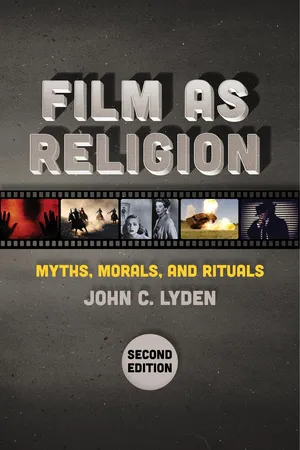
The first edition of Film as Religion was one of the first texts to develop a framework for the analysis of the religious function of films for audiences. Like more formal religious institutions, films can provide us with ways to view the world and the values to confront it. Lyden argues that the cultural influence of films is analogous to that of religions, so that films can be understood as representing a "religious" worldview in their own right.
Thoroughly updating his examples, Lyden examines a range of film genres and individual films, from The Godfather to The Hunger Games to Frozen, to show how film can function religiously.
- English
- ePUB (mobile friendly)
- Available on iOS & Android
eBook - ePub
About this book
Information
Subtopic
Film & VideoPART I
A Method for Viewing Film as Religion
1
The Definition of Religion
The Limitations of Definitions of Religion
Religion is not an easy thing to define. It is hard to list the requisite characteristics of any cultural phenomenon, given the diversity of cultures and the inevitable variations in their expressions. Defining religion offers special challenges, however, in that it is an area of culture that involves basic beliefs about the ultimate nature of reality, our purpose in the world, and how we find meaning in it. Thus the scholar’s own subjective religious worldview affects the study of the subject matter from the outset, and the judgments imported into our analyses will unavoidably influence how we define religion.
Jonathan Z. Smith has famously stated, “There is no data for religion. Religion is solely the creation of the scholar’s study.”1 By this he means that the scholar chooses what to call religion and that it therefore “exists” only as the product of the scholar’s effort. Smith reminds us that the “map is not territory,” that our understanding of religion is not equivalent to the actual cultural phenomena described. “Religion” is a construct we have invented as a label for certain sorts of activities that we classify under this rubric. But this does not mean that there is no such thing as the subject matter we classify as religion or that we cannot say anything about those things we call religions. Even though religion is a word used to describe a social construction that is dependent on humans, that does not make it imaginary in the same way as unicorns. As Kevin Schilbrack points out, politics, sports, and economics are also socially constructed and dependent on human activity, but they relate to things that are nonetheless “real,” such as the results of elections, games, and contracts.2 Furthermore, religion is not only a word used by scholars; it is used by the adherents of the social activities that are called religions. It can be argued, of course, that terms have been imposed on people who did not develop the terminology themselves: Native Americans, Hinduism, and even Christianity are labels created by outsiders to describe those groups, and religion is arguably the same sort of term. And yet in spite of the ideologically tainted histories of such terms and the obvious problems with any sort of generalizations (in that they overlook the differences between the individual things classified under them), people still describe themselves by these terms. It seems absurd to suggest that we stop using such labels at this point, even if the categories are imperfect, as all categories are imperfect: even to point at my car and say “that is an automobile” is to make assumptions about the category and the vehicle so designated that obscure all the other things it is or the fact that it is not identical with all other automobiles.3
Of course, there are more arguments about the definition of religion than about the definition of automobile. That shows that we may be continually redefining the term based on reason and the acquisition of new evidence. We should keep in mind that this process is not innocent, as it may seek to control the things described.4 We must be on our guard for the ideology present in our intellectual judgments as we decide what merits inclusion or exclusion. Later, I briefly discuss some of the ideological judgments implicit in well-known definitions of religion.
Early attempts by Christian thinkers to define the essence of religion unwittingly imported Christian categories into the definition, often assuming that all religions focus on a transcendent being such as the Christian God. Friedrich Schleiermacher (1768–1834) defined religion as “the feeling of absolute dependence” on that which the Christian calls God so that “to feel oneself absolutely dependent and to be conscious of being in relation with God are one and the same thing.”5 Although Schleiermacher’s definition was broader than those of most Western thinkers before him in that he did not equate religion with belief in God as such, the general feeling he postulates still has as its referent the Western or even the Christian concept of God. A century later, Rudolf Otto (1869–1937), on the basis of more study of world religions than Schleiermacher had undertaken, asserted that religion is the feeling that arises when we encounter the “holy” or “numinous,” that which transcends us so totally that it inspires a mixture of fascination and fear. It evokes an experience of being a creature “submerged and overwhelmed by its own nothingness in contrast to that which is supreme above all creatures.”6 Otto claimed to have found this experience of radical transcendence in all the world religions he encountered in his travels, but he seems to have neglected those aspects of religions that would not fit his view—for example, the radical this-worldliness of certain forms of Chinese religions or Buddhism.7 In spite of a genuine effort to understand other religions on their own terms, Otto still based his analysis on a concept of divine transcendence developed from a particular Western theological understanding of God. Otto influenced other thinkers in turn: Mircea Eliade defined religion by its relation to “the sacred” in distinction from “the profane,” and although he defined sacrality more broadly than Otto (as religions may have numerous sacred realities, not just one), he still understood religion as always entailing a relationship to a transcendent reality that is radically distinguished from empirical reality.8 Among philosophers of religion, John Hick has made the same claim that religion is defined by a relationship with a transcendent reality.9
The definition of religion offered by Paul Tillich in his later theology sought to overcome many of the shortcomings of previous theological definitions, and his view has probably been the most significant one for modern theology. Tillich defined religion as “ultimate concern,” meaning that each of us has something that receives our highest devotion and from which we expect fulfillment. It demands the total surrender of all other concerns to it as the primary concern of our beings.10 Even if one denies the existence of any transcendent reality, one will still hold something as being of greatest concern for one’s being—that which one finally values more highly than anything else. Even the cynic takes his cynicism with “ultimate seriousness,” and so his cynical philosophy becomes his ultimate concern.11
But Tillich also insisted that there is a criterion that can be used to appraise the validity of the various ultimate concerns one might have and so to arrive at some judgments about the relative “truth” of religions. Specifically, if one takes something that is nonultimate (finite or nontranscendent) as being of ultimate significance, one is guilty of idolatrous faith—or of attributing ultimacy to that which is not ultimate. The consequences of this include radical “existential disappointment” because the finite object cannot fulfill the promise of ultimate satisfaction that the believer expects it to fulfill. This does not prevent people from viewing finite things as ultimate, but in such cases, they have made a grave error in falsely viewing the finite as the infinite. A truer faith is one that remains focused on the ultimate itself rather than on any finite reality. The difficulty with achieving this goal, Tillich explains, is that we can never apprehend the ultimate in itself but grasp it only through symbols. The trick of avoiding idolatry is then to look beyond the symbol and to see it as a medium for the ultimate rather than the ultimate itself. If we fail in this and view the symbol as itself being the ultimate, we have given our ultimate devotion to that which is not really ultimate. We can never know for certain whether we have given our devotion to the true ultimate or to a penultimate form of it, and so faith requires commitment and courage in the face of this uncertainty.12
Tillich’s definition is more comprehensive than many others, in that through it, he can view as “religious” a wide range of phenomena, even some not normally considered religious, which have the element of intense devotion involved with them; he does not exclude the religious significance of apparently secular phenomena, such as politics or the arts. But one may still ask whether he has isolated the actual feature shared by all religions or whether he has imported a Western bias into his definition. He considers it axiomatic that everyone must have some ultimate concern to which all other concerns are subordinate, but this may not be the case. In practice, we all have many shifting areas of concern. Although one or another of these may take precedence at a particular moment, this does not mean that it is that which we take with “ultimate seriousness,” that which promises “total fulfillment” or demands our complete obedience. These terms are relevant to biblical monotheism, as Tillich shows, but they may not illustrate the religious character of polytheists, who turn to different gods for different purposes, or, for that matter, religions like Confucianism or Taoism, which rarely speak of subjecting all principles to one. Taoists go so far as to say that there is no right or wrong, good or bad, but that each thing has value when its proper use is found. It’s questionable whether there is one “ultimate concern” in this sort of system.
Of course, Tillich might regard this sort of relativism as itself a kind of ultimate concern, which subjugates absolutist systems of value to its own relativizing framework. The relativist who says there is no ultimate has made relativism his ultimate. The skeptic who says there is no truth has made skepticism his truth. The nihilist who rejects the task of finding a concern has made the lack of concern into his concern. But one has to suspect a linguistic sleight of hand here on Tillich’s part. If we are to say that anything one might believe—even a failure to take the question of the meaning of life seriously—has been taken with “ultimate seriousness” simply because there is nothing one takes more seriously, we may be misdefining “ultimate concern” by effectively reducing it to whatever the content of consciousness is, even if it seems to lack any concern or direction toward ultimacy. If any belief at all is an “ultimate concern” because there is nothing higher believed in, this usage would seem to distort the normal sense of the term and the meaning implied by it. It effectively negates the difference between the person who is truly devoted to something as an ultimate and the person who has no such devotion so that it appears they are equally religious when in fact they are not.
In addition, in distinguishing between types of ultimate concerns, Tillich sneaks value judgments on some ultimate concerns into an apparently value-free definition. He claims that one who is devoted to the nonultimate as if it were an ultimate has committed idolatry by giving ultimate status to that which he should not. In this way, a judgment is implied upon those religions that do not focus on a single ultimate concern, as they commit idolatry in their failure to properly conceptualize their ultimate. The insistence upon a transcendent is still present here, albeit in veiled form.
In spite of the Christian biases present in his definition, Tillich made it clear toward the end of his life that Christianity is not to be viewed as the “absolute” religion that effectively discredits the validity of others. No religion can fully express the ultimate, as all must use symbols, and there is always a gap between the symbol and that which it symbolizes. The best symbols are those that point beyond themselves, such as the cross—but this is not the only valid symbol of the ultimate, even though it provides the criterion for Christians.13 Still, his view defines religion in such a way as to make it seem that all valid religions must have a relationship with a unitary transcendent principle, defined according to the norms of the biblical understanding of covenant (“demand and promise”). Those that lack this focus on the transcendent (or its unity) are viewed as less adequate forms of religion.
Just as such theological definitions have narrowed the understanding of religion by their use of Christian categories, so also the ideological definitions of social-scientific approaches have tended to reduce religion to its psychological or sociological function. Most famously, Karl Marx reduced religion to a by-product of social oppression, the “opium of the people,” which they use to cope with intolerable economic conditions; Freud, on the other hand, reduced religion to a by-product of our neurotic attempts to deal with the absence of an omnipotent father. In both cases, religion is viewed as harmful and unnecessary, as well as explicable wholly through the categories of either sociological or psychological analysis based on an examination of its empirical nature. Although the pejorative and simplifying definitions of Marx and Freud are not used as widely as they once were, many social scientists still believe that in their efforts to “explain” the causes of religion in observable social forces, they effectively preclude the truth of religion. Rodney Stark and William Bainbridge, for example, write that religion is “a purely human phenomenon, the causes of which are to be found entirely in the natural world. Such an approach is obviously incompatible with faith in revelation and miracles.”14 The transcendent or otherworldly referents of religion cannot be real in such a view, as religion is merely a product of this-worldly forces that can be examined and understood by social science. Such reductionism commits the so-called genetic fallacy of believing that a this-worldly explanation for the cause of religion discredits any otherworldly explanation—and hence, transcendent referent—for religion. In opposition to this view, I would claim that it is possible to believe that religion(s) might be true, even when we believe that we have adequately explained their “causes” naturalistically. After all, a believer can hold that God works through natural processes such as evolution, so why can’t one also allow that God creates faith and religion through sociopsychological processes? Even if people can be said to believe in God “because” of such processes, that does not negate the possibility that God “exists.” Nonetheless, it has been widely held that religion must have either a theological (i.e., belief-based) or a psychosocial “explanation,” as these two approaches are held to be incompatible.15
In contrast, I would argue that social-scientific approaches do not need to accept the reductionist view that religion can be fully explained naturalistically or that such an explanation necessarily discredits the beliefs of religious people. Similarly, religion need not be viewed solely as an ideological construct that supports cultural hegemonies, as the social-scientific study of religion has sometimes held.16 Although religion is this, it is not only this, just as cultural products (such as films) may support hegemony but are not reducible to only that function. We need to be able to understand the workings of religion in ways that transcend the purely ideological. Luckily, many social scientists working in fields like anthropology and sociology have recognized that their analysis of religion does not require them to adopt reductionist views of religious behavior that suggest it can be fully understood solely as a product of societal or cultural forces. Religion can then be seen as not merely a by-product of society—a sort of cultural dross thrown off by social forces—but as a cultural force in its own right that contributes to and shapes society.
Clifford Geertz’s Definition of Religion and Its Application to Film
Given the limitations of theological definitions of religion as well as reductionistic social-scientific definitions, I have turned to Clifford Geertz’s anthropological definition as the most helpful and comprehensive one for analyzing religious phenomena.17 Geertz defines religion by its function in human society rather than by theological content (e.g., belief in a transcendent being), but he also avoids the reductionism of many social-scientific definitions. Part of the reason for this is that he views anthropology as essentially an interpretive science rather than an explanatory one. Geertz believes that we should attempt to “describe” rather than “explain” religion, as one cannot fully analyze the causes of human cultural activities in the same way that the natural sciences examine physical phenomena. One cannot assert “scientifically tested and approved” hypotheses about religion in general; the diversity and particularity of human experience and culture make it impossible to come to general conclusions about the nature of religion in the same way that one might about chemistry or physics.18 Although his views are firmly based in the observation of actual religions, Geertz does not reduce the data of religion to the mere recording of religious behavior, as he believes some social-scientific accounts have attempted to do. Rather, utilizing a semiotic approach, he insists that one must understand the meaning intended by a religious behavior in order to understand its function in a religion. A nervous twitch and a wink may look the same, but one has no intended meaning, while the other does—a meaning, furthermore, defined by its context and the set of assumptions that accompany it.19 Geertz is interested in the set of meanings implied in religion, and his definition of religion reflects this.
Geertz’s definition of religion is found in his 1966 essay “Religion as a Cultural System,” which defines it as consisting of five aspects: “1) a set of symbols which acts to 2) establish powerful, pervasive and long-lasting moods and motivations in men by 3) formulating conceptions of a general order of existence and 4) clothing these conceptions with such an aura of factuality that 5) the moods and motivations seem uniquely realistic.”20 He then unpacks each of these five aspects to spell out his conception of religion and how it functions.
First, as a set of symbols, religions provide both models “of” reality and models “for” reality. The difference is reflective of that between a worldview and an ethos—that is, the way the world is believed to be and the way it is believed the world ought to be. Models “of” reality describe the way we think the world really is, while models “for” reality describe how we would like it to be. We might al...
Table of contents
- Cover
- Title Page
- Copyright Page
- Dedication
- Contents
- Introduction
- Part I: A Method for Viewing Film as Religion
- Part II: Genre and Film Analyses
- Acknowledgments
- Notes
- Bibliography
- Name and Subject Index
- Film Index
- About the Author
Trusted by 375,005 students
Access to over 1.5 million titles for a fair monthly price.
Study more efficiently using our study tools.
Frequently asked questions
Yes, you can cancel anytime from the Subscription tab in your account settings on the Perlego website. Your subscription will stay active until the end of your current billing period. Learn how to cancel your subscription
No, books cannot be downloaded as external files, such as PDFs, for use outside of Perlego. However, you can download books within the Perlego app for offline reading on mobile or tablet. Learn how to download books offline
Perlego offers two plans: Essential and Complete
- Essential is ideal for learners and professionals who enjoy exploring a wide range of subjects. Access the Essential Library with 800,000+ trusted titles and best-sellers across business, personal growth, and the humanities. Includes unlimited reading time and Standard Read Aloud voice.
- Complete: Perfect for advanced learners and researchers needing full, unrestricted access. Unlock 1.5M+ books across hundreds of subjects, including academic and specialized titles. The Complete Plan also includes advanced features like Premium Read Aloud and Research Assistant.
We are an online textbook subscription service, where you can get access to an entire online library for less than the price of a single book per month. With over 1.5 million books across 990+ topics, we’ve got you covered! Learn about our mission
Look out for the read-aloud symbol on your next book to see if you can listen to it. The read-aloud tool reads text aloud for you, highlighting the text as it is being read. You can pause it, speed it up and slow it down. Learn more about Read Aloud
Yes! You can use the Perlego app on both iOS and Android devices to read anytime, anywhere — even offline. Perfect for commutes or when you’re on the go.
Please note we cannot support devices running on iOS 13 and Android 7 or earlier. Learn more about using the app
Please note we cannot support devices running on iOS 13 and Android 7 or earlier. Learn more about using the app
Yes, you can access Film as Religion, Second Edition by John C. Lyden in PDF and/or ePUB format, as well as other popular books in Media & Performing Arts & Film & Video. We have over 1.5 million books available in our catalogue for you to explore.