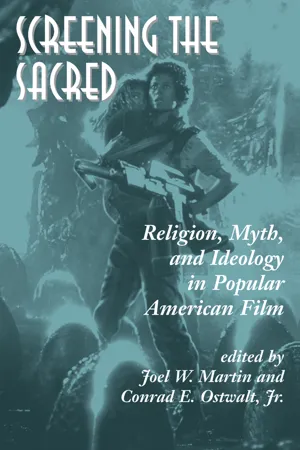
eBook - ePub
Screening The Sacred
Religion, Myth, And Ideology In Popular American Film
- 193 pages
- English
- ePUB (mobile friendly)
- Available on iOS & Android
eBook - ePub
Screening The Sacred
Religion, Myth, And Ideology In Popular American Film
About this book
What are the religious impulses in the 1976 film Rocky, and how can they work to shape one's social identity? Do the films Alien and Aliens signify the reemergence of the earth goddess as a vital cultural power? What female archetypes, borne out of male desire, inform the experience of women in Nine and a Half Weeks?These are among the several compelling questions the authors of this volume consider as they explore the way popular American film relates to religion. Oddly, religion and film?two pervasive elements of American culture?have seldom been studied in connection with each other. In this first systematic exploration, the authors look beyond surface religious themes and imagery in film, discovering a deeper, implicit presence of religion. They employ theological, mythological, and social and political criticism to analyze the influence of religion, in all its rich variety and diversity, on popular film. Perhaps more importantly, they consider how the medium of film has helped influence and shape American religious culture, secular or otherwise.More than a random collection of essays, this volume brings to the study of religion and film a carefully constructed analytic framework that advances our understanding of both. Screening the Sacred provides fresh and welcome insight to film criticism; it also holds far-reaching relevance for the study of religion. Progressive in its approach, instructive in its analyses, this book is written for students, scholars, and other readers interested in religion, popular film, and the impact of each on American culture.
Information
1
Introduction: Seeing the Sacred on the Screen
JOEL W. MARTIN
MANY YEARS AGO a college classmate went to see the first Rocky film. Afterward, he declared, "It makes me want to get into the best shape possible." We were shocked. Jack was not known for discipline or drive. Up to that point, he had spent most of his college days and nights playing poker, drinking beer, and listening to rock and roll. Stallone's film changed his life. He started jogging and pumping iron; he lost weight and became a respectable athlete. When he began attending classes, I was impressed. However, despite this convincing evidence of the movie's power, it was not until years later that I finally saw it.
The very first image shocked me, for it is not of Sylvester Stallone or even of the city of Philadelphia. The film begins with a full-screen image of the face of Christ. The camera tracks down from this image, represented in a mosaic on the wall, to Rocky, the palooka boxer who has squandered his natural gifts. Rocky, it turns out, is fighting in a gymnasium that used to be a church. Suspended above the ring is a banner reading "Resurrection A.C." (presumably the initials stand for Athletic Club). Several other Christ-figure motifs follow. Just as Christ consorted with a prostitute named Mary Magdelene, Rocky advises a girl named Marie to stop being promiscuous; like a Good Samaritan, he rescues a bum from the street; finally, like a scapegoat savior or human sacrifice, he suffers physical violence in order to redeem the hopes of the common people. Full of Christian themes, the movie is also full of civil religion, the ideology that sanctifies the United States as God's chosen nation-state. Rocky features sacred symbols such as the flag, repeats cherished narratives about patriotic heroes such as George Washington, and affirms the basic creed that the United States is the land of opportunity. As I watched this film, I wondered: Could the use of powerful symbols from Christianity and U.S. civil religion account for the film's mass appeal and its life-changing power?
Scholars Out to Lunch: Take One
In pursuing this question, I turned to two areas of scholarship: film criticism and the academic study of religion. I expected to find models of how to analyze the relationship of religion and film. What I found was disappointing. Scholars engaged in prevailing modes of film criticism have had almost nothing to say about religion. And scholars who study religion have had almost nothing to say about Hollywood film. Instead of encountering an ongoing and stimulating dialogue about religion and film, I encountered silence.1
Whether influenced by Marxist, psychoanalytic, feminist, post-structuralist, or auteur theory, film critics ignore religion and the academic study of religion. Apparently, critics assume that secular values, forces, and perspectives matter more than religious ones. If this is the case, film critics are like those historians, sociologists, economists, or psychologists who, in Bryan R. Wilson's words, "take secularization for granted. Their overwhelming tendency ... is to regard religion as a peripheral phenomenon in contemporary social organization, and one which, in their studies of the broad contours of social change, productivity, economic growth, or human psychology, they rarely find need to consider."2 Similarly, rarely does a film critic publish an article that deals with religion.
It is almost as if the discourse of cutting-edge film criticism is designed to exclude attention to religion. The index of a recent introduction to the vocabulary of contemporary film criticism is revealing. Terms such as alienation, ideology, plenitude, and resistance appear. Six types of realism and four types of discourse are indexed. Freudian terms abound—hysteria, ego, drive, oedipal complex—as do key words from the theoretical lexicons of Lacan, Derrida, Kristeva, and Saussure. But religion is not listed; nor is myth or ritual, let alone eschatology, soteriology, or theology.3
If religion is not in the vocabulary of film scholars, it is also true that they give almost no attention to the academic field of religious studies. In an introduction to a series of books on film, Edward Buscombe and Phil Rosen declare that the field of cinema studies has been hugely enriched "in interaction with a wide variety of other disciplines." They list "literary studies, anthropology, linguistics, history, economics and psychology."4 They do not mention religious studies, even though this well-established, widespread discipline involves the labors of tens of thousands of professional scholars. Perhaps this is a simple oversight. Perhaps it reveals an assumption that film studies has little to learn from religious studies. Whatever the cause, it is hoped that the present collection will make such omissions less likely in the future.
It behooves students of American film to take religion more seriously, especially as historians and sociologists argue that religion, particularly varieties of fundamentalism, is increasing in importance throughout the world and will likely do so at an accelerated rate as the dawn of the new millennium approaches and passes.5 Ironically, the power of religion was recognized by many of the thinkers whose theories have influenced contemporary film criticism. Several wrote extensively on religion (Marx, Freud, Kristeva, Derrida).6 Others advanced theories that can be reconciled with the continued powerful presence of religion in our society. Consider the theory of ideology developed by structuralist-Marxist Louis Althusser. Many film critics have appropriated Althusser's definition of ideology as a "system (possessing its own logic and rigor) of representation (images, myths, ideas or concepts as the case may be) existing and having a historical role within a given society."7 Ideology works, according to Althusser (quoted in Stam), through "interpellation, i.e., through the social practices and structures which 'hail' individuals, so as to endow them with social identity, constituting them as subjects who unthinkingly accept their role within the system of production relations."8 Using this theory, film critics have maintained that films shape spectators as social subjects.9 There is no reason critics could not use such an approach and give direct attention to religion. They could say, for instance, that the religious images and myths represented in Rocky "hailed" Jack and made him desire to become fit. The Christian and civil religious impulses in the film shaped his social identity.
Scholars Out to Lunch: Take Two
If film criticism has ignored religion and religious studies, religious studies has given little attention to popular film and film studies. It was not until the 1980s that the largest professional association of scholars of religion, the American Academy of Religion, included in its annual convention a forum on religion and film. A few books have appeared on the subject, including some pathbreaking ones by James Wall, John R. May, and Thomas M. Martin, but as late as 1993 Joseph Cunneen could still conclude that "serious study of religion in narrative film has been extremely limited." Cunneen thinks the paucity of scholarship reflects not a problem among scholars but an inherent limit of the medium of film itself, its "inevitable bias toward realism." Given this bias, it is difficult to represent the sacred in a convincing way, so an actual shortage of truly religious films results. The Hollywood production system does not help matters, Cunneen argues. Oriented toward profit and a mass audience, this system does not allow directors "to make personal movies that suggest the depth of religious mystery," films such as those by great "artists" like Robert Bresson (Diary of a Country Priest), Carl Dreyer (The Passion of Joan of Arc), Eric Rohmer (My Night at Maud's), and Ingmar Bergman (The Seventh Seal).10
Cunneen's list of directors reveals an assumption common in religious studies scholarship; namely, that only a highbrow film can be truly religious. As recent books such as Religion in Film and Image and Likeness show, religion scholars gravitate toward European films or established U.S. classics. Almost no one in religious studies deigns to study a Stallone or Schwarzenegger film. A person interested in religion in popular Hollywood film will find very few interpretative models and almost no exemplary published articles. This book is designed to correct for these blind spots in religious studies and film criticism.
Religion and Film Intersect but Also Diverge
Although the editors and authors of this volume find a good deal of religion in contemporary films, we are aware that the medium fails to express many significant aspects of human religiosity. In some key ways, religion exceeds film. For instance, the film Black Robe calls attention to the brutal way colonial Native Americans tortured some of their enemies but provides viewers with no hint of the complex spiritual motivations and narratives that shaped Indian actions and values. According to ethnohistorians, when colonial Indians tortured captives (usually adult males), it was to avenge the wrongful death of one of their kin, but more than that, it was also to free his or her soul, which was perceived to be bound in a sterile limbo until proportionate justice was exacted.11 Since the film gives viewers no real appreciation of the spiritual traditions and practices of the people it depicts, viewers will conclude incorrectly that Indians were simply sadists who enjoyed inflicting pain. Similarly, in the 1993 version of the Last of the Mohicans, there are far too many scenes of bloody combats. Set in a beautiful landscape, these acts are not situated within the context of the cultural and religious life of the Iroquois people. The film shows us battles, not visions; military campaigns, not sacred rituals; attractive Indians with the wind blowing through their long hair, not spirits circulating through all life-forms. In this film as in Black Robe, Native American religion has been inadequately represented.
If we realize that many aspects of human religiousness have not been and probably never will be represented in film, we also realize that little is to be gained by examining every film in relation to religion. In some key ways, film exceeds religion. The Police Academy movies, for instance, do not appear very promising case studies for our purposes. An interpreter might find a quasi-Christian morality encoded in these movies (the first shall be last, the last shall be first), but the yield hardly seems worth the effort, and a person advancing such an interpretation will appear humorless and driven. We have no desire to squeeze blood from turnips. Fortunately, most films fall somewhere in between those that are explicitly "religious" in theme (like Scorsese's iconoclastic Last Temptation of Christ or Redford's meditative A River Runs Through It) and those that have almost nothing to do with religion. It is in this large middle ground that we focus our efforts. We concentrate on films that make our job as interpreters of religion challenging but not impossible. Most of the films discussed in this book are Hollywood blockbusters, and two won the Academy Award for best picture (Rocky in 1976, Platoon in 1986). By examining religion in commercially successful films, we hope this anthology will, on the one hand, convince students of film that they should take religion seriously and, on the other, convince students of religion that they need to take popular films seriously. We all need to rethink the relations of religion and film, of religious studies and film criticism, and of religion and contemporary culture.
Ours is an interdisciplinary project. It brings religious studies and film criticism into contact with each other but, additionally, taps other fields important to cultural studies today. Our contributors teach in departments of religious studies, philosophy, English, American studies, and communication studies. Their diverse backgrounds and perspectives enrich this collection considerably. The common focus on religion and film unifies the entire collection.
To create an even stronger sense of unity, the editors (Conrad E. Ostwalt Jr. and Joel W. Martin) have constructed an organizing framework for the book. This framework assumes that there are three distinct ways to theorize the relation of religion and film. Accordingly, we group the contributors' chapters in three separate categories. We feel confident about the decisions we have made, but we also realize that by putting chapters together in this way, we have shaped to an extent the way any given chapter will be read. By defining the context, we influence the text's reception. Individual authors may not agree with our argument, organization, or conclusions.
Since the editors are trained in religious studies, we have relied chiefly upon this field to guide our work and structure this book. Religious studies, it must be emphasized, is an academic discipline and is not beholden to any religious institution. Its first home is the university or college, not the church or synagogue. As with other fields in the humanities and the social sciences, it is committed to the pursuit of knowledge, not the saving of souls. What distinguishes it from other fields in the academy is the fact that religion itself represents a distinct subject matter. Religion, like literature or history or art, warrants its own academic discipline and specialized modes of study. Some scholars of religion express this claim by saying that religion is sui generis—that is, religion constitutes a domain of human activity "of its own sort." Religion orients communities toward something or someone or some place sacred or inviolate.
Not all scholars of religion accept the idea that religion is sui generis. They fear this idea makes religion seem too remote from the rest of life. The editors of this volume interpret the phrase less absolutely. We do not think it means that religion is completely autonomous and cannot be interpreted in relation to politics, economics, psychology, or social context. Rather, we think religion is a semiautonomous domain of culture deserving serious academic study, and we contend that scholars should "press for religious explanations when presented with religious data."12 If they want to understand a Buddhist monk, scholars of religious studies will argue that it is important to understand something about monastic traditions in general or Buddhism in particular. Similarly, if they want to understand religion in a contemporary Hollywood film, they will assume that it is important to understand the religious traditions informing the cultural context in which the film was made and viewed. Looking for religion, they will examine the film to see if traditional religious teachings or values are present, if any of the common forms of expression normally associated with religion are present, if religious symbols are being invoked, and so on.13
Three Approaches to Religion
During the period in which the field of religious studies has been recognized as an academic discipline, it has had time to develop considerable internal diversity. We cannot pretend to introduce the many ways in which scholars approach the study of religion; we refer curious readers to more detailed surveys.14 For the purposes of this text, however, we can describe three basic approaches to religion current in the field: the theological, the mythological, and the ideological. Their conception of what constitutes religion varies greatly. Nevertheless, because all three of these approaches take religion seriously and have found a home in the academy, we feel justified in grouping them together under the rubric of religious studies. We have structured the book around these three approaches.
In their purest, "ideal" versions, these approaches diverge significantly. Theological thinkers analyze how religious texts and thinkers in various traditions, particularly Judaism and Christianity, have talked about God, Theologians try to relate these representations or teachings concerning God to modern and postmodern contexts, translating teachings about such things as the covenant, sacrifice, Incarnation, fallibility, and justice into modern philosophical categories or critiquing society in their light. Theological scholars tend to equate religion with Judaism and Christianity. Since these traditions have had a tremendous impact upon Western culture and all of its art forms, theological scholars are positioned to make many valuable insights about the modern Western art of Hollywood film.
Other scholars, often associated with the study of comparative religion, do not equate religion with monotheistic religions or with any single tradition, deity, belief, or institution. Rather, they see religion as a universal and ubiquitous human activity; they assert that religion manifests itself through cross-cultural forms, including myth, ritual, systems of purity, and gods. Myth consists of stories that provide human communities with grounding prototypes, models for life, reports of foundational realities, and dramatic presentations of fundamental values: Myth reveals a culture's bedrock assumptions and aspirations. Ritual concentrates human attention and orchestrates action in order to sanctify time. Systems of purity enable people to deal with negativity, with things that threaten the order of their world. Finally, gods include all superior beings that humans engage religiously. Different cultures fill these forms with different contents.
As we shall see in this book, Hollywood has filled these basic forms with a tremendous variety of contents, projecting onto screens a rich diversity of myths, rituals, systems of purity, and gods for us to contemplate. Some of the projections are Christian, many are not. The luminous character of Rocky may resemble Christ in many ways, but in even more important ways we will see that he represents a distinctively American, indeed, a peculiarly white American, savior. Studyi...
Table of contents
- Cover
- Half Title
- Title
- Copyright
- Contents
- Preface
- Acknowledgments
- 1 Introduction: Seeing the Sacred on the Screen
- PART ONE THEOLOGICAL CRITICISM
- PART TWO MYTHOLOGICAL CRITICISM
- PART THREE IDEOLOGICAL CRITICISM
- Notes and References
- About the Book and Editors
- Index
Trusted by 375,005 students
Access to over 1.5 million titles for a fair monthly price.
Study more efficiently using our study tools.
Frequently asked questions
Yes, you can cancel anytime from the Subscription tab in your account settings on the Perlego website. Your subscription will stay active until the end of your current billing period. Learn how to cancel your subscription
No, books cannot be downloaded as external files, such as PDFs, for use outside of Perlego. However, you can download books within the Perlego app for offline reading on mobile or tablet. Learn how to download books offline
Perlego offers two plans: Essential and Complete
- Essential is ideal for learners and professionals who enjoy exploring a wide range of subjects. Access the Essential Library with 800,000+ trusted titles and best-sellers across business, personal growth, and the humanities. Includes unlimited reading time and Standard Read Aloud voice.
- Complete: Perfect for advanced learners and researchers needing full, unrestricted access. Unlock 1.5M+ books across hundreds of subjects, including academic and specialized titles. The Complete Plan also includes advanced features like Premium Read Aloud and Research Assistant.
We are an online textbook subscription service, where you can get access to an entire online library for less than the price of a single book per month. With over 1.5 million books across 990+ topics, we’ve got you covered! Learn about our mission
Look out for the read-aloud symbol on your next book to see if you can listen to it. The read-aloud tool reads text aloud for you, highlighting the text as it is being read. You can pause it, speed it up and slow it down. Learn more about Read Aloud
Yes! You can use the Perlego app on both iOS and Android devices to read anytime, anywhere — even offline. Perfect for commutes or when you’re on the go.
Please note we cannot support devices running on iOS 13 and Android 7 or earlier. Learn more about using the app
Please note we cannot support devices running on iOS 13 and Android 7 or earlier. Learn more about using the app
Yes, you can access Screening The Sacred by Joel Martin,Conrad E. Ostwalt Jr. in PDF and/or ePUB format, as well as other popular books in Media & Performing Arts & Film History & Criticism. We have over 1.5 million books available in our catalogue for you to explore.