This unified treatment introduces upper-level undergraduates and graduate students to the concepts and methods of modern molecular spectroscopy and their applications to quantum electronics, lasers, and related optical phenomena. Starting with a review of the prerequisite quantum mechanical background, the text examines atomic spectra and diatomic molecules, including the rotation and vibration of diatomic molecules and their electronic spectra. A discussion of rudimentary group theory advances to considerations of the rotational spectra of polyatomic molecules and their vibrational and electronic spectra; molecular beams, masers, and lasers; and a variety of forms of spectroscopy, including optical resonance spectroscopy, coherent transient spectroscopy, multiple-photon spectroscopy, and spectroscopy beyond molecular constants. The text concludes with a series of useful appendixes.
Frequently asked questions
Yes, you can cancel anytime from the Subscription tab in your account settings on the Perlego website. Your subscription will stay active until the end of your current billing period. Learn how to cancel your subscription.
At the moment all of our mobile-responsive ePub books are available to download via the app. Most of our PDFs are also available to download and we're working on making the final remaining ones downloadable now. Learn more here.
Perlego offers two plans: Essential and Complete
Essential is ideal for learners and professionals who enjoy exploring a wide range of subjects. Access the Essential Library with 800,000+ trusted titles and best-sellers across business, personal growth, and the humanities. Includes unlimited reading time and Standard Read Aloud voice.
Complete: Perfect for advanced learners and researchers needing full, unrestricted access. Unlock 1.4M+ books across hundreds of subjects, including academic and specialized titles. The Complete Plan also includes advanced features like Premium Read Aloud and Research Assistant.
Both plans are available with monthly, semester, or annual billing cycles.
We are an online textbook subscription service, where you can get access to an entire online library for less than the price of a single book per month. With over 1 million books across 1000+ topics, we’ve got you covered! Learn more here.
Look out for the read-aloud symbol on your next book to see if you can listen to it. The read-aloud tool reads text aloud for you, highlighting the text as it is being read. You can pause it, speed it up and slow it down. Learn more here.
Yes! You can use the Perlego app on both iOS or Android devices to read anytime, anywhere — even offline. Perfect for commutes or when you’re on the go. Please note we cannot support devices running on iOS 13 and Android 7 or earlier. Learn more about using the app.
Yes, you can access Molecules and Radiation by Jeffrey I. Steinfeld in PDF and/or ePUB format, as well as other popular books in Physical Sciences & Physical & Theoretical Chemistry. We have over one million books available in our catalogue for you to explore.
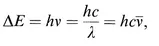
If one were to ask for a definition of the basic operation in spectroscopy, the answer would probably be in terms of carrying out a measurement on a molecule, using electromagnetic radiation as a measuring tool. The essence of the quantum mechanical behavior of systems as small as atoms and molecules is that carrying out a measurement on such a system forces it to take on a sharp value of the one or more observables being measured. In spectroscopic measurements, this observable is almost always the total energy of the system. The measured quantity is the set of differences between the possible energy levels, which is related to an observed set of resonances in the electromagnetic radiation spectrum by the Bohr-Einstein law,
where v is the frequency of the radiation, in hertz (the term cycles per second, or sec – 1, is no longer officially used); λ is the wavelength of the radiation in centimeters;
is the wave number of the radiation in reciprocal centimeters, or cm – 1.
Energy and frequency are related by Planck’s constant h = 6.626174 x 10 – 27 erg sec, while frequency and wavelength are related by the speed of light in vacuum, c = 2.99792458 x 1010 cm/sec.2
Since the concept of measurement is a key aspect of the whole, it seems appropriate to introduce the use of a quantum mechanical notation known as measurement algebra at this point. The primary advantage of this notation, as we shall see, is that it provides a very compact and handy way of expressing the matrix elements, and relations between them, in terms of which spectroscopic theory is formulated. It is well to remember that merely using a new notation, while it may be convenient, does not introduce any more content than was expressed by the more familiar language of wave functions and eigenvalues. Several classic quantum mechanics textbooks employ this notation, and the reader is encouraged to look at these as an aid in becoming familiar with this algebra. Especially recommended are the texts by Messiah, Gottfried, and Feynman, Leighton, and Sands (references 1-3).
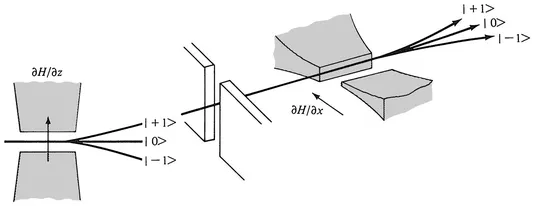
Figure 1.1
Schematic representation of a Stern-Gerlach experiment. A beam in a j = 1 state enters from the left through a magnetic field inhomogeneous in the z direction. It is split into three jz components; the +1 component is selected and sent through a magnetic field inhomogeneous in the x direction, whereupon it splits up into three jx components. If one of these components is then sent through another z magnet, it will again split up into three jz components, despite the earlier z measurement.
The basic object of this algebra is the state of a system, which is given the symbol |n〉. This state may correspond to an energy level En, or to an an...
Table of contents
Title Page
Copyright Page
Dedication
Table of Contents
Preface to the Second Edition
Preface to the First Edition
1 - Review of the Quantum Mechanical Background
2 - Atomic Spectra
3 - Diatomic Molecules
4 - Rotation and Vibration of Diatomic Molecules
5 - Electronic Spectra of Diatomic Molecules
6 - Rudimentary Group Theory
7 - Rotational Spectra of Polyatomic Molecules
8 - Vibrational Spectra of Polyatomic Molecules
9 - Electronic Spectra of Polyatomic Molecules
10 - From Molecular Beams to Masers to Lasers
11 - Optical Resonance Spectroscopy
12 - Coherent Transient Spectroscopy
13 - Multiple-Photon Spectroscopy
14 - Spectroscopy beyond Molecular Constants
Appendix A Direct Product Tables
Appendix B Lagrangian Mechanics
Appendix D Dipole Correlation and Spectral Density Functions