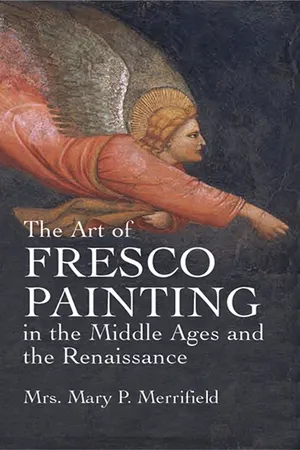
Known for its durability, a fresco painting is created in "sections" on freshly laid wet plaster, allowing the painter to comprehensively portray the subject and execute designs with ease. As both the paint and plaster dry, they become completely fused. Highly popular during the late-thirteenth to the mid-sixteenth centuries, fresco painting was almost a lost art by the time this book was first published in 1846. This volume, by a recognized authority in the field, was highly influential in reintroducing fresco painting to public attention.
In addition to translating descriptions of painting methods used by such masters as Alberti, Cennini, Vasari, Borghini, Pozzo, and Pacheco, the author also interprets passages from rare manuscripts on the causes of fresco destruction and how to retouch, repair, and clean these works of art.
Curators and art historians will find this classic reference work of immense importance and interest.
eBook - ePub
The Art of Fresco Painting in the Middle Ages and the Renaissance
- 192 pages
- English
- ePUB (mobile friendly)
- Available on iOS & Android
eBook - ePub
The Art of Fresco Painting in the Middle Ages and the Renaissance
About this book
Information
Topic
ArtSubtopic
European ArtTHE ART OF FRESCO PAINTING.

PART I.
CHAPTER I.
THE DIRECTIONS AND OBSERVATIONS OF VITRUVIUS WITH THE COMMENTARY OF SUEVARA.
OF GUEVARA.
THE very interesting work from which the following commentary on part of the seventh book of Vitruvius is translated, was written in Spanish, by Don Felipe de Guevara, who has incorporated in his work all that is material and practical in Vitruvius, on the subject of fresco painting. Guevara occupied the post of Gentil-hombre de boca (that is the prince’s taster) to the Emperor Charles the Fifth.
The period of his birth is unknown; but he mentions, in the course of the work, that he fought in the celebrated victory at Tunis, and was in the island of Sicily in the year 1535. He travelled over Italy and Flanders, and appears to have been well versed in all that relates to the fine arts, which his situation in the court of Charles the Fifth and Philip the Second gave him ample opportunities of studying. Guevara appears to have been one of the greatest antiquaries of his time, and he possessed a valuable collection of medals and coins. He wrote a work, which has never been published, on the medals and coins of the different cities of Spain, which Ambrosio de Morales (who was personally acquainted with our author,) mentions in his Spanish antiquities in terms of the highest praise. The manuscript of this work on coins, to which Guevara alludes in his commentaries, (p. 244) is lost.
The present work, which is entitled “ Commentaries on Painting,” must have been written after the year 1550, because the author mentions the work of Vasari which was published in that year, and before the commencement of the building of the Escurial, which was undertaken to commemorate the victory of St. Quintin in 1557. The work was dedicated to Philip the Second, but was never presented, nor was it ever published by the author, but was found in a bookseller’s shop by Don Josef Alfonso de Roa, a person eminent for his literary attainments and love for the fine arts, by whom it was sent to Don Antonio Ponz, author of the Viage de España, and a friend of Mengs, who published it in 1788, and who wrote the notes appended to the following pages. to which his name is attached.
DIRECTIONS AND OBSERVATIONS FROM THE COMMENTARIES OF GUEVARA.
OF PREPARING WALLS AND ROOFS.—It appears to me, (says Guevara,) that it will not be unseasonable, but on the contrary, necessary, since I have treated of the origin and beginning of painting in fresco,23 to show on what kind of walls and roofs the ancients adopted this method of painting, and how they prepared these walls, as well as what whitewashings and preparations they employed in order to make this kind of painting firm, so that it may last long, be agreeable and durable. The method is that described by Vitruvius, Book VII. c. III., but from the style in which it is written I suspect it has been noticed but by few: at least, we see the use of what the Italians now call stucco, much changed and corrupted. This I think must have occasioned new inventions for facilitating works of this description, that they might resemble those which were more ancient and perfect, although they were not equal to them in reality; and as there are perhaps but few who have a real knowledge of antiquities, these works are passed off for antiques, by persons of indifferent reputation who authorize such practices. Vitruvius contrives the roof (of the apartment) that is to be covered with what is now called by the new term stucco, in the following manner : he says, that after having fixed the timbers of the room, they are to be morticed with cross pieces, made of timber which has the property of not warping, as that of box, oak, cypress, juniper, and the olive. The holm oak (encida) is to be avoided because it is apt to warp, and occasion cracks which injure the stucco. In our Spain the pine of Cuenca24 and Balsain,25 when old and dry is good, because this wood is solid and durable.
These cross pieces are to be nailed with strong nails, which will hold them firmly and prevent warping. But it must be observed, as we learn from Vitruvius, that these are not so durable and safe on flat roofs, as on those that are somewhat vaulted and curved, that in such walls this kind of work, which is called stucco, has great solidity ; and if the vault or ceiling of the apartment be made of bricks or other similar materials, many inconveniences would be avoided, and many things would be unnecessary that wooden roofs require, without covering the roof immediately with the first coating of mortar, as is usual in walls of stones and bricks.
Vitruvius next directs, that in roofs constructed of timber, the cross-pieces being first fixed and firmly nailed, reeds are to be bruised and split, and fastened to the roof (as the curve requires) with rushes26 or slips of Spanish broom tied firmly, as is now done when roofs are to be covered with gesso, and as was anciently the custom in Spain, and is still in Andalusia and the kingdom of Grenada, on account of the deficiency of wood in some places for this purpose.
The rushes or broom should be fastened to the reeds with great care and skill, for in this operation consists a great part of the perfection of the work, and they should be fastened with nails27 between the rushes. This being done, Vitruvius says, “trusilar the roof.” This word “trusilar,” which neither the Italian nor the Latin interpreters of Vitruvius have explained throws confusion on this part of the treatise.28 It appears to me that trusilar has the same meaning as our Spanish term xaharrar, which is the first coat of mortar given to the walls in order to prepare them to receive the whiter coats (blanqueada).
But although the signification of the word “ trusilar” may be what I have said, and which I dare affirm, there arises a new doubt as to the nature of the mixture with which the roof has to be plastered; for it appears clear from Vitruvius, that the word “trusilar” does not describe either of the three sand coats, or either of the three marble coats, but is a distinct and separate process. Filandro, the interpreter of Vitruvius, suspects that “trusilar” means a coat of gesso, and Budeo affirms that this is the true signification of the word “trusilar.”
My opinion is, that “trusilar” always signifies the first preparation which we call “exaharrar,” and that it consists sometimes of gesso, and sometimes of other materials, as this does of which Vitruvius now treats; for he expressly directs, that on no consideration should gesso be mixed with this coat of plaster which the moderns call stucco, and he condemns such a mixture as bad and injurious 29 I think that this word trusilar or xaharrar, of which we are speaking, applies to a coat of lime, with which, instead of sand, pulverised bricks or tiles,30 or other similar substances are mixed, for it is well known that such a mixture works better and sets more firmly than one of chalk and sand.
My opinion is confirmed by the authority of Vitruvius himself, who in Book v. chap. x. speaking of roofs of vaults, says, inferior autem pars, quæ ad pavimentum spectat, testa primum cum calce trussiletur, deinde opere tectorio sive albario poliatur. The meaning of these words is, that the front part of the roof that corresponds with the floor, should be first plastered with lime and the powder of baked pottery, such as bricks, tiles, &c., and afterwards the whitewash should be applied. This coat of lime and powdered brick having been applied, the roof should receive three other coats of lime and sand.31 After having applied the first, time should be given for it to dry, then the second should be applied and suffered to dry, and then the third coat should be given, so that after the first coat of plaster there should be three coats of lime and sand. These having been applied and suffered to dry, three other coats of lime and marble dust should be given, the first thick, the second thinner, and the third thinner Still.32 After the application of these three coats, the wall should be smoothed or polished with pieces of smooth wood or other instrument used for burnishing, not liable to injure the surface. All these coats of plaster should be applied by rule and plummet, that no difficulties should afterwards arise when the wall has to be painted.
The plastering, says Vitruvius, which has been applied with care, will be firm and durable, and will never crack, because the burnishing will have given it great firmness and a polish of wonderful brilliancy, and the colours which are applied on it will be very bright and beautiful ; for colours which are employed and used upon roofs and walls that are fresh and just finished will last for ever, and will not fade, because the moisture which was in the lime when it was burnt in the kiln, is dried up and consumed in such a manner that it remains porous, and ready to receive and absorb anything added to it; and thus mixed and united with substances possessing other properties, and the materials and principles of the one being united with those of the others, when dry, the whole solidifies and hardens in such a manner after the mixture, that the lime seems to have recovered its peculiar properties and pristine hardness.
For this reason walls that are well finished, neither become soiled by age, nor, if rubbed or cleaned, do the colours come off or fade, unless they have been applied carelessly or in secco; so that if the coats of plaster have been applied in the manner described, they will be firm and bright, and have the property of resisting the ravages of time, for when only one covering of lime and sand, and another of lime and marble dust is applied, this weak crust cracks and spoils easily, nor does it, from its want of solidity, preserve the polish given to it by friction.
The same thing happens to plastering that is deficient in thickness as to a mirror which is too thin, and which therefore reflects but weak and uncertain images : on the contrary, the wall that has received a thick coat of plaster takes a durable polish, and presents to the spectators distinct and bright images; consequently, thin coats of plaster, which cover the surface but imperfectly, are not only liable to crack, but soon decay, whereas those that are prepared solidly with sand coats and marble coats of good thickness and which are afterwards well polished and burnished, not only cause the colours to appear lively and brilliant, but they present true images to the spectators.
This is in part what Vitruvius has written concerning the plastering of walls ; and from this author’s description, we learn that the true stucco consists of a coat of lime and brick, the proportions of which should be two parts of lime and one of pounded brick, and of three coats of lime and sand; the first of which should consist of common and coarse sand, the second should be finer and should generally be sifted, but sometimes this is unnecessary. Upon these sand coats should be applied three other coats of marble and lime.
The marble is prepared in the following manner; after being ground it should be passed through sieves of three different sizes; that which passes through the coarsest sieve is to be used for the first coat of lime and marble dust, the second size for the second coat, and the finest for the third coat; and I must inform you that there are two kinds of marble; in some quarries are found lumps only of marble, and these will do for the stucco; the other is more perfect and in larger masses, the dust of which will answer the purpose.
It is proper to observe, that where marble cannot be obtained, the white pebbles found near the rivers in Spain, if burnt, ground, and sifted, as in the glass furnaces, are well adapted for this purpose; and even, if there should be sufficient marble, these white pebbles should be mixed with the stucco, in order to render the work more brilliant. Pliny praises the stucco, which consisted of three sand coats and two marble coats, and adds that Panæus the brother of Phidias, covered the walls of the temple of Minerva, in Elis, with lime and marble, mixed with milk and saffron.
Milk communicates great solidity and whiteness to the lime,33 and this secret is known in some places, where it is worked up with the lime instead of water. Pliny says, that in his time these walls were rubbed with a moistened finger that merely smelled of saffron; whence we understand that the addition of the saffron was merely for the pleasant smell.
We should not omit to say, that the Greeks were accustomed to plaster the wall in the manner we have described,34 and moreover, for the purpose of increasing their solidity, after having mixed the lime with the marble, they put it mixed into large mortars, and, by force of labour and blows, ground the mixture thoroughly, that the ingredients might incorporate into a tough and viscous substance, and afterwards, with the same industry and diligence, they plastered the wall. It is said also, treating of the good properties which the lime for this kind of plastering should possess, that there was an old law, forbidding the use of lime that was less than three years old in plastering buildings, and this, they say, was one of the reasons why it never cracked: at the present time, however, no attention is paid to this subject, to the great prejudice of the proprietors of the work. 35
To proceed: the ancients, after plastering the roofs, ornamented them in various ways, making the roofs of winter rooms plain and smooth, that they might be easily cleaned from the smoke of fire and candles. In summer apartments they were accustomed to use ornaments in relievo, to which they gave the form of wreaths and compartments, in the same manner as the plaster mouldings now used in alcoves, cabinets, and oratories; and this composition may be moulded with the honey36 of the plasterers; for Vitruvius says, that the roofs being finished, the cornices should be added, and these should be narrow and of light weight, because heavy cornices could not well be supported, and they would fall down from their own weight.37
For this reason, it is evident that the ancients composed first the cornices, compartments, wreaths of flowers, and similar works, and then fixed them up to the roof with glue38 or with the same stucco, or any other thing that would hold them firmly, as is now done by our modellers in plaster. So that from my description may be understood what kind of stucco used by the ancients, and in our own times in many parts of Italy, is best adapted to secure durability.
OF THE COLOURS.—Having now described the manner in which the ancients plastered their walls, and prepared them for painting, it seems proper also to describe the colours which are used...
Table of contents
- Title Page
- Dedication
- Bibliographical Note
- Copyright Page
- Table of Contents
- CORRIGENDA.
- INTRODUCTION.
- AN INQUIRY
- THE ART OF FRESCO PAINTING.
- INDEX.
Trusted by 375,005 students
Access to over 1.5 million titles for a fair monthly price.
Study more efficiently using our study tools.
Frequently asked questions
Yes, you can cancel anytime from the Subscription tab in your account settings on the Perlego website. Your subscription will stay active until the end of your current billing period. Learn how to cancel your subscription
No, books cannot be downloaded as external files, such as PDFs, for use outside of Perlego. However, you can download books within the Perlego app for offline reading on mobile or tablet. Learn how to download books offline
Perlego offers two plans: Essential and Complete
- Essential is ideal for learners and professionals who enjoy exploring a wide range of subjects. Access the Essential Library with 800,000+ trusted titles and best-sellers across business, personal growth, and the humanities. Includes unlimited reading time and Standard Read Aloud voice.
- Complete: Perfect for advanced learners and researchers needing full, unrestricted access. Unlock 1.5M+ books across hundreds of subjects, including academic and specialized titles. The Complete Plan also includes advanced features like Premium Read Aloud and Research Assistant.
We are an online textbook subscription service, where you can get access to an entire online library for less than the price of a single book per month. With over 1.5 million books across 990+ topics, we’ve got you covered! Learn about our mission
Look out for the read-aloud symbol on your next book to see if you can listen to it. The read-aloud tool reads text aloud for you, highlighting the text as it is being read. You can pause it, speed it up and slow it down. Learn more about Read Aloud
Yes! You can use the Perlego app on both iOS and Android devices to read anytime, anywhere — even offline. Perfect for commutes or when you’re on the go.
Please note we cannot support devices running on iOS 13 and Android 7 or earlier. Learn more about using the app
Please note we cannot support devices running on iOS 13 and Android 7 or earlier. Learn more about using the app
Yes, you can access The Art of Fresco Painting in the Middle Ages and the Renaissance by Mrs. Mary P. Merrifield in PDF and/or ePUB format, as well as other popular books in Art & European Art. We have over 1.5 million books available in our catalogue for you to explore.