![]()
CHAPTER 1
INTRODUCTION
Design of modern high performance machines and structures often must take account of the effect of complex states of stress, strain and environment on the mechanical behavior of different classes of materials. Calculation of the mechanical behavior of a structural member under different conditions of stress or strain and environment requires that the different variables involved be related by means of fundamental equations including the following : (a) The equilibrium equations. These state the relationship among the various stress components at any given point required for equilibrium. (b) The kinematic equations. These express the strain components in terms of displacements which in turn describe the deformation of the body. (c) The compatibility equation. This states the relationship which must exist among the several strain components in order that the strain components in a continuous medium not produce discontinuities. (d) The constitutive equation. This must describe the relationship between stress, strain and time in terms of the material constants for a given material. (e) A set of boundary conditions. These describe the stresses and displacements prescribed at the boundaries. If the material behavior is linear in stress and time independent, then Hooke’s law describes the constitutive relationship. A detailed description of equations (a), (b), (c); (d) and (e) for linear, time-independent materials may be found in any book on the theory of elasticity.
In this book emphasis will be placed on discussion of the constitutive equations for time-dependent and nonlinear materials, though an introduction to time-dependent linear behavior is also discussed. Actual materials exhibit a great variety of behavior. However, by means of idealization they can be simplified and classified as follows.
1.1 Elastic Behavior
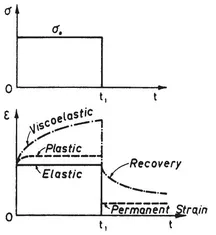
Most materials behave elastically or nearly so under small stresses. As illustrated by the solid curve in Fig. 1.1, an immediate elastic strain response is obtained upon loading. Then the strain stays constant as long as the stress is fixed and disappears immediately upon removal of the load. The chief characteristic of elastic strain is reversibility. Most elastic materials are linearly elastic so that doubling the stress in the elastic range doubles the strain.
Fig. 1.1. Various Strain Responses to a Constant Load
1.2 Plastic Behavior
If the stress is too high the behavior is no longer elastic. The limiting stress above which the behavior is no longer elastic is called the elastic limit. The strain that does not disappear after removal of the stress is called the inelastic strain. In some materials, the strain continues to increase for a short while after the load is fully applied, and then remains constant under a fixed load, but a permanent strain remains after the stress is removed. This permanent strain is called the plastic strain (dashed curves in Fig. 1.1). Plastic strain is defined as time independent although some time dependent strain is often observed to accompany plastic strain.
1.3 Viscoelastic Behavior
Some materials exhibit elastic action upon loading (if loading is rapid enough), then a slow and continuous increase of strain at a decreasing rate is observed. When the stress is removed a continuously decreasing strain follows an initial elastic recovery. Such materials are significantly influenced by the rate of straining or stressing; i.e., for example, the longer the time to reach the final value of stress at a constant rate of stressing, the larger is the corresponding strain. These materials are called viscoelastic (dot-dash curve in Fig. 1.1). Among the materials showing viscoelastic behavior are plastics, wood, natural and synthetic fibers, concrete and metals at elevated temperatures. Since time is a very important factor in their behavior, they are also called time-dependent materials. As its name implies, viscoelasticity combines elasticity and viscosity (viscous flow).
The time-dependent behavior of viscoelastic materials must be expressed by a constitutive equation which includes time as a variable in addition to the stress and strain variables. Even under the most simple loading program, as shown in Fig. 1.1, the shape of the strain-time curve, in this case a creep curve, may be rather complicated. Since time cannot be kept constant, reversed or eliminated during an experiment, the experimental study of the mechanical behavior of such materials is much more difficult than the study of time-independent materials.
Recent developments in technology, such as gas turbines, jet engines, nuclear power plants, and space crafts, have placed severe demands on high temperature performance of materials, including plastics. Consequently the time-dependent behavior of materials has become of great importance.
The time-dependent behavior of materials under a quasi-static state may be studied by means of three types of experiments: creep (including recovery following creep), stress relaxation and constant rate stressing (or straining), although other types of experiments are also available.
1.4 Creep
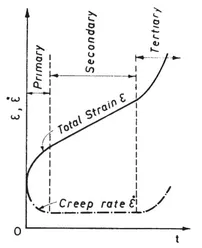
Creep is a slow continuous deformation of a material under constant stress.1 However, creep in general may be described in terms of three different stages illustrated in Fig. 1.2. The first stage in which creep occurs at a decreasing rate is called primary creep; the second, called the secondary stage, proceeds at a nearly constant rate; and the third or tertiary stage occurs at an increasing rate and terminates in fracture.
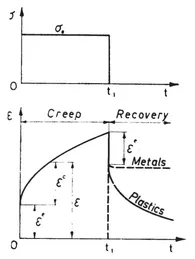
Total strain ε at any instant of time t in a creep test of a linear material (linearity will be defined later) is represented as the sum of the instantaneous elastic strain εe and the creep strain εc,
Fig. 1.2. Three Stages of Creep
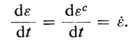
The strain rate
is found by differentiating (1.1) and noting that ε
e is a constant:
1.5 Recovery
If the load is removed, a reverse elastic strain followed by recovery of a portion of the creep strain will occur at a continuously decreasing rate.
Fig. 1.3. Creep and Recovery of Metals and Plastics
The amount of the time-dependent recoverable strain during recovery is generally a very small part of the time-dependent creep strain for metals, whereas for plastics it may be a large portion of the time-dependent creep strain which occurred (Fig. 1.3). Some plastics may exhibit full recovery if sufficient time is allowed for recovery. The strain recovery is also called delayed elasticity.
1.6 Relaxation
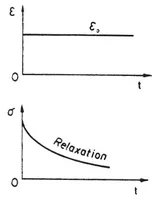
Viscoelastic materials subjected to a constant strain will relax under constant strain so that the stress gradually decreases as shown in Fig. 1.4.
Fig. 1.4. Stress Relaxation at Constant Strain
From a study of the three time-dependent responses of materials explained above, the basic principles governing time-dependent behavior under loading conditions other than those mentioned above, may be established. In actual practice, the stress or strain history may approximate one of those described or a mixture, i.e., creep and relaxation may occur simultaneously under combined loading, or the l...