"First time I've read a collection from Native American Writers. Won't be my last. Important collection that examines the contrast and sometimes conflict between Whites and Native Americans and also conflicts between full-blood and half-blood. Very interesting and enlightening. Loved it!" — BookBunnyPR
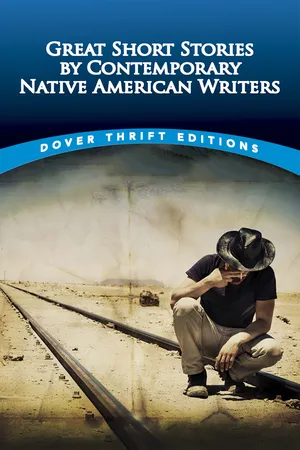
This new anthology of short fiction by Native Americans features a wide range of contemporary writers. It includes stories dating from the early twentieth century by Pauline Johnson, daughter of a Mohawk chief, whose works helped define Canadian literature; Zitkala-Sa, a Sioux writer whose books were among the first to bring Native American stories to wider recognition; John M. Oskison, whose Cherokee ancestry informed his tales of the cultural clash faced by children of mixed marriages; and D'Arcy McNickle, Cree activist and anthropologist.
Ten additional stories date from the 1960s through the twenty-first century, ranging in their settings from Canada to New Mexico. Selections include Leslie Marmon Silko's "The Man to Send Rain Clouds," "Crow's Sun" by Duane Niatum, "Beading Lesson" by Beth H. Piatote, Sherman Alexie's "War Dances," and other tales that explore cultural borders and intersections, dramatizing the ways in which people discover their own heritage as well as the wider world.
- 144 pages
- English
- ePUB (mobile friendly)
- Available on iOS & Android
eBook - ePub
Great Short Stories by Contemporary Native American Writers
About this book
Information
WAR DANCES (2009)
Sherman Alexie
Born in 1966, of Coeur d’Alene and Spokane heritage, Alexie has been publishing poems and fiction since 1993. He is the most colloquial of writers in this anthology, writing with a confessional voice that is often humorous. His books have won many awards; he adapted his early stories for the movie Smoke Signals (1998). The strange, great, and discursive “War Dances” is the title story of one of his recent collections of short fiction.
1. My Kafka Baggage
A few years ago, after I returned from a trip to Los Angeles, I unpacked my bag and found a dead cockroach, shrouded by a dirty sock, in a bottom corner. “Shit,” I thought. “We’re being invaded.” And so I threw the unpacked clothes, books, shoes, and toiletries back into the suitcase, carried it out onto the driveway, and dumped the contents onto the pavement, ready to stomp on any other cockroach stowaways. But there was only the one cockroach, stiff and dead. As he lay on the pavement, I leaned closer to him. His legs were curled under his body. His head was tilted at a sad angle. Sad? Yes, sad. For who is lonelier than the cockroach without his tribe? I laughed at myself. I was feeling empathy for a dead cockroach. I wondered about its story. How had it got into my bag? And where? At the hotel in Los Angeles? In an airport baggage system? It didn’t originate in our house. We’ve kept those tiny bastards away from our place for fifteen years. So what had happened to this little vermin? Did he smell something delicious in my bag—my musky deodorant or some crumb of chocolate Power Bar—and climb inside, only to be crushed by the shifts of fate and garment bags? As he died did he feel fear? Isolation? Existential dread?
2. Symptoms
Last summer, in reaction to various allergies I was suffering from, defensive mucus flooded my inner right ear and confused, frightened, untied, and unmoored me. Simply stated, I could not fucking hear a thing from that side, so I had to turn my head to understand what my two sons, ages eight and ten, were saying.
“We’re hungry,” they said. “We keep telling you.”
They wanted to be fed. And I had not heard them.
“Mom would have fed us by now,” they said.
Their mother had left for Italy with her mother two days ago. My sons and I were going to enjoy a boys’ week, filled with unwashed socks, REI rock wall climbing, and ridiculous heaps of pasta.
“What are you going to cook?” my sons asked. “Why haven’t you cooked yet?”
I’d been lying on the couch reading a book while they played and I had not realized that I’d gone partially deaf. So I, for just a moment, could only weakly blame the silence—no, the contradictory roar that only I could hear.
Then I recalled the man who went to the emergency room because he’d woken having lost most, if not all, of his hearing. The doctor peered into one ear, saw an obstruction, reached in with small tweezers, and pulled out a cockroach, then reached into the other ear, and extracted a much larger cockroach. Did you know that ear wax is a delicacy for roaches?
I cooked dinner for my sons—overfed them out of guilt—and cleaned the hell out of our home. Then I walked into the bathroom and stood close to my mirror. I turned my head and body at weird angles, and tried to see deeply into my congested ear. I sang hymns and prayed that I’d see a small angel trapped in the canal. I would free the poor thing, and she’d unfurl and pat dry her tiny wings, then fly to my lips and give me a sweet kiss for sheltering her metamorphosis.
3. The Symptoms Worsen
When I woke at three a.m., completely unable to hear out of my clogged right ear and positive that a damn swarm of locusts was wedged inside, I left a message for my doctor, and told him that I would be sitting outside his office when he reported to work.
This would be the first time I had been inside a health-care facility since my father’s last surgery.
4. Blankets
After the surgeon cut off my father’s right foot—no, half of my father’s right foot—and three toes from the left, I sat with him in the recovery room. It was more like a recovery hallway. There was no privacy, not even a thin curtain. I guessed it made it easier for the nurses to monitor the postsurgical patients, but still, my father was exposed—his decades of poor health and worse decisions were illuminated—on white sheets in a white hallway under white lights.
“Are you okay?” I asked. It was a stupid question. Who could be okay after such a thing? Yesterday, my father had walked into the hospital. Okay, he’d shuffled while balanced on two canes, but that was still called walking. A few hours ago, my father still had both of his feet. Yes, his feet and toes had been black with rot and disease but they’d still been, technically speaking, feet and toes. And, most important, those feet and toes had belonged to my father. But now they were gone, sliced off. Where were they? What did they do with the right foot and the toes from the left foot? Did they throw them in the incinerator? Were their ashes floating over the city?
“Doctor, I’m cold,” my father said.
“Dad, it’s me,” I said.
“I know who are you. You’re my son.” But considering the blankness in my father’s eyes, I assumed he was just guessing at my identity.
“Dad, you’re in the hospital. You just had surgery.”
“I know where I am. I’m cold.”
“Do you want another blanket?” Another stupid question. Of course, he wanted another blanket. He probably wanted me to build a fucking campfire or drag in one of those giant propane heaters that NFL football teams used on the sidelines.
I walked down the hallway—the recovery hallway—to the nurses’ station. There were three women nurses, two white and one black. Being Native American-Spokane and Coeur d’Alene Indian, I hoped my darker pigment would give me an edge with the black nurse, so I addressed her directly.
“My father is cold,” I said. “Can I get another blanket?”
The black nurse glanced up from her paperwork and regarded me. Her expression was neither compassionate nor callous.
“How can I help you, sir?” she asked.
“I’d like another blanket for my father. He’s cold.”
“I’ll be with you in a moment, sir.”
She looked back down at her paperwork. She made a few notes. Not knowing what else to do, I stood there and waited.
“Sir,” the black nurse said. “I’ll be with you in a moment.”
She was irritated. I understood. After all, how many thousands of times had she been asked for an extra blanket? She was a nurse, an educated woman, not a damn housekeeper. And it was never really about an extra blanket, was it? No, when people asked for an extra blanket, they were asking for a time machine. And, yes, she knew she was a health care provider, and she knew she was supposed to be compassionate, but my father, an alcoholic, diabetic Indian with terminally damaged kidneys, had just endured an incredibly expensive surgery for what? So he could ride his motorized wheelchair to the bar and win bets by showing off his disfigured foot? I know she didn’t want to be cruel, but she believed there was a point when doctors should stop rescuing people from their own self-destructive impulses. And I couldn’t disagree with her but I could ask for the most basic of comforts, couldn’t I?
“My father,” I said. “An extra blanket, please.”
“Fine,” she said, then stood and walked back to a linen closet, grabbed a white blanket, and handed it to me. “If you need anything else—”
I didn’t wait around for the end of her sentence. With the blanket in hand, I walked back to my father. It was a thin blanket, laundered and sterilized a hundred times. In fact, it was too thin. It wasn’t really a blanket. It was more like a large beach towel. Hell, it wasn’t even good enough for that. It was more like the world’s largest coffee filter. Jesus, had health care finally come to this? Everybody was uninsured and unblanketed.
“Dad, I’m back.”
He looked so small and pale lying in that hospital bed. How had that change happened? For the first sixty-seven years of his life, my father had been a large and dark man. And now, he was just another pale and sick drone in a hallway of pale and sick drones. A hive, I thought, this place looks like a beehive with colony collapse disorder.
“Dad, it’s me.”
“I’m cold.”
“I have a blanket.”
As I draped it over my father and tucked it around his body, I felt the first sting of grief. I’d read the hospital literature about this moment. There would come a time when roles would reverse and the adult child would become the caretaker of the ill parent. The circle of life. Such poetic bullshit.
“I can’t get warm,” my father said. “I’m freezing.”
“I brought you a blanket, Dad, I put it on you.”
“Get me another one. Please. I’m so cold. I need another blanket.”
I knew that ten more of these cheap blankets wouldn’t be enough. My father needed a real blanket, a good blanket.
I walked out of the recovery hallway and made my way through various doorways and other hallways, peering into the rooms, looking at the patients and their families, looking for a particular kind of patient and family.
I walked through the ER, cancer, heart and vascular, neuroscience, orthopedic, women’s health, pediatrics, and surgical services. Nobody stopped me. My expression and posture was that of a man with a sick father and so I belonged.
And then I saw him, another Native man, lean...
Table of contents
- Cover
- Title Page
- Copyright Page
- Note
- Contents
- “A Red Girl’s Reasoning” (1893)
- “The Soft-Hearted Sioux” (1901)
- “The Singing Bird” (1925)
- “Train Time” (1936)
- “The Man to Send Rain Clouds” (1969)
- “Turtle Meat” (1983)
- “Only Approved Indians Can Play Made in USA” (1983)
- “High Cotton” (1984)
- “Snatched Away” (1988)
- “Crow’s Sun” (1991)
- “Borders” (1993)
- “The Dog Pit” (1994)
- “Beading Lesson” (2002)
- “War Dances” (2009)
- Acknowledgments
Trusted by 375,005 students
Access to over 1.5 million titles for a fair monthly price.
Study more efficiently using our study tools.
Frequently asked questions
Yes, you can cancel anytime from the Subscription tab in your account settings on the Perlego website. Your subscription will stay active until the end of your current billing period. Learn how to cancel your subscription
No, books cannot be downloaded as external files, such as PDFs, for use outside of Perlego. However, you can download books within the Perlego app for offline reading on mobile or tablet. Learn how to download books offline
Perlego offers two plans: Essential and Complete
- Essential is ideal for learners and professionals who enjoy exploring a wide range of subjects. Access the Essential Library with 800,000+ trusted titles and best-sellers across business, personal growth, and the humanities. Includes unlimited reading time and Standard Read Aloud voice.
- Complete: Perfect for advanced learners and researchers needing full, unrestricted access. Unlock 1.5M+ books across hundreds of subjects, including academic and specialized titles. The Complete Plan also includes advanced features like Premium Read Aloud and Research Assistant.
We are an online textbook subscription service, where you can get access to an entire online library for less than the price of a single book per month. With over 1.5 million books across 990+ topics, we’ve got you covered! Learn about our mission
Look out for the read-aloud symbol on your next book to see if you can listen to it. The read-aloud tool reads text aloud for you, highlighting the text as it is being read. You can pause it, speed it up and slow it down. Learn more about Read Aloud
Yes! You can use the Perlego app on both iOS and Android devices to read anytime, anywhere — even offline. Perfect for commutes or when you’re on the go.
Please note we cannot support devices running on iOS 13 and Android 7 or earlier. Learn more about using the app
Please note we cannot support devices running on iOS 13 and Android 7 or earlier. Learn more about using the app
Yes, you can access Great Short Stories by Contemporary Native American Writers by Bob Blaisdell in PDF and/or ePUB format, as well as other popular books in Literature & Classics. We have over 1.5 million books available in our catalogue for you to explore.