This newly revised edition of Professor Crowe's accessible and enlightening book recreates one of the most dramatic developments in the history of thought: the change from an earth-centered to a sun-centered conception of the solar system. Written in a clear and straightforward manner, the work is organized around a hypothetical debate: Given the evidence available in 1615, which planetary system (Ptolemaic, Copernican, Tychonic, etc.) was most deserving of support?
Beginning with an introductory chapter on celestial motions, Dr. Crowe proceeds to a discussion of Greek astronomy before Ptolemy, mathematical techniques used by ancient astronomers, the Ptolemaic system, the Copernican and Tychonic systems, and the contributions of Kepler and Galileo. In an epilogue, quotes from writers, philosophers, and scientists reveal the impact of Copernican thought on their work. Easily within the reach of anyone with a background in high school mathematics, this absorbing study offers a sound introduction to our solar system and an opportunity to relive one of the most momentous periods in intellectual history.
eBook - ePub
Theories of the World from Antiquity to the Copernican Revolution
Second Revised Edition
- 229 pages
- English
- ePUB (mobile friendly)
- Available on iOS & Android
eBook - ePub
Theories of the World from Antiquity to the Copernican Revolution
Second Revised Edition
About this book
Information
Topic
StoriaSubtopic
Storia della scienzaChapter One
The Celestial Motions
The Motion of the Stars
This chapter doubly challenges the imagination. First, it draws on the geometrical or spatial imagination needed to conceive of the motions of the stars, sun, moon, and planets. Second, this chapter, nearly all of which could have been written by an ancient Greek astronomer, invokes the historical imagination by presenting these motions in the way that the Greeks envisioned them, that is, from a geocentric (earth-centered) perspective, which is, of course, how we see them. This approach will not only assist in understanding some of the ancient astronomies, but also facilitate a comprehension of these motions as conceptualized from the modern heliocentric (sun-centered) point of view.
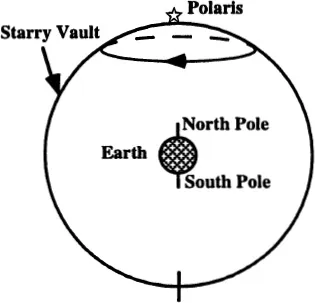
Persons watching the stars over a number of nights see that nearly all of them appear to move in a counterclockwise direction along circles varying in size. The sole stationary stars are Polaris and the southern polar stars. The motions of the stars are identical to what they would be if they were all located on a huge sphere, the starry vault, rotating once approximately every twenty-four hours, and having as its center the earth, which is assumed to be motionless. The sense of rotation of the starry vault is such that a star on its right side is moving out of the page. Typically, a given star will appear to rise on the eastern horizon and set on the western horizon.
South Polar Region
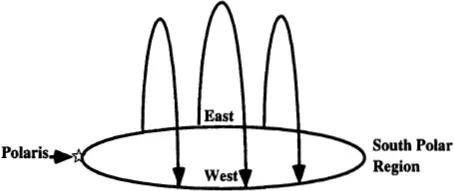
How do persons living on the earth’s equator see the stars move? Polaris and the southern polar stars appear fixed in position. The remaining stars rise perpendicularly to the eastern horizon and set perpendicularly to the western horizon. These motions are represented in the accompanying diagram in which the ellipse represents the horizon plane.
Horizon Plane at Equator
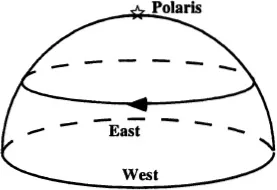
At the north pole, Polaris is seen fixed in position at the zenith (the point in the heavens directly above a person’s location). The other stars appear to move in circles parallel to the horizon plane and centered on Polaris.
Horizon Plan at North Pole
Persons living in Chicago or Boston are located at 42° north terrestrial latitude, i.e., 42° up from the equator. As the next diagram indicates, for such persons, Polaris appears fixed in position, whereas the stars near it move in circles that are always visible. Stars farther down the starry vault move in circles that are cut by the horizon plane.
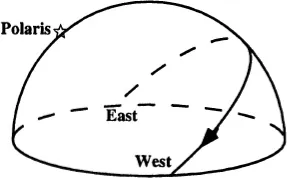
Horizon Plan at 42° North Latitude
Problems
Problem 1: Polaris is the last star in the handle of the little dipper. Draw the motion of the stars in the Little Dipper as seen from 42° north latitude over a period of three hours.
Problem 2: Suppose that there exist only two bodies in the universe: one is identical to the starry vault and the other is a very small spherical planet located at the center of the starry vault. Let us assume that the starry vault rotates once every 24 hours, whereas the planet remains fixed in position, i.e., it neither rotates nor revolves. What motion would an inhabitant of the starry vault, convinced that the starry vault is at rest, attribute to the planet at the center? Represent this by means of a diagram. Are there any conclusive arguments that an inhabitant of the planet could formulate to prove that the starry vault is rotating? Or are there arguments that the inhabitant of the starry vault could use to show that the planet is rotating?
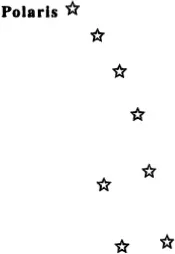
Little Dipper
The Motion of the Sun
First, some definitions:
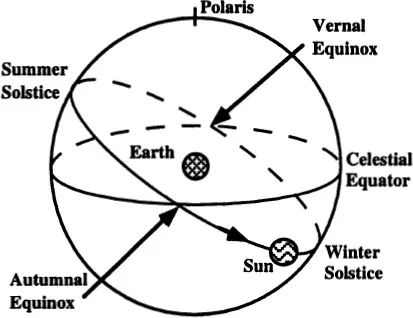
Celestial Equator: The celestial equator is the line on the starry vault that lies directly above the earth’s equator. Some point on the celestial equator is always at the zenith of a person living on the earth’s equator.
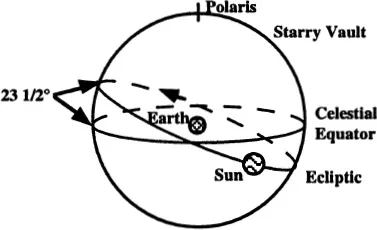
Ecliptic: The ecliptic is a line on the starry vault on which the sun always appears to be located. It is the apparent yearly path of the sun or the projection of the path of the sun on the starry vault during one year. The ecliptic is inclined at 23 1/2 degrees to the celestial equator. The sun completes one circuit of the ecliptic every 365.24220 days. From this it is evident that the sun moves approximately one degree each day on the ecliptic. Note that whereas the stars move from east to west, the motion of the sun on the ecliptic is from west to east. Let us now combine the motion of the starry vault with that of the sun. It is important to remember that the ecliptic is simply a line among the stars; it is like a seam on a basketball. If a basketball is rotated, its seam rotates with it. Correspondingly, the ecliptic rotates with the starry vault. Consequently, each day the sun makes one revolution around the earth along with the starry vault; however, the sun also moves about one degree per day along the ecliptic, moving in the opposite direction. As an aid to visualizing this, imagine an ant walking slowly down the side of a rapidly rotating basketball. The path of the ant from the point of view of the basketball is a straight line, but if seen from a fixed observer at a distance, the ant will appear to be moving along a helix. The next diagram shows the motion of the sun for one day.
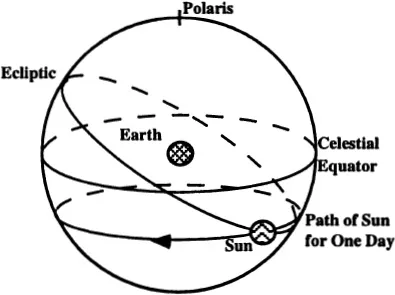
Additional definitions are now needed.
Vernal Equinox: The point on the starry vault where the ecliptic crosses the celestial equator with the sun moving toward the northern half of the heavens. The sun is at the vernal equinox around March 21. When the sun is at an equinoctial point (vernal or autumnal equinox), people on earth in most cases experience days and nights of equal length.
Summer Solstice: The most northerly point on the ecliptic. The sun is at the summer solstice around June 22.
Autumnal Equinox: The point on the starry vault where the ecliptic crosses the celestial equator with the sun moving toward the southerly half of the heavens. The sun is at the autumnal equinox around September 23.
Winter Solstice: The most southerly point on the ecliptic. The sun is at the winter solstice around December 22.
These definitions can be presented diagrammatically.
The discussion of the sun’s motion presented up to this point can be used to explain the seasons. This will also provide practice in applying these ideas. Many inhabitants of the northern hemisphere believe that summer is hot because the sun is closer at that time than in winter. In fact, the sun is farther from the earth in summer than in winter. The chief reason why summer is warm and winter cold...
Table of contents
- Cover
- Title Page
- Dedication
- Copyright Page
- Contents
- Preface
- Chapter One The Celestial Motions
- Chapter Two Greek Astronomy before Ptolemy
- Chapter Three Some Mathematical Techniques of Ancient Astronomy
- Chapter Four The Ptolemaic System
- Chapter Five Philosophical Interlude: The “Save the Phenomena” Position
- Chapter Six The Copernican System
- Chapter Seven The Tychonic System
- Chapter Eight Johannes Kepler
- Chapter Nine Galileo Galilei
- Epilogue Some Quotations Concerning Astronomy in the Copernican Revolution Period
- Appendix Archaeoastronomy
- Select Bibliography
- Index
Trusted by 375,005 students
Access to over 1.5 million titles for a fair monthly price.
Study more efficiently using our study tools.
Frequently asked questions
Yes, you can cancel anytime from the Subscription tab in your account settings on the Perlego website. Your subscription will stay active until the end of your current billing period. Learn how to cancel your subscription
No, books cannot be downloaded as external files, such as PDFs, for use outside of Perlego. However, you can download books within the Perlego app for offline reading on mobile or tablet. Learn how to download books offline
Perlego offers two plans: Essential and Complete
- Essential is ideal for learners and professionals who enjoy exploring a wide range of subjects. Access the Essential Library with 800,000+ trusted titles and best-sellers across business, personal growth, and the humanities. Includes unlimited reading time and Standard Read Aloud voice.
- Complete: Perfect for advanced learners and researchers needing full, unrestricted access. Unlock 1.5M+ books across hundreds of subjects, including academic and specialized titles. The Complete Plan also includes advanced features like Premium Read Aloud and Research Assistant.
We are an online textbook subscription service, where you can get access to an entire online library for less than the price of a single book per month. With over 1.5 million books across 990+ topics, we’ve got you covered! Learn about our mission
Look out for the read-aloud symbol on your next book to see if you can listen to it. The read-aloud tool reads text aloud for you, highlighting the text as it is being read. You can pause it, speed it up and slow it down. Learn more about Read Aloud
Yes! You can use the Perlego app on both iOS and Android devices to read anytime, anywhere — even offline. Perfect for commutes or when you’re on the go.
Please note we cannot support devices running on iOS 13 and Android 7 or earlier. Learn more about using the app
Please note we cannot support devices running on iOS 13 and Android 7 or earlier. Learn more about using the app
Yes, you can access Theories of the World from Antiquity to the Copernican Revolution by Michael J. Crowe in PDF and/or ePUB format, as well as other popular books in Storia & Storia della scienza. We have over 1.5 million books available in our catalogue for you to explore.