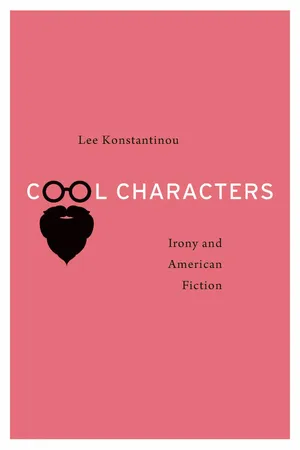
Charting a new course in the criticism of postwar fiction, Cool Characters examines the changing status of irony in American cultural and political life from World War II to the present, showing how irony migrated from the countercultural margins of the 1950s to the cultural mainstream of the 1980s. Along the way, irony was absorbed into postmodern theory and ultimately became a target of recent writers who have sought to create a practice of "postirony" that might move beyond its limitations.
As a concept, irony has been theorized from countless angles, but Cool Characters argues that it is best understood as an ethos: an attitude or orientation toward the world, embodied in different character types, articulated via literary style. Lee Konstantinou traces five such types—the hipster, the punk, the believer, the coolhunter, and the occupier—in new interpretations of works by authors including Ralph Ellison, William S. Burroughs, Thomas Pynchon, Kathy Acker, Dave Eggers, William Gibson, Jennifer Egan, Jonathan Lethem, and Rachel Kushner.
For earlier generations of writers, irony was something vital to be embraced, but beginning most dramatically with David Foster Wallace, dissatisfaction with irony, especially with its alleged tendency to promote cynicism and political passivity, gained force. Postirony—the endpoint in an arc that begins with naive belief, passes through irony, and arrives at a new form of contingent conviction—illuminates the literary environment that has flourished in the United States since the 1990s.
- 368 pages
- English
- ePUB (mobile friendly)
- Available on iOS & Android
eBook - ePub
About this book
Information
PART I:
Irony
1
The Hipster as Critic
IN HIS 1957 Dissent essay “The White Negro: Superficial Reflections on the Hipster,” Norman Mailer paints a grim portrait of “the psychic havoc of the concentration camps and the atom bomb upon the unconscious mind.” The postwar world, Mailer argues, confronted Americans with an existentially novel situation, the prospect that they might die “as a cipher in some vast statistical operation in which our teeth would be counted, and our hair would be saved, but our death itself would be unknown, unhonored, and unremarked, a death which could not follow with dignity as a possible consequence to serious actions we had chosen, but rather a death by deus ex machina in a gas chamber or a radioactive city.”1 Perhaps unsurprisingly for a novelist of his titanic egotism, Mailer cared less that he faced a greater chance of death than that he might die among a crowd, “unknown, unhonored, and unremarked,” separated from the machinery of social recognition. Mass death exceeds its empirical effects for Mailer, threatening to extinguish not only life but also honor and dignity. And yet, in this essay, Mailer celebrates not himself and his own worthy achievements but rather the cultural hero perhaps most capable of matching, if not exceeding, his apocalyptic self-regard. For the “American existentialist,” the type best able to navigate this “bleak scene,” is not the novelist but instead “the hipster, the man who knows that if our collective condition is to live with instant death by atomic war . . . then the only life-giving answer is to accept the terms of death, to live with death as immediate danger, to divorce oneself from society, to exist without roots, to set out on that uncharted journey into the rebellious imperative of the self.”2
Over fifty years later, Mailer’s grandiose claims about the hipster appear more quaint than revolutionary. His invocation of black experience and claimed insight into the psychic effects of racism are themselves troublingly racist in how they characterize black male sexuality. And his celebration of the political power of the male orgasm, the supposed solution to the problem of totalitarian terror, evinces Mailer’s infamous sexism. Finally, the “rebellious imperative of the self” he here extols can today seem like little more than a juvenile pose motivated by the desire to achieve distinction as well as a marketable image that advertisers hope will motivate teenaged consumers to buy sneakers, music players, and carbonated sugar water. Malcolm Cowley had already in 1934 trenchantly diagnosed the Bohemian lifestyle of Greenwich Village as, at root, a “consumption ethic,” observing that “self-expression and paganism encouraged a demand for all sorts of products—modern furniture, beach pajamas, cosmetics, colored bathrooms with toilet paper to match,” that “[l]iving for the moment meant buying an automobile, radio or house, using it now and paying for it tomorrow.”3 Andrew Hoberek is thus correct to locate the ultimate legacy of Mailer’s essay in “the tendency of cultural studies to celebrate ‘transgressive’ politics of style, thereby romanticizing those excluded from power rather than seeking to open power up” for the powerless.4 Writing about a more recent pedigree of Bohemian rebel, the contemporary gentrifiers of Wicker Park in Chicago, who are also called “hipsters,” the sociologist Richard Lloyd has made a similar point about the fundamental compatibility of consumerism and counterculture. Neo-Bohemian “resistance to the terms of bureaucratized, ‘corporate’ labor-force participation,” it turns out, “now contributes to the ready acceptance by educated intellectuals of manual-labor jobs in the post-Fordist entertainment industry.”5 In other words, twenty-somethings with college degrees, determined to escape the corporate “machine,” often celebrate low-paying jobs (as waiters and bartenders) as signs of rebellious freedom and personal fulfillment, rather than seeing their new jobs as signs of downward social mobility. Skeptical readings of the hipster emphasize, quite accurately, that the postwar consumer economy had special use for a countercultural population of “white negroes,” workers forced to embrace a Protestant ethic in the office on pain of unemployment who (frustrated by disempowered work lives) lived in a state of perpetual Bohemian carnival while off the clock.6 Rebellious imperative of the self, indeed.
Whatever criticisms we might justly make of the countercultural romance of the margins, we should not so easily dismiss the hipster, for he is also a figure with a significant literary history, one which exceeds Mailer’s misguided celebration of him. By studying the hipster, the Ur-ironist of postwar life—a character type many artists and intellectuals thought was best adapted to the age of abundance—we can reconstruct the foundations of our contemporary picture of irony and, in doing so, revise many deeply ingrained assumptions about its subversive power. The hipster was a negative type, an ambiguously racialized figure that aimed for pure negation, often in the name of liberation, defined more by what he disavowed or stood against than by what he fought for. Despite the doubt some have expressed about the viability of consumerist rebellion, many critics have continued to see the hipster’s political significance in his mastery of codes of consumption. In his classic No Respect: Intellectuals and Popular Culture, Andrew Ross gives one version of this argument, writing that the hipster “stands in a similar, structural relationship to cultural capital as does the intellectual.”7 Hip is “a mobile taste formation that closely registers shifts in respect / disrespect towards popular taste”8 Part of what makes it “mobile” for Ross is that hip functions differently for lower-class and middle-class hipsters. Whereas lower-class hipsters are overinformed about popular tastes, middle-class hipsters pretend to be underinformed, to engage directly with popular life. What may be surprising to those who adopt Ross’s view, however, is the degree to which those writing in the midcentury’s highbrow cultural forums (Partisan Review, Dissent, Commentary, The Noble Savage) saw hipness not only as a “taste formation” or attitude toward consumption, but also as a specimen of political awareness, a critical tool whose use went well beyond “advanced knowledge about the illegitimate.”9 Armed with hip knowingness, critics hoped to oppose what Dwight Macdonald called “midcult” or what Theodore Roszak called “technocratic society.”10 Hipness promised nothing less than, as Scott Saul has put it, “a new way of living,” a way to chart the limits of American freedom.11 All hipsters, of whatever class position, saw power as a function of knowledge, curated taste, and strategic consumption. Hip was a theory of power.
In studying the history of this hip ethos, we should heed the musicologist Phil Ford’s warning that contemporary critics have tended to discuss hipness in terms of “the most extreme and marginal figures . . . rather than the less exotic (but more commonplace) kinds of people for whom hipness was less the point of existence than a happenstance of it.”12 Even the most extreme individual hipsters, those whose lives might serve as case studies for students of hip subculture, never embodied hipness in some pure way, but instead stood in relation to a contested public image of the hipster as a figure, a midcentury racial fantasy jointly constructed by a range of intellectuals and artists. It is this public image of the hipster, and the fight to fix the meaning of this image, that I take as my object of study. Michael Szalay has argued that hipness served the Democratic Party as an important ideological component of a political-literary strategy for reconciling white professionals with African Americans. The concept of hipness helped white liberals imagine that they could inhabit black bodies, taking on a “second skin.”13 It created an acceptable way to “appeal to blacks without alienating racist whites.”14 Drawing heavily on Mailer, and Mailer’s claim that John F. Kennedy was “the Hipster as Presidential Candidate,” Szalay gives a persuasive account of one facet of the hipster’s cultural history. But the hipster’s political significance goes well beyond Democratic electoral strategy.
The hipster indeed facilitated a racial fantasy wherein white bodies might rebrand themselves as black, thus (it was imagined) frustrating a white mass society. But the hipster did more. He symbolically resisted the dominant culture using attitudinal strategies that intellectuals and critics increasingly prized. Irony—so hard to detect in the intensity of Mailer’s overheated prose—was the hipster’s primary attitudinal weapon in his war against mainstream conformity and square life. The hipster’s irony, his mastery of symbolic manipulation, harmonized with emerging white-collar fantasies of professional labor at midcentury. At a moment when writers came to see themselves as “cultural educators and national therapists” who worked in a world where “social reality is determined by ideas and values disseminated by intellectuals within the rapidly expanding new class,” the hipster’s expert use of irony as a political weapon was nearly irresistible.15 Irony was especially important for a specific subset of professionals—that is, intellectuals and critics—who thought they did a unique kind of knowledge work, who imagined themselves as manipulators not of information but of meaning.16 These assumptions inform Cleanth Brooks’s essay “Irony as a Principle of Structure,” a classic New Critical statement that identifies the “compelling reasons” that “modern poetry” emphasizes irony, which he defines as “the acknowledgement of the pressures of context” on poetic meaning.17 Among these compelling reasons are “the breakdown of common symbolism; . . . the general skepticism as to universals; . . . the depletion and corruption of the very language itself, by advertising and by the mass-produced arts of radio, the moving picture, and pulp fiction.”18 Irony, in this programmatic New Critical argument, is not just a structural principle that constitutes all poetry but also a weapon in a war of taste waged against “a public corrupted by Hollywood and the Book of the Month club, . . . a public sophisticated by commercial art.”19 Brooks’s argument depends on a crucial, undefended conflation of fact and value. For the New Critic, irony is simultaneously the objective, structural property of all poems, even those that seem nonironic (like lyric poetry); what the professional critic must learn how to discover in these poems (through the practice of close reading); and the poet’s preferred strategy for dealing with the depravities of modern culture, what every good poet ought to want to do. Because it guarantees that no poem is ever identical to its own denotative information, irony renders paraphrase not only heretical but also impossible.20 At the same time, once it is encoded in an object, irony must replicate itself in the cognitive faculty of the discerning critic, who will need to cultivate the capacity to read doubly. Without the critic’s taking up the normative mantle of ironic reading, irony will in some sense perish on the page. Irony’s survival and efficacy crucially depend on the critic’s willingness to hone a particular ethos, a characteristic way of being in the world, defined by one’s manner of interpreting that world. Pursuing this cultural program, the postwar modernist poet-critic and the hipster stand together—ironic, knowing, witting—against technocratic society, mass consumerism, and white-collar (not to mention white) conformity. The postwar hipster thus fused a specific social ontology (society as the arena of symbolic struggle), a hermeneutic strategy (close reading), and a normative attitude (irony).
The startling similarity of the postwar modernist poet-critic and the hipster—their common sense of superiority, justified in terms of knowingness, the convergence of highbrow intellectual culture and counterculture at midcentury—is starkly visible in Ralph Ellison’s Invisible Man (1952) and Thomas Pynchon’s V. (1963). Like Mailer and other midcentury intellectuals, Ellison and Pynchon looked to African American vernacular and popular culture for the resources with which they might devise strategies to survive middlebrow society. For both authors, becoming an intellectual hipster or hipster intellectual was a way to achieve an aesthetic détente between the modernist establishment and emerging countercultural values. Capable of supping from very different founts of prestige, the hipster promised to liberate language and undermine society, all while retaining literary and political credibility. Because he wrote Invisible Man at a time when the New Criticism was still relatively dynamic and ideologically in flux, Ellison adopted the title of critic with less trepidation than did Pynchon, who came of age amidst a more entrenched New Critical establishment at Cornell in the late fifties, during the Age of Criticism. Despite the significant differences in their biographies—Ellison and Pynchon are rarely read together—each places critical irony and a version of the hipster at the center of his artistic vision, sharing more than literary historians have recognized.
In Invisible Man, B. P. Rinehart—Ellison’s “name for the personification of chaos”—is the most obvious hipster-like figure, but there is a sense in which the invisible man himself becomes, by the end of the novel, a sort of hipster, a critical ironist, if not a personification, then a manipulator of chaos.21 I will argue for this claim by juxtaposing the ironic invisible man with the allegedly sincere protagonists of Richard Wright’s fiction and by considering the invisible man’s journey toward self-perception in light of Kenneth Burke’s theory of symbolic action. Pynchon brings the hipster and the critic together in different ways: first, in his rendition of the free-jazz saxophonist McClintic Sphere, a character modeled on Ornette Coleman, whom Pynchon watched at the Five Spot Café in the Bowery during the late fifties, and second, by structuring V....
Table of contents
- Cover
- Title Page
- Copyright
- Dedication
- Contents
- Preface
- Introduction. The Character of Irony
- Part I. Irony
- Part II. Postirony
- Conclusion. Manic Pixie Dream Occupier
- Notes
- Acknowledgments
- Index
Trusted by 375,005 students
Access to over 1.5 million titles for a fair monthly price.
Study more efficiently using our study tools.
Frequently asked questions
Yes, you can cancel anytime from the Subscription tab in your account settings on the Perlego website. Your subscription will stay active until the end of your current billing period. Learn how to cancel your subscription
No, books cannot be downloaded as external files, such as PDFs, for use outside of Perlego. However, you can download books within the Perlego app for offline reading on mobile or tablet. Learn how to download books offline
Perlego offers two plans: Essential and Complete
- Essential is ideal for learners and professionals who enjoy exploring a wide range of subjects. Access the Essential Library with 800,000+ trusted titles and best-sellers across business, personal growth, and the humanities. Includes unlimited reading time and Standard Read Aloud voice.
- Complete: Perfect for advanced learners and researchers needing full, unrestricted access. Unlock 1.5M+ books across hundreds of subjects, including academic and specialized titles. The Complete Plan also includes advanced features like Premium Read Aloud and Research Assistant.
We are an online textbook subscription service, where you can get access to an entire online library for less than the price of a single book per month. With over 1.5 million books across 990+ topics, we’ve got you covered! Learn about our mission
Look out for the read-aloud symbol on your next book to see if you can listen to it. The read-aloud tool reads text aloud for you, highlighting the text as it is being read. You can pause it, speed it up and slow it down. Learn more about Read Aloud
Yes! You can use the Perlego app on both iOS and Android devices to read anytime, anywhere — even offline. Perfect for commutes or when you’re on the go.
Please note we cannot support devices running on iOS 13 and Android 7 or earlier. Learn more about using the app
Please note we cannot support devices running on iOS 13 and Android 7 or earlier. Learn more about using the app
Yes, you can access Cool Characters by Lee Konstantinou in PDF and/or ePUB format, as well as other popular books in Literature & North American Literary Criticism. We have over 1.5 million books available in our catalogue for you to explore.