- 231 pages
- English
- PDF
- Available on iOS & Android
eBook - PDF
Imagination and the Contemporary Novel
About this book
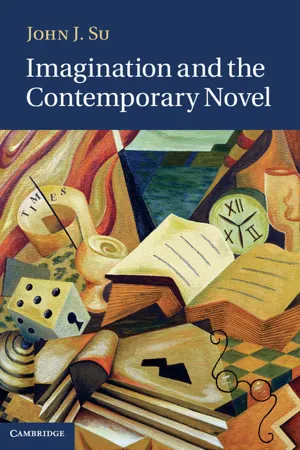
Imagination and the Contemporary Novel examines the global preoccupation with the imagination among literary authors with ties to former colonies of the British Empire since the 1960s. John Su draws on a wide range of authors including Peter Ackroyd, Monica Ali, Julian Barnes, André Brink, J. M. Coetzee, John Fowles, Amitav Ghosh, Nadine Gordimer, Hanif Kureishi, Salman Rushdie and Zadie Smith. This study rehabilitates the category of imagination in order to understand a broad range of contemporary Anglophone literature. The responses of such literature to shifts in global capitalism have often been misunderstood by the dominant categories of literary studies, the postmodern and the postcolonial. As both an insightful critique into the themes that drive a range of today's best novelists and a bold restatement of what the imagination is and what it means for contemporary culture, this book breaks new ground in the study of twenty-first-century literature.
Information
Topic
LiteraturaSubtopic
Crítica literaria inglesaTable of contents
- Cover
- Half-title
- Title
- Copyright
- Contents
- Preface and acknowledgments
- CHAPTER 1 Introduction: globalization, imagination, and the novel
- CHAPTER 2 Aesthetic revolutions: white South African writing and the State of Emergency
- CHAPTER 3 The pastoral and the postmodern
- CHAPTER 4 Hybridity, enterprise culture, and the fiction of multicultural Britain
- CHAPTER 5 Ghosts of essentialism: racial memory as epistemological claim
- CHAPTER 6 Amitav Ghosh and the aesthetic turn in postcolonial studies
- Conclusion: imagining together?
- Notes
- Bibliography
- Index
Trusted by 375,005 students
Access to over 1.5 million titles for a fair monthly price.
Study more efficiently using our study tools.
Frequently asked questions
Yes, you can cancel anytime from the Subscription tab in your account settings on the Perlego website. Your subscription will stay active until the end of your current billing period. Learn how to cancel your subscription
No, books cannot be downloaded as external files, such as PDFs, for use outside of Perlego. However, you can download books within the Perlego app for offline reading on mobile or tablet. Learn how to download books offline
Perlego offers two plans: Essential and Complete
- Essential is ideal for learners and professionals who enjoy exploring a wide range of subjects. Access the Essential Library with 800,000+ trusted titles and best-sellers across business, personal growth, and the humanities. Includes unlimited reading time and Standard Read Aloud voice.
- Complete: Perfect for advanced learners and researchers needing full, unrestricted access. Unlock 1.5M+ books across hundreds of subjects, including academic and specialized titles. The Complete Plan also includes advanced features like Premium Read Aloud and Research Assistant.
We are an online textbook subscription service, where you can get access to an entire online library for less than the price of a single book per month. With over 1.5 million books across 990+ topics, we’ve got you covered! Learn about our mission
Look out for the read-aloud symbol on your next book to see if you can listen to it. The read-aloud tool reads text aloud for you, highlighting the text as it is being read. You can pause it, speed it up and slow it down. Learn more about Read Aloud
Yes! You can use the Perlego app on both iOS and Android devices to read anytime, anywhere — even offline. Perfect for commutes or when you’re on the go.
Please note we cannot support devices running on iOS 13 and Android 7 or earlier. Learn more about using the app
Please note we cannot support devices running on iOS 13 and Android 7 or earlier. Learn more about using the app
Yes, you can access Imagination and the Contemporary Novel by John J. Su in PDF and/or ePUB format, as well as other popular books in Literatura & Crítica literaria inglesa. We have over 1.5 million books available in our catalogue for you to explore.