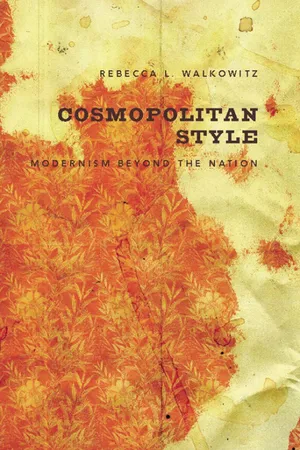
In this broad-ranging and ambitious intervention in the debates over the politics, ethics, and aesthetics of cosmopolitanism, Rebecca L. Walkowitz argues that modernist literary style has been crucial to new ways of thinking and acting beyond the nation. While she focuses on modernist narrative, Walkowitz suggests that style conceived expansively as attitude, stance, posture, and consciousness helps to explain many other, nonliterary formations of cosmopolitanism in history, anthropology, sociology, transcultural studies, and media studies.
Walkowitz shows that James Joyce, Joseph Conrad, Virginia Woolf, Salman Rushdie, Kazuo Ishiguro, and W. G. Sebald use the salient features of literary modernism in their novels to explore different versions of transnational thought, question moral and political norms, and renovate the meanings of national culture and international attachment. By deploying literary tactics of naturalness, triviality, evasion, mix-up, treason, and vertigo, these six authors promote ideas of democratic individualism on the one hand and collective projects of antifascism or anti-imperialism on the other. Joyce, Conrad, and Woolf made their most significant contribution to this "critical cosmopolitanism" in their reflection on the relationships between narrative and political ideas of progress, aesthetic and social demands for literalism, and sexual and conceptual decorousness. Specifically, Walkowitz considers Joyce's critique of British imperialism and Irish nativism; Conrad's understanding of the classification of foreigners; and Woolf's exploration of how colonizing policies rely on ideas of honor and masculinity.
Rushdie, Ishiguro, and Sebald have revived efforts to question the definitions and uses of naturalness, argument, utility, attentiveness, reasonableness, and explicitness, but their novels also address a range of "new ethnicities" in late-twentieth-century Britain and the different internationalisms of contemporary life. They use modernist strategies to articulate dynamic conceptions of local and global affiliation, with Rushdie in particular adding playfulness and confusion to the politics of antiracism.
In this unique and engaging study, Walkowitz shows how Joyce, Conrad, and Woolf developed a repertoire of narrative strategies at the beginning of the twentieth century that were transformed by Rushdie, Ishiguro, and Sebald at the end. Her book brings to the forefront the artful idiosyncrasies and political ambiguities of twentieth-century modernist fiction.
- English
- ePUB (mobile friendly)
- Available on iOS & Android
eBook - ePub
About this book
Information
Subtopic
European Literary CriticismIndex
LiteratureCOSMOPOLITAN MODERNISM
PART 1
1
CONRAD’S NATURALNESS
There was nothing foreign in his accent, except that he seemed in his slow enunciation to be taking pains with it. And Mrs Verloc, in her varied experience, had come to the conclusion that some foreigners could speak better English than the natives.
—JOSEPH CONRAD, THE SECRET AGENT
THAT ONE MIGHT belong to a culture by choice rather than by nature was commonly vilified, in the early twentieth century, as a principle of cosmopolitan “adaptability.”1 An insult with a double edge, adaptability implied a lack of positive identity, on the one hand, and a surfeit of abject identity, often Jewishness, on the other. It described, as historian Deborah Cohen has argued, a characteristic of unmarked “invaders,” whose versatility with language and manners helped them to live abroad without detection.2 As a skill of individuals, adaptability meant that people could belong to more than one culture, or they could operate within cultures that were not, or not yet, their own. As a concept, adaptability meant something more: inclusion in a culture might depend not on the expression of innate attributes but on the performance of learned codes and habitual gestures. In Britain, nativist writers were disturbed to think that foreigners were passing as locals, but they were even more disturbed to imagine that foreigners might become locals, by learning to be natural or by changing the conditions of nature.
This chapter examines the naturalness of Joseph Conrad, whose choice of English as a language of composition and whose focus on global systems of trade, imperialism, and espionage have made him, among critics in his own time and throughout the twentieth century, at once the most British and the most cosmopolitan of novelists. For some, Conrad’s choice made him exceptionally foreign: writing all of his fiction in a language he had to learn, Conrad became not simply a stranger in England but one whose fiction is nowhere at home. For others, Conrad’s foreignness made him the most English of writers, as F. R. Leavis claims in his canonical account of the English novel. Only because he was foreign, Leavis argued in 1948, could Conrad choose English and thus inaugurate “the great tradition” that precedes him: Jane Austen, George Eliot, and Henry James. Allowing origin to follow imitation, Leavis’s narrative is typically Conradian: by virtue of his choice, Leavis proposes, the novelist affirmed the coherence and value of English literature.3 Aiming to describe a distinctly national tradition, Leavis emphasizes preference and patriotism, but he minimizes agency and self-consciousness, which would imply cosmopolitanism. Leavis proposes that Conrad does not belong to English culture voluntarily, as a cosmopolitan would, but rather he belongs “in the full sense,” by nature (18). Leavis describes Conrad’s choice as a compulsion that follows not the pleasures of cultural mixing or even the necessities of social circumstance but the imperatives of art. Claiming that Conrad’s “themes and interests demanded the concreteness and action—the dramatic energy—of English” (17–18), Leavis uses the international Conrad to create a natural national tradition: a literary and cultural lineage that is both coherent and continuous.
Today, in many critical accounts, Conrad is the exemplary figure of British modernism. He is exemplary, critics propose, because his foreignness was more extreme than the exile of his contemporaries: not only did he leave his native country for reasons of personal safety, the argument goes, but he left behind his native language as well.4 Critics often attribute the innovations of Conrad’s style to his history of literal and metaphorical displacement.5 In this chapter, I make a related but in some ways opposite claim: Conrad becomes legible as a foreigner in his life because he displays adaptability, or naturalness, in his work. I do not mean to deny that Conrad was a foreigner in England; nor do I mean to underestimate the difficult conditions of immigration and transience in which Conrad’s writing developed. Rather, I propose that Conrad’s reputation comes to shape his history. I suggest that Conrad’s analysis of display and perception in his novels, what is often called his “impressionism,” should be understood both as a philosophical critique of social categories and as an urbane practice of ethnographic self-fashioning.6 To measure the aesthetic and political implications of Conrad’s writing, we need to see the relationship between two strains of cosmopolitanism in his work: the geographic cosmopolitanism of immigration, international travel, and colonialism, which the novels describe, and the aesthetic cosmopolitanism of literary impressionism and decadence, whose values the novels reproduce and whose urban meanderings and ambiguous poses are crucial to his later texts. By disaggregating the several aspects of cosmopolitanism in this period, I will show that Conrad brought to his work diverse, sometimes conflicting strategies of national and international affiliation.
In Conrad’s novels, themes of deracination and cultural mixing meet practices of experimentation and promotion. Fredric Jameson’s account of the oscillation between realism and romance in Conrad’s writing provides one very useful way to describe this encounter.7 However, I would associate Conrad’s mixing of genres less with “schizophrenic writing” (219), as Jameson does, than with a kind of critical dandyism: the tactical deployment of rhetoric and social detail, which allows Conrad to reproduce and also to manipulate the norms of British culture.8 Conrad’s preoccupation with art, perhaps the chief characteristic of literary decadence, extends from his well-known interest in the medium of writing to his corollary interests in the media of everyday culture: if Conrad establishes an analogy between the representation of storytelling and a novel’s telling of its story, as Edward Said and others have shown, he also comes to connect the novel’s art of presentation to more quotidian, more pervasive, and less visible practices of artful presentation, such as physical gesture, sartorial and bodily display, and the design of shop windows and street signs.9 Like Walter Pater, Conrad is interested in the reader’s perception of perception, the recognition of habit and the process of defamiliarization; like Oscar Wilde, he is interested in the social processes that make norms seem natural.10 Conrad’s narratives may extend the terrain of Rudyard Kipling and Rider Haggard, but they also follow the path of Wilde: in international settings, colonial and metropolitan, Conrad brings everyday culture to many of Wilde’s precepts, allowing that “facts” are made rather than found, that description creates rather than reflects social categories, that art lends coherence to “nations and individuals,” that foreign styles are the effects of British fiction.11 I will suggest at the end of this chapter that Wilde’s social paradoxes prefigure at the level of epigram the cultural artifice that Conrad represents at the level of narrative.12
As many scholars have shown, Conrad is critical of norms in some cases and reproduces nature in others: his novels present racism as an arbitrary science and an instrument of exploitation, but they also invoke racist stereotypes. Patrick Brantlinger contends persuasively that Conrad may be more interested in reputation, stereotype, and “propaganda” (Brantlinger’s term) than he is in actual people or in the project of replacing racist stereotypes with antiracist identities.13 One might say that Conrad resists, above all, the “fact” of identity, both in his own life and in the description of his characters. In the colonial context, resisting the fact of identity may seem to ignore, or even support, one of the principal strategies of European imperialism: the process of reducing individuals to abstract, dehumanized groups. However, in the European context, where the rhetoric of individuality is used to justify imperialism, resisting the fact of identity allows Conrad to show how nature is produced. Conrad does not imagine more inclusive or more flexible paradigms of belonging, but neither does he allow the old paradigm to function as it did, invisibly and timelessly. Rather, he presents belonging as a social process, introducing naturalness—the purposeful imitation of what passes for nature—as a literary tactic that later novelists, such as Kazuo Ishiguro and W. G. Sebald, will use both to reorient and to diversify British points of view.
I argue that Conrad is exemplary as a British writer in the early twentieth century not because he is the most foreign but because he is the least natural. His novels emphasize strategies of promotion: how social gestures, including the gestures of writing, become legible as necessary and defining characteristics. Conrad’s work attests to an emerging conflict between naturalness and nature, between a model of identity based on manners and a model based on instinct or race. Conrad addresses this conflict directly in his texts: he shows how social processes make details into facts, behaviors into characteristics, persons into categories. By attributing cultural distinctions to an interpretive history, Conrad links national identities to conditions of visibility, how people are perceived, rather than to conditions of existence, what people really are. Deflecting charges of adaptability in his life while depicting adaptability in his novels, Conrad develops naturalness as a characteristic of British culture and as a tactic of critical cosmopolitanism.
***
This chapter focuses on The Secret Agent, the novel about national reputations that helped to shape Conrad’s cosmopolitan reputation among early readers. The case of The Secret Agent is striking: reviewers attributed the novel, a tale of anarchists and foreigners in London, to Conrad’s cosmopolitan nature, even while the novel attributes such characteristics to the fiction of rhetorical display. I will begin by describing Conrad’s efforts, in prefaces and letters, to refute or manipulate the characteristics that readers assigned to him. I will then turn to The Secret Agent, in which Conrad teaches readers to distrust both apparent identities and “established reputations.”14 Scenes of display may be pervasive in Conrad’s work, but The Secret Agent is unique among the novels because it assigns these scenes to a specific cultural milieu: bohemian Soho and its cast of immigrants, foreigners, and other indeterminate residents. In The Secret Agent, Conrad presents the skillful manipulation of social details and local manners as a norm of cosmopolitan London.
Eager to differentiate naturalness from nature, early-twentieth-century reviewers emphasized Conrad’s foreign origins while they praised his fluent use of the English language. One is reminded that to call someone “a natural” is to notice how effortless his or her actions appear; it is to notice not nature but the appearance of nature. Whereas naturalness is culturally and historically specific because it depends on a projected impression, nature lays claim to timelessness, to a world apart from representation and recognition. Conrad understood this distinction. In a letter to his French translator Hugh-Durand Davray, he argues that his novels cannot function in any language other than English. The work, Conrad explains to Davray, “is written for the English—from the point of view of the effect it will have on an English reader.”15 Contrasting his interests with those of Rudyard Kipling, his most acclaimed predecessor in the English literature of empire, Conrad argues,
A national writer like Kipling, for example, translates easily. His interest is in the subject: the interest of my work is in the effect it produces. He talks about his compatriots. I write for them.
(29; ORIGINAL EMPHASIS)
Making English novels of “effects,” Conrad asserts the reality that writing creates against the locations and national origins that situate writing. Rather than talking “about” the English, transmitting experiences and characteristics that precede literature, Conrad writes “for” them, expressing nothing so much as the conditions of reception.
While the difference between nature and naturalness was central to Conrad’s literary project, his work was produced in the context of a literary culture devoted to categories of national distinctiveness and authenticity. For this reason, one observes in Conrad’s public writings a very different set of claims than those he offers in private letters, such as the one to his translator. In his public comments, Conrad claimed to write not for effect but for transparency. He made these claims in response to early critics and reviewers who described him in published reports as a foreigner playing the role of an Englishman; to his readers, the better he played this role, the more foreign and decadent he seemed. Reviews of The Secret Agent attributed the novel’s dark view of London to the fact that its author was a foreigner to England and to English culture. These reviews often claimed that Conrad’s novel was nothing more than the natural expression of his foreign self. His choice of English as a literary language was thought to confirm this fact, as it emphasized the artifice of Conrad’s endeavor. Through the rhetoric of choice, Conrad’s contemporaries registered his imposture; through the accusation of artifice, early-twentieth-century critics sought to differentiate Conrad’s impersonation of Englishness from the nature of Englishness and other national cultures.
The Irish critic Robert Lynd, reviewing Conrad’s writing in a London newspaper in 1908, argued that literature should follow and invigorate national traditions: one should only want or choose what one has been given, and everyone is given, he asserts, something specific and distinct. Lynd writes,
Mr. Conrad, as everybody knows, is a Pole, who writes in English by choice, as it were, rather than by nature. According to most people, this choice is a good thing, especially for English literature. To some of us, on the other hand, it seems a very regrettable thing, even from the point of view of English literature.16
The phrase “choice, as it were” reflects Lynd’s belief that language cannot be chosen at all. Lynd regrets not Conrad’s failure to be English but his failure to be Polish, the nationality to which “everybody knows” Conrad belongs. Lynd is concerned less about Conrad’s actions (giving up the Polish language, electing to write in English) than about the implication of these actions for the distinctiveness of national cultures; Conrad’s choice suggests that national culture is a matter of self-identification and practice rather than a matter of race or nativity. The logic of Lynd’s critique follows the logic of adaptability: only because Conrad is “cosmopolitan” and “homeless,” Lynd argues, does he choose to write in English; writing by “choice” rather than by “nature,” however, Conrad becomes cosmopolitan, the kind of person who chooses. Behind Lynd’s critique of Conrad is his conviction that all literature should express a particular national culture whose circulation and continuity it serves to maintain. For Conrad, on the contrary, literature is the medium through which culture is perceived and in some measure produced.
Many reviewers of The Secret Agent saw the novel as a turning point in Conrad’s career: with The Secret Agent, Hugh Walpole wrote in 1916, “a new attitude was most plainly visible.”17 Even those reviewers who sought to defend Conrad from the cosmopolitanism of whimsical, denationalized writing supported him much as Lynd attacked: by locating in his work the manifestation of an “alien … genius.”18 Everywhere, critics imposed the same language of inevitability: for Lynd, Conrad should not write in English because he is Polish; for others, Conrad’s choice of English was irrelevant because the writing betrays its author’s Polishness all the same. Edward Garnett, who recommended Conrad’s first novel for publication, later wrote in the Nation that the author of The Secret Agent had brought the “secrets of Slav thought” to “our [English] tongue”;19 a reviewer in the Glasgow News found it “not an irrelevant reflection upon The Secret Agent that its author, Joseph Conrad, is of Polish birth”;20 and Arthur Symons, whose magazine accepted Conrad’s first published short story in 1896, celebrated the novelist as a man of “inexplicable mind” who “does not always think in English” even when he uses English words.21 The reviewers are eager to keep the actual apart from the observed.
Rather than dispute the logic of these comments, Conrad spent much of his career, in prefaces and in biographical essays, insisting that his art was a product of natural inclination. This may sound like a direct contradiction of Conrad’s sensibility as he described it to his translator, and in some ways it is. However, this insistence allowed Conrad to refute the personal implications of adaptability (a foreign nature) while also embracing the professional implications of naturalness (success in art). In a 1919 introduction to A Personal Record, first published in 1912, Conrad refutes “certain statements” in the press, that he had “exercised a choice” to write in English and that his work, in its sensibility and themes, reflects its author’s “Sclavonism.”22 Conrad’s refutation seems clear enough:
The first object of this note is to disclaim any merit there might have been in an act of deliberate volition. The impression of my having exercised a choice between the two languages, French and English, both foreign to me, has got abroad somehow. That impression is erroneous. … English was for me neither a matter of choice nor adoption.
(III–V)
Conrad does not deny a specific interest in English so much as he denies an indulgent one, where his choice of English would suggest that he could have chosen, indifferently, another language altogether. He objects to the values associated with the ability to choose and to the notion that he might be “able to do freakish things in...
Table of contents
- Cover
- Half title
- Title
- Copyright
- Dedication
- Epigraph
- Contents
- Acknowledgments
- Introduction: Critical Cosmopolitanism and Modernist Narrative
- Part 1: Cosmopolitan Modernism
- Part 2: Modernist Cosmopolitanism
- Notes
- Bibliography
- Index
Trusted by 375,005 students
Access to over 1.5 million titles for a fair monthly price.
Study more efficiently using our study tools.
Frequently asked questions
Yes, you can cancel anytime from the Subscription tab in your account settings on the Perlego website. Your subscription will stay active until the end of your current billing period. Learn how to cancel your subscription
No, books cannot be downloaded as external files, such as PDFs, for use outside of Perlego. However, you can download books within the Perlego app for offline reading on mobile or tablet. Learn how to download books offline
Perlego offers two plans: Essential and Complete
- Essential is ideal for learners and professionals who enjoy exploring a wide range of subjects. Access the Essential Library with 800,000+ trusted titles and best-sellers across business, personal growth, and the humanities. Includes unlimited reading time and Standard Read Aloud voice.
- Complete: Perfect for advanced learners and researchers needing full, unrestricted access. Unlock 1.5M+ books across hundreds of subjects, including academic and specialized titles. The Complete Plan also includes advanced features like Premium Read Aloud and Research Assistant.
We are an online textbook subscription service, where you can get access to an entire online library for less than the price of a single book per month. With over 1.5 million books across 990+ topics, we’ve got you covered! Learn about our mission
Look out for the read-aloud symbol on your next book to see if you can listen to it. The read-aloud tool reads text aloud for you, highlighting the text as it is being read. You can pause it, speed it up and slow it down. Learn more about Read Aloud
Yes! You can use the Perlego app on both iOS and Android devices to read anytime, anywhere — even offline. Perfect for commutes or when you’re on the go.
Please note we cannot support devices running on iOS 13 and Android 7 or earlier. Learn more about using the app
Please note we cannot support devices running on iOS 13 and Android 7 or earlier. Learn more about using the app
Yes, you can access Cosmopolitan Style by Rebecca L. Walkowitz in PDF and/or ePUB format, as well as other popular books in Literature & European Literary Criticism. We have over 1.5 million books available in our catalogue for you to explore.