The Predicament of Culture is a critical ethnography of the West in its changing relations with other societies. Analyzing cultural practices such as anthropology, travel writing, collecting, and museum displays of tribal art, James Clifford shows authoritative accounts of other ways of life to be contingent fictions, now actively contested in post-colonial contexts. His critique raises questions of global significance: Who has the authority to speak for any group's identity and authenticity? What are the essential elements and boundaries of a culture? How do self and "the other" clash in the encounters of ethnography, travel, and modern interethnic relations?
In chapters devoted to the history of anthropology, Clifford discusses the work of Malinowski, Mead, Griaule, Lévi-Strauss, Turner, Geertz, and other influential scholars. He also explores the affinity of ethnography with avant-garde art and writing, recovering a subversive, self-reflexive cultural criticism. The surrealists' encounters with Paris or New York, the work of Georges Bataille and Michel Leiris in the Collège de Sociologie, and the hybrid constructions of recent tribal artists offer provocative ethnographic examples that challenge familiar notions of difference and identity. In an emerging global modernity, the exotic is unexpectedly nearby, the familiar strangely distanced.
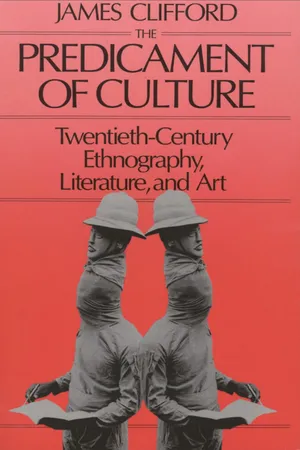
eBook - ePub
The Predicament of Culture
Twentieth-Century Ethnography, Literature, and Art
- 382 pages
- English
- ePUB (mobile friendly)
- Available on iOS & Android
eBook - ePub
About this book
Information
Publisher
Harvard University PressYear
1988Print ISBN
9780674698437
9780674698420
eBook ISBN
9780674503731

Clifford takes as his natives, as well as his informants, … anthropologists … We are being observed and inscribed.
—PAUL RABINOW, “REPRESENTATIONS ARE SOCIAL FACTS”
1. On Ethnographic Authority
THE 1724 frontispiece of Father Lafitau’s Moeurs des sauvages ameriquains portrays the ethnographer as a young woman sitting at a writing table amid artifacts from the New World and from classical Greece and Egypt. The author is accompanied by two cherubs who assist in the task of comparison and by the bearded figure of Time, who points toward a tableau representing the ultimate source of the truths issuing from the writer’s pen. The image toward which the young woman lifts her gaze is a bank of clouds where Adam, Eve, and the serpent appear. Above them stand the redeemed man and woman of the Apocalypse, on either side of a radiant triangle bearing the Hebrew script for Yahweh.
The frontispiece for Malinowski’s Argonauts of the Western Pacific is a photograph with the caption “A Ceremonial Act of the Kula.” A shell necklace is being offered to a Trobriand chief, who stands at the door of his dwelling. Behind the man presenting the necklace is a row of six bowing youths, one of them sounding a conch. All the figures stand in profile, their attention apparently concentrated on the rite of exchange, a real event of Melanesian life. But on closer inspection one of the bowing Trobrianders may be seen to be looking at the camera.
Lafitau’s allegory is the less familiar: his author transcribes rather than originates. Unlike Malinowski’s photo, the engraving makes no reference to ethnographic experience—despite Lafitau’s five years of research among the Mohawks, research that has earned him a respected place among the fieldworkers of any generation. His account is presented not as the product of firsthand observation but of writing, in a crowded workshop. The frontispiece from Argonauts, like all photographs, asserts presence—that of the scene before the lens; it also suggests another presence—that of the ethnographer actively composing this fragment of Trobriand reality. Kula exchange, the subject of Malinowski’s book, has been made perfectly visible, centered in the perceptual frame, while a participant’s glance redirects our attention to the observational standpoint we share, as readers, with the ethnographer and his camera. The predominant mode of modern fieldwork authority is signaled: “You are there … because I was there.”
This chapter traces the formation and breakup of ethnographic authority in twentieth-century social anthropology. It is not a complete account, nor is it based on a fully realized theory of ethnographic interpretation and textuality.1 Such a theory’s contours are problematic, since the activity of cross-cultural representation is now more than usually in question. The present predicament is linked to the breakup and redistribution of colonial power in the decades after 1950 and to the echoes of that process in the radical cultural theories of the 1960s and 1970s. After the negritude movement’s reversal of the European gaze, after anthropology’s crise de conscience with respect to its liberal status within the imperial order, and now that the West can no longer present itself as the unique purveyor of anthropological knowledge about others, it has become necessary to imagine a world of generalized ethnography. With expanded communication and intercultural influence, people interpret others, and themselves, in a bewildering diversity of idioms—a global condition of what Mikhail Bakhtin (1953) called “heteroglossia.”2 This ambiguous, multivocal world makes it increasingly hard to conceive of human diversity as inscribed in bounded, independent cultures. Difference is an effect of inventive syncretism. In recent years works such as Edward Said’s Orientalism (1978) and Paulin Hountondji’s Sur la “philosophie” africaine (1977) have cast radical doubt on the procedures by which alien human groups can be represented without proposing systematic, sharply new methods or epistemologies. These studies suggest that while ethnographic writing cannot entirely escape the reductionist use of dichotomies and essences, it can at least struggle self-consciously to avoid portraying abstract, ahistorical “others.” It is more than ever crucial for different peoples to form complex concrete images of one another, as well as of the relationships of knowledge and power that connect them; but no sovereign scientific method or ethical stance can guarantee the truth of such images. They are constituted—the critique of colonial modes of representation has shown at least this much—in specific historical relations of dominance and dialogue.
The experiments in ethnographic writing surveyed in this chapter do not fall into a clear reformist direction or evolution. They are ad hoc inventions and cannot be seen in terms of a systematic analysis of postcolonial representation. They are perhaps best understood as components of that “toolkit” of engaged theory recently recommended by Gilles Deleuze and Michel Foucault: “The notion of theory as a toolkit means (i) The theory to be constructed is not a system but an instrument, a logic of the specificity of power relations and the struggles around them; (ii) That this investigation can only be carried out step by step on the basis of reflection (which will necessarily be historical in some of its aspects) on given situations” (Foucault 1980:145; see also 1977:208). We may contribute to a practical reflection on cross-cultural representation by undertaking an inventory of the better, though imperfect, approaches currently at hand. Of these, ethnographic fieldwork remains an unusually sensitive method. Participant observation obliges its practitioners to experience, at a bodily as well as an intellectual level, the vicissitudes of translation. It requires arduous language learning, some degree of direct involvement and conversation, and often a derangement of personal and cultural expectations. There is, of course, a myth of fieldwork. The actual experience, hedged around with contingencies, rarely lives up to the ideal; but as a means for producing knowledge from an intense, intersubjective engagement, the practice of ethnography retains a certain exemplary status. Moreover, if fieldwork has for a time been identified with a uniquely Western discipline and a totalizing science of “anthropology,” these associations are not necessarily permanent. Current styles of cultural description are historically limited and are undergoing important metamorphoses.
The development of ethnographic science cannot ultimately be understood in isolation from more general political-epistemological debates about writing and the representation of otherness. In this discussion, however, I have maintained a focus on professional anthropology, and specifically on ethnography since 1950.3 The current crisis—or better, dispersion—of ethnographic authority makes it possible to mark off a rough period, bounded by the years 1900 and 1960, during which a new conception of field research established itself as the norm for European and American anthropology. Intensive fieldwork, pursued by university-trained specialists, emerged as a privileged, sanctioned source of data about exotic peoples. It is not a question here of the dominance of a single research method. “Intensive” ethnography has been variously defined. (Compare Griaule 1957 with Malinowski 1922:chap. 1). Moreover, the hegemony of fieldwork was established earlier and more thoroughly in the United States and in England than in France. The early examples of Franz Boas and the Torres Straits expedition were matched only belatedly by the founding of the Institut d’Ethnologie in 1925 and the much-publicized Mission Dakar-Djibouti of 1932 (Karady 1982; Jamin 1982a; Stocking 1983). Nevertheless, by the mid-1930s one can fairly speak of a developing international consensus: valid anthropological abstractions were to be based, wherever possible, on intensive cultural descriptions by qualified scholars. By this point the new style had been made popular, institutionalized, and embodied in specific textual practices.
It has recently become possible to identify and take a certain distance from these conventions.4 If ethnography produces cultural interpretations through intense research experiences, how is unruly experience transformed into an authoritative written account? How, precisely, is a garrulous, overdetermined cross-cultural encounter shot through with power relations and personal cross-purposes circumscribed as an adequate version of a more or less discrete “other world” composed by an individual author?
In analyzing this complex transformation one must bear in mind the fact that ethnography is, from beginning to end, enmeshed in writing. This writing includes, minimally, a translation of experience into textual form. The process is complicated by the action of multiple subjectivities and political constraints beyond the control of the writer. In response to these forces ethnographic writing enacts a specific strategy of authority. This strategy has classically involved an unquestioned claim to appear as the purveyor of truth in the text. A complex cultural experience is enunciated by an individual: We the Tikopia by Raymond Firth; Nous avons mangé la forêt by Georges Condominas; Coming of Age in Samoa by Margaret Mead; The Nuer by E. E. Evans-Pritchard.
The discussion that follows first locates this authority historically in the development of a twentieth-century science of participant observation. It then proceeds to a critique of underlying assumptions and a review of emerging textual practices. Alternate strategies of ethnographic authority may be seen in recent experiments by ethnographers who self-consciously reject scenes of cultural representatipn in the style of Malinowski’s frontispiece. Different secular versions of Lafiteau’s crowded scriptorial workshop are emerging. In the new paradigms of authority the writer is no longer fascinated by transcendent figures—a Hebrew-Christian deity or its twentieth-century replacements, Man and Culture. Nothing remains of the heavenly tableau except the anthropologist’s scumbled image in a mirror. The silence of the ethnographic workshop has been broken—by insistent, heteroglot voices, by the scratching of other pens.5
At the close of the nineteenth century nothing guaranteed, a priori, the ethnographer’s status as the best interpreter of native life—as opposed to the traveler, and especially the missionary and administrator, some of whom had been in the field far longer and had better research contacts and linguistic skills. The development of the fieldworker’s image in America, from Frank Hamilton Cushing (an oddball) to Margaret Mead (a national figure) is significant. During this period a particular form of authority was created—an authority both scientifically validated and based on a unique personal experience. During the 1920s Malinowski played a central role in establishing credit for the fieldworker, and we should recall in this light his attacks on the competence of competitors in the field. For example the colonial magistrate Alex Rentoul, who had the temerity to contradict science’s findings concerning Trobriand conceptions of paternity, was excommunicated in the pages of Man for his unprofessional “police court perspective” (see Rentoul 1931a,b; Malinowski 1932). The attack on amateurism in the field was pressed even further by A. R. Radcliffe-Brown, who, as Ian Langham has shown, came to epitomize the scientific professional, discovering rigorous social laws (Langham 1981 :chap. 7). What emerged during the first half of the twentieth century with the success of professional fieldwork was a new fusion of general theory and empirical research, of cultural analysis with ethnographic description.
The fieldworker-theorist replaced an older partition between the “man on the spot” (in James Frazer’s words) and the sociologist or anthropologist in the métropole. This division of labor varied in different national traditions. In the United States for example Morgan had personal knowledge of at least some of the cultures that were raw material for his sociological syntheses; and Boas rather early on made intensive field-work the sine qua non of serious anthropological discourse. In general, however, before Malinowski, Radcliffe-Brown, and Mead had successfully established the norm of the university-trained scholar testing and deriving theory from firsthand research, a rather different economy of ethnographic knowledge prevailed. For example The Melanesians (1891) by R. H. Codrington is a detailed compilation of folklore and custom, drawn from his relatively long term of research as an evangelist and based on intensive collaboration with indigenous translators and informants. The book is not organized around a fieldwork “experience,” nor does it advance a unified interpretive hypothesis, functional, historical, or otherwise. It is content with low-level generalizations and the amassing of an eclectic range of information. Codrington is acutely aware of the incompleteness of his knowledge, believing that real understanding of native life begins only after a decade or so of experience and study (pp. vi-vii). This understanding of the difficulty of grasping the world of alien peoples—the many years of learning and unlearning needed, the problems of acquiring thorough linguistic competence—tended to dominate the work of Codrington’s generation. Such assumptions would soon be challenged by the more confident cultural relativism of the Malinowskian model. The new fieldworkers sharply distinguished themselves from the earlier “men on the spot”—the missionary, the administrator, the trader, and the traveler—whose knowledge of indigenous peoples, they argued, was not informed by the best scientific hypotheses or a sufficient neutrality.
Before the emergence of professional ethnography, writers such as J. F. McLennan, John Lubbock, and E. B. Tylor had attempted to control the quality of the reports on which their anthropological syntheses were based. They did this by means of the guidelines of Notes and Queries and, in Tylor’s case, by cultivating long-term working relations with sophisticated researchers in the field such as the missionary Lorimer Fison. After 1883, as newly appointed reader in anthropology at Oxford, Tylor worked to encourage the systematic gathering of ethnographic data by qualified professionals. The United States Bureau of Ethnology, already committed to the undertaking, provided a model. Tylor was active in founding a committee on the Northwestern Tribes of Canada. The committee’s first agent in the field was the nineteen-year-veteran missionary among the Ojibwa, E. F. Wilson. He was replaced before long by Boas, a physicist in the process of turning to professional ethnography. George Stocking has persuasively argued that the replacement of Wilson by Boas “marks the beginning of an important phase in the development of British ethnographic method: the collection of data by academically trained natural scientists defining themselves as anthropologists, and involved also in the formulation and evaluation of anthropological theory” (1983:74). With Boas’ early survey work and the emergence in the 1890s of other natural-scientist fieldworkers such as A. C. Haddon and Baldwin Spencer, the move toward professional ethnography was under way. The Torres Straits expedition of 1899 may be seen as a culmination of the work of this “intermediate generation,” as Stocking calls them. The new style of research was clearly different from that of missionaries and other amateurs in the field, and part of a general trend since Tylor “to draw more closely together the empirical and theoretical components of anthropological inquiry” (1983:72).
The establishment of intensive participant observation as a professional norm, however, would have to await the Malinowskian cohort. The “intermediate generation” of ethnographers did not typically live in a single locale for a year or more, mastering the vernacular and undergoing a personal learning experience comparable to an initiation. They did not speak as cultural insiders but retained the natural scientist’s documentary, observational stance. The principal exception before the third decade of the century, Frank Hamilton Cushing, remained an isolated instance. As Curtis Hinsley has suggested, Cushing’s long firsthand study of the Zunis, his quasi-absorption into their way of life, “raised problems of verification and accountability … A community of scientific anthropology on the model of other sciences required a common language of discourse, channels of regular communication, and at least minimal consensus on judging method” (1983:66). Cushing’s intuitive, excessively personal understanding of the Zuni could not confer scientific authority.
Schematically put, before the late nineteenth century the ethnographer and the anthropologist, the describer-translator of custom and the builder of general theories about humanity, were distinct. (A clear sense of the tension between ethnography and anthropology is important in correctly perceiving the recent, and perhaps temporary, conflation of the two projects.) Malinowski gives us the image of the new “anthropologist”—squatting by the campfire; looking, listening, and questioning; recording and interpreting Trobriand life. The literary charter of this new authority is the first chapter of Argonauts, with its prominently displayed photographs of the ethnographer’s tent pitched among Kiriwinian dwellings. The sharpest methodological justification for the new mode is to be found in Radcliffe-Brown’s Andaman Islanders (1922). The two books were published within a year of each other. And although their authors developed quite different fieldwork styles a...
Table of contents
- Cover
- Title
- Copyright
- Contents
- Introduction: The Pure Products Go Crazy
- Part One: Discourses
- Part Two: Displacements
- Part Three: Collections
- Part Four: Histories
- References
- Sources
- Index
Trusted by 375,005 students
Access to over 1.5 million titles for a fair monthly price.
Study more efficiently using our study tools.
Frequently asked questions
Yes, you can cancel anytime from the Subscription tab in your account settings on the Perlego website. Your subscription will stay active until the end of your current billing period. Learn how to cancel your subscription
No, books cannot be downloaded as external files, such as PDFs, for use outside of Perlego. However, you can download books within the Perlego app for offline reading on mobile or tablet. Learn how to download books offline
Perlego offers two plans: Essential and Complete
- Essential is ideal for learners and professionals who enjoy exploring a wide range of subjects. Access the Essential Library with 800,000+ trusted titles and best-sellers across business, personal growth, and the humanities. Includes unlimited reading time and Standard Read Aloud voice.
- Complete: Perfect for advanced learners and researchers needing full, unrestricted access. Unlock 1.5M+ books across hundreds of subjects, including academic and specialized titles. The Complete Plan also includes advanced features like Premium Read Aloud and Research Assistant.
We are an online textbook subscription service, where you can get access to an entire online library for less than the price of a single book per month. With over 1.5 million books across 990+ topics, we’ve got you covered! Learn about our mission
Look out for the read-aloud symbol on your next book to see if you can listen to it. The read-aloud tool reads text aloud for you, highlighting the text as it is being read. You can pause it, speed it up and slow it down. Learn more about Read Aloud
Yes! You can use the Perlego app on both iOS and Android devices to read anytime, anywhere — even offline. Perfect for commutes or when you’re on the go.
Please note we cannot support devices running on iOS 13 and Android 7 or earlier. Learn more about using the app
Please note we cannot support devices running on iOS 13 and Android 7 or earlier. Learn more about using the app
Yes, you can access The Predicament of Culture by James Clifford in PDF and/or ePUB format, as well as other popular books in Social Sciences & Cultural & Social Anthropology. We have over 1.5 million books available in our catalogue for you to explore.