The role of large-scale business enterprise—big business and its managers—during the formative years of modern capitalism (from the 1850s until the 1920s) is delineated in this pathmarking book. Alfred Chandler, Jr., the distinguished business historian, sets forth the reasons for the dominance of big business in American transportation, communications, and the central sectors of production and distribution.
The managerial revolution, presented here with force and conviction, is the story of how the visible hand of management replaced what Adam Smith called the "invisible hand" of market forces. Chandler shows that the fundamental shift toward managers running large enterprises exerted a far greater influence in determining size and concentration in American industry than other factors so often cited as critical: the quality of entrepreneurship, the availability of capital, or public policy.
eBook - ePub
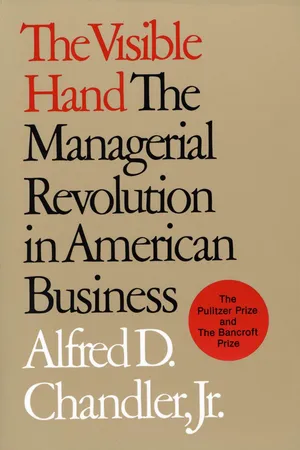
The Visible Hand
The Managerial Revolution in American Business
- 608 pages
- English
- ePUB (mobile friendly)
- Available on iOS & Android
eBook - ePub
The Visible Hand
The Managerial Revolution in American Business
About this book
Information
PART
one
The Traditional Processes of Production and Distribution
Most histories have to begin before the beginning. This is particularly true for one that focuses on institutional innovation. A history of the modern business enterprise has to start by examining the ways in which the processes of production and distribution were carried out before it came into existence, before administrative coordination became more productive and more profitable than market coordination. It has to identify the specific conditions that led to the rise of the institution and its continuing growth. An analysis of innovation requires a close inspection of the context in which it occurred.
Let us therefore first look at the changing processes of production and distribution from the 1790s to the 1840s, from the time when the ratification of the Constitution provided the legal and political underpinnings of a national economy until the decade when a new source of energy, coal, began to be used extensively in production and the railroad and telegraph began to provide fast, regular, all-weather transportation and communication. Let us begin by examining changes in distribution broadly conceived as commerce and then focus on the management of production.
Although the American economy grew rapidly between 1790 and 1840, the size and nature of business enterprises were little changed. As the population rose from 3.9 million to 17.1 million and as Americans began to move west across the continent, the total volume of goods produced and distributed and the total number of transactions involved in such production and distribution increased enormously. Nevertheless the business enterprises carrying out these processes and transactions continued to be traditional single-unit enterprises. Their numbers multiplied at an impressive rate, and their activities became, as Adam Smith would have predicted, increasingly specialized. Yet they were still managed by their owners. They operated in traditional ways using traditional business practices. Little institutional innovation occurred in American business before the 1840s.
Why was this so? As long as the processes of production and distribution depended on the traditional sources of energy—on man, animal, and wind power—there was little pressure to innovate. Such sources of energy simply could not generate a volume of output in production and number of transactions in distribution large enough to require the creation of a large managerial enterprise or to call for the development of new business forms and practices. The low speed of production and the slow movement of goods through the economy meant that the maximum daily activity at each point of production and distribution could be easily handled by small personally owned and managed enterprises.
CHAPTER 1
The Traditional Enterprise in Commerce
Institutional specialization and market coordination
In the half century after the ratification of the Constitution American business enterprise became increasingly specialized in commerce and production. The trend was particularly evident in commerce. As commerce expanded and as commercial activities became more specialized, the dependence on market mechanisms to coordinate these activities increased proportionally. In the 1790s the general merchant, the businessman who had dominated the economy of the colonial period, was still the grand distributor. He bought and sold all types of products and carried out all the basic commercial functions. He was an exporter, wholesaler, importer, retailer, shipowner, banker, and insurer. By the 1840s, however, such tasks were being carried out by different types of specialized enterprises. Banks, insurance companies, and common carriers had appeared. Merchants had begun to specialize in one or two lines of goods: cotton, provisions, wheat, dry goods, hardware, or drugs. They concentrated more and more on a single function: retailing, wholesaling, importing, or exporting.
Economic expansion and business specialization greatly increased the number of business enterprises operating in the economy. In the 1790s a relatively few merchants living in the eastern ports carried on the major share of the trade beyond local markets. By the 1840s the much larger flows of a greater variety of goods were guided from the producers of the raw materials through the processes of production and distribution to the ultimate consumer by hundreds and thousands of businessmen who had little personal acquaintance with others. The motives of the businessmen were to make a profit on each of the many transactions and such motivation seemed to be enough to assure the successful operation of the economy. Although, as Adam Smith wrote, each businessman “intends only his gain, he is … led by an invisible hand to promote an end which is not his intention.”1 In fact, Smith continued, “by pursuing his own interest he frequently promotes that of society more effectively than when he really intends to promote it.”
If the expansion of the economy brought specialization in the activities of business enterprise, it did little to alter the internal operation or organization of these enterprises or their methods of transacting business. In the 1790s American businessmen still relied entirely on commercial practices and procedures invented and perfected centuries earlier by British, Dutch, and Italian merchants. Stuart Bruchey, in his study of the Olivers, Baltimore merchants of the 1790s, points to the “remarkable” similarities between the nature of their activities and those of the Venetian merchants. The Olivers’ “form of organization, and their method of managing men, records and investments would have been almost immediately understood by the fifteenth century merchant of Venice.”2 The Americans of the 1790s and the Italians of the 1390s used the partnership form of business and the same double-entry bookkeeping records, records in which Adventure and Merchandise accounts were conspicuous features. Both sold on their own account and on consignment for standardized commission rates and employed ship captains and supercargoes as consignees. Americans also made use of institutional arrangements perfected by the Dutch and British, such as formal exchanges to carry out market transactions, more sophisticated instruments of credit, and concepts and usages of commercial law.3
The practices that Americans had inherited remained quite satisfactory until after the 1840s. The Americans adjusted commercial law to meet the needs of a rapidly expanding economy and a federal polity. They made increasing use of the incorporated stock company developed in the sixteenth century by the British to promote overseas trade and colonization and used in the eighteenth century to manage ancillary or utilities operations such as docks, water works, and the like. Traditional forms were refined, but the practices, instruments, and institutions of commercial capitalism which had evolved to meet the growth of trade and the coming of market economies in the Mediterranean basin in the twelfth and thirteenth centuries were not fundamentally altered. Before the 1840s there was no revolution in the ways of doing business in the United States. The great transformation was to await the coming of new technologies and markets that permitted a massive production and distribution of goods. Those institutional changes which helped to create the managerial capitalism of the twentieth century were as significant and as revolutionary as those that accompanied the rise of commercial capitalism a half a millennium earlier.
The general merchant of the colonial world
In 1790 general merchants still ruled the economy. In this economy the family remained the basic business unit. The most pervasive of these units was the family farm. In 1790 only 202,000 out of the 3,930,000 Americans lived in towns and villages of more than 2,500, and of the 2,881,000 workers, 2,069,000 labored on farms.4 Only in the south, where crops were cultivated by slave labor, did the production of staples become more than a family affair. In the production of crops, only on the plantation did a class of managers appear.
The small amount of manufacturing carried on outside the home was the work of artisans in small shops. In the towns, the artisan often had the assistance of one or two apprentices or journeymen, who were usually treated as part of the family. In the ports, somewhat larger, though still very small, shipyards, ropewalks, candle manufactories, and rum distilleries operated. As Sam Bass Warner wrote of Philadelphia on the eve of the American Revolution: “The core element of the town economy was the one-man shop. Most Philadelphians labored alone, some with a helper or two.”5
Other resources besides land were exploited, but on a limited scale. Lumbering continued to be a by-product of land clearing, although Maine and North Carolina supplied timber regularly for both the Royal Navy and the West Indian trade. Local farmers provided most of the lumber that went into the making of masts, spars, barrels, staves, as well as beams, shingles, and paneling for houses, churches, warehouses, and other buildings. The output of the only coal mines in the colonies, in Virginia, was hardly 1,000 tons a year.6 Except for some iron, all metals were imported. The largest business unit either in mining or manufacturing was the “iron plantation,” where the iron ore was mined, wood converted into charcoal, iron ore refined into pigs, and the pigs forged into wrought iron. These plantations, with their rural setting, the seasonal nature of their work, and the use of indentured servants and occasionally slaves, were operated in many ways like the rice and tobacco plantations of the southern colonies.
The activities of these producing units were coordinated through the business transactions of the merchants who resided in the port and river towns. The resident merchant distributed and marketed the products of these small enterprises and supplied them with raw materials, tools, and furnishings. For this reason, this all-purpose businessman dominated the economy.7 He exported, imported, and sold all types of products at retail and at wholesale. He took title to the goods he purchased for his regular customers. He also acted as correspondent or agent for merchants in other ports, taking their goods on consignment and selling for a fixed commission.
The resident general merchant acted as the community’s financier and was responsible for the transportation as well as the distribution of goods. He provided short-term loans to finance staple crops and manufactured goods when they were in transit, and he made long-term loans to planters, farmers, and artisans to enable them to clear land or to improve their facilities. Usually in cooperation with other merchants, he arranged for the handling of ships needed to carry these goods and often, with other partners, was a shareholder in these ships. With other merchants, he also insured ships and cargoes. Again with others, he built wharves for the ships. In the same port town, he helped to finance the construction, both by himself and with others, of rum distilleries, candle works, ropewalks, and shipyards—that is, those manufacturing industries not carried on by craftsmen in small family shops.
In all these activities, the colonial merchant knew personally most of the individuals involved. He tried, where possible, to have members of his own family act as his agents in London, the West Indies, and other North American colonies. If he could not consign his goods and arrange for purchase and sale of merchandise through a family member or through a thoroughly reliable associate, the merchant depended on a ship captain or supercargo (his authorized business agent aboard ship) to carry out the distant transactions. Even then, the latter was often a son or a nephew. The merchant knew the other resident merchants in his town, who collaborated with him in insuring and owning ships, as he did the shipbuilders, ropemakers, and local artisans who supplied his personal as well as his business needs. Finally, he was acquainted with the planters, the farmers, and country storekeepers, as well as the fishermen, lumbermen, and others from whom he purchased goods and to whom he provided supplies.
Between Baltimore and Charleston, where there were few ports with resident merchants, a somewhat different pattern of commerce developed.8 In Maryland and Virginia, and to some extent farther south, planters bought directly from the British merchants. Factors in London arranged for the sale of their tobacco and rice and at the same time purchased any supplies they needed. The planters, in turn, often provided their smaller neighbors with the same type of services they received from the British factors. As tobacco planting moved inland in the mid-eighteenth century, Scottish merchants began to send factors and agents to set up permanent stores, where tobacco could be collected and finished goods sold to the upland farmers and planters. Farther south, the resident merchants in the towns of Charleston and Savannah began to handle the trade of their region in much the same way as did northern merchants.
With the coming of political independence, this personal family business world began to change. The break with Britain disrupted old trading patterns and led to the opening of new areas to American merchants, including the Baltic, the Levant, China, India, and the East Indies. The continuing growth of population and the rapid expansion west into Kentucky and Tennessee, north into Maine, and southwest into Georgia enlarged domestic markets, as did the growing seaport towns themselves. After the outbreak of the wars of the French Revolution, trade with Europe and the West Indies, which had been cut off since the Revolution, again boomed. Far more important, however, for the American economy than the after-effects of the political revolution in France was the advancing industrial revolution in Great Britain. For the new United States became almost overnight the major source of supply of the raw material and the major market for the products of the new machine-made textiles. The coming of these new trades was the most important single factor in bringing specialization to business enterprise and impersonalization into business activities.
Specialization in commerce
Even without the boom in cotton and textiles, specialization in commercial business enterprises certainly would have come to the United States in the fifty years after 1790. Before the Revolution specialization was already appearing in the distribution of goods in New York, Philadelphia, and other large towns. The distinction between merchants and shopkeepers was becoming clear. The former continued to sell at retail as well as at wholesale, but the shopkeepers sold only at retail, buying from the merchants rather than directly from abroad.9 By 1790, the merchants were also beginning to specialize in certain lines of trade. Specialization was coming, too, in manufacturing in New England, and possibly parts of the middle states, with the beginning of a domestic or “putting-out” system, and the first use of simple machines.10 Well before the 1790s, shoes, boots, and even furniture were being manufactured for the West Indian and other distant markets by entrepreneurs who “put-out” work into the homes of farmers and town dwellers. Nevertheless, the rapid reorientation and expansion of American commerce and the rapid development of specialized business institutions resulted directly from the new and unprecedented high volume of cotton exports and new machine-made imports.
The impact of cotton on American commerce did not become fully apparent until after 1815, although it had begun to make itself felt in the 1790s. The French Revolution and the Napoleonic Wars kept the older West Indian and European carrying trades booming until 1807. Then, for the next eight years, embargoes, trade restrictions, and wars shut down practically all trade except for a brief period in 1810 and 1811. The wars and wartime commerce overshadowed the rise of the brand new and profoundly significant cotton trade.
As the new cotton textile machinery in Britain went into production, Americans responded quickly.11 Cotton was first grown commercially in the United States in 1786. By 1793, the year Eli Whitney invented the cotton gin, annual exports were already 488,000 pounds. By 1801, they reached 20.9 million pounds, by 1807, 66.2 million, and by 1810 (the year when trade restrictions were temporarily lifted), 83.8 million. In 1815, 83.0 million pounds exported was valued at $17.5 million. By 1825, the value of cotton exports had r...
Table of contents
- Cover
- Title
- Copyright
- Dedication
- Acknowledgments
- Contents
- Introduction: The Visible Hand
- Part I The Traditional Processes of Production and Distribution
- Part II The Revolution in Transportation and Communication
- Part III The Revolution in Distribution and Production
- Part IV The Integration of Mass Production with Mass Distribution
- Part V The Management and Growth of Modern Industrial Enterprise
- Conclusion: The Managerial Revolution in American Business
- Appendixes
- Notes
- Index
Trusted by 375,005 students
Access to over 1.5 million titles for a fair monthly price.
Study more efficiently using our study tools.
Frequently asked questions
Yes, you can cancel anytime from the Subscription tab in your account settings on the Perlego website. Your subscription will stay active until the end of your current billing period. Learn how to cancel your subscription
No, books cannot be downloaded as external files, such as PDFs, for use outside of Perlego. However, you can download books within the Perlego app for offline reading on mobile or tablet. Learn how to download books offline
Perlego offers two plans: Essential and Complete
- Essential is ideal for learners and professionals who enjoy exploring a wide range of subjects. Access the Essential Library with 800,000+ trusted titles and best-sellers across business, personal growth, and the humanities. Includes unlimited reading time and Standard Read Aloud voice.
- Complete: Perfect for advanced learners and researchers needing full, unrestricted access. Unlock 1.5M+ books across hundreds of subjects, including academic and specialized titles. The Complete Plan also includes advanced features like Premium Read Aloud and Research Assistant.
We are an online textbook subscription service, where you can get access to an entire online library for less than the price of a single book per month. With over 1.5 million books across 990+ topics, we’ve got you covered! Learn about our mission
Look out for the read-aloud symbol on your next book to see if you can listen to it. The read-aloud tool reads text aloud for you, highlighting the text as it is being read. You can pause it, speed it up and slow it down. Learn more about Read Aloud
Yes! You can use the Perlego app on both iOS and Android devices to read anytime, anywhere — even offline. Perfect for commutes or when you’re on the go.
Please note we cannot support devices running on iOS 13 and Android 7 or earlier. Learn more about using the app
Please note we cannot support devices running on iOS 13 and Android 7 or earlier. Learn more about using the app
Yes, you can access The Visible Hand by Alfred D. Chandler Jr.,Alfred DuPont Chandler Jr.,Alfred D. Chandler, Jr. in PDF and/or ePUB format, as well as other popular books in Economics & Economic Theory. We have over 1.5 million books available in our catalogue for you to explore.