The forgotten stories of America maroons—wilderness settlers evading discovery after escaping slavery
Over more than two centuries men, women, and children escaped from slavery to make the Southern wilderness their home. They hid in the mountains of Virginia and the low swamps of South Carolina; they stayed in the neighborhood or paddled their way to secluded places; they buried themselves underground or built comfortable settlements. Known as maroons, they lived on their own or set up communities in swamps or other areas where they were not likely to be discovered.
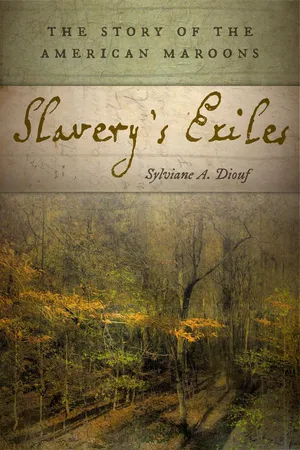
Although well-known, feared, celebrated or demonized at the time, the maroons whose stories are the subject of this book have been forgotten, overlooked by academic research that has focused on the Caribbean and Latin America. Who the American maroons were, what led them to choose this way of life over alternatives, what forms of marronage they created, what their individual and collective lives were like, how they organized themselves to survive, and how their particular story fits into the larger narrative of slave resistance are questions that this book seeks to answer. To survive, the American maroons reinvented themselves, defied slave society, enforced their own definition of freedom and dared create their own alternative to what the country had delineated as being black men and women's proper place. Audacious, self-confident, autonomous, sometimes self-sufficient, always self-governing; their very existence was a repudiation of the basic tenets of slavery.
- 403 pages
- English
- ePUB (mobile friendly)
- Available on iOS & Android
eBook - ePub
About this book
Information
[1]
THE DEVELOPMENT OF MARRONAGE IN THE SOUTH
MAROONS made their entry early in the annals of Southern history. They appeared in all colonies where slavery was introduced and the struggle against them has been particularly well chronicled. Evidence of their activities can be found in treaties with Indian nations, official correspondence, petitions, and in innumerable statutes and Acts. Laws, of course, are not to be taken at face value; they are not an indication of what really transpires in any given society. Some anticipate potential situations while others are a response to actual events. The thousands of slave statutes enacted, revised, annulled, and extended from the early 1600s to the 1860s are only one indicator of a larger reality that was also made up of customs, slaveholders’ private practices, ignorance, lax enforcement and enforcement even after the Acts had been repealed, interpretation, accommodation, municipal regulations, and other idiosyncrasies. While the statutes examined here do not cover the entire spectrum of maroon activities and antimaroon legislation, implicitly and with the above caveats, they and other documents help uncover what marronage was like in the early days and how it grew. From a longer time perspective, the development of antimaroon measures maps the geographic locations of the maroons, the evolving—real, potential, rumored, and fabricated—threat they posed and, concurrently, white anxiety.
THE UPPER SOUTH
There is little doubt that many Africans ran away to the woods as soon as they arrived in the colonies, but perhaps the earliest reference to their escapes in Virginia dates back to 1640. On June 30, the General Court granted a commission to two men to raise a party in what became York County “to go in p[ur]suit of certain runaway negroes and to bring them to the governor.”1 A month later, John Punch, an African indentured servant and two of his European colleagues were brought back from Maryland where they had run off. They were all condemned to receive thirty lashes but whereas the Scot and the Dutchman had to serve four additional years, the court stressed that “the third being a negro,” he had to become a slave for life.2 This ruling is considered the first legal evidence of the gradual establishment of slavery in Virginia where most blacks at the time were still indentured servants. In January 1639, however, a distinction had already been made between all whites—indentured and free—and all blacks, with the following statute: “ALL persons except negroes to be provided with arms and amunition [sic] or be fined at pleasure of the Governor and Council.”3 By 1660 the enslaved status of blacks was firmly in place and a new Act passed in March 1661 to discourage interracial escapes stressed that if an English servant ran away with “negroes,” since time could not be added to servitude, the servant had to work for the black runaway’s owner for as long as the latter was absent.4
As noted in the Introduction, British settlers never referred to maroons in the American mainland as maroons, but instead as runaways or outliers, and in the statutes the difference between both groups has to be inferred from the context. One case in point is the September 1672 Act entitled “An Act for the Apprehension and Suppression of Runawayes, Negroes, and Slaves.” It made reference to “many negroes [who] have lately beene, and now are out in rebellion in sundry parts of this country.”5 They had not been found and it was feared that “other negroes, Indians or servants” might decide to join them, which might result in “many mischeifes” and have “very dangerous consequences.” These feared “runaways” could not be short-term truants, nor could they be escapees hidden in towns. They had to be groups of people who settled independently and could attract a following of exploited people and provide them with a refuge. Through raids for food and ammunition and direct harassment, they could represent a threat to the development of the colony. To guard against that potential peril it was enacted that any “such negroe, molatto, Indian slave, or servant for life” who would join the “many negroes” could be wounded or killed on the spot if he resisted.
If some “runaways” had settled on their own, others had found their way to the Indian nations; therefore the Act also required Native Americans to apprehend those who would come to them and to bring them to a justice of the peace. For their services they were to receive “twenty armes length of Roanoake or the value thereof in goods.” This cooptation of Native Americans was one of the cornerstones of the early struggle against maroons.
On June 8, 1680 the colony added “An act for preventing Negroes Insurrections” to its corpus of laws.6 While the first part addressed the rebellious behavior of slaves, the second dealt directly with “any negroe or other slave [who] shall absent himselfe from his masters service and lye hid and lurking in obscure places, committing injuries to the inhabitants.” In a reaffirmation of the 1672 law, they could lawfully be killed if they resisted arrest. The phraseology “obscure places,” to which is often added “swamps and woods,” came up again and again in legal documents throughout the South, including in the nineteenth century.7 It was meant to cover—and at the same time define—the maroon landscape: the obscure places close to farms and plantations, and the hinterland of marshland and forests.
The earliest Act to deal nominally with maroons, “An act for suppressing outlying Slaves,” appeared on the books on April 16, 1691.8 Justices of the peace were asked to issue warrants against them and sheriffs to raise adequate forces to capture them. The Act gave one detail about their activities: they “hid and lurk[ed] in obscure places killing hoggs and committing other injuries.” Killing hogs, as well as cows, sheep, and poultry, was a typical maroon occupation for survival which continued to be a major point of contention until the end of marronage.
A few months after the Act was passed, two maroons went on trial. Mingo (also spelled Mingoe) “a Mullatto Slave,” Lawrence, and the English servant Richard Wilkins were “a considerable time run away & laid out.”9 Mingo and Lawrence had escaped from Rosegill, the large estate of Ralph Wormeley, who held in servitude close to 20 percent of the county’s black men, women, and children.10 The three men caused “great disturbance and Terror.” Like a number of maroons, they were on the move and were disturbing “the good Subjects” of Virginia close and far: between the one hundred and fifty miles that separated Middlesex and Rappahannock, where they were active, lay four counties.
Lawrence was accused of kicking open the door of James Douglas’s room at Wormeley’s Hog House and grabbing two shirts, a pair of breeches, and a gun still in his possession when he was arrested. In Rappahannock, Mingo raided the overseer John Powell’s quarters, taking two guns, a carbine, and other items. Mingo, Lawrence, and Wilkins, well-armed, killed hogs and other livestock that belonged to a variety of people in Rappahannock County. But on or just before October 26, Mingo surrendered to John Powell. The circumstances are not documented, but if he had resisted or fled, he could legitimately have been killed. Thus by giving himself up, Mingo was saving his life. He was brought to the court in Middlesex and confessed to stealing the firearms. Because no offense could be proved to have been committed in that county, he was transported to Rappahannock where he was sentenced to receive thirty lashes and to be whipped in the same manner by one constable after another until he reached his owner’s estate. Lawrence was captured too. Tried on December 7 in Middlesex, he confessed to the theft of Douglas’s gun. No documentation about his fate has surfaced. Severe whippings were the “mildest” punishments maroons received; over the years more brutal rules were enacted.
In August 1701, “Billy” became the first notorious maroon whose personal depredations were denounced in a piece of legislation when Virginia passed “An act for the more effectuall apprehending [of] an outlying negro who hath commited divers robberyes and offences.”11 Billy had already had three owners, and by then he had been living in the woods for several years. He was known to be “lying out and lurking in obscure places suposed within the countys of James City, York, and New-Kent.” He was “devouring and destroying the stocks and crops, robing the houses of and committing and threatening other injuryes to severall of his majestyes good and leige people within this his colony and dominion of Virginia.” Mindful of the potential help he could receive, the Act stressed that anyone who “witingly and wilingly entertaine, assist, harbour, conceale, truck or trade with the said negroe Billy,” would be committing a felony and be punished accordingly. A reflection of the extent of his “depradations” and the increasing severity of antimaroon measures, Billy was condemned to death in absentia. In his actions one can see the characteristics that marked generations of maroons after him. Like some isolated individuals and small groups, Billy was itinerant: he roamed along an arc of fifty miles. As practically all maroons did, he appropriated stock and crops, and traded with and received assistance from enslaved men and women. And like the bandits, he burglarized houses and threatened his victims.
* * *
By the beginning of the eighteenth century there were enough “new Negroes,” that is, recently arrived Africans who ran away and, by default, could only find refuge in the woods, that the Virginia legislature felt compelled to add a statute in October 1705 that addressed their particular circumstances.12 It concerned runaways who did “not speak English, and cannot, or through obstinacy will not declare the name of his or her master or owner.” The offenders were to be kept in the public goal until claimed by their rightful owner or hirer. The article was one of forty-one of “An act concerning Servants and Slaves” passed within a comprehensive law that addressed many other issues.13 It strongly reinforced the arsenal of brutal antimaroon regulations. In article thirty-seven, the Act introduced the concept of outlawry against men and women who hid in the “swamps, woods, and other obscure places,” killed hogs, and committed other injuries. A quorum of two justices of the peace was required to issue a proclamation ordering them to surrender. The statement had to be placed on a Sunday at the door of every church and chapel, immediately following service. If maroons still refused to come out after being thus exhorted through written words posted in the middle of sacred white territory, they could lawfully be killed, their owner being reimbursed their assessed value on public funds. The sentence reserved to the men and women who did not resist arrest had to be severe enough “for the reclaiming any such incorrigible slave, and terrifying others from the like practices.” They could be punished “either by dismembering, or any other way, not touching” their lives, which included the cutting off of toes, ears, and penises (castration remained legal until 1769).
In early March 1710, maronnage came to the forefront once again, this time linked to a conspiracy. It was exposed by Will, who revealed that a dangerous plot had been hatched in James City by “great numbers of the said Negroes and Indian Slaves for making their escape by force from the services of their Masters and for Destroying and cutting off Such of her Majesty’s Subjects as should oppose their Design.”14
Several men were questioned about the conspiracy, which counted Africans, native-born men, and at least one Native American. On March 24, it was determined that Scipio, Jackman, Salvadore (a Native American), Tom, and Shawn were the “principal contrivers.” Their behavior had been recently “very rude and insolent.”15 Peter, also a principal leader, had escaped and was “Lurking in or about the said County or the County’s of James City Prince George or Isle of Wight.”16 In the end, Scipio and Salvadore were condemned to a gruesome death. They were to be hanged, decapitated, and quartered. As a deterrent to potential conspirators, each man’s head and body parts were to be displayed in different counties.17 By the first decade of the eighteenth century, then, increasingly barbaric sentences reflected the colonists’ growing fear. While the informer Will’s identity was held secret, it was discovered and so intense was the resentment that “Several Negro’s Laid Wait for his Life.” He was therefore sent away to the Northern Neck. To encourage others to betray conspiracies, he received his freedom in October 1710 in exchange for 40 pounds to his owner.18
What makes this episode particularly noteworthy is that it was a premeditated mass desertion of armed men intent on settling outside white-controlled territory. It seems to be the first and so far the only recorded case of a large-scale simultaneous movement of people whose objective was to reach some secluded area to form a maroon community. In contrast, throughout American maroon history, with few, limited exceptions, people escaped individually or in small groups before regrouping.
In April 1733, for example, six men ran away from two Middlesex estates, banded together in the swamps, and broke into a store in Gloucester County, stealing goods valued at thirty pounds.19 As a posse pursued them, they successfully defended themselves with firearms and other weapons. The potential peril that armed raiders could represent was taken so seriously that the sheriffs of Gloucester, Middlesex, King and Queen, Richmond, Lancaster and Essex counties were given orders to raise forces to search their respective areas. If they discovered that the band had moved to another location, they had to inform the sheriff of that county to start his own hunt for the “runaways and felons,” who were to be caught dead or alive. The search was to focus most particularly on Dragon Swamp, located in Middlesex County.
Possible dismembering, outlawry, and accrued vigilance did little to prevent or even reduce marronage. On August 10, 1721 Governor Alexander Spotswood informed the Executive Council that “diverse Negro’s as well as his own” who lived on the frontier of Rappahannock County, ran away and were believed to be gone to the Blue Ridge Mountains of western Virginia. He feared that it would be difficult to apprehend them and should their number increase, it would prove detrimental to the frontier settlers and of ill consequence to the peace of the colony as a whole.20 By then the representation of enslaved men and women in the total population had increased to 30 percent.21 As Virginia developed its tobacco production, Africans were brought in in ever-larger numbers: between 1710 and 1720, 7,200 had disembarked from fifty-one ships.22 From a high of 52 percent in 1710, they still represented 45 percent of the enslaved population.23 Newcomers were the most likely to escape and settle into the wilderness, and with more Africans entering the Upper South, colonists were increasingly worried about having to share space with maroon communities, in addition to Native Americans.
Virginians were also well aware that maroon coloni...
Table of contents
- Cover Page
- Title Page
- Copyright Page
- Dedication
- Contents
- Acknowledgments
- Introduction
- 1. The Development of Marronage in the South
- 2. African Maroons
- 3. Borderland Maroons
- 4. Daily Life at the Borderlands
- 5. Hinterland Maroons
- 6. The Maroons of Bas du Fleuve, Louisiana: From the Borderlands to the Hinterland
- 7. The Maroons of Belleisle and Bear Creek
- 8. The Great Dismal Swamp
- 9. The Maroon Bandits
- 10. Maroons, Conspiracies, and Uprisings
- 11. Out of the Wilds
- Conclusion
- Notes
- Select Bibliography
- Index
- About the Author
Trusted by 375,005 students
Access to over 1.5 million titles for a fair monthly price.
Study more efficiently using our study tools.
Frequently asked questions
Yes, you can cancel anytime from the Subscription tab in your account settings on the Perlego website. Your subscription will stay active until the end of your current billing period. Learn how to cancel your subscription
No, books cannot be downloaded as external files, such as PDFs, for use outside of Perlego. However, you can download books within the Perlego app for offline reading on mobile or tablet. Learn how to download books offline
Perlego offers two plans: Essential and Complete
- Essential is ideal for learners and professionals who enjoy exploring a wide range of subjects. Access the Essential Library with 800,000+ trusted titles and best-sellers across business, personal growth, and the humanities. Includes unlimited reading time and Standard Read Aloud voice.
- Complete: Perfect for advanced learners and researchers needing full, unrestricted access. Unlock 1.5M+ books across hundreds of subjects, including academic and specialized titles. The Complete Plan also includes advanced features like Premium Read Aloud and Research Assistant.
We are an online textbook subscription service, where you can get access to an entire online library for less than the price of a single book per month. With over 1.5 million books across 990+ topics, we’ve got you covered! Learn about our mission
Look out for the read-aloud symbol on your next book to see if you can listen to it. The read-aloud tool reads text aloud for you, highlighting the text as it is being read. You can pause it, speed it up and slow it down. Learn more about Read Aloud
Yes! You can use the Perlego app on both iOS and Android devices to read anytime, anywhere — even offline. Perfect for commutes or when you’re on the go.
Please note we cannot support devices running on iOS 13 and Android 7 or earlier. Learn more about using the app
Please note we cannot support devices running on iOS 13 and Android 7 or earlier. Learn more about using the app
Yes, you can access Slavery's Exiles by Sylviane A Diouf,Sylviane A. Diouf in PDF and/or ePUB format, as well as other popular books in History & North American History. We have over 1.5 million books available in our catalogue for you to explore.