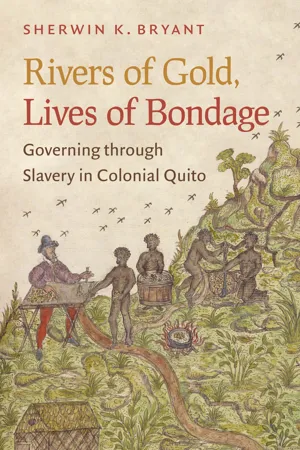
In this pioneering study of slavery in colonial Ecuador and southern Colombia — Spain’s Kingdom of Quito — Sherwin Bryant argues that the most fundamental dimension of slavery was governance and the extension of imperial power. Bryant shows that enslaved black captives were foundational to sixteenth-century royal claims on the Americas and elemental to the process of Spanish colonization. Following enslaved Africans from their arrival at the Caribbean port of Cartagena through their journey to Quito, Bryant explores how they lived during their captivity, formed kinships and communal affinities, and pressed for justice within a slave-based Catholic sovereign community.
In Cartagena, officials branded African captives with the royal insignia and gave them a Catholic baptism, marking slaves as projections of royal authority and majesty. By licensing and governing Quito’s slave trade, the crown claimed sovereignty over slavery, new territories, natural resources, and markets. By adjudicating slavery, royal authorities claimed to govern not only slaves but other colonial subjects as well. Expanding the diaspora paradigm beyond the Atlantic, Bryant’s history of the Afro-Andes in the early modern world suggests new answers to the question, what is a slave?
eBook - ePub
Rivers of Gold, Lives of Bondage
Governing through Slavery in Colonial Quito
- 264 pages
- English
- ePUB (mobile friendly)
- Available on iOS & Android
eBook - ePub
About this book
Information
Chapter One: Slavery and Colonial Development
On December 6, 1534, representatives of the crown of Castile established a cabildo (town council) in the Inka city of Quito. Renaming the site the “very loyal city” of Saint Francis, Spanish conquerors blessed and baptized the city with a Christian name. This ceremonial pause within an era of colonial warfare signaled Spain’s attempt to install colonial sovereignty. It revealed the matrix of race governance characteristic of Spanish colonial practice vis-à-vis those deemed “indios,” “negros,” and “castas” for differentiated status and social life within the order. It was an act of Spanish possession and conquest that inscribed the violence of law over a region that Spaniards were claiming through bloodshed and slaving. Weeks prior, while crossing the Andean mountains, Spaniards had depended heavily upon enslaved conscripts as they invaded the northern Inka outpost of Quito. In the process, Spaniards enslaved many indigenous war captives, making some of the new servile subjects wives and concubines.1 Entering the Quito Valley in December 1534, an army of enslaved blacks and Indians along with Spaniards gave chase to the Inka general Rumiñahui. They encountered and subdued a people already compromised by disease, death, and shifting social and political alliances within the context of warfare between competing successors for the Inka empire, Huscar and Atalluapa (1527–32).2 On that day in December, Spaniards stood triumphant with their army comprised mainly of enslaved subjects and subjugated indigenous vassals.3 There, they installed Castilian colonial claims over new territories and peoples for an expanding, slaving Christian monarchical order, sealing in law what they had enacted through invasion, conquest, and slaving and reducing human beings to servitude.4 Castile’s advancing order was a slaving project, one based on the propagation of war and making slaves of captives.
The Castilian slave-based army’s advance represented one of two methods of claiming new subjects and territories: installing foreign enslaved Africans and reducing indigenous war captives to slavery.5 The other means was the encomienda, a royal grant of indigenous towns to a slaveholding Spanish lord (encomendero). Encomienda was a mode of constituting Native Americans as Indians—subjugated vassals under Euro-Christian authority. Encomienda and slavery were thus dual modes of establishing colonial authority, extracting tribute, and extending Christian discipline within the colony. Labor, in this sense, was as much a method of subjection and establishing colonial sovereignty as it was a system of extracting produce and labor for the colonial order.6 African slavery, enslaving Amerindians, and encomienda were colonial practices of race governance that constituted blacks and Indians as servile colonial subjects and established European, Christian colonial authority.
Any peace Spaniards had envisaged for Quito’s founding on December 6, 1534, was short-lived. Immediately, Spaniards set about dividing indigenous communities and settlements into encomienda grants given to the lords of conquest. In the process, runaway slaves and periodic indigenous rebellions undermined the consolidation of Spanish rule. Early frictions developed between the conquistadors over the spoils of war, erupting into open hostilities and a civil war between the Pizarro and Almagro clans between 1538 and 1554. These tensions between royal control and encomendero/slaveholder authority were brought into sharp relief with the arrival of Peru’s first viceroy, Blasco Núñez Vela (1544–46), in Quito.
Blasco Núñez Vela arrived in May 1544 carrying royal instructions, including the infamous New Laws, which challenged conquistadors’ unrestrained exploitation of reputedly free indigenous vassals. The most controversial aspects of the New Laws of 1542 addressed the encomienda system. Among other things, the New Laws declared an end to Amerindian slavery (except for Amerindians taken in just war); that no Amerindian be sent to labor in the mines without proper cause; the establishment of a fair and honest system of taxation for all Amerindians; that all encomienda grants held by public officials and the clergy revert to the crown; and, most critically, that all encomienda grants revert back to the crown upon the death of the holder. Encomenderos resented such encroachment upon their domain within territories they had claimed.7 The viceroy’s quarrelsome disposition offended the powerful clans of Peru, especially his position on the New Laws. Lima’s powerful rallied increasingly around Gonzalo Pizarro, who, late in the year 1544, raised an army including 1,000 enslaved blacks in Cuzco to march on the viceroy in Lima. Viceroy Núñez Vela fled northward into the province of Quito on January 18, 1546, just two leagues north of Quito city, with a small, slave-based force of 400 soldiers.8 There, he faced a battalion of 700 soldiers, which by some accounts featured as many as 600 enslaved soldiers and 100 Spaniards. The viceroy fought valiantly but was mortally wounded on the battlefield. As the viceroy lay dying, one of Pizarro’s lieutenants ordered a slave to behead him. Severing the head of the viceroy and mangling the beard of the king’s embodied presence, the slave-based army carried the head back to the city of Quito triumphantly and, in the presence of many, hoisted it on a pike. Reports of the event differ concerning who ordered the beheading and who carried the head and largely focus on whether or not the viceroy received a proper burial.9 In at least one report it was a slave who carried the head as he marched behind his master while entering Quito’s central plaza. Here, the slave is front and center in this juridically significant ceremony of repossession. Upon beheading the viceroy, the slave-based army reportedly placed a string through his mouth, carrying the head triumphantly on their march southward to Lima as they announced the death of bad government in the kingdoms.
The silence around this case is deafening. Although the viceroy was clearly battling a cadre of enslaved soldiers, few have taken up this early expression of slavery in the constitution of personalistic power among masters or meditated upon the slave’s centrality to our understanding of early colonial political economy and political theory, or, simply put, colonialism.10 Yet the image of a slave beheading the viceroy and carrying the head triumphantly into the city of Quito after disgracing this representative of Castilian power, signaled the stakes of governance and showcased one of the many reasons why the very basis of colonists’ power in the kingdoms had to be checked and limited. The beheading also laid bare slavery’s constitutive value and role within the colonial power matrix, including the threat slaves posed to colonial development. Indeed, any of the 600 battle-hardened slaves might have chosen to behead the vice king without an order from Pizarro’s lieutenants. According to Andrés de Ariza, a citizen of Panama, the centrality of the slave’s role in executing the viceroy predominated. Ariza’s testimony from the Isthmus of Panama just months after the incident highlights the circulation of news about the event as well as ongoing concerns about warrior slaves. This incident shows that slaves conveyed power and prestige to their owners even as they represented a claim of the king and a threat to colonial order and that a slave served as the central actor in this moment of political transition.11 Just as the viceroy’s severed head captured the audience’s attention, so does the centrality of the slave and his potential as both servant and assassin. At this major moment of upheaval, crisis, and transition, the presence and pivotal role of the enslaved was on full display, revealing slaves as emblems of power and might, pivotal players in political transitions, and people in need of governance.
Although the colonialists struck a decisive blow against the royalist forces at the battle of Añaquito, in which the viceroy’s head was severed, divisions emerged once again among the colonists as slaves continued to fight, resist, and take flight. The crown dispatched Governor Pedro de la Gasca, who raised a slave-based army and ultimately defeated Gonzalo Pizarro at the battle of Jaquijahuana in 1548.12 After the battle, Gasca ordered Pizarro’s execution along with some of his slaves and compatriots. Other enslaved subjects belonging to Pizarro and some of his comrades were confiscated, auctioned for the royal coffers, and passed along as prizes to the crown’s most prominent supporters. In 1550, for example, seven of the most prominent royalists received 1,700 duty-free slave licenses as compensation for their expenses in supporting the Spanish crown during the time of war. 13 The case also reveals slavery’s currency as a royal favor granted to trusted vassals such as Gasca.14 Such grants aimed to honor those who helped to consolidate power among the encomendero/slaveholding elites. They reveal slavery as one of a set of privileges or fueros, inducements, and royal grants.15 Slaves continued to form the base of colonial power, underscoring the tensions that slavery contained for local masters, monarchs, and colonial officials.16 Governing through the very subjects over whom royal vassals claimed dominion was tantamount to the insertion and maintenance of colonial sovereignty within this slave-based order. In their final efforts at resistance, colonists only confirmed this reality. It was not, however, until after putting down another slave-based colonist uprising (1553–54), this one led by Francisco Hernández Girón, that the crown established a tentative peace over the region.
Francisco Hernández Girón, the last among a series of beleaguered yet defiant Pizarrists, knew all too well the personalistic power that slave subjects contained. Girón relied extensively on slave conscripts in his last battle against the crown, even as he faced royalist forces comprised of enslaved squadrons.17 In the past, Girón could have counted on other encomenderos to bring their slaves to war against the royal government, but by the mid-1550s, most encomendero families in Peru had sided with the royal effort rather than the Pizarrists.
Offering slave conscripts “vague promises of freedom and the immediate inducement of military trappings,” Girón doubled the size of his enslaved forces, taking slaves from Arequipa, Guamanga (Ayacucho), and Nazca.18 The contingent was trained and commanded by General Juan, a black carpenter credited with “disciplining and dividing the group into companies, with banners and drums, armed with pikes and harquebuses.”19 The crown also made use of enslaved blacks, and as it consolidated power among the colonists, they also brought their slaves to aid in the battle, decisively defeating Girón and his slave-based battalion. Colonial authorities hung Girón, sentencing some of his enslaved comrades to death while gifting others to loyal Spanish vassals. Simultaneously, municipal governments released a series of admonishments and reminders against the arming of enslaved subjects.20
In the midst of crackdowns on arming slaves, runaways, and death sentences against those involved in the colonist uprising, Francisco, one of Girón’s slave lieutenants, made his way to Quito and into the dominion of a Spanish patron. Francisco had fought with Girón at the battle of Purcará north of Lake Titicaca in 1554. On September 8, 1557, amid the festivals honoring the accession of Philip II, the governor of Quito, Gil Ramírez Dávalos, commuted the death sentence of Francisco, an enslaved black who had fought with Girón in the last rebellion during Peru’s civil wars. Father and guardian Fray Francisco de Morales had secured the slave’s pardon on behalf the Convent of San Francisco, insisting that the slave be forgiven the crimes committed by those in the company of Francisco Hernández Girón. With the prior approval of Viceroy Hurtado de Mendoza, Marqués de Cañete, the slave Francisco was to be sold at public auction. The proceeds of his sale were designated for the Colegio of San Andés for mestizos and poor children institutionalized within the convent. The pardon was finalized on July 15, 1558, allowing Francisco to avoid the gallows in exchange for a life of colonial captivity and black subjection. Meanwhile, the Franciscan monastery’s charitable aims would be served by saving the life of this slave warrior.21
The case of Francisco recalls slavery’s fundamental association with warfare, captivity, and redemption; regional economic development; and law and order. Here stood Franscisco, an enslaved war captive who, like the slave who beheaded the viceroy, had waged war against loyal Christian vassals and threatened the public peace. For him, the most heinous aspects of colonial discipline had been reserved. Perhaps more importantly, the case points to the two overlapping legal regimes that governed slavery and those who practiced this form of racial rule. Governing officials, including magistrates, governors, judges, and priests, all participated in slavery and slave trading and all demonstrated their colonial authority in part through overseeing the entrance, circulation, and governance of slaves and slavery throughout the realm. The governor, with the backing of the viceroy, represented the king and the dispensation of royal justice, in this case mercy. Likewise, Fray Francisco de Morales recalls the importance of the clergy in the establishment of colonial sovereignty and ecclesiastical governance and the ways that enslaved people circulated as servile subjects in convents and monasteries in cities and towns from Popayán to Quito, Guayaquil, Lima, and Cuzco. In this sense, slaves like Francisco were elemental to the “moral economies” of cities such as Quito and Cuzco, circulating as capital while laboring in the region’s gold mines, on agropastoral estates, and in obrajes (textile mills) owned by monasteries, convents, and religious orders such as the Franciscans and the Jesuits.22 Finally, it reveals priests as figures of authority who were elemental to colonial law.
Law in this sense was the order itself, enclosing prince, pontiff, citizen, subject, and territory within a system of royal and local decrees, doctrine, and doctrinal codes emerging from medieval Roman codes, customs, practices, and social values. Law was inherently theological, grounded in a dual economy of government that referenced divine and human duties without distinction.23 Counter to formulations of church and state, public and private, religious and secular, or canon and civil law, colonial law encompassed church, territory, city, prince, and the people, thus comprising an order from which an economy was derived and constituted. Law was practically created in specific moments of conflict that prompted justices to discover the law on the one hand and implement it on the other.24 All decisions replicated the divine order of things. As historian Tamar Herzog states, “This order was dictated by god, held by the king (God’s lieutenant on earth), and implemented by the king’s judges.”25 Earthly, priestly intercession was “thy will be done on earth as it is in heaven.” Fray Francisco de Morales served as an earthly advocate and intercessor for the most unworthy of slaves in need of royal mercy. In short, the pardoned slave points again to the central role that even a few slaves could play in colonial practice and daily life.
Structuring Laws and Colonial (Dis)Order
In the midst of warfare and attempts at settlement, local town councils turned their attention to regulating slavery. Much of the legislation concerned both controlling the enslaved and regulating slaveholders’ uses of their chattel. In the year 1538, for example, Quito’s town council turned its attention to governing cimaroons or runaway slaves and their owners. Amid developing war between the conquist...
Table of contents
- Cover Page
- Rivers of Gold, Lives of Bondage
- Copyright Page
- Dedication
- Contents
- Illustrations and Tables
- Acknowledgments
- Introduction: Slavery and Governance
- Chapter One: Slavery and Colonial Development
- Chapter Two: Marking Bodies
- Chapter Three: Baptism, Marriage, and the Formation of Sacred Communities
- Chapter Four: Enslaved Rebels, Fugitives, and Litigants
- Conclusion
- Notes
- Bibliography
- Index
Trusted by 375,005 students
Access to over 1.5 million titles for a fair monthly price.
Study more efficiently using our study tools.
Frequently asked questions
Yes, you can cancel anytime from the Subscription tab in your account settings on the Perlego website. Your subscription will stay active until the end of your current billing period. Learn how to cancel your subscription
No, books cannot be downloaded as external files, such as PDFs, for use outside of Perlego. However, you can download books within the Perlego app for offline reading on mobile or tablet. Learn how to download books offline
Perlego offers two plans: Essential and Complete
- Essential is ideal for learners and professionals who enjoy exploring a wide range of subjects. Access the Essential Library with 800,000+ trusted titles and best-sellers across business, personal growth, and the humanities. Includes unlimited reading time and Standard Read Aloud voice.
- Complete: Perfect for advanced learners and researchers needing full, unrestricted access. Unlock 1.5M+ books across hundreds of subjects, including academic and specialized titles. The Complete Plan also includes advanced features like Premium Read Aloud and Research Assistant.
We are an online textbook subscription service, where you can get access to an entire online library for less than the price of a single book per month. With over 1.5 million books across 990+ topics, we’ve got you covered! Learn about our mission
Look out for the read-aloud symbol on your next book to see if you can listen to it. The read-aloud tool reads text aloud for you, highlighting the text as it is being read. You can pause it, speed it up and slow it down. Learn more about Read Aloud
Yes! You can use the Perlego app on both iOS and Android devices to read anytime, anywhere — even offline. Perfect for commutes or when you’re on the go.
Please note we cannot support devices running on iOS 13 and Android 7 or earlier. Learn more about using the app
Please note we cannot support devices running on iOS 13 and Android 7 or earlier. Learn more about using the app
Yes, you can access Rivers of Gold, Lives of Bondage by Sherwin K. Bryant in PDF and/or ePUB format, as well as other popular books in History & Latin American & Caribbean History. We have over 1.5 million books available in our catalogue for you to explore.