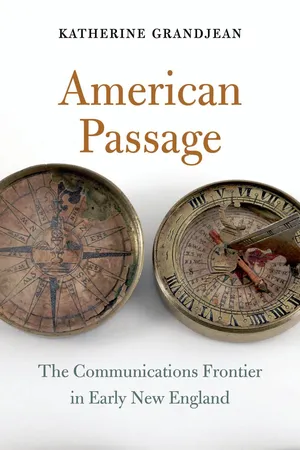
New England was built on letters. Its colonists left behind thousands of them, brittle and browning and crammed with curls of purplish script. How they were delivered, though, remains mysterious. We know surprisingly little about the way news and people traveled in early America. No postal service or newspapers existed—not until 1704 would readers be able to glean news from a "public print." But there was, in early New England, an unseen world of travelers, rumors, movement, and letters. Unearthing that early American communications frontier, American Passage retells the story of English colonization as less orderly and more precarious than the quiet villages of popular imagination.
The English quest to control the northeast entailed a great struggle to control the flow of information. Even when it was meant solely for English eyes, news did not pass solely through English hands. Algonquian messengers carried letters along footpaths, and Dutch ships took them across waterways. Who could travel where, who controlled the routes winding through the woods, who dictated what news might be sent—in Katherine Grandjean's hands, these questions reveal a new dimension of contest and conquest in the northeast. Gaining control of New England was not solely a matter of consuming territory, of transforming woods into farms. It also meant mastering the lines of communication.
- 319 pages
- English
- ePUB (mobile friendly)
- Available on iOS & Android
eBook - ePub
About this book
Information
1
“the Ocean of Troubles and Trials wherein we saile”
Now strike your sailes ye jolly Mariners,For we be come unto a quiet rode,Where we must land some of our passengers,And light this wearie vessell of her lode.Here she a while may make her safe abode,Till she repairéd have her tackles spent,And wants supplide. And then againe abroadOn the long voyage whereto she is bent:Well may she speede and fairely finish her intent.—Edmund Spenser, from The Faerie Queene, Book I, Canto XIIComishoónhom? Goe you by water?—Roger Williams, A Key into the Language of America (1643)
JOHN OLDHAM DIED in his boat. In sticky midsummer 1636, a thick heat hovering over Long Island Sound, the English trader was found dead. His corpse was discovered entangled in the netting of his pinnace, afloat off the northern tip of Block Island. Sailing by, fellow trader John Gallop spied the vessel moving erratically and quickly realized something was amiss. Gallop’s crew first spotted “an old seyne” dangling from the boat and only later “perceived a dead body under it, with the head cut off.” That the body was Oldham’s was not immediately obvious. The hapless trader was “starke naked” and “his head clefte to the braynes.” When the boat was discovered, Indians were still aboard, apparently in the midst of cutting off his hands and feet. After forcing the Native men from the pinnace (tossing some overboard with their hands tied, thereby precluding any swimming), Gallop took up the “bloody head and . . . knew it to be Mr. Oldham’s.” “[A]h Brother Oldham, it is thee,” he said. “I am resolved to avenge thy blood.” He then reverently slipped the body into the sea.1
It was barely sixteen years since the first English settlers had stepped, rather cautiously, onto the beaches of Cape Cod. New England was, in many ways, flourishing. It was welcoming numberless new migrants, the greatest part of them clustered at Massachusetts Bay. The Bay Colony had its origins at the Shawmut Peninsula, soon recast as “Boston,” but by 1636 thousands of recent English arrivals had spilled over into the adjacent countryside. They flew further, too, as crowding and quarrels, mostly theological, forced fractures among them. One of these fractures in the community of saints had sent Roger Williams fleeing southward into exile in Narragansett. Another inspired a migration westward, and inland, to found new settlements on the Connecticut River. There, migrants from Massachusetts Bay staked out a crook of land just below the falls of the Connecticut (what would later become the colony of that same name). Meanwhile, another group of Bay men built a fort at the river’s mouth. All of them jostled for control of this tempting western intervale.
The wider English Atlantic, in the 1630s, was roiling. Tens of thousands of Englishmen were pouring out of England and landing in various beach-side and island colonies. They were, collectively, creating an empire.2 New England, in many respects, was not like those other places. It seemed to grope its way toward stability faster than other parts of the English colonial world, where men competed ruthlessly and starved and died. Migrants to New England were exceptional. Mostly, they were like-minded and religious and committed to community, and they shuffled aboard ships with small children and spouses and some means, whereas migrants who went elsewhere, overwhelmingly, were indentured young men. Compared to those other places, New England looks strong and secure; better fed and more orderly, for instance, than its chaotic stepsibling, the Chesapeake.3 But in some regards, it may not have been so different. Here, too, the struggle toward stability pushed Englishmen to do brutal and desperate things. Despite its gestures toward expansion, the New England of 1636 was still a world of uncertainties. It rested on tenuous footholds and white knuckles. That became clear when John Oldham’s body surfaced in July.
No one knows quite why John Oldham died. He was a seasoned trader, one that must have seemed unlikely to meet his death at the hands of Indians. Had he angered his trading partners by brokering some bad deal? Had he gotten drunk and violated some important custom of exchange?4 What led to the murder will likely never be known. What followed in the wake of his death, though, is far less of a mystery. Somehow, the discovery of John Oldham’s body triggered a series of events that flared into New England’s first Indian war. The Pequot War—named for its eventual losers—lasted roughly from 1636 to 1638. War is, in fact, a lofty word for what occurred over these years. The conflict is better understood as a series of bloody raids and surprise attacks: traders killed, corn burned, captives taken. Eventually the violence escalated toward a wholesale assault on the Pequot people. The war reached its gruesome apex with the burning of Mystic Fort, where, in May 1637, hundreds of Pequots perished in a single morning. This would be the bloodiest episode that the newly-planted New England colonies had yet known.5
How this came about is not easy to tell. Although colonial writers nearly always cited that macabre scene in Long Island Sound—Oldham’s demise—as a chief “ground of the Pequente warr which followed,” that explanation seems, somehow, unsatisfactory.6 The death of a grizzled English trader, in short, hardly seems sufficient explanation for the horrors that followed. But John Oldham’s death came during a precarious moment in the colonies. There was not enough to eat. There was very bad weather. A great hurricane blasted through the colonies in 1635, destroying much of that year’s harvest. Crops and cattle failed. At the same time, waves of new migrants put sudden stresses on New England’s ability to provide for itself. In this perfect storm of calamities, the newer colonies were hit particularly hard. What made their situation so dire was the very fact that they were so far removed from the economic and social hub of Massachusetts Bay. Communications between colonies were fragile and often unreliable. Not only was widespread scarcity gripping New England in 1636; it was also difficult to get goods to the people who most needed them. Here lies the menace that colonists must have perceived in Oldham’s loss. In the mid-1630s, only a precious few coastal traders connected the far-flung colonies of earliest New England. One of them was John Oldham.
Nothing can justify the war’s injustices. No explanation, despite historians’ compulsion to somehow explain the inexplicable, satisfies entirely. But, with the war’s true backdrop in view, it becomes easier to see how a few dead, bloated traders could have taken on a particularly fearful meaning. These people, after all, were the ones who brought supplies, letters, food, and news. Without them, Connecticut and the other outlying colonies had no lifeline back to Massachusetts. They had little hope of survival. With menacing clarity, the Pequot War lay bare the vulnerabilities borne by English expansion and the resulting holes in the English landscape.
I.
It is hardly a secret that many of the earliest English colonies struggled with hunger. Roanoke suffered when Algonquian neighbors refused aid; Bermuda went hungry in the 1610s, after rats dispatched by a Spanish ship devoured the island’s supplies; Barbados and Providence Island were similarly strained in the 1630s. Early Jamestown endured a “starving time” so severe that some of its inhabitants were driven to cannibalism, even unearthing corpses that had been claimed by the colony’s double curse of famine and disease. To some, the inability of England’s first colonists to feed themselves appears almost baffling, inexplicable.7 Part of the problem, clearly, was that many expected to be fed by Indians, who were to provide food in exchange for English trade goods. The English in Virginia, for instance, brought great sheets of copper that they cut into pendants and jewelry and gave to the Powhatans, often in return for corn. But Native people could only afford to feed so many English—Powhatan told John Smith that he thought corn “more pretious” than copper, for “he could eate his corne, but not his copper”—and they did not like to be bullied into it. Moreover, the Powhatans’ repeated protests that they had insufficient corn to spare might have been, simply, true. Recent clues drawn from tree rings and other environmental evidence suggest that the Chesapeake Indians, too, might have been experiencing hard times brought on by record drought and cold.8 In the end, tensions over foodstuffs sparked a great deal of violence between the English and Indians of Virginia, including the massacre of 1622, in which Opechancanough’s men rose up to slay nearly 400 English colonists, in some cases after first sitting down to breakfast with them.
Yet New England’s story was different. Except, perhaps, for the miserable and deadly first winter suffered by the Pilgrims in 1620 (an ill-timed landing that sent William Bradford’s wife, intentionally or not, over the side of the Mayflower), early New England has been viewed as largely exempt from such trauma.9 If some of its first migrants battled scurvy, none, it must be said, were desperate enough to eat “powdered wife.”10 There were, nonetheless, early lessons in hunger’s propensity to beget violence. In the early 1620s a starving outpost of men at Wessagusset, most of them indentured servants sponsored by London merchant Thomas Weston, had resorted to filching corn from the nearby Massachusetts Indians. Predictably, this thievery earned the ire of the “Salvagis,” who “seemed to be good freinds with us while they feared us,” Phinehas Pratt later wrote, “but when they see famin prevall, they begun to insult.” In the depths of winter 1622–1623, a breathless Pratt sprinted to Plymouth to beg for help in defending against the Massachusetts, who were allegedly plotting “to kill all Einglish people.” (Pratt ran the entire thirty miles between Wessagusset and Plymouth, fretting all the way about the “ffoot steps” he had left in the snow.) Plymouth, in turn, sent north an expedition under Captain Miles Standish, who slew several of the Massachusett sachems and returned with Wituwamet’s head.11 Even some Englishmen thought this a rather inauspicious beginning to English relations with nearby Natives. (On hearing of the killings John Robinson, an advisor and former minister to the Plymouth English, famously proclaimed, “oh! how happy a thing had it been, if you had converted some, before you had killed any.”)12
In the mid-1630s the specter of hunger returned to New England with a vengeance. The years immediately preceding the Pequot War were hungry ones for English colonists—and perhaps for Native people, as well. Scarcity rode in on a wave of punishing weather. Late summer 1635 brought a pounding hurricane, “a mighty storme of wind & raine” the likes of which “none living in these parts, either English or Indeans, ever saw.” The great hurricane of 1635, as it became known, smashed boats, overturned homes, and swept away much that had been planted. Calling it “strang & fearfull to behould,” Plymouth’s William Bradford likened the storm to “those Hauricanes and Tuffons that writers make mention of in the Indeas.” He described a dizzying swath of destruction: blown-over houses, missing roofs, trees uprooted by the thousands, and a twenty-foot storm surge. “[S]ignes and marks of it,” Bradford thought, “will remaine this 100. years.” At Narragansett a fourteen-foot flood reportedly drowned eight fleeing Indians as they scrambled to climb trees. Where it did not destroy people and their homes, the tempest certainly threatened crops. “It threw down all the Corn to the ground, which never rose more,” Nathaniel Morton wrote.13 Extreme frost and snow followed in early winter.14
Environmental punishments exacted an especially heavy toll on the fledgling Connecticut settlements, which had been planted barely a month before the hurricane struck. So difficult was the ensuing winter that some in Connecticut, starving, chose to return to Massachusetts. During the winter of 1635, the Rebecka delivered a group of about “70: men & woemen” back to the Bay Colony. But even these poor folks encountered trouble. Seeking relief after some expected provisions had failed to arrive at Connecticut, they had hastily clambered aboard. Unfortunately, the Rebecka promptly ran aground. As its crew struggled to free the boat from sandbars, some of the passengers reportedly succumbed to starvation. Spring, unfortunately, brought little relief. The “greatest parte” of the cattle that had been brought to Connecticut prior to winter, John Winthrop noted in April 1636, had been lost to the season’s punishments (though some were miraculously able to survive, even “without any haye”). Winthrop estimated these losses at “neere 2000li: worth of Cattle.” English families were thus “putt to great streightes for want of provision,” reduced, even, to eating “Acornes.”15
But if the pattern was most acute in Connecticut, it was evident elsewhere, as well. In February 1636 John Winthrop noted the “great scarcitye of Corne” in Massachusetts Bay. That same month, colonists were heartened when the Rebecka sailed into the bay carrying thousands of potatoes, lemons and oranges, “which were a great releife to our people” (although the ship, disappointingly, had already offloaded its corn in the West Indies). Months later, food was still in short supply. In April 1636, Massachusetts allowed its more remote towns to participate by proxy in that year’s court of election, due to the “scarcity of victualls” in the country.16 Meanwhile, in a struggling English fort at the mouth of the Connecticut, Lieutenant Lion Gardiner worried that he was like to be “starved,” for Indian corn grew very expensive and he had little of it. “[S]eeing in peace you are like to be famished,” he asked himself, “what will or can be done if war?”17
Aggravating these shortfalls was the fact that New England was in the midst of an unwieldy expansion. While the woes of New England’s colonists hardly compared to the horrors known elsewhere, they did, nonetheless, experience some rather sharp growing pains. In Virginia, famine resulted largely from the fact that the Chesapeake was for so long a death trap, in which countless numbers died and those left behind were either too weak or too listless to grow any food. New England’s plight was just the opposite: Nearly all of its migrants arrived in a great rush, in only a few short years during the 1630s. And almost none died. In a sense the northern colonies suffered from their own successes.18 What spurred shortages, perhaps as much as the storms that soaked the harvest, was the endless tide of new arrivals from England. The 1630s witnessed a “great migration,” in which roughly 14,000–21,000 new colonists voyaged to New England.19 But the pace of that migration was not evenly spread over the decade; in fact, the year 1634 witnessed a “steep increase” in the number of migrants, a surge that did not abate until decade’s end. Historian Robert Charles Anderson has identified no less than 1,300 individuals and families arriving just in the years 1634–1635, “amounting probably to twenty percent or more of the entire Great Migration.” Roughly 2,000 to 2,500 people reached New English shores in 1634 alone.20
All these additional mouths necessarily ...
Table of contents
- Cover
- Title Page
- Copyright
- Dedication
- Contents
- Epigraph
- Footprints
- 1. The Ocean of Troubles and Trials wherein We Saile
- 2. A Messenger Comes
- 3. Native Tongues
- 4. Post Haste
- 5. An Adder in the Path
- 6. Terror Ubique Tremor
- Milestones
- A Note on Method
- Abbreviations
- Notes
- Acknowledgments
- Index
Trusted by 375,005 students
Access to over 1.5 million titles for a fair monthly price.
Study more efficiently using our study tools.
Frequently asked questions
Yes, you can cancel anytime from the Subscription tab in your account settings on the Perlego website. Your subscription will stay active until the end of your current billing period. Learn how to cancel your subscription
No, books cannot be downloaded as external files, such as PDFs, for use outside of Perlego. However, you can download books within the Perlego app for offline reading on mobile or tablet. Learn how to download books offline
We are an online textbook subscription service, where you can get access to an entire online library for less than the price of a single book per month. With over 1.5 million books across 990+ topics, we’ve got you covered! Learn about our mission
Look out for the read-aloud symbol on your next book to see if you can listen to it. The read-aloud tool reads text aloud for you, highlighting the text as it is being read. You can pause it, speed it up and slow it down. Learn more about Read Aloud
Yes! You can use the Perlego app on both iOS and Android devices to read anytime, anywhere — even offline. Perfect for commutes or when you’re on the go.
Please note we cannot support devices running on iOS 13 and Android 7 or earlier. Learn more about using the app
Please note we cannot support devices running on iOS 13 and Android 7 or earlier. Learn more about using the app
Yes, you can access American Passage by Katherine Grandjean in PDF and/or ePUB format, as well as other popular books in History & Early American History. We have over 1.5 million books available in our catalogue for you to explore.