W. E. B. Du Bois never felt so at home as when he was a student at the University of Berlin. But Du Bois was also American to his core, scarred but not crippled by the racial humiliations of his homeland. In Lines of Descent, Kwame Anthony Appiah traces the twin lineages of Du Bois' American experience and German apprenticeship, showing how they shaped the great African-American scholar's ideas of race and social identity.
At Harvard, Du Bois studied with such luminaries as William James and George Santayana, scholars whose contributions were largely intellectual. But arriving in Berlin in 1892, Du Bois came under the tutelage of academics who were also public men. The economist Adolf Wagner had been an advisor to Otto von Bismarck. Heinrich von Treitschke, the historian, served in the Reichstag, and the economist Gustav von Schmoller was a member of the Prussian state council. These scholars united the rigorous study of history with political activism and represented a model of real-world engagement that would strongly influence Du Bois in the years to come.
With its romantic notions of human brotherhood and self-realization, German culture held a potent allure for Du Bois. Germany, he said, was the first place white people had treated him as an equal. But the prevalence of anti-Semitism allowed Du Bois no illusions that the Kaiserreich was free of racism. His challenge, says Appiah, was to take the best of German intellectual life without its parochialism—to steal the fire without getting burned.
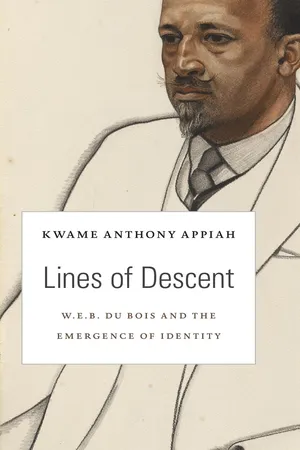
eBook - ePub
Lines of Descent
W. E. B. Du Bois and the Emergence of Identity
- English
- ePUB (mobile friendly)
- Available on iOS & Android
eBook - ePub
Lines of Descent
W. E. B. Du Bois and the Emergence of Identity
About this book
Information
Table of contents
- Cover
- Half Title
- Title Page
- Copyright
- Dedication
- Contents
- Epigraph
- Introduction
- 1. The Awakening
- 2. Culture and Cosmopolitanism
- 3. The Concept of the Negro
- 4. The Mystic Spell
- 5. The One and the Many
- Notes
- Acknowledgments
- Index
Trusted by 375,005 students
Access to over 1.5 million titles for a fair monthly price.
Study more efficiently using our study tools.
Frequently asked questions
Yes, you can cancel anytime from the Subscription tab in your account settings on the Perlego website. Your subscription will stay active until the end of your current billing period. Learn how to cancel your subscription
No, books cannot be downloaded as external files, such as PDFs, for use outside of Perlego. However, you can download books within the Perlego app for offline reading on mobile or tablet. Learn how to download books offline
Perlego offers two plans: Essential and Complete
- Essential is ideal for learners and professionals who enjoy exploring a wide range of subjects. Access the Essential Library with 800,000+ trusted titles and best-sellers across business, personal growth, and the humanities. Includes unlimited reading time and Standard Read Aloud voice.
- Complete: Perfect for advanced learners and researchers needing full, unrestricted access. Unlock 1.5M+ books across hundreds of subjects, including academic and specialized titles. The Complete Plan also includes advanced features like Premium Read Aloud and Research Assistant.
We are an online textbook subscription service, where you can get access to an entire online library for less than the price of a single book per month. With over 1.5 million books across 990+ topics, we’ve got you covered! Learn about our mission
Look out for the read-aloud symbol on your next book to see if you can listen to it. The read-aloud tool reads text aloud for you, highlighting the text as it is being read. You can pause it, speed it up and slow it down. Learn more about Read Aloud
Yes! You can use the Perlego app on both iOS and Android devices to read anytime, anywhere — even offline. Perfect for commutes or when you’re on the go.
Please note we cannot support devices running on iOS 13 and Android 7 or earlier. Learn more about using the app
Please note we cannot support devices running on iOS 13 and Android 7 or earlier. Learn more about using the app
Yes, you can access Lines of Descent by Kwame Anthony Appiah,Kwame Anthony Espinosa in PDF and/or ePUB format, as well as other popular books in Social Sciences & Social Philosophy. We have over 1.5 million books available in our catalogue for you to explore.