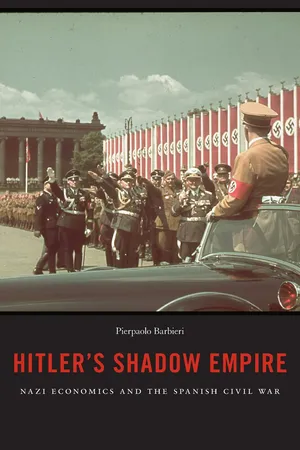
Pitting fascists and communists in a showdown for supremacy, the Spanish Civil War has long been seen as a grim dress rehearsal for World War II. Francisco Franco's Nationalists prevailed with German and Italian military assistance—a clear instance, it seemed, of like-minded regimes joining forces in the fight against global Bolshevism. In Hitler's Shadow Empire Pierpaolo Barbieri revises this standard account of Axis intervention in the Spanish Civil War, arguing that economic ambitions—not ideology—drove Hitler's Iberian intervention. The Nazis hoped to establish an economic empire in Europe, and in Spain they tested the tactics intended for future subject territories.
"The Spanish Civil War is among the 20th-century military conflicts about which the most continues to be published…Hitler's Shadow Empire is one of few recent studies offering fresh information, specifically describing German trade in the Franco-controlled zone. While it is typically assumed that Nazi Germany, like Stalinist Russia, became involved in the Spanish Civil War for ideological reasons, Pierpaolo Barbieri, an economic analyst, shows that the motives of the two main powers were quite different.
—Stephen Schwartz, Weekly Standard
- English
- ePUB (mobile friendly)
- Available on iOS & Android
eBook - ePub
About this book
Information
Publisher
Harvard University PressYear
2015Print ISBN
9780674979734
9780674728851
eBook ISBN
9780674426252
chapter one
TWO SPAINS
Aquí yace media España; | Here lies half Spain; |
murió de la otra mitad. | it died of the other half. |
—MARIANO JOSé DE LARRA, “All Saints’ Day,” Figaro, 1836
More so than London’s British Museum or New York’s Metropolitan, and perhaps comparable only to the relationship that binds the Louvre to Paris, El Prado defines Madrid. No visitor can hope to comprehend the city’s layout without understanding the centrality of its leading museum. Both its neoclassical façade and sleek, modern expansion stand tall, unavoidable, on a street that bears its name (Calle del Prado) and connects one of the city’s central arteries (Calle de Alcalá), where one can find the imposing Bank of Spain and the beautiful curves of Cibeles, with Atocha station, the country’s busiest and its rail connection to the rest of Europe.1 El Prado is at the heart of Madrid. Close to it is the Retiro, the madrileña answer to Hyde Park or Central Park, as well as the Royal Botanical Gardens, whose serene leafy vistas retain that distinctively Gallic aesthetic of Bourbon kings. El Prado’s forty-five thousand square meters cannot rival the Napoleonic grandiosity of the Louvre or the vastness of New York’s Met, yet in the words of Iberian modernist Antonio Saura, it “may not be the most extensive [museum], but it’s the most intense.”2
If El Prado defines Madrid, then Goya defines El Prado. The Diego Velázquez and El Greco collections may be favorites among tourists on busy morning tours, but Francisco de Goya is el Prado’s most carefully curated artist. Its halls exhibit no fewer than 100 of Goya’s works, which may explain why the curatorial staff includes a position dedicated to the master. It is Goya’s oversize, stern-looking effigy that oversees the museum’s main entrance, unsurprisingly named “Goya Gate.”
The master’s most evocative paintings are also his last, collectively called the “black paintings.”3 As touching as they are troubling, these fourteen murals epitomize the transformation of a romantic forced to taste invasion, war, illness, and even ostracism. Excluded from the royal court, deaf, and aged, Goya retreated to a solitary enclave in the outskirts of Madrid; at this so-called Deaf Man’s Villa, he produced paintings so private that they were—as far as we know—not even titled. As if to hide them from his statue’s sight, they now reside in a gallery at the farthest corner from Goya Gate.
Upon entering the room, most visitors are immediately taken by Saturn’s gaze as he devours one of his sons lest his progeny overthrow him. Others may be drawn to the disfigured faithful in A Pilgrimage to San Isidro (1820–1823). Yet Goya’s most astute political message is hidden in the deceptive simplicity of Duel by Clubs (1820–1823), which masterfully captures the promise of violence of a duel frozen in time.4 Against an arid landscape that could be almost anywhere in Spain, one of the duelists is about to die a painful death by clubbing, a curiously Iberian form of dueling devoid of the stiff formality—and relative civility—of Anglo-French rules. The raw physicality of such duels ended with the victor bloody and entangled with his victim, making it difficult to ascertain who ultimately prevailed.
Duel by Clubs is a fitting metaphor for the centuries-long dichotomy that culminated in the Spanish Civil War, a theme also touched upon by contemporaries of the war like Antonio Machado and Miguel de Unamuno.5 The “two Spains” underscore antagonistic answers to an elusive question: Who—and what—was Spain? Was it the absolutist, Catholic, conservative kingdom of the Bourbon kings or the freethinking, secular, Republic of liberals?
When King Philip II commissioned a traditional bronze suit of armor to depict all the territories he ruled, the product looked like the shield of Achilles—a legendary shield, as described by Homer, which Hephaestus crafted to depict the whole world. In the last decade of the sixteenth century, Philip ruled over the greatest seafaring powers (Spain, Portugal, and the Low Countries), Sicily and Naples, an uninterrupted tract of the Americas from the viceroyalty of New Spain bordering present-day Canada all the way down to Patagonia, trading ports throughout India and South Asia, the Spanish East Indies, and select holdings in Guinea and North Africa. He even had a claim on England by marriage. To say the sun never set on Philip’s empire was, strictly speaking, an understatement.6
The empire fit the motto of Philip’s father, Charles, which endures on the Spanish coat of arms: Plus ultra. Their Spain was running out of “further beyonds.” And yet, lacking the communication and bureaucratic apparatus of Queen Victoria’s empire two centuries later, Spain’s was an empire too vast to rule. A system of regional viceroyalties tied to Madrid’s absolutist control failed to deliver effective management. Under Philip’s underwhelming successors, the viceroyalty system became expensive and chaotic. The monarchy went largely unchecked by the Cortes (Parliament) and was backed by a Church keen on empire building.7 The Spanish Empire threw away the metallic wealth of its South American colonies in failed ventures fought with imported weapons and, increasingly, imported men. Not least of those ventures was Philip’s Grand Armada fiasco, an ill-fated, hubristic attempt to conquer Elizabethan England. The Spanish treasury’s chronic bankruptcy weakened Spain’s foreign influence, an early modern version of imperial overstretch.8 Not unlike the decline and fall of other great empires, Spain’s involved a self-reinforcing process linking the overcommitting of military resources with the loss of economic preeminence.
As Spain’s foreign influence declined, foreign involvement in Spanish affairs increased. It was not until Napoleon upset the European balance of power that Spain began in earnest its duel with itself. Bonaparte was the first to challenge Iberian territorial integrity since the so-called Reconquista, the process of Spanish unification under one crown (Ferdinand and Isabella’s) and one faith (Catholicism) in the 1490s. By the time Napoleon’s imperial army crossed the Pyrenees, two centuries of financial mismanagement had taken their toll: the country was another piece in the European puzzle, far from the world’s undisputed hegemon. It was the terror Napoleon’s men brought that Goya immortalized in The Third of May of 1808 (1814), a momentous development in political art.9 In it, a pure Spain rises against the invader’s firing squad, an iconic scene of Catholic martyrdom.
Europe’s internal wars meanwhile emboldened self-government movements throughout the Spanish colonies. Starting in Buenos Aires in 1810, creoles evicted Bourbon viceroys in favor of self-government.10 Along with foreign troops, Enlightenment ideals also crept into the Iberian peninsula—as they did in the colonies. Many of those who died to deliver Bourbon Spain from Bonaparte did not merely want independence from foreign rule; they also sought deep domestic reforms. Indeed, the liberal revolutions are best understood as a single historical process linking the metropolis with the colonies, where independence broadly conceived was the central goal.11
In 1812 the provisional government passed the liberal Constitution of Cádiz promising limits on both Crown and Church. It was an inspired document that challenged the traditionalist Bourbon king, Ferdinand VII. The exiled monarch did little to oppose it lest it inspire his subjects to seek more radical reform than the (mere) establishment of a constitutional monarchy. But when the Battle of Waterloo did away with the Napoleonic threat once and for all, Ferdinand swiftly abolished the Constitution. He lived up to the most famous dictum about his kin: the Bourbons “forgot nothing and learned nothing.”12
Yet Ferdinand failed to restore an ancien régime that was bankrupt both literally and figuratively.13 Not unlike the Latin American independence hero José de San Martín, Iberian officers devoted themselves to the constitutional cause. In the port of Cádiz, Gen. Rafael del Riego staged a liberal mutiny. Meeting no resistance, he marched on Madrid, where a cornered Ferdinand signed on the dotted line. Not for the last time change proved short-lived. While a new government planned long-delayed reforms, Ferdinand appealed to the Holy Alliance, the guarantor of absolutist monarchies in post-Napoleonic Europe. Conservative Russia and Prussia hesitated. Austria’s Prince Metternich, mastermind of the Alliance, pressed France’s Louis XVIII to aid his cousin. To stop the spread of liberalism, French troops crossed the Pyrenees once again, this time armed with an ideology diametrically opposed to Napoleon’s. François-René Chateaubriand, the author-cum-ultraroyalist foreign minister, fondly recalled a historically charged campaign: “Striding across the Spains, succeeding where Bonaparte had failed, triumphing on the same soil where a great man’s arms had suffered setbacks, doing in six months what he was unable to do in seven years, was a true miracle!”14 Financed by two Rothschild loans, the “Hundred Thousand Sons of St. Louis” reestablished absolutist power.15
Ferdinand’s retaliation was vicious. Yet his notoriously unchaste daughter, Isabella, also struggled to maintain Bourbon autocracy. Some argued the queen was not the rightful heir, favoring instead Ferdinand’s brother, Carlos; these royalists became known as “Carlists” and, a century later, would play a key part in the Spanish Civil War. It was during the first of the “Carlist wars” that the salient romantic journalist Mariano José de Larra wrote of a Spain “dying of the other half.” Less than a year later, spurned by his love and depressed about his fatherland, he committed suicide.16 In spite of the Carlist threat and unstable constitutional arrangements, Isabella’s nightmare was the pronunciamiento—the Iberian version of a coup d’état—from an army eager to put limits on the Crown.17 There were other enemies too: the clergy reacted against some of Isabella’s measures, particularly desamortización, the process of selling off Church-owned “dead lands” to finance Spain’s fiscal excesses.18 Reactionary forces did not move fast enough. A naval mutiny began—again—in Cádiz, leading to the “glorious revolution” of 1868. But while the Industrial Revolution gathered momentum in northern Europe, Spain stagnated. When the queen went into exile, Iberian liberals looked for a more reliable dynasty. Prussia’s Iron Chancellor, Otto von Bismarck, saw a strategic opportunity; he proposed a German prince for the throne. It would not be long before the Hohenzollern prince abandoned the bid, yet the row served Bismarck’s purpose of souring relations between Prussia and France’s Napoleon III.19 This “Spanish diversion” therefore helped pave the way for German unification under Prussian—and Bismarckian—leadership. Meanwhile Catalonian general Juan Prim scouted Europe for a monarch willing to swear on a liberal constitution. In the 1870s this was no simple task: “looking for a democratic monarch in Europe,” Prim was quoted saying, “is like trying to find an atheist in heaven.”20
Eventually he settled for Amadeo of Savoy, younger son of Italy’s unifier, Victor Emmanuel II. The arrival of the new king in Madrid coincided with Prim’s assassination. It was a bad omen. Upon Prim’s corpse, outside the Cortes, Amadeo swore to uphold the Constitution. At last Spain had a constitutional monar...
Table of contents
- Cover
- Title Page
- Copyright
- Dedication
- Contents
- Map
- Introduction: Bones Beneath
- 1. Two Spains
- 2. “Today Is So Far from Yesterday”
- 3. The Rise and Rise of Hjalmar Schacht
- 4. “Give Me Four Years”
- 5. Dawn of Intervention
- 6. The Precipice
- 7. The Shadow Empire
- 8. “Hateful to God and to His Enemies”
- 9. The Formal Empire
- Conclusion: Integrated Europe
- Illustrations
- Appendix: Economic Data
- Notes
- Acknowledgments
- Index
Trusted by 375,005 students
Access to over 1.5 million titles for a fair monthly price.
Study more efficiently using our study tools.
Frequently asked questions
Yes, you can cancel anytime from the Subscription tab in your account settings on the Perlego website. Your subscription will stay active until the end of your current billing period. Learn how to cancel your subscription
No, books cannot be downloaded as external files, such as PDFs, for use outside of Perlego. However, you can download books within the Perlego app for offline reading on mobile or tablet. Learn how to download books offline
Perlego offers two plans: Essential and Complete
- Essential is ideal for learners and professionals who enjoy exploring a wide range of subjects. Access the Essential Library with 800,000+ trusted titles and best-sellers across business, personal growth, and the humanities. Includes unlimited reading time and Standard Read Aloud voice.
- Complete: Perfect for advanced learners and researchers needing full, unrestricted access. Unlock 1.5M+ books across hundreds of subjects, including academic and specialized titles. The Complete Plan also includes advanced features like Premium Read Aloud and Research Assistant.
We are an online textbook subscription service, where you can get access to an entire online library for less than the price of a single book per month. With over 1.5 million books across 990+ topics, we’ve got you covered! Learn about our mission
Look out for the read-aloud symbol on your next book to see if you can listen to it. The read-aloud tool reads text aloud for you, highlighting the text as it is being read. You can pause it, speed it up and slow it down. Learn more about Read Aloud
Yes! You can use the Perlego app on both iOS and Android devices to read anytime, anywhere — even offline. Perfect for commutes or when you’re on the go.
Please note we cannot support devices running on iOS 13 and Android 7 or earlier. Learn more about using the app
Please note we cannot support devices running on iOS 13 and Android 7 or earlier. Learn more about using the app
Yes, you can access Hitler’s Shadow Empire by Pierpaolo Barbieri in PDF and/or ePUB format, as well as other popular books in History & Economic History. We have over 1.5 million books available in our catalogue for you to explore.