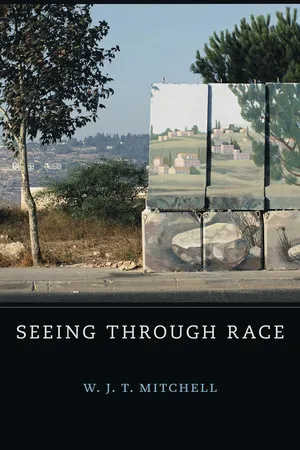
According to W. J. T. Mitchell, a "color-blind" post-racial world is neither achievable nor desirable. Against popular claims that race is an outmoded construct that distracts from more important issues, Mitchell contends that race remains essential to our understanding of social reality. Race is not simply something to be seen but is among the fundamental media through which we experience human otherness. Race also makes racism visible and is thus our best weapon against it.
The power of race becomes most apparent at times when pedagogy fails, the lesson is unclear, and everyone has something to learn. Mitchell identifies three such moments in America's recent racial history. First is the post–Civil Rights moment of theory, in which race and racism have been subject to renewed philosophical inquiry. Second is the moment of blackness, epitomized by the election of Barack Obama and accompanying images of blackness in politics and popular culture. Third is the "Semitic Moment" in Israel-Palestine, where race and racism converge in new forms of anti-Semitism and Islamophobia. Mitchell brings visual culture, iconology, and media studies to bear on his discussion of these critical turning points in our understanding of the relation between race and racism.
- 231 pages
- English
- ePUB (mobile friendly)
- Available on iOS & Android
eBook - ePub
Seeing Through Race
About this book
Information
PART I
TEACHABLE MOMENTS
Seeing Through Race consists of three lectures delivered under the title “Teachable Moments in Race, Media, and Visual Culture” at Harvard University as the W. E. B. Du Bois Lectures, April 20–22, 2010. They are accompanied by a supplementary quartet of essays, here entitled “Teachable Objects,” that were written at approximately the same time and which I hope will serve to deepen the themes explored in the lectures, especially insofar as the question of race engages issues of images, media, and the arts—including the art of teaching—in the struggle against racism.
As its title suggests, “Teachable Moments” was based in Barack Obama’s invocation of this phrase to identify events and episodes that offer themselves up for teaching and learning. Obama used it for the first time in connection with the controversy following the arrest of the W. E. B. Du Bois Professor of African American Studies at Harvard University by a Cambridge police officer in the summer of 2009. But Obama used the phrase explicitly or implicitly on a number of other occasions, usually moments of conflict in which he was “summoned” (as he likes to put it) by events to speak out on matters of broad public concern, especially those concerning race.
My notion in these lectures was to extend the range of Obama’s remarks (which have an interesting place in scenes of elementary education in the United States) to the more general question of race as a global issue in our time—our “moment,” as it were. But what is our moment? Is it the Obama era itself, a time when progressive promises of hope and change were dramatically raised, only to be compromised by political realities? Is it the decade of the post-9/11 era when the world was plunged into the “Global War on Terror” that revived racial and religious conflicts which have deep roots in the relation of “the West” to the rest of the world, particularly the world of Islam and the Arab nations? Is it the longer durée of what is sometimes called the “post-racial” era, when the very idea of race has been called into question? Or is it, more narrowly, the “post-Black” era in the United States, after the period of Jim Crow and the Civil Rights Movement, when the racial divisions of America were supposed to have been healed, de jure if not de facto?
There is, of course, an even deeper question to be answered about the nature of a “moment” in the first place. What is a moment? The word oscillates between a sense of the trivial and ephemeral on the one hand, and a claim to the “momentous” on the other. Ranging between the expansiveness of an epoch, a period, or an era, and the singular, decisive character of an event, the moment is arguably the most elastic term in the lexicons of time and history. The science of physics hints at its usefulness in the concept of “moments of force,” the “tendency of a force to twist or rotate an object,” to apply what engineers call “torque” by bringing a set of vectors to bear on a common target. In this sense, the moment is what might be called a “turning point,” but one that can range from the subtle and unnoticed to the game-changing event, the feeling that a change of momentum has occurred, that something has come to an end and something new has appeared. In recent history, the clearest symptom of the moment of torque has been the frequent invocation of “post-” as prefix, as in the postmodern, the postcolonial, the posthuman, and of course, the post-racial. All of these terms name a sense that history has turned a corner but that the new era still remains to some extent unnameable. And this momentous turn can be (and often is) a shift in perception, the “dawning of an aspect” (as Wittgenstein put it) as much as any external event. That is why the idea of the moment engages so naturally with the practice of teaching, and with a pedagogy that does not necessarily know all the answers beforehand but is compelled to improvise with the contingent and the unforeseen.
I have tried to keep all these concepts of the moment in play in these lectures, but to center them around our moment, the recent past, when the racial characters of Blacks, Arabs, Jews, and Whites converged in a new constellation around the election of Barack Hussein Obama as president of the United States. Obama’s name was immediately associated by his political antagonists not only with generalized racial groups but also with the proper names of Saddam Hussein and Osama bin Laden, the archenemies of the West, of Christian Europe, of the Jewish state of Israel, and (arguably) of “White Folks.” Even more interestingly, Obama’s election seemed to constitute a paradoxical moment, torquing between opposite vectors: on the one hand, it seemed to vindicate the claim that we are in a “post-Black” and possibly even a “post-racial” era; on the other hand, it seemed like a time in which the issue of race—the prospective topic of a long-awaited “honest conversation”—and racism itself was stronger than ever. The outpouring of racist imagery during and after Obama’s election was striking in its vehemence and incoherence: Obama was routinely portrayed as a terrorist, an illegal immigrant, a usurping tyrant comparable to Stalin and Hitler, and a chimpanzee who would turn the south lawn of the White House into a watermelon patch. Obama responded to this by accepting the role of sovereign pedagogue, the master teacher who identifies the “teachable moment”—in this case, events involving race and racism. This role was thrust upon him, and his best speech, the Philadelphia address on race during the 2008 campaign, was the one he did not want to give.1
At the level of theory, I want to torque the concept of race itself as the product of contrary vectors, treating it neither as an objective reality nor as a subjective illusion, regarding it instead as a medium constituted by the encounter of fantasy and reality. Instead of regarding race merely as a content, then, whether real or imaginary, that is mediated by forms of representation, I want to treat race as itself a medium in the most straightforward sense of the word—that is, as an “intervening substance” that both enables and obstructs social relationships. I also want to examine the way that the torquing of race transforms it from a merely abstract notion into what I call an “iconic concept,” the merging of an ideational complex with individual and collective passions, congealed in forms of totemism, fetishism, and idolatry. This may strike some readers as a strange way to think about race, and perhaps also as an unusual way to think about media. Scholars who have tracked the long history of theorizing about race may, by contrast, regard the idea of race-as-medium as strangely familiar, even obvious. I hope that readers will exercise some patience and allow both the strangeness and familiarity of the concept to unfold itself over the pages that follow.
The other major argument that is developed in what follows is an effort to reconceive the relation of race and racism, and to develop a critique of what is sometimes called the “post-racial” moment. Although this book is firmly aligned with antiracist arguments and ethical/political commitments, it is in a certain sense pro-racial or pre-racial in its attempt to recover the usefulness of this concept as what Du Bois himself called “an instrument of progress.” The reader, therefore, will not find the word “race” bracketed in scare quotes throughout, nor will there be much emphasis on declaring for the thousandth time that race is “merely” a social construct, or “simply” an obsolete concept that has outlived its usefulness, or “nothing but” a myth that ought to dissolve under critical scrutiny. Instead, one should anticipate an argument that firmly erases the “merely” and “simply” and “nothing but” in favor of a patient attempt to analyze the way in which race mediates sociopolitical relations, and further, provides a unique and necessary conceptual mediation for a striking range of nature-culture dialectics, including the dividing lines between species, classes, genders, and nations.
Although race and racism will be discussed as universal phenomena, both translocal and transhistorical in some sense, the focus here will be on three specific forms of racism: Negrophobia, Islamophobia, and anti-Semitism. To put it another way, this book concerns three “peoples” that have sometimes been defined as races: Whites, Blacks, and “Semites” (i.e., Jews and Arabs). Hence the three-part structure of the lectures, starting with (1) “The Moment of Theory” (which could also be called the time of “White Mythology” and post-racial theorizing) followed by (2) “The Moment of Blackness” centered on the simultaneous decline and resurgence of Black racialization, and concluding with (3) “The Semitic Moment,” focused on the half-century impasse known as Israel-Palestine. The emphasis in Part 2 will then shift from the moment and questions of historical temporality to objects and the spatial construction of racial difference, comprising four papers on images, media, and the imaginary-real borders of races and nations: (1) “Gilo’s Wall and Christo’s Gates”; (2) “Binational Allegory”; (3) “Migration, Law, and the Image”; (4) “Idolatry: Nietzsche, Blake, Poussin.”
I have not attempted to disguise the oral character of the lectures by renaming them as chapters or erasing the sense of their immediate occasion in the spring of 2010, only a little more than a year after the inauguration of Barack Obama as president of the United States. There is something about that moment that, to my way of thinking, deserves preservation as a time— a moment—that may itself be worthy of reflection, teachable beyond the pedagogical. Shortly after the historic passage of the first successful attempt to provide publicly financed health care for the people of the United States, it stands as a time replete with high hopes and deep disappointments, a “teachable moment” that we will be learning from in the years to come.
It also stands to me personally as a time when I was able to engage with some of the leading scholars of media, visual imagery, and the history and theory of race: Henry Louis Gates Jr., Homi Bhabha, William Julius Wilson, Stanley Cavell, Orlando Patterson, Caroline Jones, Werner Sollors, and many others honored me with their presence and their comments. I have also benefitted from the careful reading of numerous friends and colleagues, including Elizabeth Abel, Larry Abramson, Gil Anidjar, Lauren Berlant, Jonathan Bordo, Darby English, Ellen Esrock, Tanya Fernando, Robert Gooding-Williams, Stephen Korns, Lital Levy, Janice Misurell-Mitchell, Patrick Mullen, Richard Neer, Florence Tager, Alan Thomas, and Rebecca Zorach. Many of the revisions and second thoughts in these papers reflect their wise counsel.
LECTURE 1
THE MOMENT OF THEORY
RACE AS MYTH AND MEDIUM
My hope is that as a consequence of this event, this winds up being what’s called a “teachable moment.”
—Barack Obama, statement to the press, July 23, 2009, regarding the arrest of Henry Louis Gates Jr. by the Cambridge police
The truth is that there are no races: there is nothing in the world that can do all we ask “race” to do for us.
—Anthony Appiah, “The Uncompleted Argument: Du Bois and the Illusion of Race”
What is metaphysics? A white mythology which assembles and reflects Western culture: the white man takes his own mythology (that is, Indo-European mythology), his logos—that is, the mythos of his idiom, for the universal form of that which it is still his inescapable desire to call Reason.
—Jacques Derrida, “White Mythology: Metaphor in the Text of Philosophy”
My mother bore me in the southern wild
And I am black, but O my soul is white.
White as an angel is the English child
But I am black as if bereaved of light.
—William Blake, “The Little Black Boy”
It is a great honor to be invited to give the 2010 Du Bois Lectures, and one which I am quite certain I do not deserve. As Barack Obama observed on being awarded the Nobel Prize in the first year of his presidency, the honor is being conferred more as an act of hope than a recognition of achievement, and I hope that these lectures will come at least part way in fulfilling those hopes. I hardly need to belabor the fact that I am not an expert on race, either as a historical or theoretical issue, and my credentials as a scholar of African American culture are quite minimal: my contributions in this latter area consist of a couple of essays on the films of Spike Lee, and one minor intervention on the question of memory and slave narrative.1 Beyond that, my credentials as a scholar of race mainly rest on some investigations of space, place, and landscape that have focused on the deeply conflicted terrain of Israel-Palestine, a site where the issues of race are considerably complicated by a long history of religious conflict and colonialism.
Among my hopes in preparing these lectures was the thought that by taking up the vast topic of race and racism from a relatively distant, even innocent, perspective, I might be able to produce some insights that would be less than obvious to people who have been deeply immersed in these questions throughout their careers. The very disparateness of my previous work in this area might also, I thought, make it possible to say something about the very different texture of the problem of race in America, on the one hand, and the enduring global conflict between the West and the Arab world, focused in the racial and religious maelstrom known as Israel-Palestine, on the other hand. No doubt this is far too ambitious an agenda, but it is one that I hope can be useful even in its failure to achieve total comprehensiveness. At the very least, its comparative and international scope may help us to define more sharply the nature of race in relation to other forms of discrimination, and to grasp the interconnectedness of various forms of racism. I want to take seriously Franz Fanon’s insistence that there is a deep structural and affective link between various forms of racism. Although “it might seem strange,” remarks Fanon, “that the attitude of the anti-semite can be equated with that of the negrophobe,” he has never forgotten the lesson of his Antillean philosophy teacher who admonished him one day: “When you hear someone talk about the Jews, pay attention: he is talking about you.”2 I want to extend this lesson to Blacks and Jews and even to my own trace of Irish ethnicity: when they talk about Arabs and Muslims, they are talking about us.
My pathway into this complex subject is not, however, a direct one, and it is hard for me to imagine that anyone on Earth would be capable, on their own, of grasping it in its entirety. One way to limit the subject is to focus on specific historical moments in which the problem of race is dramatized with especial clarity, when racism, instead of concealing itself as it normally does, “rears its head” in a way that provides what Obama calls a “teachable moment,” an event that provides an opportunity for sober reflection and not just passionate reaction.3 At the same time, however, I want to raise some critical questions about the very idea of the “teachable moment.” This is partly a question of the relation of particulars—events, cases, examples—to the generalized “lessons” that may be drawn from them. It is also a question about pedagogy and authority: Who is the teacher and who are the learners in the teachable moment? Because I have already declared the severe limits of my own teacherly authority on this subject, I will not presume to tell you very much that you do not already know about the subjects of race and racism. My aim will be more experimental and tentative, namely, to set out a few suggestions for reframing these subjects in a perspective that I do know something about: the fields of media aesthetics, visual culture, and iconology, the theory of images across the media and the arts.
I also want to call into question the paradigm of the teachable moment as such, insofar as it takes for granted that the aim is only to replace “passionate reaction” with “sober reflection.” The teachable moment, as I am told by my students who teach in elementary schools, is ordinarily understood as a rather paternalistic and parental event, an occasion for inculcating elementary lessons in civilized behavior—taking turns, asking permission, and respecting others. All these are important lessons to be sure, but I want to suggest that there is a more critical and interesting version of the teachable moment, when pedagogy fails and the lesson is unclear, when everyone has something to learn. In this version of the teachable moment, the teacher and her normative assumptions and lesson plans are thrown into confusion and doubt, and some form of “newness” (to echo Homi Bhabha) has a chance to “enter the world.”4
I have written these lectures in the conviction that we are in the midst of a historically significant “teachable moment” in our understanding of race, racism, and racialization. This is a moment that is global as well as local, one that therefore produces new constellations of traditional racial identities such as (to name the peoples that will be central to...
Table of contents
- Cover
- Title Page
- Contents
- List of Illustrations
- Preface
- Part I Teachable Moments
- Part II Teachable Objects
- Conclusion: Money and Masquerade
- Notes
- Acknowledgments
- Index
- Copyright
Trusted by 375,005 students
Access to over 1.5 million titles for a fair monthly price.
Study more efficiently using our study tools.
Frequently asked questions
Yes, you can cancel anytime from the Subscription tab in your account settings on the Perlego website. Your subscription will stay active until the end of your current billing period. Learn how to cancel your subscription
No, books cannot be downloaded as external files, such as PDFs, for use outside of Perlego. However, you can download books within the Perlego app for offline reading on mobile or tablet. Learn how to download books offline
Perlego offers two plans: Essential and Complete
- Essential is ideal for learners and professionals who enjoy exploring a wide range of subjects. Access the Essential Library with 800,000+ trusted titles and best-sellers across business, personal growth, and the humanities. Includes unlimited reading time and Standard Read Aloud voice.
- Complete: Perfect for advanced learners and researchers needing full, unrestricted access. Unlock 1.5M+ books across hundreds of subjects, including academic and specialized titles. The Complete Plan also includes advanced features like Premium Read Aloud and Research Assistant.
We are an online textbook subscription service, where you can get access to an entire online library for less than the price of a single book per month. With over 1.5 million books across 990+ topics, we’ve got you covered! Learn about our mission
Look out for the read-aloud symbol on your next book to see if you can listen to it. The read-aloud tool reads text aloud for you, highlighting the text as it is being read. You can pause it, speed it up and slow it down. Learn more about Read Aloud
Yes! You can use the Perlego app on both iOS and Android devices to read anytime, anywhere — even offline. Perfect for commutes or when you’re on the go.
Please note we cannot support devices running on iOS 13 and Android 7 or earlier. Learn more about using the app
Please note we cannot support devices running on iOS 13 and Android 7 or earlier. Learn more about using the app
Yes, you can access Seeing Through Race by W. J. T. Mitchell,W. J. T. Mitchell in PDF and/or ePUB format, as well as other popular books in Social Sciences & Art Theory & Criticism. We have over 1.5 million books available in our catalogue for you to explore.