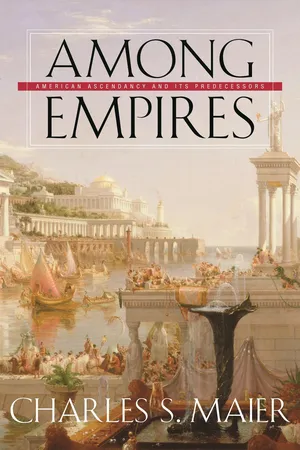
Contemporary America, with its unparalleled armaments and ambition, seems to many commentators a new empire. Others angrily reject the designation. What stakes would being an empire have for our identity at home and our role abroad?
A preeminent American historian addresses these issues in light of the history of empires since antiquity. This elegantly written book examines the structure and impact of these mega-states and asks whether the United States shares their traits and behavior. Eschewing the standard focus on current U.S. foreign policy and the recent spate of pro- and anti-empire polemics, Charles S. Maier uses comparative history to test the relevance of a concept often invoked but not always understood. Marshaling a remarkable array of evidence—from Roman, Ottoman, Moghul, Spanish, Russian, Chinese, and British experience—Maier outlines the essentials of empire throughout history. He then explores the exercise of U.S. power in the nineteenth and twentieth centuries, carefully analyzing its economic and strategic sources and the nation's relationship to predecessors and rivals.
To inquire about empire is to ask what the United States has become as a result of its wealth, inventiveness, and ambitions. It is to confront lofty national aspirations with the realities of the violence that often attends imperial politics and thus to question both the costs and the opportunities of the current U.S. global ascendancy. With learning, dispassion, and clarity, Among Empires offers bold comparisons and an original account of American power. It confirms that the issue of empire must be a concern of every citizen.
- 384 pages
- English
- PDF
- Available on iOS & Android
eBook - PDF
About this book
Information
Publisher
Harvard University PressYear
2009Print ISBN
9780674025561
9780674021891
eBook ISBN
9780674040458
Table of contents
- Contents
- Prologue: Questions at the Outset
- Part one: Recurring Structures
- Part two: America’s Turn
- Afterword: The Vase of Uruk
- Tables
- Notes
- Acknowledgments
- Index
Trusted by 375,005 students
Access to over 1.5 million titles for a fair monthly price.
Study more efficiently using our study tools.
Frequently asked questions
Yes, you can cancel anytime from the Subscription tab in your account settings on the Perlego website. Your subscription will stay active until the end of your current billing period. Learn how to cancel your subscription
No, books cannot be downloaded as external files, such as PDFs, for use outside of Perlego. However, you can download books within the Perlego app for offline reading on mobile or tablet. Learn how to download books offline
Perlego offers two plans: Essential and Complete
- Essential is ideal for learners and professionals who enjoy exploring a wide range of subjects. Access the Essential Library with 800,000+ trusted titles and best-sellers across business, personal growth, and the humanities. Includes unlimited reading time and Standard Read Aloud voice.
- Complete: Perfect for advanced learners and researchers needing full, unrestricted access. Unlock 1.5M+ books across hundreds of subjects, including academic and specialized titles. The Complete Plan also includes advanced features like Premium Read Aloud and Research Assistant.
We are an online textbook subscription service, where you can get access to an entire online library for less than the price of a single book per month. With over 1.5 million books across 990+ topics, we’ve got you covered! Learn about our mission
Look out for the read-aloud symbol on your next book to see if you can listen to it. The read-aloud tool reads text aloud for you, highlighting the text as it is being read. You can pause it, speed it up and slow it down. Learn more about Read Aloud
Yes! You can use the Perlego app on both iOS and Android devices to read anytime, anywhere — even offline. Perfect for commutes or when you’re on the go.
Please note we cannot support devices running on iOS 13 and Android 7 or earlier. Learn more about using the app
Please note we cannot support devices running on iOS 13 and Android 7 or earlier. Learn more about using the app
Yes, you can access Among Empires by Charles S. Maier,Charles S MAIER in PDF and/or ePUB format, as well as other popular books in History & European History. We have over 1.5 million books available in our catalogue for you to explore.