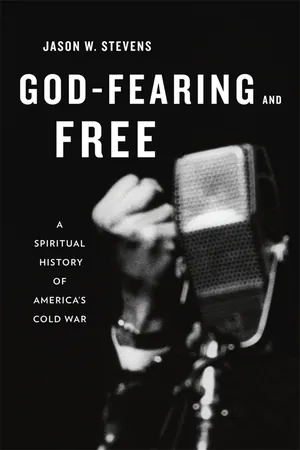
Religion has been on the rise in America for decades—which strikes many as a shocking new development. To the contrary, Jason Stevens asserts, the rumors of the death of God were premature. Americans have always conducted their cultural life through religious symbols, never more so than during the Cold War. In God-Fearing and Free, Stevens discloses how the nation, on top of the world and torn between grandiose self-congratulation and doubt about the future, opened the way for a new master narrative. The book shows how the American public, powered by a national religious revival, was purposefully disillusioned regarding the country's mythical innocence and fortified for an epochal struggle with totalitarianism.
Stevens reveals how the Augustinian doctrine of original sin was refurbished and then mobilized in a variety of cultural discourses that aimed to shore up democratic society against threats preying on the nation's internal weaknesses. Suddenly, innocence no longer meant a clear conscience. Instead it became synonymous with totalitarian ideologies of the fascist right or the communist left, whose notions of perfectability were dangerously close to millenarian ideals at the heart of American Protestant tradition. As America became riddled with self-doubt, ruminations on the meaning of power and the future of the globe during the "American Century" renewed the impetus to religion.
Covering a wide selection of narrative and cultural forms, Stevens shows how writers, artists, and intellectuals, the devout as well as the nonreligious, disseminated the terms of this cultural dialogue, disputing, refining, and challenging it—effectively making the conservative case against modernity as liberals floundered.
- 449 pages
- English
- PDF
- Available on iOS & Android
eBook - PDF
About this book
Information
Table of contents
- Contents
- Prologue
- Introduction: Going beyond Modernism from World War I to the Cold War
- Part One: How a Theologian Served the Opinion Elite, and How an Evangelist Startled Them
- Part Two: Narratives of Blindness and Insight in an Era of Confession
- Part Three: Cold War Cultural Politics and the Varieties of Religious Experience
- Part Four: Versions of Inwardness in Cold War Psychology and the Neo-Gothic
- Part Five: The Styles of Prophecy
- Epilogue: Putting an End to Ending Our Innocence
- Notes
- Acknowledgments
- Index
Trusted by 375,005 students
Access to over 1.5 million titles for a fair monthly price.
Study more efficiently using our study tools.
Frequently asked questions
Yes, you can cancel anytime from the Subscription tab in your account settings on the Perlego website. Your subscription will stay active until the end of your current billing period. Learn how to cancel your subscription
No, books cannot be downloaded as external files, such as PDFs, for use outside of Perlego. However, you can download books within the Perlego app for offline reading on mobile or tablet. Learn how to download books offline
Perlego offers two plans: Essential and Complete
- Essential is ideal for learners and professionals who enjoy exploring a wide range of subjects. Access the Essential Library with 800,000+ trusted titles and best-sellers across business, personal growth, and the humanities. Includes unlimited reading time and Standard Read Aloud voice.
- Complete: Perfect for advanced learners and researchers needing full, unrestricted access. Unlock 1.5M+ books across hundreds of subjects, including academic and specialized titles. The Complete Plan also includes advanced features like Premium Read Aloud and Research Assistant.
We are an online textbook subscription service, where you can get access to an entire online library for less than the price of a single book per month. With over 1.5 million books across 990+ topics, we’ve got you covered! Learn about our mission
Look out for the read-aloud symbol on your next book to see if you can listen to it. The read-aloud tool reads text aloud for you, highlighting the text as it is being read. You can pause it, speed it up and slow it down. Learn more about Read Aloud
Yes! You can use the Perlego app on both iOS and Android devices to read anytime, anywhere — even offline. Perfect for commutes or when you’re on the go.
Please note we cannot support devices running on iOS 13 and Android 7 or earlier. Learn more about using the app
Please note we cannot support devices running on iOS 13 and Android 7 or earlier. Learn more about using the app
Yes, you can access God-Fearing and Free by Jason W. Stevens in PDF and/or ePUB format, as well as other popular books in History & North American History. We have over 1.5 million books available in our catalogue for you to explore.