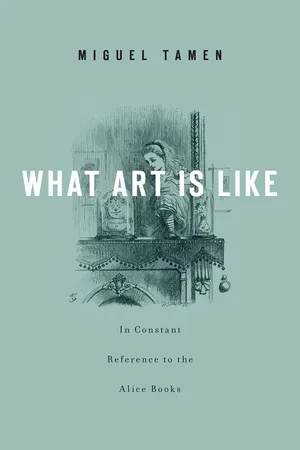
What Art Is Like is a comic, serious inquiry into the nature of art. It provides welcome relief from prevailing modes of explaining art that involve definitions, philosophical claims, and critical judgments put forth by third parties. Scrapping all such chatter, Miguel Tamen's aphoristic lark with aesthetic questions proceeds by taking its technical vocabulary only from Lewis Carroll's Alice's Adventures in Wonderland and Through the Looking-Glass.
According to Tamen, it would be ridiculous to think of poems or paintings or films or any variety of artistic production as distinct from other things in the world, including people. Talking about art should be contiguous with talking about many other relevant and important matters. Tamen offers a series of analogies and similes to help us imagine these connected experiences. One, taken from the analytical table of contents where the book is writ small, suggests that "understanding a poem is like understanding a cat; neither ever says anything back and you can't keep a conversation with them. All art is like this, but not only art is like this; nature, the past, numbers are also like this."
Tamen takes up many central issues in aesthetics and the philosophy of art, including the connection between art and having fuzzy ideas about art, the mistake of imagining that art-decisions are put forth by art-courts where you are both judge and jury, and the notion that what happens with art also happens to you.
- English
- ePUB (mobile friendly)
- Available on iOS & Android
eBook - ePub
What Art Is Like, In Constant Reference to the Alice Books
About this book
Information
Topic
PhilosophySubtopic
Art Theory & CriticismTable of contents
- Cover
- Half Title
- Title Page
- Copyright
- Dedication
- Contents
- Epigraph
- Introduction: What to Expect
- 1. Ideas (§§1–55)
- 2. Furniture (§§56–103)
- 3. A Mistake (§§104–150)
- 4. What Happens (§§151–199)
- Analytical Table of Contents
- Index of Citations
- Acknowledgments
- Index
Trusted by 375,005 students
Access to over 1.5 million titles for a fair monthly price.
Study more efficiently using our study tools.
Frequently asked questions
Yes, you can cancel anytime from the Subscription tab in your account settings on the Perlego website. Your subscription will stay active until the end of your current billing period. Learn how to cancel your subscription
No, books cannot be downloaded as external files, such as PDFs, for use outside of Perlego. However, you can download books within the Perlego app for offline reading on mobile or tablet. Learn how to download books offline
Perlego offers two plans: Essential and Complete
- Essential is ideal for learners and professionals who enjoy exploring a wide range of subjects. Access the Essential Library with 800,000+ trusted titles and best-sellers across business, personal growth, and the humanities. Includes unlimited reading time and Standard Read Aloud voice.
- Complete: Perfect for advanced learners and researchers needing full, unrestricted access. Unlock 1.5M+ books across hundreds of subjects, including academic and specialized titles. The Complete Plan also includes advanced features like Premium Read Aloud and Research Assistant.
We are an online textbook subscription service, where you can get access to an entire online library for less than the price of a single book per month. With over 1.5 million books across 990+ topics, we’ve got you covered! Learn about our mission
Look out for the read-aloud symbol on your next book to see if you can listen to it. The read-aloud tool reads text aloud for you, highlighting the text as it is being read. You can pause it, speed it up and slow it down. Learn more about Read Aloud
Yes! You can use the Perlego app on both iOS and Android devices to read anytime, anywhere — even offline. Perfect for commutes or when you’re on the go.
Please note we cannot support devices running on iOS 13 and Android 7 or earlier. Learn more about using the app
Please note we cannot support devices running on iOS 13 and Android 7 or earlier. Learn more about using the app
Yes, you can access What Art Is Like, In Constant Reference to the Alice Books by Miguel Tamen in PDF and/or ePUB format, as well as other popular books in Philosophy & Art Theory & Criticism. We have over 1.5 million books available in our catalogue for you to explore.