For 250 years, the Turkic Muslims of Altishahr—the vast desert region to the northwest of Tibet—have led an uneasy existence under Chinese rule. Today they call themselves Uyghurs, and they have cultivated a sense of history and identity that challenges Beijing's official national narrative. Rian Thum argues that the roots of this history run deeper than recent conflicts, to a time when manuscripts and pilgrimage dominated understandings of the past. Beyond broadening our knowledge of tensions between the Uyghurs and the Chinese government, this meditation on the very concept of history probes the limits of human interaction with the past.
Uyghur historical practice emerged from the circulation of books and people during the Qing Dynasty, when crowds of pilgrims listened to history readings at the tombs of Islamic saints. Over time, amid long journeys and moving rituals, at oasis markets and desert shrines, ordinary readers adapted community-authored manuscripts to their own needs. In the process they created a window into a forgotten Islam, shaped by the veneration of local saints.
Partly insulated from the rest of the Islamic world, the Uyghurs constructed a local history that is at once unique and assimilates elements of Semitic, Iranic, Turkic, and Indic traditions—the cultural imports of Silk Road travelers. Through both ethnographic and historical analysis, The Sacred Routes of Uyghur History offers a new understanding of Uyghur historical practices, detailing the remarkable means by which this people reckons with its past and confronts its nationalist aspirations in the present day.
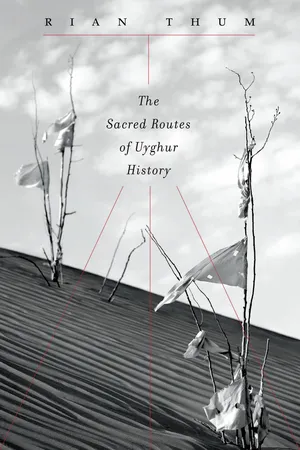
- 328 pages
- English
- ePUB (mobile friendly)
- Available on iOS & Android
eBook - ePub
The Sacred Routes of Uyghur History
About this book
Information
1
THE HISTORICAL CANON
The past is an unimaginably vast resource, and no culture can colonize its expansive landscape completely. But in most societies certain parts of the past, shaped as history, become an “our history,” the mediated past that matters to a certain group of people, at a certain time. The most eloquent and durable artifacts of such manipulations of the past are written texts. Although the pilgrimages, rituals, recitations, conversations, and oral traditions that comprised the larger part of historical practice in the Altishahr of a century ago are lost to us in their original evanescent forms—voice, gesture, travel—the written texts that were both byproducts of and tools for these practices have survived in great numbers, presenting us with a remarkably rich picture of the content of history as it was cultivated in Altishahr. One goal of this book is to expand the focus of historiography beyond the written or memorized word to those impermanent forms of historical practice, but we cannot begin to understand Altishahri historical practice without some knowledge of the contents and forms of narratives that Altishahris deployed as they molded parts of the past into their own history. There is no greater source for this knowledge than the thousands of Altishahri manuscripts that are preserved in archives around the world, and so we begin by tracing out the constantly shifting historical canon as it was frozen in these artifacts. However, our indulgence in the world of the written narrative will be short-lived, for even as we focus our gaze on the text, we will find the analysis inevitably drawn outward to the social context that framed and even constituted history in Altishahr.
The phrase “our history” (Uygur: bizning tarikhimiz or simply bizning tarikh) was one I heard often in Altishahr, where it implied history pertinent to members of the Uyghur ethnic group, the descendants of the Altishahris. In the context of the tensions between Uyghurs and their predominantly Han Chinese rulers, the phrase said as much about what history for the Uyghurs is not (i.e., the histories propagated by Han Chinese authors and institutions) as it did about what that history is. It was also a response to my own presence, as a foreign observer or participant. To my ears, the phrase also hinted at a suspicion that histories are culturally defined, that the salience of a certain historical discourse ends where the group who shared in the same systems of meaning ends.
There are many processes by which the selecting and shaping of the past into a group’s “our history” occurs. In the Silk Road hub of Altishahr, where, like most places in the world, cultures continuously met, conquered, merged, and exchanged, many of the oldest historical texts may be attributed to a process of inheritance. The people who call themselves “Uyghur” today participate in a culture forged from Iranic, Semitic, Turkic, Mongolic, Indic, and Chinese influences, which contributed to the Uyghurs parts of their own “our history”s.1 This process of inheritance, in which one people adopted the histories of others as their own, involved a winnowing at the points of both transmission and adoption. Written texts that existed in large numbers or were performed with great frequency in the transmitting culture had the greatest chance of being transported and of finding fertile ground in Altishahr. But not all texts that arrived in Altishahr flourished, for people had to find relevance in the foreign material. Many popular texts from Western Turkestan, for example, made it to Altishahr but were never fully embraced.2 Yet despite the constraints on textual transmission from distant times and places, many foreign texts were adopted, to such an extent that more than half of the Altishahri manuscripts surviving today are copies of texts with foreign roots.
A millennium ago, when Buddhism, Zoroastrianism, Christianity, and Manichaeism in Altishahr began succumbing to the swords and sermons of Muslims, the region also started to inherit the heroes and villains of a wide Islamic world’s vision of the past. From Indian roots came the fabulous tales of Hazār Afsāne; from a distant Greek memory, the story of Alexander the Great; from Persia, the Shāhnāmah’s account of great epic warriors; from the biblical tradition, tales of prophets; and from Arabia, chronicles of the Caliphs and star-crossed lovers. All of these depictions of the past would thrive in the manuscripts of Altishahr, where textual survival depended on copying, and copying was spurred by reader demand. For many Uyghurs today, each of these texts is fully and equally authentic, a source for the true events of their past. The heroes are no longer foreign; they have been domesticated and naturalized. Some of them, it turns out, were not entirely foreign to begin with.
By the end of the seventeenth century, however, new works from outside Altishahr ceased to be adopted. Virtually no manuscript works authored outside Altishahr after 1700, including Altishahri translations of such texts, are to be found in the archives of Altishahri manuscripts. At about the same time, local Altishahri authors began to produce their own written historical texts in increasing numbers. The emergence of locally authored histories, circulating side by side with older foreign texts, was critical to the formation of a historical tradition uniquely useful to Altishahris. The shape of this canon of historical literature is clearest in the period of about 1880–1930, during which many of the greatest surviving collections of Altishahri manuscripts were formed. This chapter presents an introduction to the texts that formed the foundations of the historical tradition as it was practiced in Altishahr during that period, beginning with inherited texts that can be traced deep into the past and far from Altishahr, and continuing with local texts produced in Altishahr itself. The boundary between inherited and local texts is of course not always clear. Inherited texts were often thoroughly reworked and appropriated, while many locally written texts display influences from distant cultures. Still, it seems useful to distinguish between the products of authors, both individual and communal, who shared symbols, geography, and language with their Altishahri readers, and those whose systems of meaning were less familiar in Altishahr.
Our survey begins with a tale that demonstrates the difficulties of distinguishing between inherited and local texts, and shows the complex means by which apparently foreign texts were domesticated. As a reminder that rich social contexts determined the meaning of each of the texts discussed below, this first stop in the Altishahri historical canon will be accessed by way of a live performance in a small and rarely visited oasis. The performance presents the curious case of a venerable Uyghur cleric crying over the death of a pre-Islamic Persian hero. It is an event that both sheds light on Altishahri notions of textual indigeneity, and provides a glimpse of the social contexts in which historical texts were delivered. While most of this book treats the historical tradition of Altishahr since 1700, analysis of the cleric’s tale also serves as an introduction to the complex literary history of the region as it stretches back to pre-Islamic times. It illustrates a blending of foreign inheritance, deeply rooted—sometimes pre-Islamic—local traditions, and more recent Altishahri accretions and transformations, all of which shaped Altishahr’s textual corpus, and in many cases, individual texts. And while it touches on Altishahr’s deep past, this exemplary tale will also provide the reader with a taste of the Altishahri historical corpus as a living and lively tradition before we turn to the manuscripts that captured in physical form aspects of the tradition as it existed a century ago.
Cosmopolitan Inheritance: The Case of Siyāvush
Our exemplary historical narrative is the story of Siyāvush, a tale with a very complicated biography of its own, which, in its most famous version, reaches its tragic climax in the following verses:
They will strike off this guiltless head of mine,And lay my diadem in my heart’s blood.For me no bier, shroud, grave, or weeping people,But like a stranger I shall lie in dust,A trunk beheaded by the scimitar;3
Such were the words of the dying hero Siyāvush in Firdawsī’s famous tenth-century rendition of the great epic of Iran, the Shāhnāmah, or Book of Kings. Seemingly endless ranks of heroes march through the verses of Firdawsī’s epic, but for readers in Altishahr, Siyāvush holds a special place: among all the legendary champions of Iran, only this one is said to have made his home in Altishahr, in the city of Khotan. More importantly, Siyāvush died there, and in spite of the lament reproduced above, his grave has not been forgotten. To an outsider, Siyāvush may be no more “real” than Achilles, but to the pilgrims who weep at his grave, he is a martyr and a friend of God.
The memory of Siyāvush is remarkably tenacious, as has been demonstrated vividly over the last half century of trials. Until the last few decades, Siyāvush’s grave lay on the main intercity road that strung together all the important southern oases, from Kashgar to Niya, in a single curving line. In those days, travelers between the neighboring towns of Khotan and Chira could visit the tomb along their way, and the shrine benefited from steady traffic.4 Today, though, the old road has been replaced by a new asphalt highway that passes seventeen kilometers to the southwest. Like so many Islamic holy places, the grave of Siyāvush has also been the target of the Chinese Communist Party’s varying efforts to control or eliminate Islamic practices. According to a neighbor of the shrine, the adjacent mosque was taken over to be used for Party business and the book that contained the story of Siyāvush was confiscated. Yet pilgrims still come to pray by the grave of Siyāvush, leaving cloth ribbons on the trees in record of their visits.
The pilgrims come to an oasis, Băsh Toghraq, that is no longer on the way to anywhere else, a patch of irrigated land about six kilometers across, hemmed in on all sides by the sands of the Taklamakan Desert. Those sands whip across the only road to the oasis, and in places bury it, before the road dives under the shelter of tall, thin poplars at the edge of town. Like most oases in Altishahr, Băsh Toghraq is watered by a stream carrying melted snows from the mountains that ring the Taklamakan Desert. Through a system of canals, this stream nourishes groves of walnut and apricot trees, grape vines, fields of wheat, and the rows of slender poplars that line the roads and channels. The shrine of Siyāvush sits in the center of this improbable patch of cultivation, forty kilometers into the desert from the foothills of the Karakorum Mountains.
When I arrived in Băsh Toghraq in 2005 from Khotan, I came in search of Siyāvush’s shrine, and the taxi driver found it easily by shouting out questions to local residents from the car window.5 I was enrolled at the provincial university studying the Uyghur language, and I was finding that my interest in local history led me again and again to the tombs of the saints. This was not just the product of my own investigative intuition. When I asked Uyghur friends, taxi drivers, and teahouse acquaintances about various historical events, the tombs of important personages were often mentioned as sources of knowledge. On this trip I was interested in seeing how a story quite hostile to the Turkic world had been adopted as a hagiography, for Siyāvush did not originally share the Turkic heritage of the Uyghurs who populate the land today.
In the v...
Table of contents
- Cover
- Title Page
- Copyright
- Contents
- Note on Orthography
- Map
- Introduction
- 1. The Historical Canon
- 2. Manuscript Technology
- 3. The Shrine
- 4. History in Motion
- 5. Saints of the Nation
- 6. The State
- Conclusion
- Notes
- Acknowledgments
- Index
Trusted by 375,005 students
Access to over 1.5 million titles for a fair monthly price.
Study more efficiently using our study tools.
Frequently asked questions
Yes, you can cancel anytime from the Subscription tab in your account settings on the Perlego website. Your subscription will stay active until the end of your current billing period. Learn how to cancel your subscription
No, books cannot be downloaded as external files, such as PDFs, for use outside of Perlego. However, you can download books within the Perlego app for offline reading on mobile or tablet. Learn how to download books offline
We are an online textbook subscription service, where you can get access to an entire online library for less than the price of a single book per month. With over 1.5 million books across 990+ topics, we’ve got you covered! Learn about our mission
Look out for the read-aloud symbol on your next book to see if you can listen to it. The read-aloud tool reads text aloud for you, highlighting the text as it is being read. You can pause it, speed it up and slow it down. Learn more about Read Aloud
Yes! You can use the Perlego app on both iOS and Android devices to read anytime, anywhere — even offline. Perfect for commutes or when you’re on the go.
Please note we cannot support devices running on iOS 13 and Android 7 or earlier. Learn more about using the app
Please note we cannot support devices running on iOS 13 and Android 7 or earlier. Learn more about using the app
Yes, you can access The Sacred Routes of Uyghur History by Rian Thum in PDF and/or ePUB format, as well as other popular books in History & Chinese History. We have over 1.5 million books available in our catalogue for you to explore.