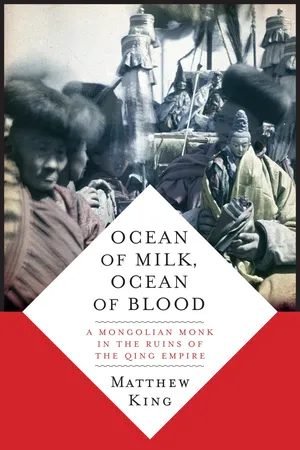
After the fall of the Qing empire, amid nationalist and socialist upheaval, Buddhist monks in the Mongolian frontiers of the Soviet Union and Republican China faced a chaotic and increasingly uncertain world. In this book, Matthew W. King tells the story of one Mongolian monk's efforts to defend Buddhist monasticism in revolutionary times, revealing an unexplored landscape of countermodern Buddhisms beyond old imperial formations and the newly invented national subject.
Ocean of Milk, Ocean of Blood takes up the perspective of the polymath Zava Damdin (1867–1937): a historian, mystic, logician, and pilgrim whose life and works straddled the Qing and its socialist aftermath, between the monastery and the party scientific academy. Drawing on contacts with figures as diverse as the Dalai Lama, mystic monks in China, European scholars inventing the field of Buddhist studies, and a member of the Bakhtin Circle, Zava Damdin labored for thirty years to protect Buddhist tradition against what he called the "bloody tides" of science, social mobility, and socialist party antagonism. Through a rich reading of his works, King reveals that modernity in Asia was not always shaped by epochal contact with Europe and that new models of Buddhist life, neither imperial nor national, unfolded in the post-Qing ruins. The first book to explore countermodern Buddhist monastic thought and practice along the Inner Asian frontiers during these tumultuous years, Ocean of Milk, Ocean of Blood illuminates previously unknown religious and intellectual legacies of the Qing and offers an unparalleled view of Buddhist life in the revolutionary period.
eBook - ePub
Ocean of Milk, Ocean of Blood
A Mongolian Monk in the Ruins of the Qing Empire
- English
- ePUB (mobile friendly)
- Available on iOS & Android
eBook - ePub
About this book
Information
Topic
Theology & ReligionSubtopic
20th Century HistoryPART I
Enchantment
ONE
Wandering
While the tracks of fleeing insects may appear as letters,
the insect is not an author.
Likewise, an ordinary person’s activity, however virtuous,
is never the story of a holy life.
—Zava Damdin, The Summary
The best ethnographic study will never make the reader a native.… All that the historian or ethnographer can do, and all that we can expect of them, is to enlarge a specific experience to the dimensions of a more general one, which thereby becomes accessible as experience to men of another country or another epoch.
—Claude Lévi-Strauss, Structural Anthropology
Uijing Güng, 1869: A mother attending children in a Gobi Desert felt yurt catches sight of her youngest son. He is once again sitting motionless, ignoring the play of siblings around him. He stares, never speaking, at the sky through the open roof. Is he stupid? Mute? She worries about him terribly. An aged nun comforts her. “Because this boy gazes uninterruptedly at the sky and the like, he must surely possess great virtue.”1 A great-grandmother offers more soothing words. “Though I have many great-grandchildren,” she says with scripture in hand, “I wish to bequeath to him this precious Dharma object of my ancestors.”2
* * *
Eastern Tibet, 1917: The oracle, his body enlivened by an otherwise unseen Dharma Protector, sputters “Hri!” The life and lives of a middle-aged monk in distant Urga who has put a question to him are reflected clearly in his divine mirror. Taktsang Rinpoché, that faraway monk’s teacher, sits at the oracle’s side awaiting answers he can pass on to his disciple. The deity animating the oracle knows that many lifetimes ago that Urga disciple was born in the city of Potal in south India. At the feet of a great yogi, he took refuge in the Buddhadharma, generated the far-reaching bodhicitta attitude aiming for enlightenment in order to benefit all sentient beings, and extensively served the teachings.3 Tracking the courses of karma to the present, the oracle discerns that the ancient Indian adept has now taken rebirth in Khalkha to serve the Yellow Religion. Yet still more reflections of scattered lives dance across his divine mirror.
He will excellently accomplish vast activities for the teachings
but will encounter a few demonic obstacles.
He will be fine if he puts effort into activities
such as reciting the Perfection of Wisdom Sūtras,
[undertaking] a close retreat of the Life-Conferring Goddess,
and repeatedly [reciting] a longevity sādhana.
For some seventy to eighty years,
he will set uncountable disciples
on the path to ripening and liberation.4
Looking further into the future, the oracle perceives that the distant Urga disciple will take rebirth in the pure land of Tuṣita and will sit at the feet of Buddha Maitreya in the company of other enlightened beings.5 Addressing Taktsang Rinpoché directly, he intones, “Without a doubt [the activity of your disciple] will spread across the entire earth!”6
* * *
Na Küriye, 1918: Another oracle, possessed by another Dharma Protector, wheezes prophecies about the boy who stared at the sky, the disciple who centuries ago lived at the feet of an Indian yogi, the monk who now serves the Buddha’s teachings in yurt temples on steppe grasses. This time, the Urga monk is present to hear directly about his future selves. The deity contorts its host in a trance. The oracle tells the monk he will be most successful in his Dharma practice. Though he will live to be eighty-eight, he will face obstacles at seventy-eight (c. 1945). With an appropriate ritual arsenal, the oracle says reassuringly, those obstacles can be purified without difficulty. “If you take refuge in the Triple Gem, your fame will spread everywhere and many sentient beings will respect you. Keep this in mind!”7
* * *
Ulaγanbaγatur, 1936: Racked with illness, the now elderly monk—he who stared at the sky, sat at his guru’s feet in ancient India, served the Buddha’s teaching in Mongol lands, and was told he would become famous—pens the last lines of the last text of his 9,000-page opus: his life story.8 Now only dying plays upon his mind. The closing lines of this final text incise only an aspiration for rebirth in a Pure Land, where the enlightened now exclusively reside. Unlike all the other substantive texts among the 416 he wrote, this life story does not close with prayers for the flourishing of the Buddhadharma in the world, for the long life of personal teachers, or for the longevity of monasteries in the Khalkha crossroads. Such futures lie already abandoned.
His monkish world had been pulled to pieces. Teachers, fellow abbots, and disciples languished in prison awaiting show trials. Others had already been led to complete their life’s karma on the lip of killing pits.
In this way, for seventy years
I have engaged in many activities of body, speech, and mind.
But I am unable to write everything down
or else I have forgotten.
I am uncertain if all my activity has been virtuous or not.…
If in this long text you see [only] a very ridiculous story,
keep it in your mind that I was lying
and simply offer all of it to the fire god!
I was born in the last five hundred-year period of Śākyamuni’s teachings.
Even though I was young,
I came to hold the appearance of a monk and joined the monastery.
I spent my whole life studying, teaching, and building holy statues,
but that activity is common, so who cares?
When my consciousness goes to the next life,
may it separate from nonvirtue, illusion, and fear!
May the messengers of Maitreya Buddha show me the path
so that I may be born without obstacle in Tuṣita!9
He is hidden away in the modest home of lay siblings, and illness soon affirms the Buddha’s teachings on impermanence. Within weeks, tens of thousands follow him along those paths that come after dying. They line up before judges, then crumple before firing squads.
At the end of pens and guns, the Yellow Religion is extinguished in Mongol lands with chilling bureaucratic efficiency.
“Wandering” in the Late Qing
That monk who as a boy stared at the sky, who sought his future in the mirrors of gasping spirits, and who penned his life story in the fog of state violence and illness was Zava Damdin. His 1936 autobiography was the last of his major compositions, a lifetime of writing that covered late imperial scholastic concerns from matters philosophical to ritual procedure, monastic order, contemplative techniques, and writing the past. Written soon before his death, this was the last iteration of nearly four decades of autobiographical writing, the only corpus of its kind by a Mongol monk to have survived the purges. This comes to us in dedicated autobiographies, authorial intrusions into dozens of other works, notes scratched in margins and colophons, letters, and prophetic accounts.
Zava Damdin’s writing on the vast terrain of scholastic fields of knowledge—from arts and crafts to veterinary medicine, geography, logic, and methods to nonconceptually realize the ultimate nature of mind at death—essentially concern the nature of the world, how we know it, how we may know it more perfectly, and the effects such knowing might have on one’s saṃsāric plight. Reading Damdin’s other, nominally nonautobiographic works is still an intimate encounter with an author. Whether writing about the Kālacakra Tantra, Madhyamaka, medicine, the names of mountain gods, grammar, ethics, the sons of Chinggis Khan, or the domes of Saint Petersburg, Zava Damdin always inserted himself into the flow of narrative. His texts burst with notes and signs pointing to other works, stitched together with half-done corrections, clarificatory marginalia, and almost always with tender, first-person reflection.
The first of Zava Damdin’s dedicated autobiographies is an expansive, three-volume effort written in the shared Tibeto-Mongolian genre of “record of teachings received” (Tib. thob yig, gsang yig). Such works construct genealogical maps of every religious transmission an (auto)biographical subject ever received—from the alphabet and first vows to the heights of tantric esotericism and sundry other highly restricted, secret instructions. “Records of teachings received” is a relatively neglected genre of historical writing from t...
Table of contents
- Cover
- Title Page
- Copyright
- Dedication
- Contents
- Acknowledgments
- List of Conventions
- Introduction
- Part I: Enchantment
- Part II: Disenchantment
- Conclusion
- Notes
- Bibliography
- Index
Trusted by 375,005 students
Access to over 1.5 million titles for a fair monthly price.
Study more efficiently using our study tools.
Frequently asked questions
Yes, you can cancel anytime from the Subscription tab in your account settings on the Perlego website. Your subscription will stay active until the end of your current billing period. Learn how to cancel your subscription
No, books cannot be downloaded as external files, such as PDFs, for use outside of Perlego. However, you can download books within the Perlego app for offline reading on mobile or tablet. Learn how to download books offline
Perlego offers two plans: Essential and Complete
- Essential is ideal for learners and professionals who enjoy exploring a wide range of subjects. Access the Essential Library with 800,000+ trusted titles and best-sellers across business, personal growth, and the humanities. Includes unlimited reading time and Standard Read Aloud voice.
- Complete: Perfect for advanced learners and researchers needing full, unrestricted access. Unlock 1.5M+ books across hundreds of subjects, including academic and specialized titles. The Complete Plan also includes advanced features like Premium Read Aloud and Research Assistant.
We are an online textbook subscription service, where you can get access to an entire online library for less than the price of a single book per month. With over 1.5 million books across 990+ topics, we’ve got you covered! Learn about our mission
Look out for the read-aloud symbol on your next book to see if you can listen to it. The read-aloud tool reads text aloud for you, highlighting the text as it is being read. You can pause it, speed it up and slow it down. Learn more about Read Aloud
Yes! You can use the Perlego app on both iOS and Android devices to read anytime, anywhere — even offline. Perfect for commutes or when you’re on the go.
Please note we cannot support devices running on iOS 13 and Android 7 or earlier. Learn more about using the app
Please note we cannot support devices running on iOS 13 and Android 7 or earlier. Learn more about using the app
Yes, you can access Ocean of Milk, Ocean of Blood by Matthew W. King in PDF and/or ePUB format, as well as other popular books in Theology & Religion & 20th Century History. We have over 1.5 million books available in our catalogue for you to explore.