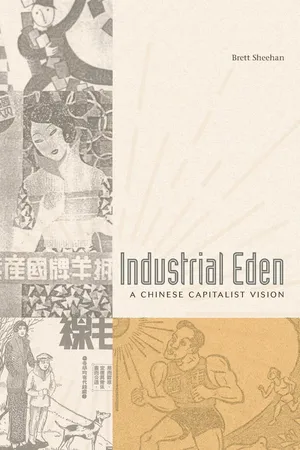
This illuminating study of the evolution of Chinese capitalism chronicles the fortunes of the Song family of North China under five successive authoritarian governments. Headed initially by Song Chuandian, who became rich by exporting hairnets to Europe and America in the early twentieth century, the family built a thriving business against long odds of rural poverty and political chaos.
A savvy political operator, Song Chuandian prospered and kept local warlords at bay, but his career ended badly when he fell afoul of the new Nationalist government. His son Song Feiqing—inspired by the reformist currents of the May Fourth Movement—developed a utopian capitalist vision that industry would redeem China from foreign imperialism and cultural backwardness. He founded the Dongya Corporation in 1932 to manufacture wool knitting yarn and for two decades steered the company through a constantly changing political landscape—the Nationalists, then Japanese occupiers, then the Nationalists again, and finally Chinese Communists. Increasingly hostile governments, combined with inflation, foreign competition, and a restless labor force, thwarted his ambition to create an "Industrial Eden."
Brett Sheehan shows how the Song family engaged in eclectic business practices that bore the imprint of both foreign and traditional Chinese influences. Businesspeople came to expect much from increasingly intrusive states, but the position of private capitalists remained tenuous no matter which government was in control. Although private business in China was closely linked to the state, it was neither a handmaiden to authoritarianism nor a natural ally of democracy.
- 334 pages
- English
- ePUB (mobile friendly)
- Available on iOS & Android
eBook - ePub
About this book
Information
1
The Warlord State and the Capitalist-Politician
WHEN SONG CHUANDIAN left his village to go to school, the Qing dynasty (1644–1911) still ruled China.1 Of the same generation as the late Qing revolutionaries who would advocate overthrow of the Qing, over the course of his life Song Chuandian saw the fall of the Qing dynasty, the establishment of a republic in its place, and then the disintegration of that republic into regional and local warlord rule.2 Warlord China from approximately 1916 to 1928 witnessed both economic vitality in certain sectors and a concurrent breakdown of the national political system.3 On the surface, the ever-escalating civil wars—at the rate of about one war every two years—the predatory military governments, the lack of the rule of law, and the constantly changing political regimes created an inhospitable environment for business. Nonetheless, some businesses did grow and prosper.
Small rural businesspeople like Song Chuandian at the start of his career could operate in a laissez-faire space out of the extractive reach of the warlord governments. As time went on, warlord governments became more predatory and Song’s business grew to substantial proportions, but he used political position to protect and promote his business interests until a regime change in 1928 ruined him. The story of the Song family’s rise and fall from the early part of the twentieth century to 1928 shows both the resilience of business amid uncertainty as well as its ultimate weakness when faced with coercive political power. To understand this story, though, it is necessary to go back to the 1870s and 1880s and investigate the conditions in which the Song family first turned to business as a profession.
The Gospel of Economic Development
Song Chuandian came from the Song Family Village (Songwangzhuang), where even in the year 2000 mud-thatched houses gave the appearance of a sleepy place that time forgot. Nestled among rolling hills spotted with wheat fields, the Song Family Village is in the mountainous southwest part of Qingzhou (formerly Yidu) County in central Shandong Province. This part of the county “was barren and the people poor,” according to an observer in 1919.4 Hills around the Song Family Village were too steep for extensive fields, so many peasants relied on products from the mountains such as firewood for their livelihoods.5 In this barren and hilly landscape, the village is still so insignificant that it does not appear on the county map a century later in the 1989 local gazetteer.6
At the end of the nineteenth century, the Song Family Village was a half day’s walk to the Qingzhou county seat, which itself was a three-day ride—by the relatively exalted means of riding a horse—from the provincial capital of Jinan.7 Qingdao, Shandong’s largest commercial city, was twice as far. Shanghai was a twelve-day journey, partly by boat.8 From the standpoint of geography, the residents of Song Family Village did not seem to have a propitious position for upward social mobility.
Yet appearances can be deceiving. Isolated and poor, the Song Family Village nonetheless lay in, or at least near, the path of wrenching changes that transformed Shandong Province in the nineteenth and twentieth centuries. The commercial core of Shandong Province had previously been west of the provincial capital, Jinan, among towns along the Grand Canal, which connected North and South China. In the nineteenth century, environmental degradation and a shift in the locus of commerce away from this center to the coasts left a backwater where the economy previously thrived.9 Rising coastal cities such as Qingdao, where Germany established the beachhead of its imperialist project in China, became Shandong’s new economic centers. The Song Family Village lay between the old declining western part of the province and the new rising east. As these changes were taking place, in the 1870s and 1880s, agents of new opportunities arrived not just in the county seat of Qingzhou, but in rural areas such as the Song Family Village as well. New commercial opportunities came in the form of British Baptist missionaries who arrived on horseback, on foot, and on sedan chair. Confronted by the poverty of central Shandong where rural people “built their own houses, made their own bricks, [and] ground and [ate] their own [grain],” these missionaries eventually turned themselves to the task of bettering the lives of locals with a kind of gospel of economic development.10
Barred by the Qing dynasty from living in the provincial capital of Jinan during the nineteenth century, foreign missionaries took up residence in various Shandong county seats.11 Most centers of missionary activity, such as Chifu and Weihai, were near the coast, but some hardy souls penetrated places in Shandong’s rather unwelcoming interior such as Qingzhou County. Qingzhou’s county seat was a medium-sized city which also served as the prefectural seat overseeing administration of eleven counties. By the 1870s an agreement between American Presbyterians and British Baptists placed Qingzhou in the latter’s sphere of activity.12 Qingzhou was as far into the interior of Shandong Province as protestant missionaries ventured during the nineteenth century. In fact, one missionary later noted that journeying southwest from Qingzhou, “one might travel all the way to [Hankou] [in central China, a distance of about five hundred miles] without meeting a single mission station.”13 As its pioneer in interior Shandong the British Baptist Missionary Society (BMS) dispatched Timothy Richard. After arriving in Qingzhou in 1875, he noted that the city “possessed an Islamic theological college, two mosques, Buddhist and Taoist temples, and an abundance of new religious sects.”14 Richard advocated an approach that focused on converting elites, teaching science and technology, and providing opportunities for the poor, thus making himself vulnerable to criticisms of working for social change rather than teaching the gospel. During the famine in Shandong in the late 1870s, Richard established an orphanage for boys that taught “occupations, so that the boys, who ranged from twelve to eighteen years of age, could earn their living.”15 Richard was soon posted to Shanxi and replaced in Qingzhou by Alfred Jones who shared many of Richard’s ideas. Both of them were on the forefront of the so-called social gospel movement, which would become popular with some Protestants in the West in the 1880s and 1890s.16
Locals called Jones “foreign devil,” so in order to blend in and gain acceptance, he adopted a Chinese style of dress, including growing the long braid, or queue, worn by Chinese men.17 His unorthodox appearance may have helped him in the eyes of wary Chinese, but his future in-laws, American protestant missionaries in a coastal Shandong city, disapproved.18 Western missionaries enjoyed some privileges, of course. For local travel, “where there are roads [missionaries] have mule-litters, carts & barrows, but where there are NO ROADS [they] are carried in sedan chairs, protected thoroughly from the sun.”19
In Song Family Village, poor peasants like the Song family had no such luxury. They walked everywhere. Song Chuandian’s father, Song Guangxu had been left an orphan by the age of eleven; he herded sheep, worked for relatives, and collected firewood in the mountains for sale in the county seat.20 At the age of twenty-two, his relatives found him a bride, a woman from a nearby village who might have been a Christian protestant.21 If she was protestant, she was one of very few. Even a decade after her marriage, the BMS mission in Qingzhou counted only “1,094 members, scattered over 63 stations.”22 If she was Christian, it would help explain how, in spite of their poverty, they sent their first son, Song Chuandian away to a Christian-sponsored rural school around the age of seven. By 1886 the BMS had eight schools attached to its village stations “where some 80 boys study both native and Christian books.”23
The fact that such schools existed at all defied the directives of the BMS in Britain, whose members saw little need for secular education. Alfred Jones encountered fierce opposition when he decided to go beyond village schools and proposed turning the Qingzhou county seat orphanage Timothy Richard had founded into a “good school on a small pointed well directed base, to act as a promoter of scientific knowledge—a melter of supersticion [sic].… It is a right handmaid to a church in heathen land.”24 The China subcommittee of the BMS argued that missionary resources would be better spent on “ecumenical extension.” On leave in England, Jones made a personal appeal to members of the society and asked for sympathy for “peculiar forms of work necessitated by our peculiar—our most peculiar circumstances.… If our work is not to be suicidal, if we are not going to set class against class and breed sedition over again, then Literary, Official, and Educational work must be begun.”25 Eventually Jones prevailed and returned to China with a BMS blessing for a new school in 1884.26
Perhaps drawn to Jones, a number of like-minded missionaries would make their way to Qingzhou over the final years of the nineteenth century. By 1885 there were a total of seven Western missionaries, including J. S. Whitewright who founded the Whitewright Institute and Museum, because “we know that a little natural science is able to kill a great deal of superstition, and to set men enquiring—in a word, to waken men into mental activity.”27 In addition to Whitewright, the BMS also sent Samuel Couling and his wife to oversee the new county seat school. Samuel Couling became an accomplished sinologist who was one of the first Westerners to collect the earliest known forms of Chinese writing, oracle bones, and who in 1917 published The Encyclopaedia Sinica, which became a standard English-language reference work on China. He would also later become “joint author of The History of Shanghai and editor of the New China Review.”28 Mrs. Couling’s presence derived from a specific strategy conceived by Alfred Jones to convert Chinese women to Christianity.29 In addition to requesting a married couple like the Coulings, Jones also requested two “unmarried female missionaries to work among the women.”30
The Coulings arrived in Qingzhou in March of 1886, and in 1887 opened a boys’ school where “a select number of boys from the village schools may in addition to a good Chinese education learn something of western mathematics and the cultural sciences, and receive that moral training which it is so difficult for them to get at home.”31 One of their first students was none other than Song Chuandian. Song arrived in the Qingzhou county seat with his father who worked as a laborer in the mission compound, while his son, and later his other children, attended school.32 Song Guangxu had to work to offset the cost of his children’s education because the school was run on a shoestring and required more contributions from families than most missionary schools in North China.33
In the early 1890s, about five years after Song Chuandian started school in the Qingzhou county seat, Alfred Jones and Samuel Couling became obsessed with finding new economic opportunities to alleviate the poverty they perceived as the number one problem in rural Shandong. Couling was particularly qualified in this respect because he had been “brought up to business [and] … was for years engaged on the Correspondence of a London Insurance Office.”34 On leave in Scotland in 1891, Couling spent much of his time visiting local congregations saying that “in addition to the spiritual loss—of heaven or of the soul, the Chinese were also in this life of all men most miserable; because lack of Christianity implies lack of all those material benefits which come to English people as indirect results of Christianity.”35 Alfred Jones who had himself spent time in the woolen trade before becoming a missionary was another enthusiastic supporter of developing the rural Chinese economy. On leave in England in 1891 he wrote, “I see the people starving while we are teaching to them. Giving them money does not fill the bill. Giving them the Gospel even does not fill their stomachs nor lighten the load of work that weights down moral progress.” Like Couling, he believed in a causal link between Christianity and prosperity. Elsewhe...
Table of contents
- Cover
- Title Page
- Copyright
- Dedication
- Contents
- Map
- Introduction
- 1. The Warlord State and the Capitalist-Politician
- 2. The Prewar Nationalists’ Uncertain Developmental State
- 3. Building Eden outside the Firm with National Products and Urban Consumerism
- 4. Japanese Occupation and the “Economy of Things”
- 5. Building Eden inside the Firm
- 6. The Postwar Nationalists’ Unresponsive Developmental State
- 7. The People’s “New Democratic” Developmental State
- 8. Industrial Eden’s Legacy under Socialist Development
- Conclusion
- Glossary of Chinese and Japanese Characters and Names
- Notes
- Bibliography
- Acknowledgments
- Index
Trusted by 375,005 students
Access to over 1.5 million titles for a fair monthly price.
Study more efficiently using our study tools.
Frequently asked questions
Yes, you can cancel anytime from the Subscription tab in your account settings on the Perlego website. Your subscription will stay active until the end of your current billing period. Learn how to cancel your subscription
No, books cannot be downloaded as external files, such as PDFs, for use outside of Perlego. However, you can download books within the Perlego app for offline reading on mobile or tablet. Learn how to download books offline
Perlego offers two plans: Essential and Complete
- Essential is ideal for learners and professionals who enjoy exploring a wide range of subjects. Access the Essential Library with 800,000+ trusted titles and best-sellers across business, personal growth, and the humanities. Includes unlimited reading time and Standard Read Aloud voice.
- Complete: Perfect for advanced learners and researchers needing full, unrestricted access. Unlock 1.5M+ books across hundreds of subjects, including academic and specialized titles. The Complete Plan also includes advanced features like Premium Read Aloud and Research Assistant.
We are an online textbook subscription service, where you can get access to an entire online library for less than the price of a single book per month. With over 1.5 million books across 990+ topics, we’ve got you covered! Learn about our mission
Look out for the read-aloud symbol on your next book to see if you can listen to it. The read-aloud tool reads text aloud for you, highlighting the text as it is being read. You can pause it, speed it up and slow it down. Learn more about Read Aloud
Yes! You can use the Perlego app on both iOS and Android devices to read anytime, anywhere — even offline. Perfect for commutes or when you’re on the go.
Please note we cannot support devices running on iOS 13 and Android 7 or earlier. Learn more about using the app
Please note we cannot support devices running on iOS 13 and Android 7 or earlier. Learn more about using the app
Yes, you can access Industrial Eden by Brett Sheehan in PDF and/or ePUB format, as well as other popular books in History & Economic History. We have over 1.5 million books available in our catalogue for you to explore.