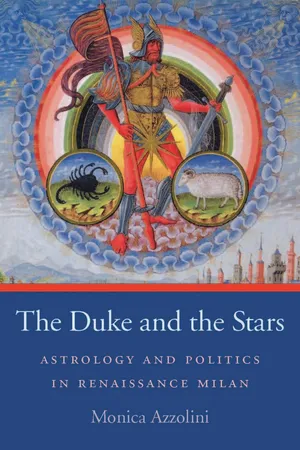
This study is the first to examine the important political role played by astrology in Italian court culture. Reconstructing the powerful dynamics existing between astrologers and their prospective or existing patrons, The Duke and the Stars illustrates how the "predictive art" of astrology was a critical source of information for Italian Renaissance rulers, particularly in times of crisis. Astrological "intelligence" was often treated as sensitive, and astrologers and astrologer-physicians were often trusted with intimate secrets and delicate tasks that required profound knowledge not only of astrology but also of the political and personal situation of their clients. Two types of astrological predictions, medical and political, were taken into the most serious consideration. Focusing on Milan, Monica Azzolini describes the various ways in which the Sforza dukes (and Italian rulers more broadly) used astrology as a political and dynastic tool, guiding them as they contracted alliances, made political decisions, waged war, planned weddings, and navigated health crises.
The Duke and the Stars explores science and medicine as studied and practiced in fifteenth-century Italy, including how astrology was taught in relation to astronomy.
- 370 pages
- English
- ePUB (mobile friendly)
- Available on iOS & Android
eBook - ePub
About this book
Information
1
The Science of the Stars
Learning Astrology at the University of Pavia
In the dramatic days that followed the occupation of Milan by the troops of the King of France, Charles VIII of Valois, in 1499, Leonardo da Vinci, who had served Ludovico Maria Sforza for over twenty years, left the Lombard capital with all of his belongings. The year that followed saw the Florentine artist travel across the peninsula in search of more stable employment: first to Mantua, then to Venice, finally to Florence. Leonardo, it was reported, was neglecting painting in order to dedicate himself almost obsessively to geometry.1 It may not be surprising, therefore, to discover two copies of Euclid’s Elementa (one in the vernacular) among the books listed in one of the artist’s library inventories tentatively dated to 1503–1504.2 It is clear that Leonardo was still under the influence of his friend and teacher Luca Pacioli (c. 1445–1517), the Franciscan monk who had been invited to Milan by Duke Ludovico Maria Sforza to teach mathematics and who had imparted Leonardo lessons in Euclidean geometry. Leonardo’s list of books, however, offers some genuine surprises. Together with the two copies of Euclid’s Elementa—a text that, as we shall see, was the staple of the mathematical curriculum of the degree in arts and medicine at most Italian universities—Leonardo also possessed a book entitled Sphera mundi (most likely a printed edition of Sacrobosco’s Sphaera),3 a copy of Regiomontanus’s Kalendar, an unidentified book on the quadrant, a text by Albumasar (most likely either the Introductorium maius or De magnis coniunctionibus), and a vernacular copy of Alcabitius’s Introductorius that he had borrowed from the Florentine astronomer-astrologer Francesco Serigatti.4 While the first three books fell into the broad remit of geometry and astronomy, the other two belonged unequivocally to the field of judicial astrology, this despite the fact that on at least one occasion Leonardo expressed his reservations about the validity of the latter.5 To these works we could also add two copies of a Chiromantia, and a copy of Michael Scot’s Physiognomia, two texts that, as we shall see in the following pages, appeared often in the collections of students of medicine and astrology and were often present in fifteenth-century Italian scientific collections.6
In the context of this book it is not necessary to establish whether Leonardo believed in astrology, or indeed whether his apparent aversion toward judicial astrology was more simply motivated by his dislike of Ludovico’s chief astrologer, Ambrogio Varesi da Rosate, as one scholar has suggested.7 Leonardo certainly knew Varesi, as both were present at a “scientific duel” staged by Ludovico Maria Sforza in February 1498.8 In the Divina proportione, where Pacioli describes the event, the Franciscan mathematician praised Varesi as an “expert investigator of the celestial bodies and interpreter of future events.”9 In the same work, however, he argued that geometry was superior to astrology and astronomy, much like Leonardo did in his Paragone.10 As I have argued elsewhere, disciplinary rivalry was rife at the Sforza court, and both Pacioli and Leonardo may have tried to advance their social status at court through debate and writing.11 That said, there is no way of telling whether Leonardo’s objections to judicial astrology were motivated by his personal dislike of Varesi or by his dislike of the discipline more generally. It is possible that, like some contemporaries, Leonardo saw in Varesi the person responsible for Ludovico’s fall in 1499, but if this was the case, the evidence does not allow us to prove it conclusively. What we can say, however, is that Leonardo’s scientific collection bears some revealing similarities with that of many of his contemporaries who would have studied for a degree in arts and medicine at a university like Pavia. As this chapter will illustrate, the Sphaera of Sacrobosco and a text on the quadrant were two works that were taught regularly in courses of spherical astronomy at Italian universities, while Alcabitius’s Introductorius and the works of Albumasar were regular readings for students in astrology. This is in itself relevant, as it highlights how works of spherical astronomy as well as judicial astrology were reasonably affordable and had wide circulation among learned men in Milan.
The purpose of this chapter is therefore to reconstruct, to the degree possible, the curriculum studiorum of students of astrology at the University of Pavia, the Studium of the Duchy of Milan. What books of astronomy and astrology were most commonly studied at university? In a seminal study on the teaching of astronomy, Olaf Pedersen located a series of texts that were taught regularly at late-medieval universities. He called this group of texts a corpus astronomicum and argued that this corpus first developed when Sacrobosco himself taught in Paris and was expanded later to contain other astronomical treatises.12 Can we similarly locate a corpus of astrological texts—a Renaissance corpus astrologicum—that constituted the staple of fifteenth-century teaching in astrology at Italian universities? Can we establish what kind of texts were taught at Pavia? The task is not easy—we do not possess official documents for Pavia—but the existing evidence goes some way in suggesting what Pavian students of astrology may have read. Our knowledge of astrological manuscripts, their contents, provenance, and ownership, is still very limited. Scores of them remain unstudied in Italian and other libraries. How many of these were student notebooks, for instance, is impossible to say. How many had Lombard origin even more so. My attempt to establish what texts were likely to be read in Pavia, therefore, is par force summary and imperfect. It is just the start of a process that will require the collaborative and cumulative work of many more historians and philologists.13
While a full study of university teaching in arts and medicine at Pavia goes beyond the scope of this work, the Studium of Pavia was the most common choice for Lombard students wanting to pursue a career as physicians and astrologers in the fifteenth century, and for this reason determining to the degree possible what kind of astronomy and astrology was studied in Pavia is clearly relevant to the study of Sforza court astrology with which this book is concerned. Not only did many of the physicians and astrologers associated with the Sforza court study at Pavia, but many of them also taught there. The contacts between the university and the court, therefore, were considerable, and the boundaries between court and university often porous. The appointment of university professors at Pavia was officially administered by the Sforza Privy Council, the core organ of Sforza administration, but was often heavily influenced by the Duke of Milan himself.14
The early history of Italian universities is notoriously poorly documented and Pavia is no exception: little evidence exists about the way in which teaching was imparted and what texts were studied. The documentation for Pavia, unsurprisingly, has some serious lacunae: the archives of the college of arts and medicine, which must have existed at some point, have not been preserved, and for this reason we similarly lack matriculation lists for the period under consideration. Furthermore, only some of the rolls, or rotuli, namely the lists of professors teaching at Pavia (together with their disciplines), have come down to us.15 The best sources of information, therefore, are the graduation papers of those students who completed their courses at Pavia. These documents include the name of the student, the person who “promoted” him for the degree, the names of other representatives of the university, and those of other participants at exams, including other students.16 As Paul Grendler highlighted, however, not all of the promoters also taught at the university, and this makes it harder to establish who held a chair and who did not.17 These documents are complemented by correspondence regarding the Studium among the Sforza papers at the Archivio di Stato in Milan. This correspondence is quite varied, ranging from salary payments to issues concerning students. Very little, however, is said about the kind of texts that were taught. Even in the case where official information about the curriculum studiorum exists, moreover, the list of texts indicated should only be taken as prescriptive, and is probably only partly representative of what was studied at Italian Studia from year to year. As Nancy Siraisi has argued in her exemplary study of the University of Padua, a sounder approach is one based on a reconstruction of the interests of those associated, whether directly or indirectly, with the various universities.18 Such work remains to be done for Pavia. Answering the questions outlined above, therefore, requires a multidirectional approach.
A first modest attempt in this direction is provided in the following pages, which try to trace the most important aspects of university teaching of astronomy and astrology in Pavia during the Sforza period. The evidence to be presented here comes from a variety of documents: given the dearth of information as to what was taught at Pavia, the personal inventories of university professors who taught there are particularly valuable. Likewise, the libraries of Milanese physicians and other members of the elite may provide an indication of which astrology and astronomy books circulated in Milan in manuscript or print. Some of these books, as we shall see, were deemed essential to the study of astrologia. To these one should add the library of the Sforza family housed in Pavia, which served in many ways as a reference library for courtiers and university professors alike. Other scant evidence comes from the astrology and astronomy books printed in the Duchy of Milan, but this evidence should not be taken as fully representative of what circulated in print in Milan as we know that the Milanese elite had easy access to books printed in other Italian cities, particularly Venice, which by the 1480s had come to dominate the Italian printing industry (and, indeed, for a time, the European printing industry as well).19
Unfortunately, I have thus far been unable to trace many astrology and astronomy manuscripts that could be firmly attributed to Pavian professors or students. The lamentable dispersion of this kind of material and the scant information included in most library catalogs about any notes of ownership or provenance makes such a task particularly arduous. Yet, as we shall see, the one actual Pavian manuscript I have located provides much insight into the interests and type of knowledge available to one particular fifteenth-century Pavian student and allows us to make more general statements as to the kinds of books that may have been read by other fifteenth-century Pavian students.20
The Astrologer’s World: a Corpus Astrologicum?
By the second half of the thirteenth century the study of astronomy and astrology occupied a firm place in the curricula of Italian universities.21 There was not, however, a degree in astronomy/astrology proper. Rather, astronomy and astrology were part of the training imparted to students in arts and medicine at most European universities as astrology was closely linked to medical theory and practice.22 The fact that the two Latin terms astrologia and astronomia were used interchangeably in the period with which this book is concerned (as indeed in an earlier period) indicates that the two discplines were not thought to be different and irreconcilable, but part of the same realm of knowledge concerned with celestial motion and its effects. Then as now, people were able to distinguish what constituted astronomy and astrology, and there is ample evidence that the two disciplines were not considered to be equivalent. What is most striking to a modern reader, however, is the fact that astronomy (i.e., the study of celestial motion) was often seen as propaedeutic and subservient to astrology and astrological medicine, which focused on the predictable effects of this motion on Earth and the human body, and that for this reason, at least initially, greater emphasis and importance was given to astrology over astronomy.23 Together with the study of the movements of the planets in the sky, therefore, students also learned about their effects on Earth. Studied within three distinctive scientific disciplines—mathematics, natural philosophy, and medicine—that formed the traditional four-year...
Table of contents
- Cover
- Title Page
- Copyright
- Dedication
- Contents
- Preface
- Illustrations
- Introduction
- 1. The Science of the Stars: Learning Astrology at the University of Pavia
- 2. The Making of a Dynasty: Astrology under Bianca Maria Visconti and Francesco Sforza
- 3. Astrology Is Destiny: Galeazzo Maria Sforza and the Political Uses of Astrology
- 4. The Star-Crossed Duke: Gian Galeazzo Sforza and Medical Astrology
- 5. The Viper and the Eagle: The Rise and Fall of Astrology under Ludovico Sforza
- Epilogue
- Abbreviations
- Notes
- Bibliography
- Acknowledgments
- Index
Trusted by 375,005 students
Access to over 1.5 million titles for a fair monthly price.
Study more efficiently using our study tools.
Frequently asked questions
Yes, you can cancel anytime from the Subscription tab in your account settings on the Perlego website. Your subscription will stay active until the end of your current billing period. Learn how to cancel your subscription
No, books cannot be downloaded as external files, such as PDFs, for use outside of Perlego. However, you can download books within the Perlego app for offline reading on mobile or tablet. Learn how to download books offline
Perlego offers two plans: Essential and Complete
- Essential is ideal for learners and professionals who enjoy exploring a wide range of subjects. Access the Essential Library with 800,000+ trusted titles and best-sellers across business, personal growth, and the humanities. Includes unlimited reading time and Standard Read Aloud voice.
- Complete: Perfect for advanced learners and researchers needing full, unrestricted access. Unlock 1.5M+ books across hundreds of subjects, including academic and specialized titles. The Complete Plan also includes advanced features like Premium Read Aloud and Research Assistant.
We are an online textbook subscription service, where you can get access to an entire online library for less than the price of a single book per month. With over 1.5 million books across 990+ topics, we’ve got you covered! Learn about our mission
Look out for the read-aloud symbol on your next book to see if you can listen to it. The read-aloud tool reads text aloud for you, highlighting the text as it is being read. You can pause it, speed it up and slow it down. Learn more about Read Aloud
Yes! You can use the Perlego app on both iOS and Android devices to read anytime, anywhere — even offline. Perfect for commutes or when you’re on the go.
Please note we cannot support devices running on iOS 13 and Android 7 or earlier. Learn more about using the app
Please note we cannot support devices running on iOS 13 and Android 7 or earlier. Learn more about using the app
Yes, you can access The Duke and the Stars by Monica Azzolini in PDF and/or ePUB format, as well as other popular books in History & European Renaissance History. We have over 1.5 million books available in our catalogue for you to explore.