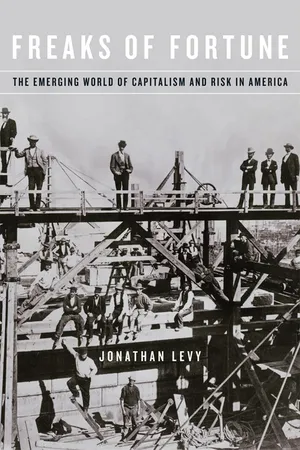
Until the early nineteenth century, "risk" was a specialized term: it was the commodity exchanged in a marine insurance contract. Freaks of Fortune tells the story of how the modern concept of risk emerged in the United States. Born on the high seas, risk migrated inland and became essential to the financial management of an inherently uncertain capitalist future.
Focusing on the hopes and anxieties of ordinary people, Jonathan Levy shows how risk developed through the extraordinary growth of new financial institutions—insurance corporations, savings banks, mortgage-backed securities markets, commodities futures markets, and securities markets—while posing inescapable moral questions. For at the heart of risk's rise was a new vision of freedom. To be a free individual, whether an emancipated slave, a plains farmer, or a Wall Street financier, was to take, assume, and manage one's own personal risk. Yet this often meant offloading that same risk onto a series of new financial institutions, which together have only recently acquired the name "financial services industry." Levy traces the fate of a new vision of personal freedom, as it unfolded in the new economic reality created by the American financial system.
Amid the nineteenth-century's waning faith in God's providence, Americans increasingly confronted unanticipated challenges to their independence and security in the boom and bust chance-world of capitalism. Freaks of Fortune is one of the first books to excavate the historical origins of our own financialized times and risk-defined lives.
- English
- ePUB (mobile friendly)
- Available on iOS & Android
eBook - ePub
About this book
Information
Publisher
Harvard University PressYear
2012Print ISBN
9780674736351
9780674047488
eBook ISBN
9780674071124
CHAPTER 1
The Assumption of Risk
Safety from an evil which may lurk in the future is as real as any other commodity.
—Elizur Wright, “Life Insurance for the Poor” (1876)
IN 1836, NICHOLAS FARWELL WAS AN ENGINE-MAN on the one-year-old Boston and Worcester Railroad when a train ran off the tracks because a fellow employee mislaid a switch. Farwell and his car were thrown from the rail, and the railcar crushed and permanently destroyed his right hand. His career as an engine-man over, Farwell asked the Railroad for compensation but it refused. Farwell hired a lawyer and took his case eventually all the way to the Massachusetts Supreme Court. He valued his right hand at $10,000.
Chief Justice Lemuel Shaw’s 1842 decision in Farwell v. Boston and Worcester R.R. Corp. ruled that Farwell himself was responsible for the “peril” that had destroyed his right hand.1 Farwell therefore also personally assumed a “risk.” By invoking risk Shaw’s decision rested upon precedents in the international law of marine insurance.2 In 1842 railroad wage work was new. Maritime commerce was old. Shaw granted “that the maritime law has its own rules and analogies” not always applicable to other “branches of law.” Applying the moral logic of risk to a dispute concerning an industrial workplace accident followed no direct legal precedent. But Shaw still held it a “good authority” for the case at hand. To grapple with a novel aspect of American economic life, Shaw invited risk inland.
In ruling Farwell personally responsible for the “risk,” Shaw also led the wage worker, almost by the nose, to a fledgling corporate financial system. There the wage worker might offload, commercially, that same personal “risk”—just like merchants offloaded the risks of long-distance trade. Farwell was thus an early and emblematic agent of the larger dynamic that launched risk’s national history in the United States, which eventually drew almost all Americans within its orbit. Shaw attached “risk” to the very meaning and substance of Farwell’s personal freedom, empowering both his individual autonomy and what would become, by the end of the nineteenth century, modern American corporate risk management. Therefore Farwell provides the opportunity to concretely establish the historical problem of risk.
The Massachusetts Court ruled against the crippled workingman. According to Shaw, Farwell, in contracting out his productive labor, had taken “upon himself the risks and perils incident to his situation” as an engine-man. The two words “risk” and “peril” did not then have the same meaning, and Shaw was not being loose with language. The peril of the accident, Shaw reasoned, was already priced into Farwell’s wage, which was higher than the wages paid to workers who were engaged in less hazardous tasks. Within his two-dollar-per-day wage was a “premium for the risk which he thus assumes.” Therefore, the railroad corporation was responsible to Farwell for no further compensation.3
Farwell stated that as a free man the plaintiff was a proprietor of a personal “risk.” The risk he assumed was an element of his self-ownership—the same as the productive labor embodied in his now mangled and disabled right hand. No different than his own body, Farwell’s “risk” was part of his selfhood. Like his productive labor, it was his private property, a thing over which he held absolute dominion. The peril was not conceived along propertied terms.
Shaw arrived to this ruling in a series of related moves. For one, Farwell became the owner of what might be termed a downside risk. He became responsible for the possibility of an abnormal future peril, hazard, or danger. The cost of this industrial accident was his own, and the Boston and Worcester Railroad owed him no compensation for his injury. It was a “pure accident,” Shaw declared, as the freak event was neither the fault of Farwell nor of the railroad corporation.4 But Farwell was ruled responsible for its consequences.
Yet, as a free man, Farwell also owned an upside risk—an equally abnormal and corresponding future pecuniary reward. In this case, it was represented monetarily in his higher wage. Both Farwell and the Boston and Worcester Railroad were ruled free and equal contracting parties in like pursuit of commercial gain. In contracting out his productive labor for the new, hazardous employment of railroad work, Farwell—Shaw held—had bargained for extra money compensation for “the risk which he thus assumes.” This was a moral idea, the notion that more “risk” assumed justified more reward. As a free man, Farwell was entitled to an upside. But, for the same reason, he assumed a downside. Linking together freedom, self-ownership, and the personal assumption of risk, it was as if Shaw had enclosed a new “risk” within the sphere of Farwell’s individual autonomy.
“Enclosure” is a term than can only be historically associated with one specific kind of commodity: land. In England, from the fifteenth to the nineteenth centuries, parliamentary magistrates, lawyers, landowners, mortgage lenders, and enterprising farmers conducted the slow process of “enclosing” a common-fields system that dated back to early medieval times. Land previously held in commons became the exclusive property of private individuals. The word “enclosure” referred to the techniques of demarcating newly private property—the building of hedges, fences, and drainage canals, or the filings and petitions of lawyers and magistrates—along the way to the creation of early modern English agrarian capitalism. By the nineteenth century, the crazy quilt of mutualist obligations that was early modern landed property was all but gone. An old set of hedges that had allocated some land to individual households and some to broader collectivities was replaced by a new set demarcating absolute, and therefore alienable, individual property rights.5
In the seventeenth century, when English colonists arrived on American shores, one of the first things they did was to begin to enclose the land, and to claim it as their own. Some New England villages had a full-blown common-field system, and all colonies to some degree maintained collective use-rights in land. They did so through a blend of customary practices that treated the land as a social good as much as an individual commodity. But in America as well, by the nineteenth century a not too dissimilar set of actors had enclosed the land.6
Farwell provided a legal technique for an analogous, later enclosure. “Risk,” the commodity long exchanged in a marine insurance contract, was something that a person could in fact “assume” and own, alienate, or contract out to another to “carry.” And yet, in the early modern period, outside the world of long-distance trade the notion that the cost of a contingent event could be priced and enclosed into a commodity that could then be offloaded through a financial instrument called “insurance” would have baffled most people. At least a fence, a hedge, or a drainage canal could demarcate an enclosed piece of land for the naked eye to see. But a future peril was much more abstract and ephemeral.
A legal precedent, however, could do something like the boundary work of a physical hedge. Enclosed “marine risks” had existed for centuries. In 1842, Shaw enclosed the new personal “accident risk” of the modern industrial workplace. Just as Farwell could sell his productive labor to a boss, so could he sell his accident risk to an insurance corporation. Farwell’s employment implicated two commodities which existed in tandem—his productive labor and now the “risk” attendant to its hire. Farwell perfectly captured the capitalist approach to peril: commodify it.
To do so Shaw first had to dispense with a legal principle in which the burden of hazard was held in common, much like the land had once been. If the early modern enclosure of land had commodified the commons, then Shaw’s enclosure of an “accident risk” commodified a contingency. The common-fields system was after all a form of safety-first agriculture, a communal hedge against the danger of a bad harvest or a bad market.7 Farwell had sued under the English common law rule respondeat superior, which rendered “masters” responsible for accidents caused by their “servants.” The paternalist legal rule was premised upon a status-based hierarchy, and was typical of the many highly personal, if asymmetrical, social bonds that persisted into nineteenth-century America. Such bonds achieved social security but were not predicated upon the demand for individual autonomy—and certainly not the individualist moral logic of risk. To understand just how remarkable a decision Farwell was, consider that according to the international law of marine insurance—at the time Shaw handed Farwell down—a seaman’s wages were not legally insurable. As Shaw’s contemporary Theophilus Parsons wrote in 1859, masters were legally responsible to directly care for and compensate a seaman who became “sick, or wounded, or maimed in the discharge of his duty” provided it was “not by his own fault.”8
Shaw departed with respondeat superior. Speaking of the “pure accident” that had befallen Farwell, he snapped one chord in the dependent bond between “masters” and “servants,” enshrining the Nicholas Farwells of the world as masters and proprietors of their own personal risks. Having personally assumed a risk, Farwell appeared to have no social recourse whatsoever.
For this reason, through the years Farwell has struck many as a callous decision—an early blow to the incipient American working class, an implicit subsidy for nascent railroad corporations. That it was, although for what it is worth in the end the Boston and Worcester Railroad, seemingly from charitable impulses, provided Farwell some compensation, even if it was far less than the $10,000 he thought he was owed. And, over time, American courts would begin to recognize employer negligence and liability for some categories of workplace accident. Further down the road, railroad brotherhoods, a new collective strategy, would cope with the individual cost of workplace accident. In time, in the early twentieth century, states would pass workmen’s compensation laws.9
All of these paths run through Farwell and have been illuminated by historians with great care. The reason to linger over Farwell—besides, at the outset, to emphasize the crucial role of the law in setting the working rules of risk—is to pin down the maritime source of its individualist logic. But it is also to underscore the practical endpoint it implied: the potential offloading of Farwell’s freshly minted personal risk onto a financial corporation.
An “assumption of risk” occurred because Farwell was a free man. But that very same freedom suggested a financial solution for the peril at hand. Departing with the domestic law of master–servant relations, Shaw sure enough turned to the international law of marine insurance. Marine insurance had for centuries offered long-distance trading merchants financial compensation in the contingent event their cargoes were lost to the “perils of the seas.” One merchant assumed another merchant’s risk. Shaw cited an 1841 decision of his own, Copeland v. New England Marine Ins. Co, in which he held that a marine insurance corporation was responsible for a cargo lost due to the “insanity” of the ship’s captain. The owner of the ship was bound “in the first instance, to provide the ship with a competent crew; but he does not undertake for the conduct of the crew in the subsequent part of the voyage.”10 Likewise, the fellow servant responsible for mislaying the switch that destroyed Farwell’s hand was by all accounts “a careful and trustworthy servant.”11 The loss thus fell with Farwell; unless he had insured it. Notably, Shaw equated Farwell not with a waged seaman, but with a ship’s owner—the railroading wage not with the seafaring wage (which was not then legally insurable) but with the ship’s cargo (which was). Farwell’s productive labor was lost, Shaw analogized, to the “perils incident” to his industrial employment.
Shaw had further ruled that Farwell’s wage had a “premium” in it—monetarily representing a slight but ideologically significant upside—representing the risk he had assumed. If Farwell had absolute dominion over the assumed risk, why could he not alienate a portion of his upside—just like merchants insured their cargoes? Shaw did not say so, but presumably Farwell could have taken the “premium” paid to him in the labor market and through an insurance contract financially offset the potential loss of his productive labor. There was only one problem: there were no accident insurance corporations in the United States when Shaw issued his opinion in 1842.
By 1846 there would be such corporations, present on both ends of Farwell’s old line in Boston and Worcester. The legal precedent of Farwell helped drag railroad workers to the front doors of the new accident insurance corporations that first sprung up in the United States during the 1840s. In 1850 the American Railway Times reported that one “Mr. W. Richardson, a conductor on the Worcester and Norwich Railroad, received Two Hundred Dollars from the Franklin Health Assurance Company for injury received at Fisherville, by the cars falling through the bridge.” He had been “insured at that office against railroad accidents, and paid but fifteen cents for his policy.”12
Wage workers could now insure their newly coined personal risks against workplace accident. Farwell thus hedged a risk, as in to enclose and bound a future contingency within the inviolate sphere of self-ownership. But it also suggested the second historical meaning of the word “hedge.” For the outcome of the decision was that the same personal “risk” could be offloaded onto an insurance corporation and thus hedged financially. An accident insurance policy could not bring back Farwell’s right hand. The peril inextricab...
Table of contents
- Cover
- Half Title
- Title Page
- Copyright
- Dedication
- Contents
- Epigraph
- Prologue: Voyage
- 1. The Assumption of Risk
- 2. The Perils of the Seas
- 3. The Actuarial Science of Freedom
- 4. The Failure of the Freedman’s Bank
- 5. Betting the Farm
- 6. Fraternity in the Age of Capital
- 7. Trading the Future
- 8. The Trust Question
- Epilogue: Freaks of Fortune
- Appendix
- Notes
- Acknowledgments
- Index
Trusted by 375,005 students
Access to over 1.5 million titles for a fair monthly price.
Study more efficiently using our study tools.
Frequently asked questions
Yes, you can cancel anytime from the Subscription tab in your account settings on the Perlego website. Your subscription will stay active until the end of your current billing period. Learn how to cancel your subscription
No, books cannot be downloaded as external files, such as PDFs, for use outside of Perlego. However, you can download books within the Perlego app for offline reading on mobile or tablet. Learn how to download books offline
Perlego offers two plans: Essential and Complete
- Essential is ideal for learners and professionals who enjoy exploring a wide range of subjects. Access the Essential Library with 800,000+ trusted titles and best-sellers across business, personal growth, and the humanities. Includes unlimited reading time and Standard Read Aloud voice.
- Complete: Perfect for advanced learners and researchers needing full, unrestricted access. Unlock 1.5M+ books across hundreds of subjects, including academic and specialized titles. The Complete Plan also includes advanced features like Premium Read Aloud and Research Assistant.
We are an online textbook subscription service, where you can get access to an entire online library for less than the price of a single book per month. With over 1.5 million books across 990+ topics, we’ve got you covered! Learn about our mission
Look out for the read-aloud symbol on your next book to see if you can listen to it. The read-aloud tool reads text aloud for you, highlighting the text as it is being read. You can pause it, speed it up and slow it down. Learn more about Read Aloud
Yes! You can use the Perlego app on both iOS and Android devices to read anytime, anywhere — even offline. Perfect for commutes or when you’re on the go.
Please note we cannot support devices running on iOS 13 and Android 7 or earlier. Learn more about using the app
Please note we cannot support devices running on iOS 13 and Android 7 or earlier. Learn more about using the app
Yes, you can access Freaks of Fortune by Jonathan Levy in PDF and/or ePUB format, as well as other popular books in Economics & Finance. We have over 1.5 million books available in our catalogue for you to explore.