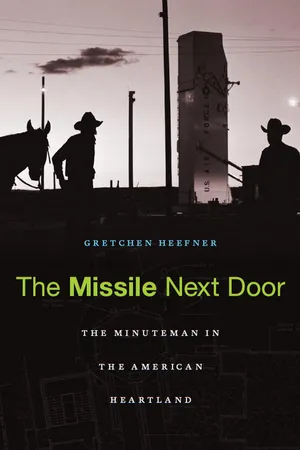
Between 1961 and 1967 the United States Air Force buried 1,000 Minuteman Intercontinental Ballistic Missiles in pastures across the Great Plains. The Missile Next Door tells the story of how rural Americans of all political stripes were drafted to fight the Cold War by living with nuclear missiles in their backyards—and what that story tells us about enduring political divides and the persistence of defense spending.
By scattering the missiles in out-of-the-way places, the Defense Department kept the chilling calculus of Cold War nuclear strategy out of view. This subterfuge was necessary, Gretchen Heefner argues, in order for Americans to accept a costly nuclear buildup and the resulting threat of Armageddon. As for the ranchers, farmers, and other civilians in the Plains states who were first seduced by the economics of war and then forced to live in the Soviet crosshairs, their sense of citizenship was forever changed. Some were stirred to dissent. Others consented but found their proud Plains individualism giving way to a growing dependence on the military-industrial complex. Even today, some communities express reluctance to let the Minutemen go, though the Air Force no longer wants them buried in the heartland.
Complicating a red state/blue state reading of American politics, Heefner's account helps to explain the deep distrust of government found in many western regions, and also an addiction to defense spending which, for many local economies, seems inescapable.
- English
- ePUB (mobile friendly)
- Available on iOS & Android
eBook - ePub
About this book
Information
1
Ace in the Hole
At 5:00 AM on September 17, 1960, three U.S. Air Force trucks pulled up to the Bay Bridge Toll Plaza. It was still dark, though in a few hours the sun would burn off the fog that habitually clung to San Francisco. That Saturday would be an ideal day: crisp blue skies, highs around 70 degrees. It was a good day to build a missile.1
The trucks, loaded with 10-foot-wide Titan missile cylinders, rumbled across Market Street and came to rest on Grove Street, in front of San Francisco’s Civic Auditorium. The night before, just a block away, Tosca had opened the season at the War Memorial Opera House. It was “the leading tribal rite” of fall, declared the San Francisco Chronicle, which also carried a brief story about the Titan’s arrival. If opening night at the opera was the event of the season for San Francisco’s elite, then the fourteenth annual Air Force Association Convention served a similar purpose for the nation’s aerospace enthusiasts. Convention organizers predicted that for five days the Bay Area would become the “aerospace center of the world.” So for the rest of the week there would be plenty of time to see a missile on the way to the opera.2
By Thursday, in addition to the Titan missile, millions of dollars’ worth of military hardware had been deposited near city hall. Much of the material was on exhibit inside the civic center auditorium as part of the Aerospace Panorama, though a handful of weapons remained outside, “contributing to the city’s skyline.” The display was “dazzling,” providing the public with a glimpse of the instruments of the newly arrived space age. There was a Bell X-1B rocket plane and North American Aviation’s Hound Dog air-launched standoff missile. The Titan stood nine stories tall. The Thor-Able missile promised a trip to the moon. Alluding to contemporary fears about Soviet military superiority and the much-hyped “missile gap,” reviewers noted that “the Russians may have outstripped us in the missiles but not in displaying them to the public.”3
The real coup of the convention, however, was the unveiling of the Air Force’s newest intercontinental ballistic missile (ICBM): the Minuteman. Descriptions of the weapon had been circulating since 1958, when the Pentagon funded Minutemen for development, but Thursday, September 22, 1960, would be the “first time anywhere” that the missile would be seen by the public, according to the Air Force Association press release. General Thomas D. White, the Air Force chief of staff, flew in for the occasion. San Francisco mayor George Christopher expressed his delight that the city could host such an important moment. Both shared the podium with NBC producer Roy Neal, who introduced the new missile. At precisely 7:00 PM White pushed a button and said “Off we go …,” and the gleaming dummy missile rose to a vertical static display, where it would remain through the weekend. Floodlights bathed the scene. An Air Force band played. “It was truly a heart warming sight,” the convention newsletter, The Booster, gushed. “The big bird appears ready to defend City Hall and Old Glory, which truly in a short time it will be doing.” Once fully erect the missile stood 60 feet tall.4
Here was the country’s “ace in the hole,” literally and figuratively. The Minuteman was presented as the ultimate deterrent force; it was the nuclear weapon that would keep the peace. It was also the first rocket that could be stored underground—in a hole. This was because the Minuteman was powered by solid fuels, rather than the liquid fuels that propelled the other big rockets, Titan and Atlas. Solid fuels are far more stable, making underground storage and launch possible. Air Force planners noted two major benefits to this approach. First, the Soviets would have a harder time eliminating underground weapons in the event of war. The missiles were built to be relatively invulnerable. In addition, the Minuteman could be fired remotely and instantaneously, vaulting out of its underground silo and capable of covering more than 6,000 miles in less than 30 minutes. Enough, the savvy listener would have realized, to reach the other side of the world.5
Push-button war, long the stuff of science fiction, had arrived. And the Air Force would not miss a chance to herald its importance. Indeed, White understood the power of image. He knew that making the Air Force the nation’s preeminent deterrent force depended on the good graces of the American public. “It is only through public support that [the Air Force] gets resources,” he had reminded the airmen assembled for the annual Air Force Commanders conference earlier that year. White found the topic “sufficiently important” to devote an entire session to telling his commanders how to be public relations agents. When speaking with the press, he warned, “don’t try to be funny,” “don’t gild the lily,” “don’t be evasive or criticize the newspaper profession,” and “don’t play favorites.” The stakes were considerable. In White’s estimation, the Navy “out sells us.” More damning still, “even the Army has seen the light.” As a result those two services were basking in positive attention.6
By sharing the podium with the Minuteman missile in San Francisco, White was thus sending a strong signal about the importance of this new weapon. He had long been an advocate for missiles. The chief of staff had little patience for those airmen who refused to see the future. And missiles, he knew, were the future.7
But the questions remained: Would the American people accept the strange new requirements of this type of war? Would they allow the deployment of nuclear weapons across the country? Even strategist Herman Kahn, known for obtuse and fantastical thinking about nuclear weapons and strategy, understood this anomaly. “If somebody ten years ago had said that in the mid-’60s we would be living with thousands of nuclear missiles poised on either side,” he wrote in 1961, “we would have said ‘You’re crazy. It’s too dangerous.’ ” Yet in 1960 this is precisely what the U.S. Air Force had planned. And White knew it. Clearly this was going to be a complicated “sell.”8
The Minuteman was not the first weapon featured in advertisements, magazine stories, and publicity tours. But promotion for these missiles was exceptional—and revealing—in a number of ways. The missiles introduced Americans to the nuclear space age and also required unprecedented levels of civilian engagement. For the first time, Americans would be asked to live next door to weapons of war. In promoting its latest missile system, then, the Air Force had many concerns with which to contend: Could the Air Force convince the Pentagon and Congress of the importance of nuclear missiles without eliciting larger public fears? Would Americans accept weapons of mass destruction in the heartland? Was it possible to promote a missile system that, in the end, was to be hidden away? How could you sell the population on a strategy that they were meant to forget?
While the outline of the Minuteman program has been described in numerous Air Force publications, the public presentation of the missile itself has been overlooked by scholars. But the publicity was critical, not only in getting the system built, but also in bringing Americans on board with the idea of nuclear deterrence and the Cold War. The missiles were presented to the American public as a panacea to Cold War security needs. A mere pencil-and-paper sketch in the fall of 1957, the Minutemen were rushed through development precisely as the nation was undergoing a massive reconsideration of weapons and war. In October 1957, the Soviets launched Sputnik into orbit. The era of push-button war was at hand, but it was not the Americans who controlled the lead. “Missile gap” hysteria was not far behind. Over the next few years Americans were repeatedly, though erroneously, warned that the Soviets would soon wield missile superiority, an advantage that purportedly would lead them to launch a preemptive nuclear strike against the United States. Many members of the Air Force Association and the U.S. Air Force encouraged these fears.9
Just as Sputnik was more than a beeping ball in orbit, the Minutemen were much more than strategic weapons. The Minutemen and the ways they were sold to the public helped inure the country to an extraordinary military landscape. The missiles were not built in a vacuum, but took careful account of public concerns as well as economic and political pressures. Only in understanding these relationships does the Minuteman program, and the nuclear arms race it was so integral to, make sense. Nothing in September 1957 pointed to the installation of 1,000 thermonuclear warheads across the United States. But just three years later, during the Air Force Association Convention, Minuteman planners were hoping for a force as much as ten times that amount. No one seemed to blink.
Part of the reason the Minutemen were pushed forward so quickly was that in the late 1950s they seemed to provide answers for yawning strategic and political questions. In fact just about everyone with an interest in missiles had some claim to the newest system. Congress needed it to fill the missile gap; the American public needed it to assuage their fears of Soviet military superiority; Eisenhower needed it to quiet those unfounded national concerns about strategic inferiority; in 1961 the new Kennedy administration needed it so as not to look feckless and weak; and all the while the Air Force needed it to keep its status as primary deterrent force. For a time the Minutemen were allowed to fill all of these needs; there were few real limitations on the imagining of the system and therefore few restraints on its development. Well into the early 1960s, the Minuteman program had no specific deployment numbers. Tellingly, from development in 1958 through the start of deployment in 1962, no one was certain how many missiles would be built—600? 1,000? 10,000? When the Joint Chiefs of Staff finally tried to reconcile Minuteman force levels in the fall of 1959, they noted warily the absence of basic statistics that would make their job possible. Not until 1964 did Secretary of Defense Robert McNamara sit down and set the outer limit: 1,000, a number arrived at not through careful consideration but through compromise and because it was a nice round figure. In the Minuteman program this ambiguity is precisely what allowed the perception of the missile’s inexpensiveness to prevail for so long. No firm numbers, no clear performance data, and no real cost estimates were available. It was because of this general failure to articulate clear and consistent strategic and operational needs that the Minuteman’s inexpensiveness would be seriously and irrevocably compromised. The ambiguity also allowed the missiles to fulfill, however erroneously, the desires of nearly everyone. It was the “ultimate weapon,” Reader’s Digest’s “missile that closed the gap,” and President Kennedy’s “ace in the hole.”10
To understand how and why this happened with little opposition, we first have to go back to the days when the Minutemen were on the drawing board. When the Air Force Ballistic Missile Division (BMD) began work on the Minuteman, no one yet realized that the missiles would have to fulfill surprising cultural functions.
In September 1957, the organization charged with building ICBMs, the Air Force BMD, opened a small, one-man office in the back of its Inglewood, California, headquarters. It was there that Colonel Edward N. Hall was put in charge of designing the nation’s first instantaneous missile. Hall, by all accounts a rather irreverent but brilliant engineer, worked alone, without a secretary or assistant. Rumor had it he once tried to quit, but his resignation was not accepted. Hall named his project Weapon System Q, not for something, but simply because Q was a letter that had not been taken by another project and also had a nice “air of mystery about it.”11
The solitary work of an Air Force engineer hardly seemed the propitious beginnings of what, in 1960, Roy Neal would describe as the nation’s salvation. And it was not. In fact the difference between the humble origins of the Minuteman program and its unveiling just three years later demonstrates just how much politics, paranoia, and groupthink could influence strategic decisions.
As Hall began work on Q, there was no certainty that such a new missile would be built. Throughout 1957, the pace and size of the nation’s strategic missile programs remained a matter of debate. Most strategic planners accepted the necessity of building missiles but disagreed about the resources that should be expended on them. The president was a case in point. Dwight D. Eisenhower tended to take a long view of the nation’s defense, preferring measured programs with clear results. He was certain of the importance of missiles but also understood that technology would take time and that there was no point in rushing headlong into something simply because of psychological ramifications. Eisenhower was more perturbed with the “competitive publicity” of the armed services. Well before warning the nation of the military-industrial complex, Eisenhower excoriated the Pentagon for turning weapons spending into a public pissing match. Such public rhetoric would inflame passions without fact; it would escalate the arms race without regard to means, needs, or repercussions. Even if the Soviets developed the first missiles, Eisenhower reasoned, they would be so crude as to be ineffective. The strategic balance would hold.12
In the fall of 1957 Eisenhower was quite confident in the nation’s missile programs. The Pentagon had more than thirty different missile systems under development, including two ICBMs, Atlas and Titan, both of which were to be deployed by the end of the decade. So certain was Eisenhower, in fact, that the Department of Defense enacted budgetary restrictions that summer, including caps on overtime spending, slowing the deployment schedule for existing missiles like Titan and Atlas, and ordering the review—and probable cancellation—of redundant missiles. The intent was to avoid knee-jerk developments. Eisenhower hoped that the country would need at most 150 “well-targeted” ICBMs to deter a Soviet first strike.13
The men of the Air Force BMD were less sanguine, which is precisely why Hall was put to work on Q. They believed that strategic superiority required nuance; it was no longer about how much megatonnage you could hurl at the other side. Rather it was about how well disguised and protected that megatonnage was; how instantaneous you could make your weapons; how well you could fool the other side. In this context the ICBMs already being readied, the Titan and Atlas, were obsolete. Both were huge and lumbering and relied on liquid propellants that had to be manually loaded before launch, a process that could take hours and leave a significant window of vulnerability for preemptive attack. For the men of the BMD, national security depended on developing a next-generation rocket, regardless of the resources required.
In creating ever-more sophisticated weapons, the BMD had important allies. As Hall tinkered away in Inglewood, more prominent missile advocates—a group Time magazine called the “missilemen”—turned rocketry into a public spectacle. “With every tick of the clock,” missile advocate Trevor Gardner warned in 1956, “the Soviet Union is moving closer … to knocking this country out. Intercontinental air power and missiles are the new double-edged sword of destruction, hanging by a hair over us all.” Gardner assured the public that the Soviets were ahead of the United States in ICBM development. Here were the makings of the missile gap. Weapon System Q would be ideally positioned to plug the perceived hole.14
But there was another side to Weapon System Q, one that belied the appearance of prudence. As Eisenhower warned,...
Table of contents
- Cover
- Half Title
- Title Page
- Copyright
- Dedication
- Contents
- Introduction: A Strange New Landscape
- 1. Ace in the Hole
- 2. Selling Deterrence
- 3. The Mapmakers
- 4. Cold War on the Range
- 5. Nuclear Heartland
- 6. The Radical Plains
- 7. Dismantling the Cold War
- Conclusion: Missiles and Memory
- Illustrations
- Abbreviations
- Notes
- Acknowledgments
- Index
Trusted by 375,005 students
Access to over 1.5 million titles for a fair monthly price.
Study more efficiently using our study tools.
Frequently asked questions
Yes, you can cancel anytime from the Subscription tab in your account settings on the Perlego website. Your subscription will stay active until the end of your current billing period. Learn how to cancel your subscription
No, books cannot be downloaded as external files, such as PDFs, for use outside of Perlego. However, you can download books within the Perlego app for offline reading on mobile or tablet. Learn how to download books offline
Perlego offers two plans: Essential and Complete
- Essential is ideal for learners and professionals who enjoy exploring a wide range of subjects. Access the Essential Library with 800,000+ trusted titles and best-sellers across business, personal growth, and the humanities. Includes unlimited reading time and Standard Read Aloud voice.
- Complete: Perfect for advanced learners and researchers needing full, unrestricted access. Unlock 1.5M+ books across hundreds of subjects, including academic and specialized titles. The Complete Plan also includes advanced features like Premium Read Aloud and Research Assistant.
We are an online textbook subscription service, where you can get access to an entire online library for less than the price of a single book per month. With over 1.5 million books across 990+ topics, we’ve got you covered! Learn about our mission
Look out for the read-aloud symbol on your next book to see if you can listen to it. The read-aloud tool reads text aloud for you, highlighting the text as it is being read. You can pause it, speed it up and slow it down. Learn more about Read Aloud
Yes! You can use the Perlego app on both iOS and Android devices to read anytime, anywhere — even offline. Perfect for commutes or when you’re on the go.
Please note we cannot support devices running on iOS 13 and Android 7 or earlier. Learn more about using the app
Please note we cannot support devices running on iOS 13 and Android 7 or earlier. Learn more about using the app
Yes, you can access The Missile Next Door by Gretchen Heefner in PDF and/or ePUB format, as well as other popular books in History & Military & Maritime History. We have over 1.5 million books available in our catalogue for you to explore.