For centuries a bastion of tradition and the jewel in the crown of French viticulture, Bordeaux has in recent years become dogged by controversy, particularly regarding the 2012 classification of the wines of St.-Émilion, the most prestigious appellation of Bordeaux's right bank. St.-Émilion is an area increasingly dominated by big international investors, especially from China, who are keen to speculate on the area's wines and land, some of whose value has increased tenfold in the last decade alone.
In the controversial 2012 classification, certain châteaux were promoted to a more prestigious class because of insider deals that altered the scoring system for the classification of wines into premier crus and grand crus. This system now takes into account the facilities of each château's tasting room, the size of its warehouse, and even the extent of its parking lot. The quality of the wine counts for just 30% of the total score for the wines of the top ranking, those deemed premier grand cru classé A.
In
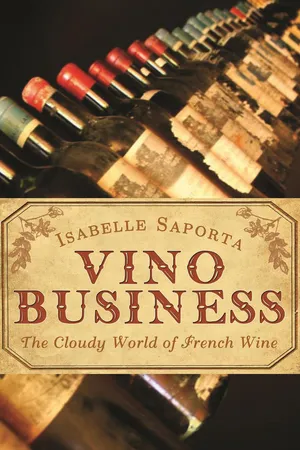
Vino Business, Saporta shows how back-room deals with wine distributors, multinational investors like the luxury company LVMH, and even wine critics, have fundamentally changed this ancient business. Saporta also investigates issues of wine labelling and the use of pesticides, and draws comparisons to Champagne, Burgundy and the rest of the wine world. Based on two years of research and reporting,
Vino Business draws back the curtain on the secret world of Bordeaux, a land ever more in thrall to the grapes of wealth.
- English
- ePUB (mobile friendly)
- Available on iOS & Android
eBook - ePub
About this book
Information
Topic
ArtSubtopic
Journalism1
The Bordeaux Elite and the Fête de la Fleur
Security is tighter than at the French president’s palace, with walkie-talkies, barricades, and bodyguards. After guests are asked to leave their cars, flocks of young women in white dresses shield them with umbrellas so they don’t get soaked in the pouring rain while stepping to the golf carts that will take them to the château. The anticipation is at its peak. A black sedan makes its way through the crowd, the only car permitted to enter the courtyard. It comes to a stop, and French actress Carole Bouquet emerges, looking magnificent.
Welcome to the Fête de la Fleur, the highlight of the spring season for the crème de la crème of the world of Médoc and the other wines of Bordeaux’s left bank. In 2013, this huge party thrown by the Commanderie du Bontemps, the self-proclaimed “wine brotherhood” of Bordeaux’s left bank, took place on the last day of the big wine show Vinexpo in Saint-Julien-de-Beychevelle, at Château Lagrange, which is owned by the Japanese company Suntory, the alcohol and soft drink giant whose holdings include the Orangina Schweppes Group. It’s a magical place, the sign of a time when big capital has invested in vineyards and businessmen have replaced winegrowers.
The Bordeaux wine industry has become adept at bringing VIPs on board and crafting a swanky image. In thirty years, this very private world has undergone a sea change. The important wine figures of yesteryear have yielded to wealthy investors, traditional winegrowers have been pushed aside by CEOs, and old vineyard owners have been replaced by movie stars. In just three decades, the business has radically changed in scope. Big capital has invaded the vineyards, bringing its marketing managers and PR apparatus. And the guilds, those old bastions of the Bordeaux bourgeoisie where the local officials used to love to get together, now hold glamorous celebrations that resemble Hollywood premieres.
In the multimillion-euro splendor of the Fête de la Fleur, with its chandeliers and gilded ceilings, deals are closed and reputations are forged. No self-respecting wine merchant or established winegrower would think of missing it. But it’s not cheap. Members of the Commanderie du Bontemps, the so-called commanders, pay €5,000 for a table for ten. Despite this high price, they all jump at the chance to get a table and invite celebrities, important clients, and those to whom they owe a favor. These ten seats provide the opportunity to display not only your power but also your gratitude. Of course, the well-known wine critics are seated at the best tables, including Jean-Marc Quarin, a Bordeaux critic who simultaneously proclaims his integrity as he grabs a spot at these elite shindigs. Or the American critic James Suckling, formerly of Wine Spectator, who describes himself as a California surfer who fell into wine by chance. Just a few years ago, he said that he loved Berlusconi and hated France and its pathetic soccer team. He also declared that Bordeaux was over.1 A few tables away sits Michel Rolland, the man who invented the profession of wine consultant. You may remember him as the man of almost Mephistophelian power who was seen in the movie Mondovino commanding his driver with the same authority he exercises in the vineyard. The owners of the greatest estates are here too, such as Pierre Lurton, head of Cheval Blanc and Yquem. The most prestigious Bordeaux vineyards are all represented. The circle is large, but not too large—a handpicked elite.
In 2013, there were only fifteen hundred tickets and competition to obtain them was fierce. The day before, people were still trying to wangle a ticket. “I heard that such and such château still has one available,” one local whispered to me. “I’m going to call them!” People worm their way in—or at least they try. After all, your presence may not be noticed, but your absence will be.
That was the experience of Bernard Pujol, head of the wine purveyor Bordeaux Vins Sélection. He is handicapped from a serious boating accident. As soon as he received the announcement, he rushed to reserve a table, but apparently he was not deemed prestigious or successful enough, for he was rejected. Two of his most important clients, SAQ (the Société des alcools du Québec) and the international French-owned supermarket chain Auchan, had asked for seats at his table. Aggrieved and embarrassed at losing face, he decided to sue the head of the Commanderie du Bontemps in Bordeaux civil court. “I look like a clown in front of my clients, like somebody with no influence, and that’s bad for business.”2 He’s seeking €500,000 in damages. But he’s willing to settle if the Commanderie will hear his arguments. “They’ll listen. You just have to put enough pressure on them,” he told me, with a smile.3
This elite world may look civilized and discreet. But being excluded from it can mean financial ruin. The day of the event, the organizers made sure that no interlopers managed to crash the party, which was indeed a splendid one. You have to be made of strong stuff to survive being left out of this charming little clique. A few rebels make a point of boycotting these high-class affairs. One of them is the world-renowned wine consultant Stéphane Derenoncourt. Every year he thumbs his nose at the Bordeaux elite by throwing an anti–Fête de la Fleur with the cellar masters—the laborers whose hard work is behind the production of fine wines. He likes to call it the beggars’ ball. Derenoncourt hasn’t forgotten his roots. After a troubled childhood in northern France, he moved to the Bordeaux region and started at the bottom of the ladder as a laborer in the fields. In twenty years, he worked his way up from vineyard worker to internationally renowned wine consultant. Refusing to attend the Fête de la Fleur is his way of rejecting the privileged classes of Bordeaux, who wanted nothing to do with him when he was just a nobody.
That evening, as soon as guest of honor Carole Bouquet had gotten out of her car, the Commanderie began to pay her its respects. She was entitled to this privilege not just as a famous actress, but also as a winemaker. She has a vineyard on the Sicilian island of Pantelleria. In Michel Rolland’s opinion, her wine is not even worth carrying back to the mainland—perhaps a harsh assessment, but who cares? A gorgeous winemaker–actress is the perfect image. Two other actresses—Bond girl Michelle Yeoh and Karl Lagerfeld’s muse Anna Mouglalis—were also wearing the Commanderie’s traditional wine-colored robes. In addition to famous actresses, as well as the Japanese ambassador, there were the big clients, especially Chinese wine importers—everyone who makes the Bordeaux market what it is today, that is to say, extremely speculative. The Fête de la Fleur is for thanking and honoring those who make Bordeaux thrive, and this exceptional wine industry has made its living from China ever since that country developed a thirst for red wine.
A few days before, under clearer skies, the Jurade de Saint-Émilion held its own event on the right bank. Of course, it wasn’t quite as nice, since the right bank doesn’t have as much money as the Médoc. At least that’s what the local gossips say (and there are many of them). But Hubert de Boüard, president of the Jurade and the owner of one of the biggest crus classés, Château Angélus, maintains that Saint-Émilion represents history, knowledge, and culture, while Médoc is for shopkeepers, even nouveaux riches. Be that as it may, Saint-Émilion couldn’t have gotten Michelle Yeoh or Anna Mouglalis, not to mention Carole Bouquet. The only actor who deigned to make the trip is Stéphane Henon, who plays a police officer on the French soap opera Plus belle la vie. But Chinese and American investors also had a place of honor in the picturesque village of Saint-Émilion, which is a UNESCO World Heritage site. As at the Fête de la Fleur, the highest honors go to those who make deals, not wine.
There was not an empty seat at the Fête de la Fleur, but at the Jurade de Saint-Émilion some tables were sparsely filled. Two major figures in the world of fine wine refused to attend: Pierre Lurton of Cheval Blanc and Alain Vauthier of Ausone. Their wines were the first ever to be classified as Saint-Émilion premiers grands crus but, for them, it would have been a disgrace to attend this flashy ceremony put on by the man they’ve nicknamed Hubertus Magnus or don Hubert de Saint-Émilion. It is this man, Hubert de Boüard de Laforest, who is responsible for the Saint-Émilion classification scandal.
Welcome to the private world of the grands crus classés, a.k.a. Vino Business, a kingdom that can be more cutthroat than Wall Street.
2
Louis Vuitton and Prada Make Wine
He’s not very tall, and he proudly displays the round belly of a bon vivant who enjoys the pleasures of the table. Two large wrinkles extend diagonally from his forehead, looking to all the world like devil’s horns. His eyes sparkle, but they’re also piercing. This jovial businessman with the sharp eyes, the man who punctuates all his sentences with a booming laugh even before they’re finished, is Michel Rolland. The wine-making king of kings. The man who has spread the wine gospel to every corner of the world. But this savvy businessman, this modern shark of the wine industry, becomes wistful when he talks about his properties,1 especially the family estate in Pomerol, Bon Pasteur, which he had to sell to satisfy the monetary desires of his lawyer brother.
Like many before him, he was caught up in the financial spiral that’s taken hold of vineyards these last few years. The price of land has skyrocketed, whetting the appetites of all the heirs to these great dynasties.
“Why was Cheval Blanc sold, why was Pavie sold, why is everything being sold?”2 asks Rolland, irritated. It’s of course because the land is such a gold mine that the brother or sister who has left the family wine-making business behind won’t agree to wait a long time before cashing in. “We try to get as much money as possible from the property to save it, but the profits are nothing compared to what the land is worth! It’s only human that each person wants a piece of the pie.”3 And, at age seventy, Rolland’s brother decided to get his.
All over Bordeaux, in a painful process, the current winemakers’ siblings are now claiming their right to the riches within their grasp. When land reaches astronomical prices, it is indeed hard to rein in a family’s dreams of instant wealth. A press attaché who knows Bordeaux well explained to me: “Just think of the brother or sister who didn’t take up wine making and knows perfectly well that they’re sitting on a colossal fortune that they can’t touch! There’s no way they’d accept this!” Not to mention the estate taxes, which reduce the chances that land will stay in the family even further. How can the heirs get access to that much cash when the money is all in the land?
Michel Rolland, like many others before him, had to resign himself to selling most of his estates—the very ones that made his reputation and his success—to a real estate conglomerate, Hong Kong’s Goldin Group.
Rolland knows Goldin well because he was already a consultant for Sloan Estate in California, which it owns. The sale price was not released, but it must have been very high. People in the Bordeaux wine community believed it was on the order of €15 million. For that kind of money, you reluctantly give up the family estate. The one that belonged to your grandfather, a landowning Pomerol farmer. The one where your parents were wed in 1942. You forget the little stone bench that had been kept until then, a souvenir of all those old memories that make a family’s history. “I can’t let myself be melancholy. I don’t have the means. It’s fantastic to get to keep your estate. But when you can’t, you have to stop being emotional.”4
These small family tragedies play out every day in French wine country. Why is there such a crazy spike in land prices? Because big companies, afraid of stock market fluctuations and real estate speculation, decided to invest in land, creating a bubble. But big money hasn’t invested everywhere; they’ve focused on the most prestigious appellations. Prices in Pomerol in 1993 were on average €292,000 per hectare and reached a peak of €2.35 million per hectare in 2012.5 In Saint-Émilion, the increase is also staggering: €120,000 in 1993 versus €1.1 million today. Over twenty years, with the massive influx of money into renowned terroirs, prices have gone up almost by a factor of ten. And while this upward movement began in 2002 (when the Internet bubble burst), it became even stronger in 2008 during the financial crisis, with Pomerol passing the €1.7 million per hectare.
At the same time, in lesser-known appellations, such as Côtes de Castillon, despite its location right next to Saint-Émilion, prices have stagnated for twenty years: €16,100 per hectare in 1993, €21,000 today. In fact, prices are half what they were at their peak in 2002, when this magnificent land reached the modest record of €56,400 per hectare. At that time, investors thought they had found a new gold mine in this special ...
Table of contents
- Vino Business
- Title Page
- Imprint
- Epigraph
- Contents
- Map: Wine Regions of Bordeaux
- Vino Business
- Introduction
- 1 The Bordeaux Elite and the Fête de la Fleur
- 2 Louis Vuitton and Prada Make Wine
- 3 The Hidden Side of the System: Blockbuster Wines
- 4 The Classification Scandal
- 5 Sach a Nice Dictator
- 6 With a Bogus Authority, the INAO
- 7 And in the Middle, a Handful of Alchemists
- 8 The Hide a Dangerous Street
- 9 Maintained by Curious Methods
- 10 Praised by an Enthusiastic Court
- 11 A Very Nice Carnival
- 12 Bordeaux Is Booming in China
- 13 Vino China
- 14 The Sharks Divide Up the Land
- 15 The Long March of the Pomerol Exiles
- 16 You Have to Think Bigger
- 17 The Helicopters of Good Taste
- 18 Little Arrangements Between Lords
- 19 Pesticide Victims
- 20 The One Who Said No
- 21 A Little Guy Among the Greats
- 22 Tribulations of a Bourdeaux Winemaker in China
- 23 The CAP Jackpot
- 24 Fear, or the Reign of Modern Oenology
- 25 My Kingdon for a Chip
- Afterword
- Acknowledgments
- Notes
Trusted by 375,005 students
Access to over 1.5 million titles for a fair monthly price.
Study more efficiently using our study tools.
Frequently asked questions
Yes, you can cancel anytime from the Subscription tab in your account settings on the Perlego website. Your subscription will stay active until the end of your current billing period. Learn how to cancel your subscription
No, books cannot be downloaded as external files, such as PDFs, for use outside of Perlego. However, you can download books within the Perlego app for offline reading on mobile or tablet. Learn how to download books offline
Perlego offers two plans: Essential and Complete
- Essential is ideal for learners and professionals who enjoy exploring a wide range of subjects. Access the Essential Library with 800,000+ trusted titles and best-sellers across business, personal growth, and the humanities. Includes unlimited reading time and Standard Read Aloud voice.
- Complete: Perfect for advanced learners and researchers needing full, unrestricted access. Unlock 1.5M+ books across hundreds of subjects, including academic and specialized titles. The Complete Plan also includes advanced features like Premium Read Aloud and Research Assistant.
We are an online textbook subscription service, where you can get access to an entire online library for less than the price of a single book per month. With over 1.5 million books across 990+ topics, we’ve got you covered! Learn about our mission
Look out for the read-aloud symbol on your next book to see if you can listen to it. The read-aloud tool reads text aloud for you, highlighting the text as it is being read. You can pause it, speed it up and slow it down. Learn more about Read Aloud
Yes! You can use the Perlego app on both iOS and Android devices to read anytime, anywhere — even offline. Perfect for commutes or when you’re on the go.
Please note we cannot support devices running on iOS 13 and Android 7 or earlier. Learn more about using the app
Please note we cannot support devices running on iOS 13 and Android 7 or earlier. Learn more about using the app
Yes, you can access Vino Business by Isabelle Saporta, Kate Deimling in PDF and/or ePUB format, as well as other popular books in Art & Journalism. We have over 1.5 million books available in our catalogue for you to explore.