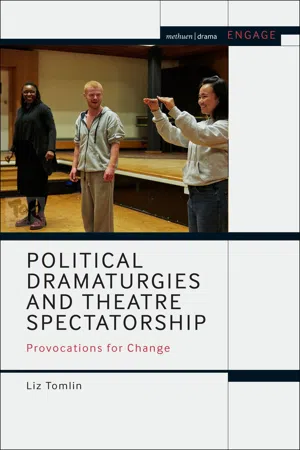
What do we mean when we describe theatre as political today? How might theatre-makers' provocations for change need to be differently designed when addressing the precarious spectator-subject of twenty- first century neoliberalism? In this important study Liz Tomlin interrogates the influential theories of Jacques Rancière to propose a new framework of analysis through which contemporary political dramaturgies can be investigated. Drawing, in particular, on Ernesto Laclau and Chantal Mouffe, Lilie Chouliaraki and Judith Butler, Tomlin argues that the capacities of the contemporary and future spectator to be 'effected' or 'affected' by politically-engaged theatre need to be urgently re-evaluated.
Central to this study is Tomlin's theorized figuration of the neoliberal spectator-subject as precarious, individualized and ironic, with a reduced capacity for empathy, agency and the ability to imagine better futures. This, in turn, leads to a predilection for a response to injustice that is driven by a concern for the feelings of the subject-self, rather than concern for the suffering other. These characteristics are argued to shape even those spectator-subjects towards the left of the political spectrum, thus necessitating a careful reconsideration of new and long-standing dramaturgies of political provocation.
Dramaturgies examined include the ironic invitations of Made in China and Martin Crimp, the exploration of affect in Kieran Hurley's Heads Up, the new sincerity that characterizes the work of Andy Smith, the turn to the staging of the spectators' 'other' in Developing Artists' Queens of Syria and Chris Thorpe and Rachel Chavkin's Confirmation, and the community activism of Common Wealth's The Deal Versus the People.
eBook - ePub
Political Dramaturgies and Theatre Spectatorship
Provocations for Change
- 216 pages
- English
- ePUB (mobile friendly)
- Available on iOS & Android
eBook - ePub
Political Dramaturgies and Theatre Spectatorship
Provocations for Change
About this book
Information
Part One
Configuring the Spectator-Subject
1
Real and Imagined Spectators
A trend of revitalized interest in the spectator can be seen to emerge towards the end of the 2000s, heralded by Bruce McConachie’s Engaging Audiences: A Cognitive Approach to Spectating in the Theatre (2008), Helen Freshwater’s theatre & audience (2009), Helena Grehan’s Performance, Ethics and Spectatorship in a Global Age (2009) and Josephine Machon’s (Syn)aesthetics: Redefining Visceral Performance (2009). These texts are commonly seen as vanguards for the subsequent decade’s interest, respectively, in cognitive, ethnographic, ethico-political and participatory modes of spectatorship. This flurry of interest is notable given that it had been almost two decades since the first publication of Susan Bennett’s Theatre Audiences: A Theory of Production and Reception (1990) and Herbert Blau’s The Audience (1990), only significantly preceded by Jill Dolan’s The Feminist Spectator as Critic (1988) and Daphna Ben Chaim’s Distance in the Theatre: The Aesthetics of Audience Response (1984).
The nascent field of audience research that emerged in 2008–9 was rapidly accelerated and broadened by a swathe of subsequent publications,1 but McConachie and Freshwater have been particularly influential in their advocation for empirical, if distinctly different, approaches to spectator analysis, both sharing a scepticism of the kind of theoretical study of spectators that is the focus of this book. In this chapter, I thus begin by addressing the challenge that is mounted by both cognitive analysis and audience research to the theoretical tradition of analysis that this study pursues. I will argue that, despite claims to the contrary, no mode of analysis transcends theorization and, furthermore, that modes of audience research are particularly vulnerable to assimilation within the neoliberal obsession with the spectator-consumer. In conclusion, I will thus argue for the potency and potential of a theorized, or imagined, spectator as a necessary figure in the design of political dramaturgies of all models.
Real spectators
Bruce McConachie’s vanguard call to the discipline dismisses proponents of theorized audience research from psychoanalysts to poststructuralists for trying ‘to place their ideas beyond the protocols of empirical evidence and falsifiability’ (2008: 11). Materialist criticism is afforded only marginally more credibility before it too falls under the umbrella of ‘many of our current theories in theatre and performance studies’ that ‘cannot be falsified or supported with reliable evidence’ and are consequently charged with offering conclusions that are ‘potentially built upon sand’ (13). Yet, as McConachie himself acknowledges, ‘scientists themselves do not agree on what I have called (with intentional blandness) “a fair reading of the available evidence”’ (15), thus scientific theories are admitted to being precisely that. McConachie argues that the ongoing theoretical debates between scientists offer theatre and performance scholars an opportunity to further scientific research with their own insights and investigations, but he himself confesses to only drawing on ‘theories about culture, history, and audiences from anthropology, phenomenology, communications, and cultural studies’ with the intention ‘to supplement the insights of cognitive science’ (14), thus asserting a clear hierarchy of knowledge that is all, nonetheless, equally theoretical.
Conversely, I would argue that insights drawn from cognitive research as often serve to reinforce understandings of spectatorship and reception that have long been arrived at via theorized calculation. For example, cognitive research into mirror neurons (McConachie 2008: 18–19) that suggests how a spectator may internally replicate the actions performed by the actor reinforces, rather than challenges, historical theories of empathy that propose the spectator can vicariously experience the ‘fear’, in Aristotelian terms, of the protagonist. Thus, science, in some key instances, gives us different ways of talking about operations that have long been familiar to scholars within the discipline. This should give us confidence in current informed and theorized speculation that might, in the future, also prove to be ahead of the scientific ‘evidence’.
Further challenges to the kind of theoretical analysis that this study will propose have been mounted by scholars such as Freshwater and Kirsty Sedgman, who both demand that greater attention is paid to empirical methods of audience research, long-standing in film and television criticism but virtually absent, until recent years, in theatre studies. In theatre & audience, Helen Freshwater asks why theatre scholars ‘appear to prefer discussing their own responses, or relaying the opinions of reviewers, to asking “ordinary” theatre-goers – with no professional stake in the theatre – what they make of a performance?’ (2009: 4). Unlike the long tradition of empirical audience research in the fields of film and television, Freshwater argues, theatre scholars have tended to speculatively theorize audiences rather than asking real audiences what they think, thus limiting, she suggests, the scope and potential of disciplinary enquiry. Kirsty Sedgman likewise argues:
The field of theatre studies has sometimes seemed on the verge of moving from ‘rhetorical’ work, understanding audiences by dismantling texts for their capacity to produce responses, via ‘high theory’ about how hypothetical audiences do or should respond to things, to conducting cognitive experiments on them, without actually stopping to talk to audiences on the way. (2016: 10, original emphasis)
Both Freshwater and Sedgman offer a number of reasons why this might be the case, from the methodological complexities noted by Christopher Balme (Balme 2008: 34 in Freshwater 2009: 36–7), to the time-consuming nature of empirical enquiry (Freshwater 2009: 37), to a long-held suspicion that audiences can’t be trusted (Freshwater 2009: 38–55), to a full-blown sense of protectionism over the ‘ineffable’ nature of the art object and the desire to hold onto the expertise of the professional critic or scholar who alone is qualified to appreciate it (Bourdieu 1996: xvi–xvii in Sedgman 2016: 25).
Implicit within the allegations of unwelcome expertise that are levelled at the critic or scholar is the underlying assumption that these are somehow less valuable, and perhaps less authentic, than the responses of ‘real’ audience members who are without professional or vested interest. The trend in audience research also plays to the broader movement that is the focus of this study: the logic of autonomy that valorizes the subjective and individual response (that in audience research can be evidenced and authorized after the fact) over any speculative prediction of collective interpretation. Yet, the reservations voiced by Kim Schröder et al. in the context of ethnographic media research would also hold here. Schröder et al. argue that when real-life responses, such as interviews, are assumed to be of ‘a higher quality than, say, textual analyses or surveys [s]uch an insistence easily slides into an academic fundamentalism that has no methodological or theoretical grounding’ (Schröder et al. 2003: 85). The claims that would validate qualitative interviews over quantitative surveys or textual analysis are ultimately derailed by the fact that, as with all personal testimony, the respondent’s narrative is never an unmediated truth. It is shaped firstly by the questionnaire itself which, as Reinelt et al. caution, ‘does not always capture ordinary experiences of theatre spectatorship but may model a new kind of theatre spectatorship’ (2014: 52). Secondly, it is mediated by the respondent themselves, aware of the context of the interview, the status of the interviewer and the narrative of self they are presenting. Sedgman’s comparative analysis of respondents who feel they hold more or less cultural authority is telling, and her work highlights that ways of articulating value are intrinsically bound up in ‘Who Feels They Have the Right to Say What, and on What Grounds’ (2016: 115). Finally, and inevitably, the research is shaped by the researcher. For it to go beyond an unmediated cacophony of testimony that may be more or less distorted by issues of cultural confidence, ‘contradictions’ that arise within individual transcripts (Reinelt et al. 2014: 32) and, pace Erving Goffman (1959), particular presentations of self, the discourse that emerges requires the authority of the analyst to construct a metanarrative that finds commonalities and patterns that enable the research to offer something of cultural significance. Without this metanarrative, as Schröder et al. contend, ‘we may trace the meanderings of contemporary mediated meaning-making in their depth and richness, but we cannot hope to simultaneously chart the full breadth of these processes – let alone predict how they will proceed’ (Schröder et al. 2003: 85). Thus, despite its evident capacity to offer additional, and sometimes valuable, insights, the idea that empirical audience research can somehow evade the limitations of subjective expert theorization is not, I would argue, a sustainable one.
The ‘real’ spectator’s ‘authentic’ response is, rather, doubly mediated: firstly, by the spectator herself, who is constructing a response that is congruent with the narrative of self she wishes to sustain and promote; and secondly, by the researcher, who is then required to select, edit and position the response in a way that supports the shape of the particular theoretical narratives that she wishes to sustain and promote. The first mediation is particularly notable in its absence from most accounts of contemporary audience research, possibly because it continues to give credence to ‘the behaviourist “effects” model’ which followed Theodor Adorno’s critiques of the mass media and which was subsequently dismissed by Herbert Blumer and empiricists after him (Staiger 2005: 44). This model suggested, as Janet Staiger observes, that the responses of participants were unreliable: ‘If mass media necessarily produced a psychological regression for audiences, open-ended questionnaires and other sorts of empirical questioning of individuals made no sense’ as the answers given were not to be trusted (Staiger 2005: 30). Subsequent trends in criticism have sought to challenge the assumed passivity and vulnerability to media manipulation that the behaviourist effects model proposed, but beyond Adorno’s Marxist argument, philosophers from Jacques Derrida to Slavoj Žižek have also problematized the degree to which any subject is able to represent herself or her opinions in isolation from cultural ideological conditioning. In Derridean terms, ideology apart, the ‘thing itself’ – in this case the authentic response – slips from our grasp the moment it becomes subject to its own representation – in this case its articulation through speech or writing. As Derrida contests, ‘contrary to what our desire cannot fail to be tempted into believing, the thing itself always escapes’ (1973: 104). In this sense, the ‘real’ spectator’s ‘authentic’ response, while a perfectly valid object of research, is no more authentic or reliable than the predicted response of the theorized spectator who is the subject of this study. Furthermore, as I will argue at length in the following two chapters, no response can entirely escape the effects of the ideological conditions in which it is conceived, thus necessitating some level of materialist analysis to productively interpret each ‘authentic’ response in its wider context.
Spectator-consumers
The enthusiasm for audience research, in the context of political dramaturgies, carries additional risks in the contemporary neoliberal moment in which the sovereignty of the individual consumer is paramount. Like the immersive and interactive models of performance, discussed in the following chapter, that have also risen to prominence in the first two decades of the twenty-first century, qualitative audience research prioritizes the subjective, individual and affective response that is central to phenomenological modes of analysis. In the report Critical Mass: Theatre Spectatorship and Value Attribution (2014), undertaken by the British Theatre Consortium, Janelle Reinelt et al. are clear that within the broad parameters of the empirical field, ‘the phenomenology of actual experience’ (2) is the methodology at the heart of their research. In a real sense both Critical Mass and Sedgman’s empirical research in Locating the Audience (2016) broaden the opportunity for each individual spectator to engage in the kind of phenomenological analysis that underpins the performative writing of scholar Peggy Phelan. As Helen Freshwater notes,
At its best this approach can show how fully our responses to performance are generated by individual preoccupations and experiences, as well as allowing the writer to explore – and thus validate – emotional and physiological aspects of response which will never be captured by statistical analysis and which have not been considered ‘proper’ subjects for academic analysis in the past. (2009: 24)
Freshwater’s identification of the potential of phenomenological research to unlock responses that are both specific to the individual and emotional or physiological in nature demonstrates the necessary synergy between new models of practice that seek to explore the emotional and physical affects of theatre through a range of immersive strategies, the individualization of experience through trends such as one-to-one theatre and the new methods of analysis required for these kinds of audience experience. The potential of widening opportunities for phenomenological analysis within empirical models might be understood as democratizing the scholarly tradition which Phelan’s work exemplifies – a tradition that Sedgman notes is too often ‘embedded within a set of “expert” discourses inflected by the position of its author, and so is unable to map the existence of different kinds of responses from varying subject positions’ (2016: 9). Yet, an over-reliance on phenomenology within an empirical framework, regardless of the expertise or otherwise on the part of the reflexive analyst, necessitates the insistence on the autonomy and subjectivity of response that this book is seeking to interrogate. Following work by Jen Harvie (2013) and Adam Alston (2016) in relation to the spectator-participant of, respectively, social art and immersive theatre, I will now suggest that the turn to audience research also holds the risk of substantiating the reification of the neoliberal, individualized consumer operating within the auspices of contemporary global capitalism.
It is significant that the projects undertaken by Reinelt et al. and Sedgman were conducted in the context of (in the first instance in explicit collaboration with) specific theatre institutions and both placed the question of if, and how, particular theatre productions were ‘valued’ by their audiences at the heart of the research. Helen Freshwater notes that the common distinction between audience research undertaken by the theatre industry and that undertaken by scholars is that the latter ‘for the most part, [are] interested in how audiences interpret what they have seen, whereas the industry is concerned with ensuring the profitability of its investment and is consequently more interested in why a production appeals and in generalising about patterns of consumption’ (2009: 30). Freshwater’s caution about the distinctly economic interest of the industry’s investment, while clearly logical from a venue’s perspective, does underline, for me, an uneasy alignment of recent academic interest in what the ‘real’ spectator thinks and the neoliberal concern with the customer being given exactly what it is that they think they want. In response to Sedgman’s research, for example, John E. McGrath, then artistic director of National Theatre Wales, acknowledged that the challenge for him was how to use the outcomes to ‘usefully inform the new production’ (Sedgman 2016: 165). Although McGrath was clear that ‘understanding audiences’ responses does not necessarily mean doing everything differently’ (165) and that ‘to make shows that absolutely everyone will like, all the time, is simply impossible’ (165), I’m not as confident as Sedgman in her conclusion that ‘finding out more about audiences does not therefore have to lead to fewer risks’ (165).
For some time now, in the UK theatre ecology, venues have gone further than the extrapolation of data from audience evaluations of previous shows to inform the selection, or production, of new ones. Helen Freshwater notes that ‘the desire to engage with audiences and their responses has resulted in the emergence of a new category of work in the United Kingdom in recent years, as venues have begun to host “scratch nights,” where unfinished work is presented and artists have an opportunity to gather feedback from audiences’ (2009: 73). My view on scratch nights, while acknowledging the many productive aspects of them, is more critical than Freshwater’s, and I have elsewhere expressed wider concerns about some of the implications of the proliferation of scratch nights on the new work ecology (Tomlin 2015: 277–9). Scratch nights are, as Freshwater observes, marketed to audiences with a strong emphasis on the opportunity to see future work at an early stage of development, and to input directly into a work in progress, whether through post-show discussions or questionnaires, or both. When I was first making work in the early 2000s, such responses were predominantly for the company to consider and could be extremely helpful in gaining disinterested perspectives on a piece of work in progress. However, as the decade advanced, it became increasingly common for venues interested in potential future production of the work to utilize these as guidance for the artist, with companies being asked to follow certain directions indicated by their scratch night spectators as a condition of further support.2 Here, for me, we return precisely to that uneasy alignment between audience analysis and customer satisfaction where the art is at risk of being led by what the consumer thinks they want. This holds serious consequences for the type of work that is made which inevitably rests on how work comes to be valued and, ultimately, funded. By 2018 Arts Council England was set to re-tender for the latest version of the discredited Quality Metrics Framework, rebranded, rather terrifyingly, as the Consumer Insight Toolkit (Hill 2018). Like its discarded predecessor this would establish a standardized evaluation system to be used across (initially) the larger National Portfolio Organizations, so that a set of predetermined quality metrics, largely drawing on consumer satisfaction, could be used to measure and benchmark the quality of each organization’s artistic output against their own objectives and the corresponding statistics of their competitors.
Lewis, Inthorn and Wahl-Jorgensen argue that the market ideal of the consumer is now subsuming the agency of the human subject, no longer ‘actively engaged in the shaping of society and the making of history’ but rather consigned to ‘simply choose between the products on display’ (Lewis et al. 2005: 5–6). In the discourse of political theatres, the danger of such a reconfiguration is hugely counterproductive. Locating not the active citizen but the consumer at the heart of the theatre experience is to relocate the artistic work as a commodity that is designed to please consumers who already know what they like and what they want to buy. The implications extend further as the rules of the marketplace then seek artistic products that will sell the best and satisfy the widest range of spectators. At this point, art becomes an exercise in giving audiences more of what they have already enjoyed and abandoning the risk factor – and the possibility of changing existing aesthetic preferences or political perspectives – altogether.
This, of course, is precisely the kind of commodification of art that Theodor Adorno and Max Horkheimer (1997) identified in their seminal critique of the cultural industries and that practitioners of politically engaged theatre have historically been intent on resisting. The figure of the consumer can be seen to stand, throughout the range of political philosophy drawn on in this study, for the spectator-subject who has accepted the terms of the ideological norms of their society and their own role and complicity within neoliberalism. The consumer within the economic and political order happily accepts the compensations on offer from that economic and political order and does not question the structural apparatus, with all its inequaliti...
Table of contents
- Cover
- Halftitle Page
- Title Page
- Dedication Page
- Contents
- Acknowledgements
- Introduction
- Part One: Configuring the Spectator-Subject
- Part Two: Contemporary Political Dramaturgies
- Epilogue
- References
- Index
- Imprint
Trusted by 375,005 students
Access to over 1.5 million titles for a fair monthly price.
Study more efficiently using our study tools.
Frequently asked questions
Yes, you can cancel anytime from the Subscription tab in your account settings on the Perlego website. Your subscription will stay active until the end of your current billing period. Learn how to cancel your subscription
No, books cannot be downloaded as external files, such as PDFs, for use outside of Perlego. However, you can download books within the Perlego app for offline reading on mobile or tablet. Learn how to download books offline
Perlego offers two plans: Essential and Complete
- Essential is ideal for learners and professionals who enjoy exploring a wide range of subjects. Access the Essential Library with 800,000+ trusted titles and best-sellers across business, personal growth, and the humanities. Includes unlimited reading time and Standard Read Aloud voice.
- Complete: Perfect for advanced learners and researchers needing full, unrestricted access. Unlock 1.5M+ books across hundreds of subjects, including academic and specialized titles. The Complete Plan also includes advanced features like Premium Read Aloud and Research Assistant.
We are an online textbook subscription service, where you can get access to an entire online library for less than the price of a single book per month. With over 1.5 million books across 990+ topics, we’ve got you covered! Learn about our mission
Look out for the read-aloud symbol on your next book to see if you can listen to it. The read-aloud tool reads text aloud for you, highlighting the text as it is being read. You can pause it, speed it up and slow it down. Learn more about Read Aloud
Yes! You can use the Perlego app on both iOS and Android devices to read anytime, anywhere — even offline. Perfect for commutes or when you’re on the go.
Please note we cannot support devices running on iOS 13 and Android 7 or earlier. Learn more about using the app
Please note we cannot support devices running on iOS 13 and Android 7 or earlier. Learn more about using the app
Yes, you can access Political Dramaturgies and Theatre Spectatorship by Liz Tomlin, Enoch Brater, Mark Taylor-Batty, Enoch Brater,Mark Taylor-Batty in PDF and/or ePUB format, as well as other popular books in Media & Performing Arts & Theatre. We have over 1.5 million books available in our catalogue for you to explore.