Where Wizards Stay Up Late
eBook - ePub

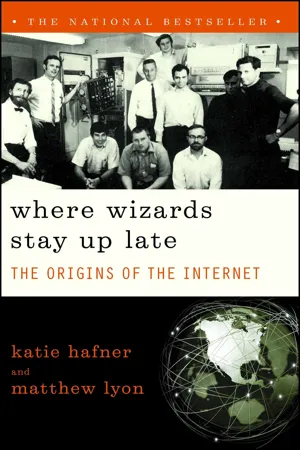
Where Wizards Stay Up Late

The Origins Of The Internet

  1. 304 pages
  2. English
  3. ePUB (mobile friendly)
  4. Available on iOS & Android
eBook - ePub

Where Wizards Stay Up Late

The Origins Of The Internet

About this book

Twenty five years ago, it didn't exist. Today, twenty million people worldwide are surfing the Net. Where Wizards Stay Up Late is the exciting story of the pioneers responsible for creating the most talked about, most influential, and most far-reaching communications breakthrough since the invention of the telephone.
In the 1960's, when computers where regarded as mere giant calculators, J.C.R. Licklider at MIT saw them as the ultimate communications devices. With Defense Department funds, he and a band of visionary computer whizzes began work on a nationwide, interlocking network of computers. Taking readers behind the scenes, Where Wizards Stay Up Late captures the hard work, genius, and happy accidents of their daring, stunningly successful venture.
Frequently asked questions

Yes, you can cancel anytime from the Subscription tab in your account settings on the Perlego website. Your subscription will stay active until the end of your current billing period. Learn how to cancel your subscription.
At the moment all of our mobile-responsive ePub books are available to download via the app. Most of our PDFs are also available to download and we're working on making the final remaining ones downloadable now. Learn more here.
Perlego offers two plans: Essential and Complete
  • Essential is ideal for learners and professionals who enjoy exploring a wide range of subjects. Access the Essential Library with 800,000+ trusted titles and best-sellers across business, personal growth, and the humanities. Includes unlimited reading time and Standard Read Aloud voice.
  • Complete: Perfect for advanced learners and researchers needing full, unrestricted access. Unlock 1.4M+ books across hundreds of subjects, including academic and specialized titles. The Complete Plan also includes advanced features like Premium Read Aloud and Research Assistant.
Both plans are available with monthly, semester, or annual billing cycles.
We are an online textbook subscription service, where you can get access to an entire online library for less than the price of a single book per month. With over 1 million books across 1000+ topics, we’ve got you covered! Learn more here.
Look out for the read-aloud symbol on your next book to see if you can listen to it. The read-aloud tool reads text aloud for you, highlighting the text as it is being read. You can pause it, speed it up and slow it down. Learn more here.
Yes! You can use the Perlego app on both iOS or Android devices to read anytime, anywhere — even offline. Perfect for commutes or when you’re on the go.
Please note we cannot support devices running on iOS 13 and Android 7 or earlier. Learn more about using the app.
Yes, you can access Where Wizards Stay Up Late by Matthew Lyon,Katie Hafner in PDF and/or ePUB format, as well as other popular books in Social Sciences & Sociology. We have over one million books available in our catalogue for you to explore.

Information

1

The Fastest Million Dollars

February 1966

Bob Taylor usually drove to work, thirty minutes through the rolling countryside northeast of Washington, over the Potomac River to the Pentagon. There, in the morning, he’d pull into one of the vast parking lots and try to put his most-prized possession, a BMW 503, someplace he could remember. There were few if any security checkpoints at the entrances to the Pentagon in 1966. Taylor breezed in wearing his usual attire: sport coat, tie, button-down short-sleeve shirt, and slacks. Thirty thousand other people swarmed through the concourse level daily, in uniform and mufti alike, past the shops and up into the warrens of the enormous building.
Taylor’s office was on the third floor, the most prestigious level in the Pentagon, near the offices of the secretary of defense and the director of the Advanced Research Projects Agency (ARPA). The offices of the highest-ranking officials in the Pentagon were in the outer, or E-ring. Their suites had views of the river and national monuments. Taylor’s boss, Charles Herzfeld, the head of ARPA, was among those with a view, in room 3E160. The ARPA director rated the highest symbols of power meted out by the Department of Defense (DOD), right down to the official flags beside his desk. Taylor was director of the Information Processing Techniques Office (IPTO), just a corridor away, an unusually independent section of ARPA charged with supporting the nation’s most advanced computer research-and-development projects.
The IPTO director’s suite, where Taylor hung his coat from 1965 to 1969, was located in the D-ring. What his office lacked in a view was compensated for by its comfort and size. It was a plushly carpeted and richly furnished room with a big desk, a heavy oak conference table, glass-fronted bookcases, comfortable leather chairs, and all the other trappings of rank, which the Pentagon carefully measured out even down to the quality of the ashtrays. (Traveling on military business, Taylor carried the rank of one-star general.) On one wall of his office was a large map of the world; a framed temple rubbing from Thailand hung prominently on another.
Inside the suite, beside Taylor’s office, was another door leading to a small space referred to as the terminal room. There, side by side, sat three computer terminals, each a different make, each connected to a separate mainframe computer running at three separate sites. There was a modified IBM Selectric typewriter terminal connected to a computer at the Massachusetts Institute of Technology in Cambridge. A Model 33 Teletype terminal, resembling a metal desk with a large noisy typewriter embedded in it, was linked to a computer at the University of California in Berkeley. And another Teletype terminal, a Model 35, was dedicated to a computer in Santa Monica, California, called, cryptically enough, the AN/FSQ 32XD1A, nicknamed the Q-32, a hulking machine built by IBM for the Strategic Air Command. Each of the terminals in Taylor’s suite was an extension of a different computing environment—different programming languages, operating systems, and the like—within each of the distant mainframes. Each had a different log-in procedure; Taylor knew them all. But he found it irksome to have to remember which log-in procedure to use for which computer. And it was still more irksome, after he logged in, to be forced to remember which commands belonged to which computing environment. This was a particularly frustrating routine when he was in a hurry, which was most of the time.
The presence of three different computer terminals in Taylor’s Pentagon office reflected IPTO’s strong connection to the leading edge of the computer research community, resident in a few of the nation’s top universities and technical centers. In all, there were some twenty principal investigators, supporting dozens of graduate students, working on numerous projects, all of them funded by Taylor’s small office, which consisted of just Taylor and a secretary. Most of IPTO’s $19 million budget was being sent to campus laboratories in Boston and Cambridge, or out to California, to support work that held the promise of making revolutionary advances in computing. Under ARPA’s umbrella, a growing sense of community was emerging in computer research in the mid-1960s. Despite the wide variety of projects and computer systems, tight bonds were beginning to form among members of the computer community. Researchers saw each other at technical conferences and talked by phone; as early as 1964 some had even begun using a form of electronic mail to trade comments, within the very limited proximity of their mainframe computers.
Communicating with that community from the terminal room next to Taylor’s office was a tedious process. The equipment was state of the art, but having a room cluttered with assorted computer terminals was like having a den cluttered with several television sets, each dedicated to a different channel. “It became obvious,” Taylor said many years later, “that we ought to find a way to connect all these different machines.”

A Research Haven

That there even existed an agency within the Pentagon capable of supporting what some might consider esoteric academic research was a tribute to the wisdom of ARPA’s earliest founders. The agency had been formed by President Dwight Eisenhower in the period of national crisis following the Soviet launch of the first Sputnik satellite in October 1957. The research agency was to be a fast-response mechanism closely tied to the president and secretary of defense, to ensure that Americans would never again be taken by surprise on the technological frontier. President Eisenhower saw ARPA fitting nicely into his strategy to stem the intense rivalries among branches of the military over research-and-development programs. The ARPA idea began with a man who was neither scientist nor soldier, but soap salesman.
At fifty-two, Neil McElroy was a newcomer to the defense establishment. He had never worked in government, had never lived in Washington, and had no military experience except in the national guard. For thirty-two years, he had climbed the corporate ladder at Procter & Gamble, the giant soap manufacturer in Cincinnati.
A Harvard graduate, McElroy took his first job at P&G slitting envelopes as a mail clerk in the advertising department for twenty-five dollars a week. It was supposed to be a summer job; he had intended to enter business school in the fall. But he stayed on and began peddling soap door-to-door. Soon he became promotion manager. From there, he worked his way up by pioneering the selling of soap on radio and television. The TV soap opera was McElroy’s brainchild, about which he once said without apology, “The problem of improving literary taste is one for the schools. Soap operas sell lots of soap.” By 1957, P&G was selling about a billion dollars’worth of Ivory, Oxydol, Joy, and Tide every year. He had perfected the strategy of promoting brand-name competition—as if there were real differences—between similar products made by the same company. And for the past nine years, tall, handsome “Mac” as he was known to most (or “Soapy Mac from Cinci-O” to some), had been the company’s president—until Eisenhower recruited him for his cabinet.
On the evening of Friday, October 4, 1957, President Eisenhower’s new nominee for secretary of defense, McElroy, was in Huntsville, Alabama. He had already been confirmed by the Senate and was touring military installations in advance of his swearing-in. A large entourage of Pentagon staff was in tow for Mac’s tour of Redstone Arsenal, home of the Army’s rocket program. At about six o’clock in the evening in the officers’ club, McElroy was talking to German Ă©migrĂ© Wernher von Braun, the father of modern rocketry, when an aide rushed up and announced that the Russians had succeeded in launching a satellite into earth orbit. Now suddenly, even before taking office, McElroy found himself engulfed in a crisis of huge proportions. In one night, the Soviet achievement had reduced America’s booming postwar confidence and optimism to widening fear and despair. Suddenly “the spectre of wholesale destruction,” in the president’s words, bore down on the American psyche.
Five days later McElroy was sworn in, with Washington fully consumed in controversy over the question of who had let the Soviets steal the march on American science and technology. Some people had predicted the Soviets would launch a satellite in observance of the International Geophysical Year. “Their earlier preaching in the wilderness was redeemed by the Soviet scientific spectaculars,” one observer said. “It now took on the aura of revealed truth.” “I told you so” became a status symbol. Genuine fear, ominous punditry, and harsh criticism flowed around the central issue of the new Soviet threat to national security. Hysterical prophecies of Soviet domination and the destruction of democracy were common. Sputnik was proof of Russia’s ability to launch intercontinental ballistic missiles, the pessimists said, and it was just a matter of time before the Soviets would threaten the United States. The least-panicked Americans were resigned to disappointment over Russia’s lead in the race to explore space.
Eisenhower hadn’t wanted a seasoned military expert heading the Pentagon; he was one himself. The president distrusted the military-industrial complex and the fiefdoms of the armed services. His attitude toward them sometimes bordered on contempt.
By contrast, he loved the scientific community. He found scientists inspiring—their ideas, their culture, their values, and their value to the country—and he surrounded himself with the nation’s best scientific minds. Eisenhower was the first president to host a White House dinner specifically to single out the scientific and engineering communities as guests of honor, just as the Kennedys would later play host to artists and musicians.
Hundreds of prominent American scientists directly served the Eisenhower administration on various panels. He referred to them proudly as “my scientists.” Ike “liked to think of himself as one of us,” observed Detlev W. Bronk, president of the National Academy of Sciences.
Two prominent scientists once had breakfast with the president, and as they were leaving Eisenhower remarked that the Republican National Committee was complaining that scientists close to him were not out “whooping it up” sufficiently for the Republican Party.
”Don’t you know, Mr. President?” replied one of the men with a smile. “All scientists are Democrats.”
“I don’t believe it,” Eisenhower shot back. “But anyway, I like scientists for their science and not for their politics.”
When the Sputnik crisis hit, Eisenhower pulled his scientists still more tightly into his circle. First, he held a number of private meetings with prominent scientists from outside the government. Eleven days after the news of the Soviet satellite, on October 15, 1957, Eisenhower sat down for a lengthy discussion with his Science Advisory Committee, a full contingent of the nation’s best minds. Neither he nor any of them was as concerned about the actual significance of Sputnik as were those who were using the issue against Ike. For one thing, Eisenhower knew a great deal more than he could say publicly about the status of the Russian missile programs; he had seen the exquisitely detailed spy photographs made from a U-2 spy plane. He knew there was no missile gap. He also knew that the American military and its contractors had a vested interest in the Soviet threat. Still, he asked his science advisors for their estimation of Soviet capability. Eisenhower listened closely as they soberly assessed the meaning of the Sputnik launch. They told him the Russians had indeed gained impressive momentum. They said the United States would lose its scientific and technological lead unless it mobilized.
Many of the scientists around Eisenhower had been worrying since the early 1950s that the government either misused or misunderstood modern science and technology. They urged Eisenhower to appoint a single high-level presidential science advisor, “a person he could live with easily,” to help him make decisions involving technology. The launch of Sputnik II just a month after the first Sputnik increased the pressure. The first satellite, a 184-pound object the size of a basketball, was bad enough. Its fellow traveler weighed in at half a ton and was nearly the size of a Volkswagen Bug.
A few days after the news of Sputnik II, Eisenhower told the nation that he found his man for science in James R. Killian Jr., president of the Massachusetts Institute of Technology. Killian was a nonscientist who spoke effectively on behalf of science. On November 7, 1957, in the first of several addresses to reassure the American people and reduce panic, the president announced Killian’s appointment as science advisor. It came late in the address but made front-page news the following day. The president had drawn links between science and defense, and said Killian would “follow through on the scientific improvement of our defense.” The press dubbed Killian America’s “Missile Czar.”
During the October 15 meeting with his science advisors, the president had spoken of his concern over the management of research in government. “With great enthusiasm and determination the president wanted the scientists to tell him where scientific research belonged in the structure of the federal government,” said Sherman Adams, the president’s executive assistant. In addition, Eisenhower told them he had a fine man in Secretary of Defense McElroy and urged the scientists to meet with the new secretary, which they did that very day.
They found that Secretary McElroy had a similar appreciation for them. One aspect of his career at P&G that he was most proud of was the amount of money the company had devoted to research. He believed in the value of unfettered science, in its ability to produce remarkable, if not always predictable, results. McElroy and P&G had created a large “blue-sky” research laboratory, had funded it well, and rarely if ever pressured its scientists to justify their work. It was one of the first corporate research operations of its kind, one in which scientists were left to pursue almost anything and were well supported from the top.
Significant technological advances had come from a similar arrangement between universities and government during World War II: radar, nuclear weapons, and large calculating machines resulted from what Killian called “the freewheeling methods of outstanding academic scientists and engineers who had always been free of any inhibiting regimentation and organization.”
In consultation with Killian, whose support was crucial, McElroy began discussing the idea of establishing an independent agency for research. Perhaps McElroy was aware that the U.S. Chamber of Commerce had floated the notion of creating a single research-and-development agency for the federal government during congressional hearings months before Sputnik. Such talk was in the air. The idea now emerged in discussions with an informal advisory committee of astute industrialists who met regularly with the secretary of defense.
In the days immediately following the Soviet launch, two men had been to see McElroy: eminent nuclear physicist Ernest O. Lawrence, and Charles Thomas, a former CEO of the Monsanto Chemical Company and an occasional advisor to the president. In a meeting lasting several hours, they discussed the idea of a strong advanced R&D agency that would report to the secretary, and both visitors urged McElroy to run with it. Physicist Herbert York, director of the Livermore Laboratory and close confidant to both Eisenhower and Killian, joined the conversations. At the same time, McElroy himself was consulting frequently with Killian and the president. In Killian’s view, the traditional missions of the armed services had been outmoded by modern science and technology. Here was a way to move the Pentagon into the new age. One of the principal attractions of the research agency concept, in McElroy’s mind, was the ability it would give him to manage the fierce competition within DOD over R&D programs and budgets. The competition was reaching absurd new heights. Army, Navy and Air Force commanders treated Sputnik like the starting gun in a new race, each vying against the other for the biggest share of R&D spending.
McElroy believed that a centralized agency for advanced research projects would reduce interservice rivalry by placing federal R&D budgets substantially under his own close supervision. Moreover, it would almost certainly appeal to the president, since the...

Table of contents

  1. Cover
  2. Dedication
  3. Epigraph
  4. Prologue
  5. Chapter 1
  6. Chapter 2
  7. Chapter 3
  8. Chapter 4
  9. Chapter 5
  10. Chapter 6
  11. Chapter 7
  12. Chapter 8
  13. Epilogue
  14. Chapter Notes
  15. Bibliography
  16. Acknowledgments
  17. Index
  18. Copyright