- 224 pages
- English
- ePUB (mobile friendly)
- Available on iOS & Android
eBook - ePub
A Dark History of Chocolate
About this book
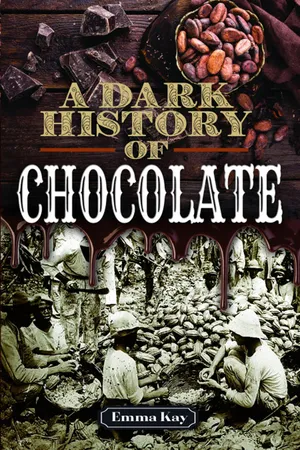
A Dark History of Chocolate looks at our long relationship with this ancient 'food of the Gods'. The book examines the impact of the cocoa bean trade on the economies of Britain and the rest of Europe, as well as its influence on health, cultural and social trends over the centuries. Renowned food historian Emma Kay takes a look behind the façade of chocolate – first as a hot drink and then as a sweet – delving into the murky and mysterious aspects of its phenomenal global growth, from a much-prized hot beverage in pre-Colombian Central America to becoming an integral part of the cultural fabric of modern life. From the seductive corridors of Versailles, serial killers, witchcraft, medicine and war to its manufacturers, the street sellers, criminal gangs, explorers and the arts, chocolate has played a significant role in some of the world's deadliest and gruesome histories. If you thought chocolate was all Easter bunnies, romance and gratuity, then you only know half the story. This most ancient of foods has a heritage rooted in exploitation, temptation and mystery. With the power to be both life-giving and ruinous.
Information
Subtopic
European HistoryIndex
HistoryChapter 1
Killers, Cargo and Cajolery: Chocolate at its Darkest
Throughout history, characters like Casanova and Madame du Barry procured chocolate to seduce their partners while early Mexican communities were reliant on its hallucinogenic properties, evidence of which has been uncovered in ancient cave drawings.
From poisonous potions concealed with cocoa, to the heinous acts of slavery and piracy, the archives are littered with evidence linking chocolate to a myriad of dirty deeds and sullied tales of the trade and consumption of chocolate.
Chocolate also features at the heart of many tragic and perilous endeavours, as if the ancient Aztec communities themselves had cursed cacao the very day it left their shores.
Trade and slavery
Formed in 1600 by a group of merchants granted a Royal Charter by Queen Elizabeth I, which then expanded into an entire naval system, commanding armies and controlling nations, the East India Company managed all trading activities from the ‘East Indies’ to England up until 1833. British colonies in the West Indies were regulated in a very different way. The first colonies of the British Empire were those of Virginia in North America and Barbados in the West Indies. African slaves were transported to these colonies to work on the plantations from the early 1600s. This trade increased after 1700 when slaves were also transported to Spanish South America. It has been estimated that some twelve million Africans were captured and transported to the Americas over a 200-year period. Jamaica was earmarked for cacao cultivation by the English early on, following the lucrative spoils of cotton, sugar and the highly coveted natural blue dye, indigo.
By 1688 the Dutch were importing large quantities of cacao from the Spanish controlled West Indies into Holland, which raised the price considerably for the English, who were finding Jamaican cacao difficult to acquire, while trade relations with Spain remained difficult.1 Bahia in Brazil was also the location for small experimental cacao plantations in the 1600s. These expanded and became some of the most significant cacao producing regions in the world.
The South Sea Company, the company granted monopoly to trade with the islands of the south seas and south America from 1711, documented an estimated 5,000 slaves being imported into Spanish American ports including Porto Bello, Panama, Cartagena, Havana, Guatemala and many others between 1727 and 1739.
The peak of the French slave trade in Africa was between 1783-92, and cocoa, along with sugar, coffee and cotton, poured into the nation at an estimated value of 160 million livres in 1785.2 São Tomé, one of Africa’s oldest colonial cities, and its neighbouring island, Principe, were the world’s third largest exporters of cocoa after Ecuador and Brazil by the early 1900s. Despite its abolition some half a century before, slaves were still being used to harvest the fruit.3
By the eighteenth century the world had become bewitched by chocolate, with nations competing with one another for control of its production and distribution, regardless of the cost to lives. Countless ships were intercepted by the Spanish and plundered for their cargoes of cacao beans. This letter from Governor Pulleine to The Council of Trade and Plantations, offers one example of this:
The Spaniards, from several of ye ports, here in ye North Seas, arm out sloops with commissions to seize all English vessels in which they find, any Spanish money (even to ye value of but ten peices of eight), any salt, cacao, or hides, for wch. reasons any vessels that trade in these parts, from port to port, are certainly prizes, if they can overpower them, having one or other of these commodities always aboard ‘em. This Island has already had three vessels thus taken, since ye Peace, and they even apprehend their total ruin, if your Ldships Do’t interfere, by our Embassadour, at ye Court of Spain, to gain them reparation, and that, very suddenly: For, we know not what remedy to apply against people, that make daily captures of us, in ye midst of a Peace newly concluded; for which reason, we might hope, it wou’d have been better observ’d. I most humbly entreat your Lordships to let me hear something encourageing from you on this head, to keep this poor Island from desponding; for they are in ye uttmost consternation. Refers to enclusure, the rest haveing not given in their complaints: but I expect it from them daily. I hear likewise, of several other vessels taken belonging to other collonys; but that being no business of mine, shall say nothing further to it, etc. P.S. Since my concludeing this letter, one Mr. Jones has brought the enclosed complaint, etc. I am afraid if some speedy care be not taken; your Lships will have frequent occasions of being teaz’d with things of this kind, to ye great sorrow of H.M. subjects here.
Signed, Henry Pulleine. Endorsed, Recd.
22nd, Read 23rd Feb. 1713/14. 2 pp. Enclosed,4
The following deposition made by mariner George Graves from 1671 is also indicative of the marauding actions of the Spanish at this time.
He was a prisoner at Carthagena in the West Indies last December, and there saw and was on board the Thomas and Richard, and spoke with the mate, boatswain, and others of her company, who told him that the said ship being laden with cacao, sugar, elephants’ teeth, gold, and divers other goods, and some passengers bound from Jamaica to London, was, last September, taken by a Spanish ship in latitude 29° 30’ about three days’ sail this side the Gulf of Florida, and brought in there as prize, and that the said mate and others are made prisoners and slaves there, and that when he made his escape thence about the end of March last, they were detained there as prisoners, and that when he made his escape there were several Englishmen kept there as slaves and very barbarously used, being forced to work with irons on with the King’s slaves all day, and put into prison at night, having only the allowance of half a royal a day, and that two of them told him they had been slaves there these five years past, and that about last February, when news was brought of a peace concluded between the English and Spanish, some of the said Englishmen made slaves there went to the Governor and demanded their liberty, and begged that their irons might be taken off, and that he answered, “Ye dogs and cuckolds, go to work,” and thereupon one of the Spaniards in company of the Governor drew his sword and cut one or two of the said Englishmen in the head.5
Even after its so-called abolition, the production of both coffee and cocoa continued to increase, along with the import and export of slave labour. At the beginning of the twentieth century Henry Nevinson wrote a damning new book affirming the continued practice of slavery, despite abolition. He recounted his time spent in São Tomé, one of the oldest African colonial cities founded by the Portuguese to cultivate sugar cane in the 1400s.
By 1909, together with neighbouring Angola and Principe, these countries were recognised as areas practising forced labour on a massive scale. Individuals, listed as ‘servicaes’ (signed documents agreeing to willingly work for a contracted number of years) – or, as Nevinson wrote, ‘the free will of sheep going to the butcher’s’ – were brought from Angola to work on the islands of São Tomé and Principe, which had become the world’s leading source of cacao at this time. It was also primarily where Cadbury acquired at least fifty per cent of its cocoa during the early 1900s. An estimated 67,000 ‘servicaes’ were shipped there between 1888 and 1908.6 Americans and English at this time were benefitting significantly from the cheap chocolate and cocoa from this region.
These islands were once famed for their coffee production, but the trade decreased significantly between 1891 and 1901, whereas the cocoa trade boomed, increasing from 3597 tons to 14, 914 in the same period.7 Nevinson’s 1906 description of a cocoa plantation located about six miles or so from the port at São Tomé makes for disturbing reading. The plantation owner’s house had separate buildings attached for the overseers, or ‘gangers’, to live, together with quarters for domestic slaves and possibly coerced concubines. Opposite stood the slave quarters for the plantation labourers. These were long sheds, some two stories high, arranged like army barracks. Some dwellings were isolated, while some were partitioned off like stables. Other buildings stored the cocoa and work equipment, while a large barn served as a kitchen for the slaves. Each family had their own space here to light a fire for cooking on the ground. The other end of the quadrangle served as a hospital. The centre was paved and occupied with large flat pans to dry the cocoa beans. And here the slaves would gather two or three times a week to receive their rations of meal or dried fish. At 6.00 pm those designated with the task of feeding the cattle and horses brought large bundles of grass. On a Sunday at this same time slaves were ‘treated’ to a sup of wine, and tobacco leaves for the adults, surrounded by intimidating overseers with whips or long sticks and growling dogs. The distribution of rations was all completed in silence, moving around a circle in single file, reminiscent of a military exercise.
Once a month wages were paid. The minimum for a man was fixed at the equivalent of under ten shillings. Women received considerably less.8 In 1910 this would have the purchasing power of around £39, or the average daily wage for a skilled tradesman. The money could only be spent in the plantation store, which meant any profits just went straight back into the pockets of the plantation owners. Nevinson conversed with a visiting doctor who confirmed that on one of the plantations the death rate was between twelve and fourteen-per cent annually. He attributed these dramatic figures to unhappiness. To live for three or four years as a cocoa plantation slave in São Tomé would be considered an achievement. There was also a high mortality rate among children, with a quarter of them dying each year, making the price of slaves high.9 As a direct consequence of Nevinson’s observations, and a great deal of negative press generated by a considerable British abolitionist campaign, Portugal suspended all its shipments of ‘servicaes’ to the islands in 1909. What followed were years of complex legislation and attempts to reform national Portuguese attitudes on forced labor.10
But the problem of slavery and the processing of cacao was much greater than any legislation can reform. It was embedded in the culture of its production. With plantations often located in remote areas, where vulnerable local communities became fodder for exploitation, the land was controlled by criminal bribery and corruption.
Today the Ivory Coast produces a third of the world’s cocoa and a study conducted in 2002 revealed that over 284,000 children were working as slaves on cocoa farms located in Ghana, Nigeria, Cameroon and the Ivory Coast.11
Pirates and Privateers
Pirates or privateers (an authorised pirate), frequently raided ships carrying cacao. Privateer Captain Fowler of St. Kitts took down a French brigantine on the coast of Caracas in 1746, her cargo chiefly consisting of cacao.12
Sir Thomas Cavendish, an English explorer and privateer who enjoyed raiding Spanish towns and ships in the manner of Francis Drake, took control of the defenceless port of Guatulco (Huatulco), Mexico, in 1586. It had a few hundred inhabitants and good local trade networks. On arrival, Cavendish and his crew raided a fifty-tonne ship anchored in the port, loaded with cacao. The area was described as ‘having a hundred brush and wattle huts, a church and a large custom house filled with cacao and indigo.’ Cavendish and his men torched the whole town and desecrated the church. All the remaining inhabitants fled into the jungle to safety. What became of them is anyone’s guess.13
François L’Olonnais, or Jean-David Nau, was a French pirate operating in the Caribbean in the 1660s. His reputation reads like the stuff of ...
Table of contents
- Cover
- Title
- Copyright
- Contents
- Acknowledgements
- Introduction
- Chapter 1 Killers, Cargo and Cajolery: Chocolate at its Darkest
- Chapter 2 Potions, Perilous Passages and Political Conflict: The Milkier Elements of Chocolate
- Chapter 3 Money, Markets and Merchandise: Chocolate at its Sickly Sweetest
- Chapter 4 An Audience with Chocolate
- List of Illustrations
- Bibliography
- Endnotes
- Plates
Trusted by 375,005 students
Access to over 1.5 million titles for a fair monthly price.
Study more efficiently using our study tools.
Frequently asked questions
Yes, you can cancel anytime from the Subscription tab in your account settings on the Perlego website. Your subscription will stay active until the end of your current billing period. Learn how to cancel your subscription
No, books cannot be downloaded as external files, such as PDFs, for use outside of Perlego. However, you can download books within the Perlego app for offline reading on mobile or tablet. Learn how to download books offline
Perlego offers two plans: Essential and Complete
- Essential is ideal for learners and professionals who enjoy exploring a wide range of subjects. Access the Essential Library with 800,000+ trusted titles and best-sellers across business, personal growth, and the humanities. Includes unlimited reading time and Standard Read Aloud voice.
- Complete: Perfect for advanced learners and researchers needing full, unrestricted access. Unlock 1.5M+ books across hundreds of subjects, including academic and specialized titles. The Complete Plan also includes advanced features like Premium Read Aloud and Research Assistant.
We are an online textbook subscription service, where you can get access to an entire online library for less than the price of a single book per month. With over 1.5 million books across 990+ topics, we’ve got you covered! Learn about our mission
Look out for the read-aloud symbol on your next book to see if you can listen to it. The read-aloud tool reads text aloud for you, highlighting the text as it is being read. You can pause it, speed it up and slow it down. Learn more about Read Aloud
Yes! You can use the Perlego app on both iOS and Android devices to read anytime, anywhere — even offline. Perfect for commutes or when you’re on the go.
Please note we cannot support devices running on iOS 13 and Android 7 or earlier. Learn more about using the app
Please note we cannot support devices running on iOS 13 and Android 7 or earlier. Learn more about using the app
Yes, you can access A Dark History of Chocolate by Emma Kay in PDF and/or ePUB format, as well as other popular books in History & European History. We have over 1.5 million books available in our catalogue for you to explore.