In this thoroughly revised and updated edition of one of the most popular change methods in the world, Cooperrider et al. track the recent changes in the field and explain how AI can contribute to sustainability and the triple bottom line. One of today's most popular change methods, Appreciative Inquiry (AI) has been used to undertake transformational initiatives in dozens of organizations, ranging from McDonalds to the U.S. Navy to Save the Children. The assumption of AI is simple. Every organization has things that work right-things that give it life when it is vital, effective, and successful. AI begins by identifying this positive core and connecting organizational visions, plans, and structures to it in ways that heighten energy and inspire action for change. This book presents all of the concepts, examples, and aids necessary to engage groups of all sizes in Appreciative Inquiry. The authors provide background information on what AI is and how it works and offer sample project plans, designs, agendas, course outlines, interview guidelines, participant worksheets, a list of resources, and more. This second edition has been extensively revised, updated, and expanded, including new case studies, new tools and supplemental articles, an expanded bibliography and resource list, and an entirely new chapter on case applications. And throughout, the authors focus on how AI can support an organizational focus on sustainability and the triple bottom line of people, prosperity, and planet.
eBook - ePub
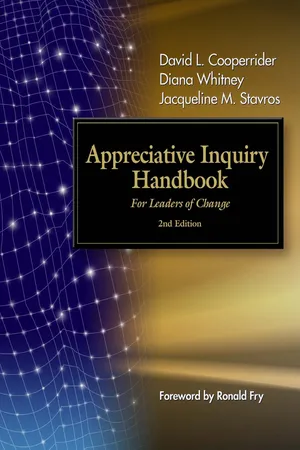
The Appreciative Inquiry Handbook
For Leaders of Change
- 454 pages
- English
- ePUB (mobile friendly)
- Available on iOS & Android
eBook - ePub
The Appreciative Inquiry Handbook
For Leaders of Change
About this book
Information
PART 1
Essential Elements of Appreciative Inquiry
Part I: Essential Elements of Appreciative Inquiry (AI)
Since the publication of the first edition in 2003, much has happened in the practice of Appreciative Inquiry (AI) and in the creation of new and connecting theories, as is apparent from the additional 125 resources and 40 studies/dissertations that were completed. (You can find these in the updated Bibliography.) The field of AI has “come of age” and has taken its place as a prominent change process within the field and textbooks of organizational development, behavior, and change.
Part 1 seeks to impart a powerful learning approach to gaining a better understanding of basic AI principles, theories, and applications. Chapter 1 touches briefly on the evolutionary changes in AI over the past several years. In addition, as in the first edition, this book gives a brief but precise review of the theory of AI with nine mini-lectures that includes one new piece on why AI works and sustains itself. These mini-lectures have been found to be useful in introducing AI to an organization.
AI as a strength-based approach and a process (4-D Cycle) has recently exhibited resonance with broader definitions of sustainable development and sustainable enterprise. Sustainable development is defined by the World Business Council for Sustainable Development (WBCSD) as “forms of progress that meet the needs of the present without compromising the ability of future generations to meet their needs” (http://www.wbcsd.org). The sustainable enterprise is a firm or an organization that maintains and re-creates itself over time while simultaneously attending to the triple bottom line of social, environmental, and economic benefits being distributed to the entire world. These concepts are connected to AI in Chapter 2 and in the case study of Fairmount Minerals, more fully developed in Chapter 8.
Chapter 3 presents the basics of starting an AI initiative that includes 60 new questions to consider in the planning phases, together with sample agendas ranging from a one-hour brief introduction to a two-day AI workshop. A new case application in healthcare, The University of Kentucky Hospital/UK Children’s Hospital, is included with a project overview, agendas, the interview guide, and summit materials.
1
The Theoretical Basis of Appreciative Inquiry
Ap-pre’ci-ate, v., 1. to value; recognize the best in people or the world around us; affirm past and present strengths, successes, and potentials; to perceive those things that give life (health, vitality, excellence) to living systems. 2. to increase in value, e.g., the economy has appreciated in value. Synonyms: value, prize, esteem, and honor.
In-quire’, v., 1. to explore and discover. 2. to ask questions; to be open to seeing new potentials and possibilities. Synonyms: discover, search, systematically explore, and study.
This chapter begins by introducing the theory and creation of AI. Appreciative Inquiry is an organization development (OD) process and approach to change management that grows out of social constructionist thought and its applications to management and organizational transformation. Through its deliberately positive assumptions about people, organizations, and relationships, AI leaves behind deficit-oriented approaches to management and vitally transforms the ways to approach questions of organizational improvement and effectiveness. Such questions include culture change, survey analysis, strategic planning, organizational learning, customer focus groups, leadership development, team building, quality management, measurement systems, joint ventures and alliances, diversity training, performance appraisal, communications programs, internal online networks, corporate history writing and others.
Presented here is a thesis, a proposition regarding the future of OD and change management. The thesis is a significant shift from “traditional” problem-solving methodologies. AI exhibits embedded wisdom that is reminiscent of early pioneers such as Kurt Lewin, Mary Parker Follett, Herb Shepard, and others. The thesis might be summarized this way:
We may have reached the end of traditional problem solving. AI is a powerful approach to transformation as a mode of inquiry capable of inspiring, mobilizing, and sustaining human system change. The future of OD belongs, instead, to methods that affirm, compel, and accelerate anticipatory learning involving larger and larger levels of collectivity.
The new methods are distinguished by the art and science of asking powerful and unconditional positive questions. (Someday there will be an “encyclopedia of questions” that brings together classic formulations such as Maslow’s interview protocols on peak human experience and Peters and Waterman’s studies of organizational excellence or Vereena Kast’s exceptional studies of joy, inspiration, and hope.) The new methods view realities as socially constructed. Therefore, they will become more radically relational, widening the circles of dialogue to groups of hundreds, thousands, and perhaps (due to cyberspace) millions. The arduous task of intervention will give way to the speed of imagination and innovation. Instead of negation, criticism, and spiraling diagnoses, there will be discovery, dream, design, and destiny.
AI: A Brief Introduction
AI has been described in many ways. Here is a practitioner-oriented definition:
Appreciative Inquiry is the cooperative co-evolutionary search for the best in people, their organizations, and the world around them. It involves the discovery of what gives “life” to a living system when it is most effective, alive, and constructively capable in economic, ecological, and human terms. AI involves the art and practice of asking questions that strengthen a system’s capacity to apprehend, anticipate, and heighten positive potential. The inquiry is mobilized through the crafting of the “unconditional positive question,” often involving hundreds or thousands of people. AI interventions focus on the speed of imagination and innovation instead of the negative, critical, and spiraling diagnoses commonly used in organizations. The discovery, dream, design, and destiny model links the energy of the positive core to changes never thought possible.
AI is based on the simple assumption that every organization has something that works well, and those strengths can be the starting point for creating positive change. Inviting people to participate in dialogues and share stories about their past and present achievements, assets, unexplored potentials, innovations, strengths, elevated thoughts, opportunities, benchmarks, high-point moments, lived values, traditions, core and distinctive competencies, expressions of wisdom, insights into the deeper corporate spirit and soul, and visions of valued and possible futures can identify a “positive core.” From this, AI links the energy of the positive core directly to any change agenda. This link creates energy and exc...
Table of contents
- Cover Page
- Title Page
- Copyright Page
- Contents
- List of Tables, Figures, and Exhibits
- Foreword
- Preface
- Acknowledgments
- Introduction
- PART 1 Essential Elements of Appreciative Inquiry
- PART 2 Application of the 4-D Cycle of Appreciative Inquiry
- PART 3 Learning Applications and Resources
- Appreciative Inquiry Bibliography
- Glossary of Terms
- Index
- Statement of Taos Institute
- Taos Institute Publications
- Statement of Appreciative Inquiry Consulting
- Positive Organizational Scholarship
- About the Authors
- Footnotes
Trusted by 375,005 students
Access to over 1.5 million titles for a fair monthly price.
Study more efficiently using our study tools.
Frequently asked questions
Yes, you can cancel anytime from the Subscription tab in your account settings on the Perlego website. Your subscription will stay active until the end of your current billing period. Learn how to cancel your subscription
No, books cannot be downloaded as external files, such as PDFs, for use outside of Perlego. However, you can download books within the Perlego app for offline reading on mobile or tablet. Learn how to download books offline
Perlego offers two plans: Essential and Complete
- Essential is ideal for learners and professionals who enjoy exploring a wide range of subjects. Access the Essential Library with 800,000+ trusted titles and best-sellers across business, personal growth, and the humanities. Includes unlimited reading time and Standard Read Aloud voice.
- Complete: Perfect for advanced learners and researchers needing full, unrestricted access. Unlock 1.5M+ books across hundreds of subjects, including academic and specialized titles. The Complete Plan also includes advanced features like Premium Read Aloud and Research Assistant.
We are an online textbook subscription service, where you can get access to an entire online library for less than the price of a single book per month. With over 1.5 million books across 990+ topics, we’ve got you covered! Learn about our mission
Look out for the read-aloud symbol on your next book to see if you can listen to it. The read-aloud tool reads text aloud for you, highlighting the text as it is being read. You can pause it, speed it up and slow it down. Learn more about Read Aloud
Yes! You can use the Perlego app on both iOS and Android devices to read anytime, anywhere — even offline. Perfect for commutes or when you’re on the go.
Please note we cannot support devices running on iOS 13 and Android 7 or earlier. Learn more about using the app
Please note we cannot support devices running on iOS 13 and Android 7 or earlier. Learn more about using the app
Yes, you can access The Appreciative Inquiry Handbook by David L. Cooperrider,Jacqueline M. Stavros,Diana Whitney in PDF and/or ePUB format, as well as other popular books in Economics & Development Economics. We have over 1.5 million books available in our catalogue for you to explore.