Putting our differences to work means creating an environment where people, naturally unique and different—diverse by nature and experience—can work more effectively in ways that drive new levels of creativity, innovation, problem solving, leadership, and performance in the marketplaces, workplaces, and communities of the world. Debbe Kennedy shows how to make all the dimensions of difference—such as thinking styles, perspectives, experiences, work habits, and management styles, as well as more traditional diversity considerations like gender, race, ethnicity, physical abilities, sexual orientation, and age—tremendous sources of strength.Kennedy draws on the latest research and a wealth of real-world examples to offer compelling evidence showing exactly how putting our differences to work accelerates innovation and contribution. She identifies five distinctive qualities of leadership that leaders must add to their portfolio of skills to make differences an engine of success. And she provides a detailed six-stage process for making the most of differences in the workforce, combining first-person best-practice stories and strategic with tactical ideas to help you put each step into action. Kennedy has written both a personal and a practical guide that changes the prevailing rules of how to think, behave, and operate as a leader, connecting four diverse elements of business and society that have traditionally been siloed: innovation, leadership, diversity, and inclusion. She and futurist Joel Barker also look at how new discoveries, including Web 2.0 technologies, can draw us closer together in previously unimagined ways.
eBook - ePub
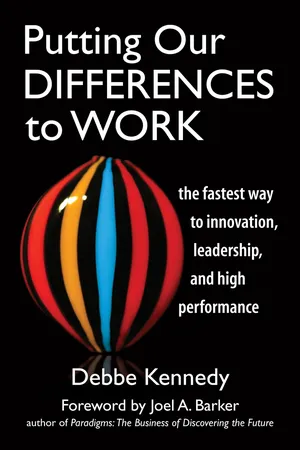
Putting Our Differences to Work
The Fastest Way to Innovation, Leadership, and High Performance
- 240 pages
- English
- ePUB (mobile friendly)
- Available on iOS & Android
eBook - ePub
Putting Our Differences to Work
The Fastest Way to Innovation, Leadership, and High Performance
About this book
Information
13
PART I
PART I
Taking Your Leadership to a New Level
“It is not the mountain we conquer but ourselves.”
—Sir Edmund Hillary
New Zealand mountain climber and Antarctic Explorer
First to successfully climb Mount Everest
New Zealand mountain climber and Antarctic Explorer
First to successfully climb Mount Everest
Taking one’s leadership to a new level challenges the best of us. If you are like the leaders and innovators I know, unless we get a chance to slip away to attend a class or a conference or take a long-needed vacation, the demands of life and work leave little time to think about such personal renewal. However, this is a time in our organizations and in the world that requires something different from us all. A new world, an ever-changing reality is sounding its call to leaders at all levels. We are being asked to prove what we can do, what one of my mentors once called “changing our spots.” We need to rethink where we are, how we act, where we need to go, and how we’re going to get there. Part 1 is designed to get you started.
To set the stage for Part 1 and the chapters that follow, I have chosen a personal story to begin this part of our journey, knowing it will be a relevant theme throughout the rest of the book.
I am a hiker. I say this with a great sense of accomplishment as it didn’t come naturally to me. Knowing we’ve all had our mountains to climb in work and life, it seems certain you will relate even if your mountains have been of a different nature. There are many parallels in my story about learning to hike a mountain and taking your leadership to a new level. The process of raising your capability, capacity, knowledge, and know-how in order to reap the benefits of diversity, accelerate innovation, and boost productivity requires a similar learning curve. As you read it, think about the experiences you’ve had that asked you to reach inside to grow.
I went on my first hike about ten years ago. It was a new beginning that stretched me mentally, emotionally, and physically. It was an awakening about the world around me. The outdoors was a foreign place at the time Up to that point, my life and work had been so filled with making my way and surviving that I hadn’t even taken the time to consciously notice that trees came in many varieties and mountains had paths upward with vistas that would become a catalyst for new visions, new contributions, and a sense of becoming more.
At first, I was clumsy, and everything about the experience felt awkward and unfamiliar. I had to retrain my thinking and beliefs to conquer even the first mountain peak. The journey required new skills, new tools, new discipline, and new habits. I had to reframe my flair for independence, join-ng in an interdependent collaboration with two friends, who were dramatically unique in every way. Our collective knowledge, focus, capability, agility, and adaptability were essential to forging unknown trails; each of us found our place to take the lead. We learned that it was our differences that generated safety, well-being, and the shared accomplishment of reaching the top We learned like trees that grow on the ridge of a mountain, battered by the wind; like them, we, too, gained inner strength as we ascended.
14
In Part 1, we’ll begin the climb of leadership renewal.
In Chapter 1, you’ll have a chance to explore the need for change, as well as the what, why, and how of the new business essentials for putting our differences to work. Included are the findings of recent studies, as well as two extraordinary stories that respond to the question “So who says putting our differences to work is the fastest way?”
In Chapter 2, the focus is on introducing the Five Distinctive Qualities of Leadership. Here’s where our paradigm gets shifted with five behavior-based qualities that fundamentally change how we think and operate as leaders and innovators, while using what we already know.
Chapter 3 includes the road map, compass, and necessary gear—the Basics. It walks through the process, introduces tools, and offers principles for success to guide your way.
15 CHAPTER I
Sameness or Difference:
“So it is, in fact, more likely that someone will take it on himself to champion the idea of collective wisdom, and in that way create the conditions that will allow it to flourish.”
—James Surowiecki
author, The Wisdom of Crowds
author, The Wisdom of Crowds
CHAPTER I
The New Business Essentials
We don’t have to look too far to see the pattern that has emerged in recent years showing our own struggles as leaders when it comes to putting differences to work effectively in our organizations. As cutting-edge global, market-driven strategies have become essential, it is clear that we, perhaps unintentionally, lost our focus on “people being our greatest assets.” As we’ve worked to adapt to a changing world, the best of organizations have proven for a time that they are skilled at creating comprehensive worldwide business plans, launching a new strategic direction, blowing everyone away with innovative products or services, and compiling the financials that prove their worth. However, at the same time, behind the scenes, deep within the day-to-day operations, we also see genuine concern for people who slip into obscurity.
So how has this happened? Why do we continually struggle to keep a focus on people and putting differences to work, when there are such great benefits? Many would instantly argue that organizations and their leaders today are widely driven by their measures—the short-term bottom line, not what they do with people. True. Others would admit that many leaders focus on what they know how to do, especially when the demands to produce are ever-increasing and people leadership generally isn’t a core skill for everyone. So we easily revert to what’s familiar—the numbers and processes we can handle. We learned about them in school. We’ve mastered them. This part of our organizations is pragmatic. No emotion. Just clear and well-defined parameters we fully understand. Best of all, the numbers and processes ask only for our head work, without the inherent heart work 16that entangles us when people are part of the mix. Numbers and processes ask much less from us than what we perceive people require. We try to be supportive, but it is easy to assume human resources will deal with the bulk of all that soft stuff. This perspective is no longer good enough to solve the problems we face today or to meet the challenges ahead in the marketplace, workplace, or community—and our troubled world.
In 2000, futurist, filmmaker, and author Joel Barker shared what he termed a “surprising discovery” as he searched to find the connection between wealth and innovation. I worked with him collaboratively on his groundbreaking film, Wealth, Innovation and Diversity. In it, he presents a compelling business case that “societies and organizations that most creatively incorporate diversity will reap the rewards of innovation, growth, wealth, and progress.” Having a diversity initiative is important, and great organizations have them in place today, but the integrated approach Joel Barker’s discoveries suggest—with direct links to innovation and growth—reaches way beyond the best in traditional diversity and inclusion initiatives and programs. His findings note measurable benefits, including producing new kinds of wealth, like the wealth of sustainability, reduced risk, predictability, and innovation in addition to economic wealth.
In 2001, shortly after the launch of his film, we wrote an article together for the American Society of Training & Development (ASTD) called “Leveraging Diversity: Putting Our Differences to Work.” In it we offer compelling ideas from our collaborative work about the ongoing struggle both people and organizations have when it comes to sameness and difference, noting seven telling signs that will give you a pretty good indication of what your organization values, not in words but in practice.
SAMENESS OR DIFFERENCE?
“Why do we wrestle with sameness and difference as people and as organizations, especially when we have so much to gain by working together? Scientist and author George Ainsworth-Land offered a powerful explanation in his book Grow or Die. It is his contention that all things grow and develop within the same three-stage pattern.
For example, we start out focused on our own survival, seeking love, food, and security. In our second stage of growth, starting at adolescence, we begin finding others like us. There are many advantages here. We are validated by others like us. We can accomplish things better together. Since we all talk alike and think alike, decisions and communications are easier.
17 All of these similarities also increase the level of predictability within our group. We learn to like it. We see equivalent patterns of replication in many of today’s organizations for the very same reasons.
So the struggle between sameness and difference is universal. It is part of the evolution of individual and organizational growth—and it is clear as we move further into the twenty-first century, it is time for us as individuals and as organizations to reach for an additional stage of growth. George Ainsworth-Land calls this third stage of growth mutualism. In this stage, we come together in different combinations to open the way for innovations leading to new technology, new music, new art, new businesses, new friendships, new cultures, and new opportunities to grow. All of us—east and west, north and south—have to choose between two pathways, and this choice has to be made at every level and in every organization. One way leads us back where sameness is rewarded and differences are demonized. The other path is toward organizations and communities where diversity, variety, and difference are prized. Why is this so important to our future? Because the people most likely to bring us the paradigm-shifting innovations we need to create new wealth are almost always outsiders, people who know little or nothing about the normal way of doing things—people different from us. This is true at every level of every enterprise, community, and country. New wealth is the result of innovation. And innovation is driven by diversity. Diversity is the key that will open the door to the new wealth of the twenty-first century.
Sameness or Difference:
What Does Your Organization Value?
Here are seven telling signs:
- Your leadership team at all levels (including the board) lacks diversity.
- Old notions, perceptions, preferences, and prejudices still exist; they are sometimes subtle and left unchallenged.
- Every group or team has its own agenda; efforts are fragmented and lack new ideas from “outsiders” or collaboration for best execution of plans and results.
- People who are different are rarely hired, developed, promoted, or included; slow progress against stated goals is an indicator.
- New ideas and innovative thinking are subtly shunned with cynicism, risk aversion, and exclusion or seen as a nuisance— or ignored completely.18
- The words say you value diversity and inclusion, but your actions speak louder.
- You dismiss diversity and inclusion as a human resource issue instead of recognizing that they are drivers of innovation and new wealth; your business plans reflect this view
Part of our struggle is our search for the words to have meaning. I’m often asked what it means to put our differences to work. It’s easy to rattle off an answer like this when someone insists: “Putting our differences to work means creating an environment where people, naturally unique and different—diverse by nature and experience—can work more effectively in ways that drive new levels of creativity, innovation, problem solving, leadership, and performance in the marketplaces, workplaces, and communities of the world.” What’s always missing in such a definition is how limiting the words are, how ambiguous they are depending on your own differences and experience, and how absent the human element seems to be.
Definitions have their place, but they’re only words until we breathe life into them by our actions and example. Let me paint a more vivid picture. Putting our differences to work at every level within an organization requires a new kind of intention from everybody. It means consciously recognizing one undeniable fact: that people are the number one source of new thinking and new ideas needed for change and the betterment of business and society. Here I’m not suggesting that leaders use the phrase as a rhetorical slogan. Remember “People are our greatest asset”? It lost its magic and meaning when the words and actions didn’t align. Now it sits on the shelf with other overused phrases. Leading this charge requires a strong belief in people that is reflected day to day in our work and behavior. It calls for us to creatively utilize the many dimensions of diversity within our organizations, in business, and in society to their full potential.
As we’ve stripped to “lean and mean” and buzzwords like human capital and talent management have come into fashion, the rippling influence appears to have distanced many leaders from the very heart and soul of achievement in their organizations: the people. It is the heartbeat, commitment, and hard work of every individual that fulfills a business strategy and brings about innovation, leadership, and high performance for any organization or endeavor. Those leaders who consciously and intentionally focus on the mastery of leading the workplace and building diverse teams will be well on their way to pioneering a new era leadership excellence the fastest way.
Numerous studies have followed Joel Barker’s pioneering discoveries and my own early study and practice, both affirming our findings and also 19throwing new questions into the mix. This new thinking calls us to step further inside this compelling issue to get a deeper understanding of where we are today and where we need to go.
One significant study that has created a buzz of controversy is the work of Robert D. Putnam, a distinguished political scientist and professor at Harvard University—and, I must add, a champion for the power that people hold when they work together. You need not wonder where his heart is on this topic if you visit the Better Together initiative (www.bettertogether. org), which grew out of his notable work on civic engagement. The website tagline reflects his call to action: “Connect with others. Build trust. Get involved.”
Controversy arose when Putnam’s findings were published in “Diversity and Community in the Twenty-first Century” in the Nordic Political Science Association Journal in June 2007 and hit the media in sound-byte form. In reading the study, cover to cover, and listening directly to Putnam’s personal reflections on it, you realize one of the contributions he made in...
Table of contents
- Cover Page
- Title Page
- Copyright Page
- Foreword: by Joel A. Barker
- Preface
- Introduction: The Fastest Way
- PART I: Taking Your Leadership to a New Level
- CHAPTER I The New Business Essentials
- CHAPTER 2 Five Distinctive Qualities of Leadership
- CHAPTER 3 The Basics for Putting Our Differences to Work
- PART 2: Knowledge and Know-how to Guide the Way
- CHAPTER 4 Step I—Assessment: Defining Current Realities
- CHAPTER 5 Step 2—Acceptance: Developing Support for Change
- CHAPTER 6 Step 3—Action: Moving Forward
- CHAPTER 7 Step 4—Accountability: Establishing Shared Ownership
- CHAPTER 8 Step 5—Achievement: Measuring Progress; Celebrating Success
- CHAPTER 9 Step 6—More Action: Keeping Momentum Alive
- PART 3: Ever-Expanding Possibilities
- CHAPTER 10 Innovation at the Verge of Differences by Joel A. Barker
- CHAPTER 11 Collaborating at the Verge of Differences
- CHAPTER 12 The Power of the Virtual Gathering Place
- A Send-off: A Final Word
- Resources and Studies
- Notes and Sources
- Acknowledgments
- Index
- About the Author
- ABOUT BERRETT-KOEHLER PUBLISHERS
Trusted by 375,005 students
Access to over 1.5 million titles for a fair monthly price.
Study more efficiently using our study tools.
Frequently asked questions
Yes, you can cancel anytime from the Subscription tab in your account settings on the Perlego website. Your subscription will stay active until the end of your current billing period. Learn how to cancel your subscription
No, books cannot be downloaded as external files, such as PDFs, for use outside of Perlego. However, you can download books within the Perlego app for offline reading on mobile or tablet. Learn how to download books offline
Perlego offers two plans: Essential and Complete
- Essential is ideal for learners and professionals who enjoy exploring a wide range of subjects. Access the Essential Library with 800,000+ trusted titles and best-sellers across business, personal growth, and the humanities. Includes unlimited reading time and Standard Read Aloud voice.
- Complete: Perfect for advanced learners and researchers needing full, unrestricted access. Unlock 1.5M+ books across hundreds of subjects, including academic and specialized titles. The Complete Plan also includes advanced features like Premium Read Aloud and Research Assistant.
We are an online textbook subscription service, where you can get access to an entire online library for less than the price of a single book per month. With over 1.5 million books across 990+ topics, we’ve got you covered! Learn about our mission
Look out for the read-aloud symbol on your next book to see if you can listen to it. The read-aloud tool reads text aloud for you, highlighting the text as it is being read. You can pause it, speed it up and slow it down. Learn more about Read Aloud
Yes! You can use the Perlego app on both iOS and Android devices to read anytime, anywhere — even offline. Perfect for commutes or when you’re on the go.
Please note we cannot support devices running on iOS 13 and Android 7 or earlier. Learn more about using the app
Please note we cannot support devices running on iOS 13 and Android 7 or earlier. Learn more about using the app
Yes, you can access Putting Our Differences to Work by Debbe Kennedy in PDF and/or ePUB format, as well as other popular books in Business & Business Skills. We have over 1.5 million books available in our catalogue for you to explore.