In 1948, Moss Kendrix, a former New Deal public relations officer, founded a highly successful, Washington, D.C.-based public relations firm, the flagship client of which was the Coca-Cola Company. As the first black pitchman for Coca-Cola, Kendrix found his way into the rarefied world of white corporate America. His personal phone book also included the names of countless black celebrities, such as bandleader Duke Ellington, singer-actress Pearl Bailey, and boxer Joe Louis, with whom he had built relationships in the course of developing marketing campaigns for his numerous federal and corporate clients. Kendrix, along with Ebony publisher John H. Johnson and Life photographer Gordon Parks, recognized that, in the image-saturated world of postwar America, media in all its forms held greater significance for defining American citizenship than ever before. For these imagemakers, the visual representation of African Americans as good citizens was good business.
In Represented, Brenna Wynn Greer explores how black entrepreneurs produced magazines, photographs, and advertising that forged a close association between blackness and Americanness. In particular, they popularized conceptions of African Americans as enthusiastic consumers, a status essential to postwar citizenship claims. But their media creations were complicated: subject to marketplace dictates, they often relied on gender, class, and family stereotypes. Demand for such representations came not only from corporate and government clients to fuel mass consumerism and attract support for national efforts, such as the fight against fascism, but also from African Americans who sought depictions of blackness to counter racist ideas that undermined their rights and their national belonging as citizens.
The story of how black capitalists made the market work for racial progress on their way to making money reminds us that the path to civil rights involved commercial endeavors as well as social and political activism.
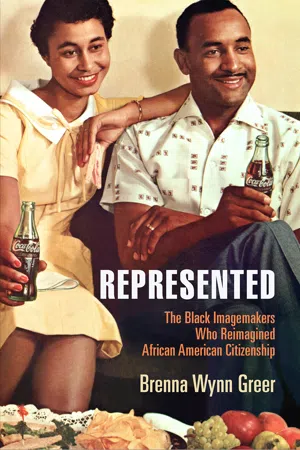
eBook - ePub
Represented
The Black Imagemakers Who Reimagined African American Citizenship
- 336 pages
- English
- ePUB (mobile friendly)
- Available on iOS & Android
eBook - ePub
About this book
Information
Publisher
University of Pennsylvania PressYear
2019Print ISBN
9780812225013
9780812251432
eBook ISBN
9780812296372
Chapter 1
A Way In: The Public Relations of New Deal Black Citizenship
We have fought America’s cause of freedom, of Unity, of Imperialism, and of Democracy!
. . . But, Are We Americans?
—Moss Kendrix in the Maroon Tiger
The public relations counsel, then, is the agent who . . . brings an idea to the consciousness of the public.
—Edward Bernays, Propaganda
In 1937, eight years into the Great Depression, Life magazine published a photograph taken by Margaret Bourke-White, a noted documentary photographer. The black-and-white photograph depicts how a great many African Americans experienced the worst economic crisis in U.S. history (Figure 3). The documentary image shows black men, women, and children lined up, waiting to collect food and clothing from a relief agency. Several among them hold empty bags, pails, and buckets to carry away the much-needed goods they hope to collect. Others brought only their “hungry stomachs.” The African Americans pictured were residents of the “Negro” quarter of Louisville who narrowly survived the recent flooding of the Mississippi River: “refugees,” the magazine dubbed them. In the photograph, a large billboard serves as the background: it pictures an exuberant, well-dressed, white family of four and their terrier crowded into an automobile that the smiling father figure steers through a rolling countryside. One might imagine this is a family enjoying a Sunday drive after church. The wholesome cheeriness of the billboard images gives it the appearance of being in full color, despite the black-and-white medium of the photograph. Written across the billboard’s top in large block letters is “WORLD’S HIGHEST STANDARD OF LIVING,” and in script letters to the right of the car is written the declaration, “There’s no way like the American Way.”1
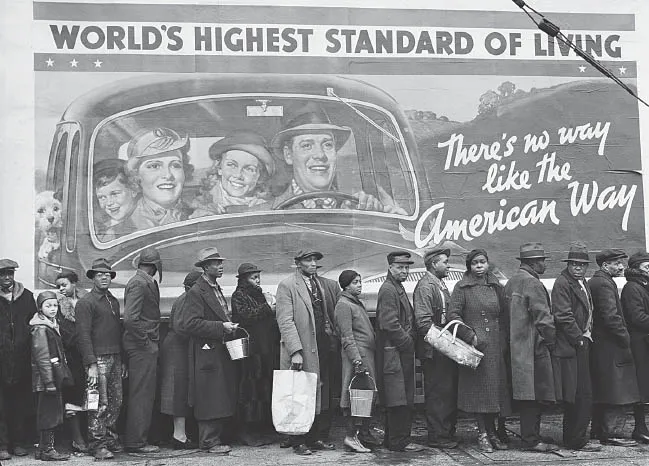
Figure 3. The American Way, Margaret Bourke-White photograph, 1937. Getty Images.
Bourke-White’s photograph is a composite of key occurrences that defined the Depression era. Most apparent, the photograph is a visual representation of hardship. The juxtaposition of the billboard and the downtrodden black “refugees” lined up before it symbolized a dramatic decline in the “real world” American experience. Erected as it was in the soil of the depressed South, the billboard seemed more indicative of the prosperity and “good times” that characterized the previous decade. Behind the queue of unsmiling, beleaguered-looking, African Americans, the cheery tableau is especially mocking—a colorful and gay backdrop for a bleak and tragic play. The clashing images in Bourke-White’s photograph, of white bounty and black need—each of which, the image suggests, is the “American Way”—emphasized the separateness and severity of blacks’ economic plight during the Depression.
In addition to being a record of blacks’ Depression-era experience, the Life photograph is an artifact of the phenomenal expansion of public relations during the 1930s, in large part as a response to the nation’s economic crisis. When she took the photograph of black Louisianans, Bourke-White worked on behalf of the Farm Security Administration (FSA). One of the many New Deal agencies established to spur recovery during the Depression, the FSA addressed issues of rural poverty exacerbated by the Depression. The agency employed a team of first-rate photographers to roam the country taking pictures of the nation’s poor and displaced agricultural workers. The FSA photography program represented the Roosevelt administration’s embrace of public relations to shape public opinion concerning its experimental economic and social programs. The New Deal allowed for government involvement in economic matters to an unprecedented degree, which threatened corporate interests. For their part, industrialists devised public relations campaigns to revive trust in the free enterprise necessary to their survival. The billboard pictured in Bourke-White’s photograph belonged to a campaign implemented by the National Association of Manufacturers (NAM), an industrial trade and lobby organization. The Depression era witnessed both government and private business interests increasingly turn to public relations to advance their respective agendas. Bourke-White’s photograph is a convergence of these trends. But what about the African Americans pictured?
In the Life image, the blacks pictured appear as black Americans were: among the most impoverished, disenfranchised, and vulnerable in the nation. They unwittingly perform the public relations work of the FSA image as the emotional center of the scene. They are public relations objects. This chapter tells the story of how the crisis in capitalism in the 1930s provided an opening for African Americans to enter the field of public relations. The training they received as New Deal imagemakers and image managers would prove essential to black campaigns to redefine blackness and, in particular, black citizenship.
In 1933, newly elected Franklin Delano Roosevelt initiated the New Deal to “stop the bleeding,” save U.S. capitalism, and aid the nation’s psychic healing. A series of emergency relief, public works, and financial reform programs, the New Deal constituted the largest government relief apparatus in U.S. history. It was also a public relations apparatus larger than any to that point in the nation’s history. The scale of operation of this federal public relations machine required the participation of African Americans, particularly when it came to selling New Deal programs to black America.
Moss Hyles Kendrix is a central black figure in the development of public relations, particularly in relation to the New Deal. A young, southern black man, Kendrix became an official New Deal publicist when hired to represent the National Youth Administration (NYA), an agency that addressed unemployment among American youths between the ages of sixteen and twenty-five. Born on March 8, 1917, he experienced the Great Depression while coming of age in Atlanta, Georgia, a city enveloped by federal employment, education, and public works programs that permeated life across racial lines. His Depression-era experiences highlight connections between Roosevelt’s New Deal, federal conceptions of “America” and American citizenship, contemporary black political concerns, and the development of modern public relations. As a New Deal publicist, Kendrix promoted New Deal programs, as well as ideas about American character, citizenship, and capitalism that legitimated the government’s expansive role. The New Deal had many skeptics and outright opponents, including multiple members of Congress, due to the politics of interventionism and social democracy at its center. Roosevelt’s recovery initiatives required constant selling and reselling, as did the worthiness of the constituencies these programs served—largely recognized as the first generation of modern welfare recipients.
Those who knew Kendrix best swear he was born for public relations. Remembering his father, Moss Kendrix Jr. puts it plainly: public relations was “his avocation as much as his vocation.”2 Contemporaries described the elder Kendrix as a “well-known, well-liked, handsome, intense [and] sophisticated” man who desired to “work with people” and who was indefatigable and relentless by nature.3 He was also a handsome man with a soft face and smooth, caramel-taffy-colored skin, the agelessness of which suggested that, like Oscar Wilde’s fictional character Dorian Gray, he might have an enchanted portrait stowed in his attic that bore his wrinkles for him. Large, doe-like eyes stared out from beneath his thick, dark eyebrows, which were often raised with inspiration or expectation and rarely furrowed in worry. “All I want is one new idea each day,” he liked to say.4 In personality and countenance, Kendrix possessed traits that smoothed the way for him into upper-crust circles, both white and black. One reporter summarized, “[He could] mingle with equal ease in the politic phrase-tossing of an Inaugural Ball or the hail-fellow of a national convention”—which he did.5
At the height of his career in the 1950s and early 1960s, Kendrix enjoyed a reputation as one of the most, if not the most, ambitious, and therefore successful, African American marketing specialists on the Eastern Seaboard. With a client list that included large advertisers such as Coca-Cola and Carnation Foods, he interacted with the elite of white corporate America and counted as friends prominent African Americans across the realms of entertainment, sports, business, and journalism. Given his disposition and inclinations, Kendrix was seemingly well suited to professions of persuasion, but, as he was an African American male born and raised in the Jim Crow South, entry into such professions was hardly inevitable. How did he enter a field that, when he reached adulthood, was still in the making and dominated by white, educated businessmen servicing white corporate clients? The answer lies in the necessity to elicit support for the New Deal, which provided African Americans of a particular cultural class the opportunity to become New Deal publicists. In this role, they received training in persuasion politics and contributed to the professionalization, standardization, and legitimization of modern public relations.
As a black New Deal publicist, Kendrix’s job was to sell the national recovery program to southern blacks, which entailed convincing them to participate in New Deal initiatives and commit to the nation’s economic recovery but also, more importantly, to embrace the principles and institutions of democracy. The target market for this sell was hardly primed. African Americans had come to the nation’s aid not so long ago. During World War I, many heeded the instruction of the intellectual and activist W. E. B. Du Bois, who instructed African Americans to join the fight, despite their collective experience as second-class citizens. As editor of the Crisis, Du Bois wrote, “Let us not hesitate. Let us . . . forget our special grievances and close our ranks shoulder to shoulder with our own white fellow citizens.” German victory, Du Bois reasoned, meant “death to the aspirations of Negroes . . . for equality, freedom and democracy.”6 Over three hundred thousand African Americans answered his call. But when they returned, they experienced a “red summer” of nationwide race riots, during which whites lynched dozens of African Americans.7 “This country of ours,” Du Bois wrote on the other side of the war, “is yet a shameful land.”8 How to appeal to this disenchanted, disenfranchised population?
For one, as a New Dealer, Kendrix promoted the Roosevelt administration’s conceptions of American citizenship, which encouraged hard work, displays of unity, and—somewhat ironically, given the circumstances—faith in capitalism. Officials of the New Deal presented national belonging in terms of individual civic contributions. Kendrix, however, bent these “official” discourses of citizenship to contemporary black political concerns, including self-definition, community development and education, and political representation. The publicity and events he produced encouraged African Americans’ sense of duty as citizens and asserted a black citizenship ethos essential to the nation’s greatness. His Depression-era public relations work illuminates the growing recognition of African Americans’ significance as Americans and intentional efforts on behalf of the federal government to identify their concerns and interests and target them on that basis. The nation’s economic crisis provided opportunities and technologies through which Kendrix and other black New Dealers—African Americans employed to promote or administer New Deal programs—redefined and publicized the national belonging of African Americans.
The popular history of the Great Depression remains a white story, populated mainly by dusty and tired, rural white farmers, like the Joad family of John Steinbeck’s Pulitzer Prize–winning 1939 novel, The Grapes of Wrath. When schoolchildren in the United States do encounter African Americans in the Depression story, it is often as former slaves, because a popular educational source from the period is firsthand accounts of slavery collected by the Works Progress Administration (WPA)—a New Deal agency—during the Depression. While invaluable (if also problematic) historical sources, WPA slave narratives foreground the inferior social position of blacks within U.S. history. Moreover, these Depression-generated narratives of blacks’ enslaved experiences supplant stories of how African Americans actually experienced the Depression.
When African Americans appear in historical studies of the Depression or New Deal, it is generally in the form of voter-relief recipients (the “poor black masses”), artists, or bureaucrat-reformers—most notably the educated black activists that composed the Federal Council of Negro Affairs, popularly known as Roosevelt’s Black Cabinet.9 Kendrix offers an alternative and understudied example of the New Deal agent. What prompted Kendrix and other African Americans to assist the government in its promotion of American democracy and capitalism, given their collective experience as marginalized citizens? What black political agendas did black participation in the New Deal public relations machine serve? Finally, what does knowledge of black New Deal public relations work add to our understanding of the Depression, t...
Table of contents
- Cover
- Half title
- Title
- Copyright
- Dedication
- Contents
- Preface
- Introduction
- Chapter 1. A Way In: The Public Relations of New Deal Black Citizenship
- Chapter 2. A Choice Weapon: World War II and Black Propaganda
- Chapter 3. Selling Progress: Liberia and the Early Cold War Trade in Black Markets
- Chapter 4. Black Appeal: The Profits and Politics of Representing Black Female Sexuality
- Chapter 5. A Consuming Image: The Civil Rights Work of Marketing Black Citizenship
- Conclusion. What Is a Civil Rights Image?
- Notes
- Index
- Acknowledgments
Trusted by 375,005 students
Access to over 1.5 million titles for a fair monthly price.
Study more efficiently using our study tools.
Frequently asked questions
Yes, you can cancel anytime from the Subscription tab in your account settings on the Perlego website. Your subscription will stay active until the end of your current billing period. Learn how to cancel your subscription
No, books cannot be downloaded as external files, such as PDFs, for use outside of Perlego. However, you can download books within the Perlego app for offline reading on mobile or tablet. Learn how to download books offline
Perlego offers two plans: Essential and Complete
- Essential is ideal for learners and professionals who enjoy exploring a wide range of subjects. Access the Essential Library with 800,000+ trusted titles and best-sellers across business, personal growth, and the humanities. Includes unlimited reading time and Standard Read Aloud voice.
- Complete: Perfect for advanced learners and researchers needing full, unrestricted access. Unlock 1.5M+ books across hundreds of subjects, including academic and specialized titles. The Complete Plan also includes advanced features like Premium Read Aloud and Research Assistant.
We are an online textbook subscription service, where you can get access to an entire online library for less than the price of a single book per month. With over 1.5 million books across 990+ topics, we’ve got you covered! Learn about our mission
Look out for the read-aloud symbol on your next book to see if you can listen to it. The read-aloud tool reads text aloud for you, highlighting the text as it is being read. You can pause it, speed it up and slow it down. Learn more about Read Aloud
Yes! You can use the Perlego app on both iOS and Android devices to read anytime, anywhere — even offline. Perfect for commutes or when you’re on the go.
Please note we cannot support devices running on iOS 13 and Android 7 or earlier. Learn more about using the app
Please note we cannot support devices running on iOS 13 and Android 7 or earlier. Learn more about using the app
Yes, you can access Represented by Brenna Wynn Greer in PDF and/or ePUB format, as well as other popular books in History & Media & Communications Industry. We have over 1.5 million books available in our catalogue for you to explore.