We all have images that we find unwatchable, whether for ethical, political, or sensory and affective reasons. From news coverage of terror attacks to viral videos of police brutality, and from graphic horror films to transgressive artworks, many of the images in our media culture might strike us as unsuitable for viewing. Yet what does it mean to proclaim something "unwatchable": disturbing, revolting, poor, tedious, or literally inaccessible?With over 50 original essays by leading scholars, artists, critics, and curators, this is the first book to trace the "unwatchable" across our contemporary media environment, in which viewers encounter difficult content on various screens and platforms. Appealing to a broad academic and general readership, the volume offers multidisciplinary approaches to the vast array of troubling images that circulate in global visual culture.
- English
- ePUB (mobile friendly)
- Available on iOS & Android
eBook - ePub
Unwatchable
About this book
Information
Subtopic
Performing ArtsPart I
Violence and Testimony
1
Theorizing the Unwatchable
Positing the unwatchable as a key concept in the history of aesthetics and in our contemporary media and political environment, the essays in this opening chapter address a core set of questions. What distinguishes watching from other modes of vision (e.g., seeing, gazing, beholding), and how do we differentiate the watchable from the unwatchable, and the unwatchable from the invisible? Is any particular content ontologically or metaphysically unwatchable, or does the category function instead as an aesthetic judgment or moral imperative? And, lastly, what political work does the concept of the unwatchable perform (or fail to perform) in our time, characterized by neoliberal threats to democracy, the resurgence of right-wing populism, and accumulating incidents of political violence and ecological disaster?
Media theorist W. J. T. Mitchell traces the idea of the unwatchable back to religious notions of aniconism and iconoclasm and discerns an ongoing dialectic between prohibition and desire in the field of visual culture. Whereas Mitchell discusses Chris Ofili’s painting The Holy Virgin Mary and an episode of the TV series Black Mirror, philosopher Boris Groys concentrates on contemporary installation art, which has assumed the project of early twentieth-century avant-garde movements in dissolving the distinction between art and life. Drawing from Hegel’s and Heidegger’s philosophical aesthetics, Groys argues that living inside art is the sole way of relating to a truth that cannot be presented in external, imagistic form.
Cultural theorists Stefano Harney and Fred Moten extend Groys’s argument to the sphere of politics, suggesting that blackness is unwatchable from an outside position—a point they elaborate in a Marxist and Schmittian-informed discussion of security and surveillance apparatuses and issues of law, criminality, and spatiality. Psychoanalytic philosopher Alenka Zupančič defines the unwatchable as the “melting into visibility” of an ontological impossibility, using the Buchenwald concentration camp and the 2017 “Unite the Right” rally in Charlottesville as her examples. She further critiques the neoliberal rhetoric of self-care, calling for a focus on what Lacan termed “objective feeling” rather than personal triggers.
Like Zupančič, film and media scholar Meghan Sutherland maintains that the watchable and unwatchable have become interchangeable designations. Bringing the chapter full circle to the discussion of social anxiety, moral prohibitions, and modes of vision, Sutherland argues that insofar as watching relates to formal qualities of visual attention, the unwatchable is undefinable in terms of specific content. It is for this reason, she finally suggests, that the concept of the unwatchable cuts across the traditional division between “high” and “low” culture.
Unwatchable
W. J. T. MITCHELL
A dear friend of mine loves movies so much that the worst thing he can find to say about a film is that it is “watchable.” We know that when he says something like this, it really means that the movie is terrible, but nevertheless there is something in it, however minor, that deserves attention. The great film director John Waters, asked in an interview which films he cannot bear to watch, confessed that he simply loves to watch movies, and when he sees a bad one, he always finds something to enjoy, something as simple as the miraculous apparition of a lamp glowing in the corner of a room.
I find the question “what do you find unwatchable?” very difficult to answer. In fact, I am tempted to say that I cannot think of anything that I find unwatchable, except, increasingly, professional football with its unending parade of injuries. Still, I find myself making exceptions with no good reason except that it is a Big Game. As a scholar of something called “visual culture” or “visual studies,” moreover, I feel professionally obliged to study the unwatchable, the watchers, and their guardians.
But first, perhaps we should consider things that are invisible or unseeable, things that I am physically prevented from seeing. Clearly I cannot watch things that cannot be seen. If my TV is broken, I can’t watch it, though if I wanted to be perverse, I could sit for a while and watch the TV set itself. Since, as I write, my eyesight is failing and I am looking forward to a cataract operation, there is an increasing number of things in the world I cannot see. Road signs are becoming increasingly illegible. As they grow faint, however, my desire and need to watch for them only grows, and my wife spends more time telling me to watch where I am going when we drive into the city.
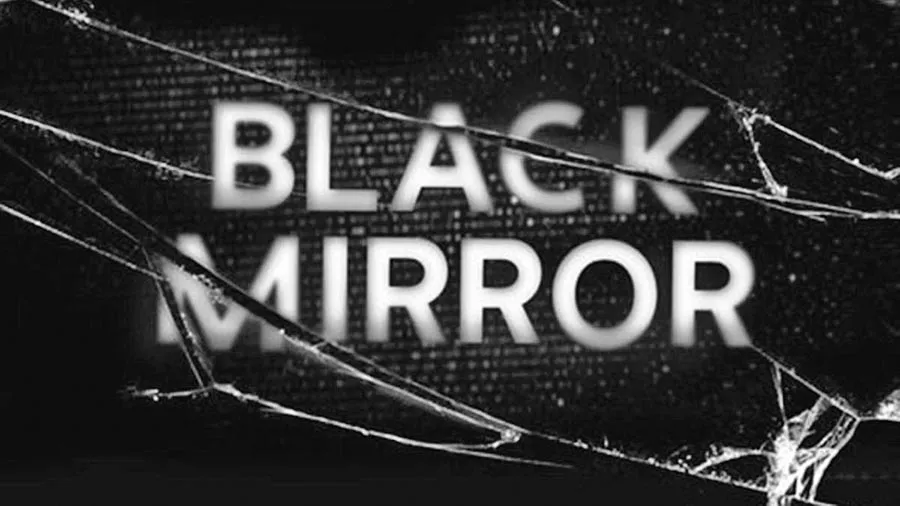
Title image for Charlie Brooker’s Black Mirror.
So seeing and watching are quite distinct activities, the passive and active poles of the scopic field. We see lots of things that we do not watch, or (more precisely) watch for. In fact, most of the things we watch for are things that we cannot see, things we are looking for, waiting for, trying to bring into focus. Should we say that the less we see, the more watchful we become? Is watching a form of trying to see? Of keeping your eye on the ball? Watching is attentive, focused seeing, but perhaps not the only kind. Beholding, staring, and gazing, for instance, seem to occupy some middle zone between seeing and watching. The beholder (especially of art) is usually portrayed as a kind of hybrid figure, cultivating a “wise passiveness” of looking, receptive but well trained. Staring is, of course, impolite. It is the shameful moment when someone is caught watching in a way that he or she shouldn’t, closely related to a voyeur who is caught in the act. And gazing is closely related to beholding, but perhaps even more passive: it is a kind of ruminative, contemplative, even bovine exercise of seeing, abstract and detached—a bit like John Waters’s finding of pleasure in even the worst movies.
So what does the “un-” add to or subtract from watching and the watchable? How does this negation of seeing work? The obvious starting point is to divide what should not be watched, because it is prohibited, forbidden, from what we cannot bear to watch because it is too painful or disturbing. But this distinction is frequently blurred in practice. The feeling that I cannot bear to watch something can, under the right social conditions, become a moral imperative that no one should watch it. If I cannot stand to see pornography, and “I know it when I see it,” the next step is to ban it for everyone else. Scenes of cruel violence and torture that are unbearable to some are prohibited from being seen by others. So “unwatchability” is frequently accompanied by an asterisk that divides those who can or must watch (e.g., grown-ups, police, and other professionals) from those who should not (e.g., children and vulnerable, sensitive souls). There is also the prohibition on merely watching something, particularly the suffering of others, while remaining detached and even taking pleasure in the spectacle. Why is there something deeply tasteless about a president of the United States visiting the spectacular flooding of a city, praising the size of the crowd that comes to meet him, and never bothering to meet a single victim? Why did George W. Bush’s flyover of the disaster of Hurricane Katrina prove so politically damaging? If one is going to watch, so goes the feeling, one should also be prepared to act. “I just like to watch” is almost always a morally ambiguous declaration, especially when it has to do with what someone else regards as the unwatchable.
Moral prohibitions on seeing and showing are everywhere: images of god are forbidden, not because we cannot see them, but because we should not. Therefore, when they are shown, there is a powerful urge to destroy the images themselves, sometimes right along with their beholders. Iconoclasm is the attempt to transform the morally or politically unwatchable into the literally unseeable, and to convert or disappear the watchers. When a pious Roman Catholic smeared paint over Chris Ofili’s famous The Holy Virgin Mary (aka “Madonna with Elephant Dung”) at the Brooklyn Museum some years ago, his intention was not to disfigure or erase the Madonna (whose image is not prohibited but celebrated) but to protect the Madonna from being seen in the wrong way, accompanied by the obscene material of shit. He was happy to venerate the Madonna as represented in visual images, but this particular image he found unbearable, unwatchable. His action had the predictable effect of making many more people come to the Brooklyn Museum just to see the defaced painting.
The best rendering I have seen of the dynamics of the unwatchable is the first episode of the British television series Black Mirror. In this episode, a popular British princess has been kidnapped and is threatened with death if the prime minister refuses to fuck a pig on live television. As popular sentiment trends toward the minister giving in to this demand, he is finally compelled to do it. The government urges viewers not to watch this obscene spectacle as a way of resisting terrorism. But of course the mandate has exactly the opposite effect, and pubs all across England are jammed with eager spectators who await the broadcast in a kind of festival atmosphere. When the telecast is finally shown, however, a strange alteration occurs in the faces of the spectators. It takes the disgusted PM over an hour to fulfill the demand by completing the sex act. As the show goes on, the faces in the audience begin to shift to appalled disgust and horror. People begin to look away. The princess is released unharmed on a bridge over the Thames, but no one notices because they are all jammed into the pubs. It turns out that the kidnapper was not a terrorist, but an artist who was staging the entire thing as a performance. He had already released the princess and hanged himself before the deadline he had given the PM. His performance is quickly declared by sophisticated critics to be the first great work of art of the twenty-first century.
The declaration of the unwatchable, then, can often have just the opposite of its intended effect. To be told you must not see or show something is arguably the greatest temptation to do both. Thankfully, Black Mirror does not show the sex act, focusing instead on the faces of the spectators. I think that may be the general lesson to be learned from the category of the unwatchable. There is nothing in the world that is metaphysically and absolutely unwatchable. Or at least I personally have not been able to come up with an example of something I find unwatchable, because the minute I th...
Table of contents
- Cover
- Title Page
- Copyright
- Contents
- Introduction: Envisioning the Unwatchable
- Part I: Violence and Testimony
- Part II: Histories and Genres
- Part III: Spectators and Objects
- Acknowledgments
- Filmography
- Bibliography
- Notes on Contributors
- Index
Trusted by 375,005 students
Access to over 1.5 million titles for a fair monthly price.
Study more efficiently using our study tools.
Frequently asked questions
Yes, you can cancel anytime from the Subscription tab in your account settings on the Perlego website. Your subscription will stay active until the end of your current billing period. Learn how to cancel your subscription
No, books cannot be downloaded as external files, such as PDFs, for use outside of Perlego. However, you can download books within the Perlego app for offline reading on mobile or tablet. Learn how to download books offline
Perlego offers two plans: Essential and Complete
- Essential is ideal for learners and professionals who enjoy exploring a wide range of subjects. Access the Essential Library with 800,000+ trusted titles and best-sellers across business, personal growth, and the humanities. Includes unlimited reading time and Standard Read Aloud voice.
- Complete: Perfect for advanced learners and researchers needing full, unrestricted access. Unlock 1.5M+ books across hundreds of subjects, including academic and specialized titles. The Complete Plan also includes advanced features like Premium Read Aloud and Research Assistant.
We are an online textbook subscription service, where you can get access to an entire online library for less than the price of a single book per month. With over 1.5 million books across 990+ topics, we’ve got you covered! Learn about our mission
Look out for the read-aloud symbol on your next book to see if you can listen to it. The read-aloud tool reads text aloud for you, highlighting the text as it is being read. You can pause it, speed it up and slow it down. Learn more about Read Aloud
Yes! You can use the Perlego app on both iOS and Android devices to read anytime, anywhere — even offline. Perfect for commutes or when you’re on the go.
Please note we cannot support devices running on iOS 13 and Android 7 or earlier. Learn more about using the app
Please note we cannot support devices running on iOS 13 and Android 7 or earlier. Learn more about using the app
Yes, you can access Unwatchable by Nicholas Baer,Maggie Hennefeld,Laura Horak,Gunnar Iversen in PDF and/or ePUB format, as well as other popular books in Media & Performing Arts & Performing Arts. We have over 1.5 million books available in our catalogue for you to explore.