Christianity Today 2018 Book Award Winner
Respected New Testament scholar Cynthia Long Westfall offers a coherent Pauline theology of gender, which includes fresh perspectives on the most controverted texts. Westfall interprets passages on women and men together and places those passages in the context of the Pauline corpus as a whole. She offers viable alternatives for some notorious interpretive problems in certain Pauline passages, reframing gender issues in a way that stimulates thinking, promotes discussion, and moves the conversation forward. As Westfall explores the significance of Paul's teaching on both genders, she seeks to support and equip males and females to serve in their area of gifting.
eBook - ePub
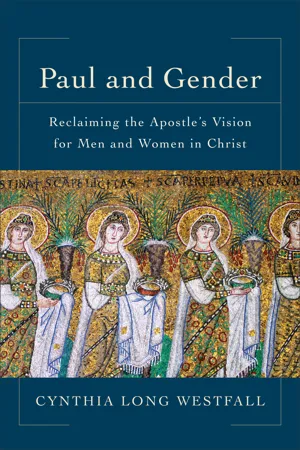
Paul and Gender
Reclaiming the Apostle's Vision for Men and Women in Christ
- 368 pages
- English
- ePUB (mobile friendly)
- Available on iOS & Android
eBook - ePub
About this book
Information
one
Culture
Our understanding of the language and culture of the first-century Greco-Roman world is vital to interpreting the Pauline Letters. This chapter shows how the context of culture helps to explain Paul’s language when he addresses gender and gender concerns.1 It is necessary to understand what Paul was trying to do with words in the light of the culture. The context of culture includes behavior that “is typical, recurrent, general.”2 These patterns of behavior are the way a culture works. It consists of typical social relationships and roles that apply across many situations, yet it also includes typical behavior within specific situations in that culture.3 Cultural and linguistic information about gender is demonstrated through the culture and specifically through the structure of the language, as well as the vocabulary, symbols, and metaphors. However, a culture’s language structure, symbols, and metaphors that involve gender should not be equated with the message of a speaker who utilizes that language. When Paul employs the structure and vocabulary of the Greek language or refers to cultural symbols, metaphors, or practices about gender, we need to be alert as to how much of Greco-Roman cultural practices and worldview are part of Paul’s message, and what cultural assumptions are truly adopted by him. For example, in the patterns that merely express grammatical gender, there is no choice, so there is no meaning. On the other hand, does Paul utilize “filter mechanisms” that select some features of the culture and language as relevant to his message, while he excludes other features as irrelevant?4 Does Paul utilize and redefine common metaphors and practices in such a way that their meanings are transformed? The answer to this question in this study will be yes: Paul exploits Hellenistic literature, philosophy, symbols, and language to take every thought captive to Christ (2 Cor. 10:5). We will see this, for example, in his discussion about the veil and his use of the metaphor of “head.” Paul used the Koine Greek language within a specific historical context; he was writing to specific recipients in specific historical situations. However, it does not follow that Paul accepted all historical-cultural and linguistic conventions that he utilized in communication as theologically normative for his Christian worldview. Precisely what was accepted as normative and what was rejected or altered must be determined.
1.1 Paul’s Hellenism and Palestinian Judaism
Paul lived in and moved back and forth between the broader hellenized culture and Palestinian Judaism. How is Paul to be understood in his relationship to Greco-Roman culture? By definition, since he was a Jew born in Tarsus, Paul was a Hellenistic Jew. However, according to both Paul and Luke, Paul identified himself as a Pharisee descended from a Pharisaic line with impeccable Jewish credentials (Phil. 3:4–6; Acts 23:6). Paul’s claim that he was “a Hebrew born of Hebrews” (Phil. 3:5) may have meant that he spoke Aramaic or Hebrew in the home.5 According to Luke’s account, Paul most likely first received an elementary Hellenistic education in Tarsus,6 and then later received a formal education in Judaism in Jerusalem, where he was thoroughly trained in the law under Gamaliel (Acts 22:2–3). What does this say about his orientation to the Greco-Roman and Palestinian Jewish cultures of his day? In the first half of the twentieth century, it was argued that Paul’s primary orientation was to a syncretistic hellenized Judaism, in which popular Greco-Roman philosophy provided the background of his thought.7 In the second half of the twentieth century, the consensus of scholarship experienced a profound shift and began to argue that Paul’s primary orientation in life and thought was to Palestinian Judaism.8 However, Palestinian Judaism was clearly embedded in Hellenism,9 and first-century Jewish culture included complex sets of beliefs that were not uniform. Nevertheless, Judaism as a whole differentiated itself from the dominant Greco-Roman worldview and consciously resisted assimilation while continuing to exist as a subculture.
One area in which Palestinian Judaism differentiated itself was sexual ethics. It has been convincingly argued that there is continuity between Paul’s ethical teachings about sexuality and the Jewish legal traditions.10 Most importantly, Peter Tomson demonstrated that Paul affirmed the law in his view on sexual relationships and sexuality.11 In the Greco-Roman world wide-ranging sexual license was practiced, though a clear double standard existed in the sexual expectations for men and women that reflected the culture’s beliefs about gender, hierarchy, and privilege.12 Paul’s fundamental teaching on Christian behavior directly confronted prevalent Greco-Roman sexual practices and expectations:
Finally, brothers and sisters, we ask and urge you in the Lord Jesus that, as you learned from us how you ought to live and to please God (as, in fact, you are doing), you should do so more and more. For you know what instructions we gave you through the Lord Jesus. For this is the will of God, your sanctification: that you abstain from fornication; that each one of you know how to control your own body in holiness and honor, not with lustful passion, like the Gentiles who do not know God; that no one wrong or exploit a brother or sister in this matter, because the Lord is an avenger in all these things, just as we have already told you beforehand and solemnly warned you. (1 Thess. 4:1–6 NRSV)
Paul not only confronted the sexual licentiousness of Hellenistic culture, but also, what is much more revolutionary, he continued the Christian and Jewish practice of not maintaining a double standard of sexual ethics.13 Although sexuality is only part of the gender issues, if Paul’s sexual ethics have any logical coherence, then it is a significant indicator that Paul’s theology of gender is going to be distinct from that of the dominant Greco-Roman culture. The claim that Paul would uncritically adopt a Greco-Roman model in the construction of his ethics or theology, particularly for his theology of gender, should be carefully reexamined.14
On the other hand, Paul was a part of the Greco-Roman culture and displayed familiarity with the formal and material characteristics of ethical Hellenistic literature. Granted, he did not hesitate to “employ current forms, concepts, and standards, even secular ones, already familiar to his readers.”15 Paul was a first-century Hellenistic Jew who chose a Palestinian Jewish worldview as his primary orientation, and who also undertook a Christian mission to the Greco-Roman culture. In conducting this gentile mission, Paul lived within Greco-Roman culture as one who understood it and thus was well positioned to explain spiritual realities foreign to his recipients by using concepts that were familiar and easily understood. Paul stood at the intersection of Christianity, Judaism, and the broader Hellenistic world. From that position he reread the law in relationship to his encounter with Christ on the road to Damascus and to his ministry experiences in the gentile revivals in Antioch and his gentile mission. As a result, he critiqued not only aspects of Greco-Roman culture but also aspects of Jewish culture and elements in the developing institutional culture of the early church. Paul’s utilization of Greco-Roman linguistic forms, cultural concepts, and ethical standards concerning gender needs to be carefully read and examined in light of the discourses and contexts in which these occur—in order to distinguish between what he critiques, what he transforms, and what he adopts.
1.2 The Pauline Relationship with the Church and Greco-Roman Society
Paul attempted to establish gentile churches within the context of the mainstream of Greco-Roman culture. His general purpose in writing his letters was to further his mission to the gentiles by spiritually forming, guiding, and correcting the gentile churches that had been founded by his mission team (with the exception of the church in Rome, which presumably did not have an apostolic foundation and was a unique mixture of Jew and gentile).16 Paul was very successful at contextualization for the purposes of communication and evangelism, which largely accounts for the success of his mission. One of the tricky aspects of Pauline studies involves accounting for the fact that in order to communicate spiritual realities, Paul would seek to use Greek language and metaphors that were meaningful to his Greco-Roman recipients (Rom. 6:19 NRSV: “I am speaking in human terms because of your natural limitations”).17 However, though he used Greek language embedded in the Hellenistic worldview, he intended for the church to be distinct from “the world,” which for him was a term that corresponded roughly to Greco-Roman society and culture.18 In other words, in order for his message to be communicated meaningfully, he deliberately employed commonly understood metaphors, conventions, and cultural institutions to transform the churches into a movement that was spiritually and ethically countercultural. To achieve this, Paul utilized common figures of speech, but did so in a manner so that such expressions frequently diverged from their normal meaning. Understanding Paul’s beliefs about gender cannot simply be a matter of studying the meaning of words, understanding facts about the culture, and then imposing Greco-Roman notions of gender onto Paul.
Instances of language and particularly figures of speech are to be correctly understood in the context of the communicator’s thought: the message of any communication must be understood in terms of its intended pragmatic effect on its ...
Table of contents
- Cover
- Title Page
- Copyright Page
- Dedication
- Contents
- Preface
- Abbreviations
- Introduction
- 1. Culture
- 2. Stereotypes
- 3. Creation
- 4. The Fall
- 5. Eschatology
- 6. The Body
- 7. Calling
- 8. Authority
- 9. 1 Timothy 2:11–15
- Conclusion
- Select Bibliography
- Index of Greek Terms
- Index of Modern Authors
- Index of Ancient Sources
- Index of Subjects
- Back Cover
Trusted by 375,005 students
Access to over 1.5 million titles for a fair monthly price.
Study more efficiently using our study tools.
Frequently asked questions
Yes, you can cancel anytime from the Subscription tab in your account settings on the Perlego website. Your subscription will stay active until the end of your current billing period. Learn how to cancel your subscription
No, books cannot be downloaded as external files, such as PDFs, for use outside of Perlego. However, you can download books within the Perlego app for offline reading on mobile or tablet. Learn how to download books offline
Perlego offers two plans: Essential and Complete
- Essential is ideal for learners and professionals who enjoy exploring a wide range of subjects. Access the Essential Library with 800,000+ trusted titles and best-sellers across business, personal growth, and the humanities. Includes unlimited reading time and Standard Read Aloud voice.
- Complete: Perfect for advanced learners and researchers needing full, unrestricted access. Unlock 1.5M+ books across hundreds of subjects, including academic and specialized titles. The Complete Plan also includes advanced features like Premium Read Aloud and Research Assistant.
We are an online textbook subscription service, where you can get access to an entire online library for less than the price of a single book per month. With over 1.5 million books across 990+ topics, we’ve got you covered! Learn about our mission
Look out for the read-aloud symbol on your next book to see if you can listen to it. The read-aloud tool reads text aloud for you, highlighting the text as it is being read. You can pause it, speed it up and slow it down. Learn more about Read Aloud
Yes! You can use the Perlego app on both iOS and Android devices to read anytime, anywhere — even offline. Perfect for commutes or when you’re on the go.
Please note we cannot support devices running on iOS 13 and Android 7 or earlier. Learn more about using the app
Please note we cannot support devices running on iOS 13 and Android 7 or earlier. Learn more about using the app
Yes, you can access Paul and Gender by Cynthia Long Westfall in PDF and/or ePUB format, as well as other popular books in Theology & Religion & Biblical Criticism & Interpretation. We have over 1.5 million books available in our catalogue for you to explore.