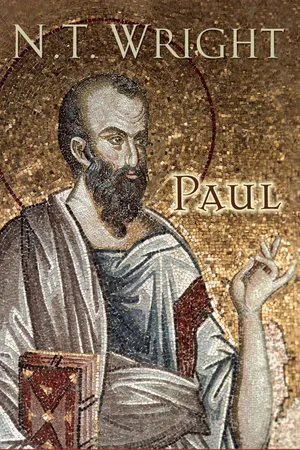
The letters of the Apostle Paul changed the world like no others before or since, and they continue to strike us afresh with their panoramic vision of human history and destiny.
Preeminent New Testament scholar and churchman N. T. Wright here offers a fresh perspective on the Apostle Paul's content and convictions. Wright ranks Paul as "one of the most powerful and seminal minds of the first or any century," endlessly engaging and perennially elusive. Yet, with recent research, Wright argues, we can now sketch with confidence a new and more nuanced picture of the Apostle and the radical way in which his encounter with Jesus redefined his life, his whole thought-world, his mission, and his expectations for a world made new in Christ. The result: a masterful, engaging, and enlightening portrait that situates Paul in his time and for our own.
- 208 pages
- English
- ePUB (mobile friendly)
- Available on iOS & Android
eBook - ePub
About this book
Information
Print ISBN
9780800663575
II
STRUCTURES
5
Rethinking God
1. Introduction
In this and the next two chapters I offer an outline sketch of the shape of Paul’s theology.
There has been enormous debate over the years about the proper way of arranging the various topics Paul talks about. All kinds of systems and arrangements have been tried. The familiar topics of reformation soteriology have often provided a framework, with the state of humankind, the nature of sin, death and the Law, the grace of God and the atoning death of Jesus as the major topics. This has produced the odd situation that other vital Pauline themes such as the resurrection, the place of Israel and even God himself have not been integrated into the overall structure. It is of course possible in theory that Paul had only incidental things to say on such topics, but even a nodding acquaintance with the letters suggests otherwise. Having often felt profoundly dissatisfied with the usual systems, I have wanted for some time to propose a fresh way of organizing Pauline theology, for which the earlier chapters in this book have been as it were preliminary studies.
The obvious place to begin is with the shape of classic Jewish theology. It is a measure of how little Paul’s Jewish context was taken seriously in older formulations that this simply doesn’t seem to have occurred to writers like, say, Rudolf Bultmann. Systematic theology has not been a Jewish concern in the same way that it has been a Christian concern, for reasons outside our present purpose. But when Jewish writers have taken it upon themselves to summarize what Jews believe, they have focused on two topics, with a third not far behind.[1] The main two are God and God’s people: monotheism and election. When you put monotheism and election together, and then look at the present state of the world and of God’s people, you will quickly come up with a third, namely eschatology. If there is one God, and if Israel is God’s people, something is surely wrong: how is the one God going to fulfil his promises to his people, and indeed to the world? Hence the threefold pattern: one God, one people of God, one future for God’s world. My proposal in this second main part of the book is that Paul’s thought can best be understood, not as an abandonment of this framework, but as his redefinition of it around the Messiah and the Spirit. This chapter and the following two will explore these topics in turn, leaving the way clear for a final chapter which offers some concluding reflections and proposals.
Monotheism, election and eschatology are thus closely interrelated:
(1) The one God is revealed not only as the creator and sustainer of the world, but also precisely as the God of Israel, that is, the electing God, and also the God of that final judgment for which he, as creator and sustainer, must remain responsible.
(2) Election, as it becomes refocused on Jesus as Messiah, is seen as the personal self-revelation of the one God in action and, so to speak, in passion. As we have already seen, Paul’s Christology binds the story of God and the story of Israel tightly together, and in doing so also gives eschatology its characteristically Christian shape: the long-awaited end has come forwards into the present, and has given the present time its peculiar character of now-and-not-yet.
(3) The coming end is itself guaranteed because of the justice of the one creator and covenant God. This eschatological vision is already revealed in Jesus the Messiah, and the energy by which the world and the church are moved from the present time to that ultimate future is the Spirit.
Each of the three topics is sliced through at right angles by three others, which we cannot develop in any detail in the present book but which form vital elements in the way Paul worked – that is, both the way his mind worked and the way he organized and conducted his whole life.
First, each of these redefinitions is rooted in a re-reading of Israel’s scriptures.[2] This re-reading is not, however, a matter merely of typology, picking a few earlier themes and watching the same patterns repeating themselves, though this also happens often enough. As I have argued in the earlier chapters, Paul had in mind an essentially historical and sequential reading of scripture, in which the death and resurrection of the Messiah formed the unexpected but always intended climax of God’s lengthy plan. Paul drew especially on the idea of a new exodus, and on a reading of Genesis, Deuteronomy, Isaiah and the Psalms in particular. In offering this fresh reading, he was regularly in at least implicit, and sometimes explicit, dialogue with alternative readings of the same scriptures, necessitating an essentially intra-Jewish, and sometimes intra-Christian, running controversy in favour of this fulfilment of scripture against other possible claims and agendas.
Second, in each case Paul’s main polemical target is not Judaism, as has so often been thought, despite this running battle on the side, but paganism. He remained at this point a typical Jew, understanding paganism in terms of idolatry, immorality and the consequent corruption of God’s good creation and of image-bearing humankind. At each point – God, God’s people, God’s future for the world – he offered a vision reshaped around Jesus and the Spirit, rooted in the Jewish scriptures, and claiming to be the reality of which paganism possessed a parody. We have already seen this to good advantage in Paul’s Christian reworking of the Jewish critique of pagan empire; the same can be said, mutatis mutandis, of his critique of other aspects of paganism.
Third, each of these redefined doctrines came to expression in the task of preaching the gospel to the world and then of building up the church through prayer, personal visits and teaching, and letters themselves. Paul would have seen this not as an accidental or a secondary expression, but as the necessary context for their exploration. His detailed apostolic work was not merely incidental, the way he happened to devise or stumble upon for propagating a set of abstract truths. It was entailed by those very redefined truths themselves.
One final word of introduction. I suggest, though there is no space to follow this through, that Paul’s redefined Jewish theology, resulting as it did in the redemption and renewal of human beings, gives him a robust epistemology in which, through worship, praise and prayer he is called to know and love the God who already knows and loves him, and through sharing the mind of the Messiah and the fresh insight of the Spirit he is called to know and love other human beings and the world. Thus the wisdom which Paul expounds in, for instance, Colossians 1 and 2 and 1 Corinthians 1—3 and 8.1–6 is itself the energy which drives the epistemology which sustains the theology. At this point, in fact, Paul’s Christian epistemology merges imperceptibly into what today we call, however loosely, spirituality.
So to the theology itself. We begin with Paul’s redefinition of the most central Jewish doctrine of all, that of the one God.
2. Monotheism: The Jewish Roots
There was, of course, more than one type of monotheism in the ancient world, as in the modern. People sometimes talk as if the word ‘monotheism’ always referred to the same kind of theology, but that is just as mistaken as the still common idea that the word ‘God’ itself is univocal. An obvious example of another kind of monotheism is pantheism, some form of which was well known in Paul’s world through the various kinds of Stoicism: if everything is divine, or if divinity lives within everything, then there may be one divinity, but this is a very different kind of divinity to the one invoked by ancient Israel. Similarly, it is possible for those who go down the Epicurean road, with divinity (or divinities) and the world separated by a vast gulf, to land up with a kind of Deism where there is indeed only one God – but where this ‘God’ is very different from the passionately involved and compassionately committed God of Exodus, Isaiah or the Psalms. Within the twenty-first-century world of religious discourse, it is a matter of sensitive debate whether we should suppose that the one God revealed in Jesus is identical to the one God known in Judaism or the one God revealed in the Koran – or whether, to put that more carefully, the language used in these different traditions about the one God does in fact refer to the same being, even though the things predicated of God contain serious mutual incompatibilities (it is analytically true of the God of the Koran that he would not and could not have become incarnate in the form of a ‘son’, and that he neither would nor could have died on a cross). Whatever we say about that, my point is that Jewish monotheism of the sort that Paul knew when he was growing up is a particular type of monotheism, which elsewhere I and others have called creational and covenantal monotheism. The one God of Israel made the world and has remained in dynamic relationship with it; and this one God, in order to further his purposes within and for that world, has entered into covenant with Israel in particular.
This in turn allows for the characteristically Jewish view of the problem of evil. This is really a separate topic. But, just as any serious view of God and the world will include some integrated treatment of evil, so the ancient Jewish worldview in particular (in each of its bewildering varieties; let us not get stuck on the old canard of ‘Judaism’ versus ‘Judaisms’) includes a view of evil, flexible enough to be sustained through many variations, and belonging closely with monotheism, election and eschatology. Let me summarize crudely. Ancient Judaism, and the Christianity which came to birth from within it, can be contrasted with its two main contemporary rivals at the level of worldview: pantheism and Epicureanism.
Pantheism (of which Stoicism provided the main first-century variety) always has difficulty giving a sustained account of evil. If the world itself is divine, there ought to be no problem, and the answer to any problems that may be felt is to get more deeply in touch with the true nature of things, and of oneself. By contrast, Epicureanism (of which Deism is one modern expression) has no difficulty giving an account of evil, since the ontological gap between the divine and the world in which we live is so great that there is really nothing to be explained. Evil is simply part of where we are, a shabby, second-rate world, a long way away from the bliss of heaven. The only solution is then to enjoy the world where one can, and shrug one’s shoulders where one cannot.
But within most varieties of Judaism, and certainly within those varieties upon which the early Christians drew, and which they rethought around Jesus himself, neither of these was an option. There was one God, the creator, who had remained passionately and compassionately involved with the world, and had expressed that in the call of Israel; that, as we have seen, is the meaning of covenant and election. Evil is thus a far greater problem in Judaism than in either pantheism or Epicureanism, ancient or modern. That is why we have, within ancient Judaism, such works as Psalms 73 and 88 and, towering high above the rest with its summit in the clouds, the book of Job. Judaism, even under intense pressure, never quite gives up on the belief that evil – moral evil, societal evil, evil within the natural order itself – matters desperately to God, and that he will one day not only put the world to rights but somehow deal retrospectively with the horror, violence, degradation and decay which has so radically (from this point of view) infected creation, not least human beings, including Israel. The wolf will at the last lie down with the lamb, and the earth shall be full of the glory of God as the waters cover the sea. The question of how God is involved in the mess and shame of the world at the present time, and more particularly of how he will ultimately deal with it, often remains opaque, though we have suggested some of the larger themes in Chapters 2 and 3 above. Monotheism, election and eschatology are, at one level, all about the problem of evil.
Jewish analyses of evil regularly focus on idolatry, that is, the worship of someone or something other than the true God. Idolatry inevitably, in such analysis, leads to the failure of humans to reflect the image of the true God, that is, the failure to be genuinely human: this means ‘missing-the-mark’, hamartia, in other words, ‘sin’. This analysis of evil regularly extends, within Law, prophets, writings and the continued thought of the second-Temple period, to a critique of the same flaws and failings within Israel itself. And it is this analysis of evil, in the pagan world and also, against the grain of election and covenant, within Israel itself, that sets the context for characteristically Jewish, characteristically monotheistic, solutions to the problem. Here the lines of thought converge, again and again, on the central themes of exile and restoration. Adam and Eve are expelled from the garden; Abraham is promised the Land. Jacob and his family are enslaved in Egypt; Moses and Joshua lead them through the Red Sea, the wilderness and the Jordan, home to their inheritance. David flees Jerusalem during Absalom’s rebellion, and is brought back after a great but tragic victory. Israel is dragged away captive to Babylon, and then promised a return so glorious that the ‘return from exile’, when it happened, never quite matched the expectation. And it is within these great themes, not as a separate or detached theological reflection, that we find the sudden bright, yet still mysterious, flashes of a redemption which speaks of much more than the to-and-fro of ethnic migrations: of God ransoming his worshippers from Sheol, breathing his Spirit into lifeless skeletons, revealing his powerful Arm in the form of a Servant who is stricken for the people’s transgressions. The problem of evil, as it appears within characteristically Jewish monotheism, and as it is given a second dimension within the covenant people themselves, receives – or at least, is promised – a solution commensurate with the analysis. More of all this anon, especially in the next chapter.
Jewish monotheism, then, always ranged itself over against paganism, seeing the pagan world as embodying and expressing the failure of human beings to live as they were made to live, to reflect the image of their maker. When Israel looked back in folklore to the time of slavery in Egypt, it was envisaged in terms of living alongside an alien people c...
Table of contents
- Cover
- Title Page
- Copyright
- Table Of Contents
- Preface
- Themes
- Structures
- Notes
- Bibliography
- Index of Selected Topics
- Index of Modern Authors
- Index of Text References
Trusted by 375,005 students
Access to over 1.5 million titles for a fair monthly price.
Study more efficiently using our study tools.