How the Sermon on the Mount Promotes Human Flourishing
The Sermon on the Mount, one of the most influential portions of the Bible, is the most studied and commented upon portion of the Christian Scriptures. Every Christian generation turns to it for insight and guidance.
In this volume, a recognized expert on the Gospels shows that the Sermon on the Mount offers a clear window into understanding God's work in Christ. Jonathan Pennington provides a historical, theological, and literary commentary on the Sermon and explains how this text offers insight into God's plan for human flourishing.
As Pennington explores the literary dimensions and theological themes of this famous passage, he situates the Sermon in dialogue with the Jewish and Greek virtue traditions and the philosophical-theological question of human flourishing. He also relates the Sermon's theological themes to contemporary issues such as ethics, philosophy, and economics.
Jesus Creed 2017 Commentary of the Year
Outreach 2018 Resource of the Year (Theology)
Academy of Parish Clergy 2017 Top Five Reference Book for Parish Ministry
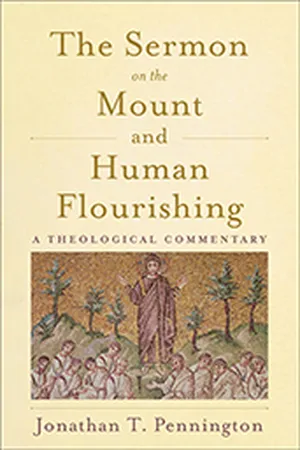
eBook - ePub
The Sermon on the Mount and Human Flourishing
A Theological Commentary
- 352 pages
- English
- ePUB (mobile friendly)
- Available on iOS & Android
eBook - ePub
About this book
Information
Topic
Theology & ReligionSubtopic
Biblical CommentaryPart 1
Orientation
1
The Encyclopedic Context of the Sermon
Base Camp: Understanding the Encyclopedic Context (with Help from Umberto Eco)
Any wise mountain climber spends thoughtful time in preparation before beginning the ascent. This preparation involves many elements, including mental and physical training, analyzing the goal, collecting equipment, and finding a good guide. All of this ultimately comes together at the foot of the mountain in the base camp.
This chapter is the base camp for our ascent of the Sermon on the Mount. In this base camp I will provide a reconnaissance of the mount that lies before us and how best to approach it. This reconnaissance reveals that to reach the highest vistas of the Sermon we must become competent readers who understand the encyclopedic context in which the Sermon exists.
Everything is in a context. This sentence, this paragraph, this chapter, this book, and its title all exist in a printed context. This is literary context. There are other contexts as well. There is the original context of me sitting on my red couch early one Sunday morning, before anyone else in my house is awake, writing that sentence. There are several later contexts of me revising this paragraph, each with their own historical situatedness. There is the context of the now, a very different one: your context as a reader. Your place in time and space makes your context different from mine as the writer. My writing exists in the complex context of my whole life up to this point; your reading does too, with your life. Today is shaped and formed by all the days that came before it, turtles stacked on top of each other from the foundation of the world until this moment. If you come back and read this paragraph again sometime in the future, while its compositional context and intent will not have changed, much else will have, resulting in a different contextual reading.
One of the most insightful thinkers who can help us understand the importance of these multiple contexts is Umberto Eco, especially in terms of his notions of the context of the cultural encyclopedia and the Model Reader. Eco, famous for his voluminous and influential output of everything from best-selling novels to technical works on translation theory, was a semiotician. Semiotics is a branch of literary and linguistic study that focuses on how signs and symbols function in human communication.1 His academic work focuses on how language works to communicate meaning through cultural signs and phenomena.2 This is where the idea of contexts becomes so important for reading and interpreting any text, such as the Sermon.
Eco is a heavyweight thinker who steps into the ring of a heated, long, and highly publicized fight between theorists on how to interpret literature and how meaning occurs. At the risk of oversimplification, in one corner are those who emphasize the role of the author who produced the original text. In the other corner are those who suggest that the reader plays the determinative role in meaning production. Again, with some unfortunate but necessary oversimplification, this could be called the difference between objectivism and subjectivism or modernism and postmodernism, between authorial intent and reader response, when these categories are applied to the interpretation of texts (hermeneutics).
Eco’s position, which comes to greater clarity and strength over the course of his long career, is unique and provides a helpful way forward on these complicated debates. In short, Eco recognizes the complexity of the experience of reading and how different cultural contexts and traditions affect what one discerns in a text and what resonances it evokes. Yet in contrast to much of literary theory today, Eco insists on the importance of intention in the creation of a text and on the historical situatedness of the author, who exists in a particular time and place. This puts Eco at odds with much of postmodern literary theory, including that of the poststructuralists and even other semioticians.3 One cannot simply use a text to say whatever one wants—well, of course, one can do that, but this is not a good theory for literature or a good practice if one wants to interpret texts. One cannot ignore the author as if he or she has no role in the meaning: the “words brought by the author are a rather embarrassing bunch of material evidences [if one is trying to ignore them] that the reader cannot pass over in silence, or in noise.”4 Rather, “interpreting texts involves discerning the nature of the text, the very intent of the text, composed of words and strings of words that have conventional meanings and functions.”5
Eco’s unique contribution is that he provides a model for how this text-focused reading relates to the complexity of the enculturated nature of language and communication and the experience of readers. The key to understanding what Eco is saying here is his idea of “encyclopedic competence.” Eco argues that the meaning of words and phrases should not be approached with a dictionary model, where understanding of the language is stored in the dictionary while knowledge of the real world—its culture, history, beliefs—is stored separately, in the encyclopedia. On the contrary, Eco shows that we can never “sever language from its location and function within a cultural framework.” Language is a social phenomenon and thus real, not abstract and ideal.6 Communication and texts come from real people in real situations, complete with cultural assumptions and evocations; communication does not exist outside of these historical realities. A dictionary approach to language relates facts in a discursive, point-to-point way; but “the idea of encyclopedia attempts to take into account a process of interpretation which takes the form of an inference.”7 Or, in the words of John Haiman, “Dictionaries relate words to other words. Encyclopedias, in more or less sharp contradistinction, relate words to extralinguistic facts,”8 or cultural realities. By way of example, Stefan Alkier notes that in the encyclopedia of cultural understanding of the Roman Empire there would have been an entry for “love spell,” even though in most modern Western cultures there would not.9 This difference speaks to the fact that our reading entails understanding not only the words but also the cultural differences between us and the text before us.
Thus, rather than thinking about language and texts in terms of a dictionary, we must consider language and texts as products of a certain cultural phenomenon, something that can only be understood and described with a massive encyclopedic understanding. For Eco, the “encyclopedia” is the totality of the collection of all possible cultural interpretations and phenomena in which a text is created; it is the “grand universe of semiosis” or signs.10 The encyclopedia is “the cultural framework in which the text is situated and from which the gaps of the text are filled.”11 Therefore, the encyclopedia is never finished and exists only as a regulative idea; the potential associations of meanings are endless as culture continues to develop.
But here is the key idea and what separates Eco from the poststructuralists. For poststructuralism (and much of current literary theory and discussions of intertextuality), reading is completely open as one explores the infinite process of semiosis, where meaning is never really found and certainly not in any authorial intention in the text. For Eco, by contrast, texts are particular instantiations of encyclopedic materials and thus arrest the infinite play of semiosis that one might engage in as a reader.12 Every text is not just language but is also an actualization of some aspects of the cultural encyclopedia in which it was created. And because texts are created in real situations and have an intention, through historical, cultural, and literary analysis a good reader can actually “isolate a given portion of the social encyclopedia so far as it appears useful in order to interpret certain portions of actual discourses (and texts).”13 Or to say it more simply, because words come from and evoke cultural resonances (not simply denote dictionary meanings) we must interpret texts sensitive to those cultural evocations.
The Model Reader then, for Eco, is the one who sits at the juncture where the particular text connects with the cultural encyclopedia in the most coherent and economic way possible.14 The best readings of a text will seek to approximate the position of the Model Reader through an ever-increasing competence in encyclopedic understanding (imperfect though it must be). The Model Reader is one who reads sympathetically and “with the grain” of the text.15 Good reading involves an “interpretive c...
Table of contents
- Cover
- Title Page
- Copyright Page
- Dedication
- Epigraphs
- Contents
- Acknowledgments
- Abbreviations
- Translation of the Sermon on the Mount
- Introduction
- Part 1: Orientation
- Part 2: Commentary
- Part 3: Theological Reflection
- Author Index
- Scripture and Ancient Writings Index
- Back Cover
Trusted by 375,005 students
Access to over 1.5 million titles for a fair monthly price.
Study more efficiently using our study tools.
Frequently asked questions
Yes, you can cancel anytime from the Subscription tab in your account settings on the Perlego website. Your subscription will stay active until the end of your current billing period. Learn how to cancel your subscription
No, books cannot be downloaded as external files, such as PDFs, for use outside of Perlego. However, you can download books within the Perlego app for offline reading on mobile or tablet. Learn how to download books offline
Perlego offers two plans: Essential and Complete
- Essential is ideal for learners and professionals who enjoy exploring a wide range of subjects. Access the Essential Library with 800,000+ trusted titles and best-sellers across business, personal growth, and the humanities. Includes unlimited reading time and Standard Read Aloud voice.
- Complete: Perfect for advanced learners and researchers needing full, unrestricted access. Unlock 1.5M+ books across hundreds of subjects, including academic and specialized titles. The Complete Plan also includes advanced features like Premium Read Aloud and Research Assistant.
We are an online textbook subscription service, where you can get access to an entire online library for less than the price of a single book per month. With over 1.5 million books across 990+ topics, we’ve got you covered! Learn about our mission
Look out for the read-aloud symbol on your next book to see if you can listen to it. The read-aloud tool reads text aloud for you, highlighting the text as it is being read. You can pause it, speed it up and slow it down. Learn more about Read Aloud
Yes! You can use the Perlego app on both iOS and Android devices to read anytime, anywhere — even offline. Perfect for commutes or when you’re on the go.
Please note we cannot support devices running on iOS 13 and Android 7 or earlier. Learn more about using the app
Please note we cannot support devices running on iOS 13 and Android 7 or earlier. Learn more about using the app
Yes, you can access The Sermon on the Mount and Human Flourishing by Jonathan T. Pennington in PDF and/or ePUB format, as well as other popular books in Theology & Religion & Biblical Commentary. We have over 1.5 million books available in our catalogue for you to explore.