Scot McKnight here explains the Letter of James both in its own context and as it may be seen in light of ancient Judaism, the Graeco-Roman world, and emerging earliest Christianity.
From beginning to end, the book is shaped for pastors, teachers, and scholars. McKnight is less interested in shedding new light on James than on providing a commentary for those who want to explain the letter and its significance to congregations and classes.
This commentary is accessible to a broad readership, at once full of insight and of good sense and wit that makes for good reading. The Letter of James is an especially helpful source for consultation as to what James is about.
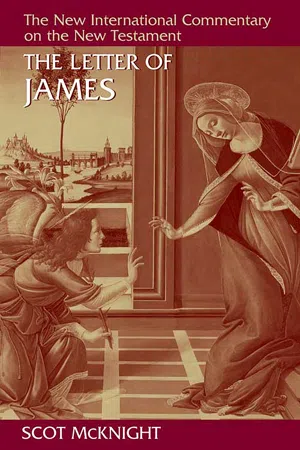
- 532 pages
- English
- ePUB (mobile friendly)
- Available on iOS & Android
eBook - ePub
The Letter of James
About this book
Information
Print ISBN
9780802826275
Commentary
1. SALUTATION (1:1)
The language of the first verse indicates that James is a letter,1 though there is little in the remainder of the text to lead one to think of James as a letter. Letters in the first-century Jewish and Christian worlds varied in substance (Romans, 2 Corinthians, 1–2 Timothy) and style (Romans, 1 Thessalonians, Hebrews), so one should not infer from James’s substance, which is largely hortatory, homiletical, and even sapiential, to its form (letter). There was no prescribed format, especially in the cauldron of a new movement like messianism, that one had to follow for one’s writing to be classified as a “letter” or “epistle.” Unlike the Pauline and Petrine epistolary form, which have both typical salutations and some kind of introductory thanksgivings, James has only the salutation and from that point on launches into his letter. We should perhaps be careful not to compare this letter to the form of the Pauline and Petrine letter, since those apostolic letters and their substantive form were probably only in the infancy of their own developments.2
James, a servant of God 3 and of the Lord Jesus Christ,
To the twelve tribes in the Dispersion:a
Greetings.
1 Standard Hellenistic letters included the writer and the addressee (A to B) as well as a greeting (“greetings”), while the evidence that survives suggests that Jewish letters modified the greeting by wishing “peace” (shalom, eirēnē) and other blessings (berakot).4 A typical Greek letter, dated to 29 August 58 CE, begins as follows:
Chairas to his dearest Dionysios many greetings and continual good health.5
From a Jewish letter, we read:
Thus speaks Baruch, the son of Neriah, to the brothers who were carried away in captivity: Grace and peace be with you (2 Baruch 78:2, OTP).
James’s salutation is Hellenistic:6
James, a servant of God and of the Lord Jesus Christ, to the twelve tribes in the Dispersion: Greetings.
James’s letter conforms in part to reflections on the nature of letter writing as seen now in Seneca’s Moral Epistles (75.1–2): “You have been complaining,” he writes, “that my letters to you are rather carelessly written.” And it is here that he ventures a reflection that articulates how James functions: it is the personal presence of James. Seneca begins with the question of why his letters are as they are:
Now who talks carefully unless he also desires to talk affectedly? I prefer that my letters should be just what my conversation would be if you and I were sitting in one another’s company or taking walks together,—spontaneous and easy; for my letters have nothing strained or artificial about them. If it were possible, I should prefer to show, rather than speak, my feelings.7
This is the sort of letter James has composed: he is speaking, sometimes forthrightly and prophetically and other times more didactically, as if he were in the recipients’ presence speaking to them. The letter is not an abstract “epistle” designed for posterity or intellectual reputation. It is a gritty in-your-face pastoral letter zippered up at times with some heated rhetoric.
The letter says it is from James. But who is “James”? There are no fewer than, to reduce our discussion from the Introduction, three serious candidates for this “James” (Hebrew Yakov or Jacob; cf. Gen 25; 27:36).8 James, son of Zebedee and one of the twelve original apostles (Mark 3:17; Acts 12:2), was put to death by Herod Agrippa I (c. 44 AD). James, son of Alphaeus and otherwise unknown (Mark 3:18), was also an original apostle. As we concluded in the Introduction, James, the brother of Jesus (Mark 6:3) and leader of Jerusalem-based messianic Judaism,9 is most likely the figure intended here, whether or not “James” is a pseudonym.
That James emerges from the same family as Jesus is not without significance for him, for his socio-religious background, and for the message of this letter.10 In particular, as will become clear, the Magnificat of Mary has manifold parallels with both the teachings of Jesus and the letter of James. Mary, Jesus, and James speak from the world of the Anawim (the “pious poor”) and we will mention this socio-economic community and faith tradition at times in this commentary.11
That James, brother of Jesus, was an established leader in Jerusalem—Paul calls him a “pillar” (Gal 2:9)—gave this letter the authority that was needed to keep it afloat through the canonical process in spite of the tragic neglect and sometimes biased dismissal of Christian Judaism.12 Forgotten in the rise of both Peter and Paul is the fact that James cast a shadow over them in Jerusalem’s earliest messianic community (see Gal 2:12; Acts 15:13–21; 21:18; 1 Cor 15:7).13 In the Lukan portrayal of James at the Jerusalem Conference, James is depicted as a wise man, a theologically-astute leader, open to Gentile inclusion in the messianic community with conditions, and desirous of reconciling split parties. It was James who delivered the most effective speech at that conference (Acts 15:13–21), and in the literary tradition final speeches are reserved for the most influential leader.
James calls himself a “servant of God,” and thereby both evokes his own personal vocation and places himself in a deep and potent Jewish tradition. Elsewhere in the New Testament, letter writers call themselves “servant,” “apostle,” or “prisoner” and, with others, “servants.”14 Only James and Jude call themselves “servant” with no other designation, thereby possibly indicating their self-awareness that they are not part of the original twelve apostles. What “servant” also indicates is that neither James nor Jude, both traditionally “brothers” of Jesus, used their family status to leverage power. “Servant,” however, is not to be understood as some term of extreme humility, as in “not an apostle, but just a servant,” or as “simply a believer,” but instead points toward two features of James, first, that he sees himself as one who serves the Lord Jesus Christ (confirmed a few words later with the word “Lord”)15 and, second, that he stands in line with some illustrious forbears.16 Others called “servant” are Moses, David, Amos, Jeremiah, and Daniel.17 Therefore, using this term of oneself is paradoxical: it is both a claim to subordination to Christ and a claim to privilege and honor in the Jewish messianic community that carries forward the work of Moses, David, and the great prophets of Israel’s history.18 By placing “God and the Lord Jesus Christ” between “James” and “servant,” James intentionally sets “servant” in a messianic/Christian context. James is a servant of both (the one) God and the Lord Jesus Christ.19
James, brother of Jesus, sees himself as a servant “of God and of the Lord Jesus Christ.”20 Herein is an early Jacobean glimmer of what was destined to become trinitarian thought. Jesus Christ is defined by “Lord,” or better yet, “Lord” is defined by Jesus Christ. As mentioned in the Introduction, that we cannot always be sure whether “Lord” refers to Father/God or to Jesus Christ puts us on the threshold of a profound shift at work in the messianic community’s theology. Larry Hurtado’s magnum opus has demonstrated with full documentation that “Lord” belongs to and emerges from the earliest stratum of Christian worship and theological reflection.21 We can surmise that ascribing lordship to Jesus Christ is shaped by liturgical practice in the messianic community 22 to which James writes.23
But James’s line is not to be understood simply as theological reflection. Indeed, James makes a personal confession here that he is one who serves God and the Lord Jesus Christ, thereby making it clear that his allegiance within Judaism has been reshaped by the messianic community and its hermeneutic of reading a messianically-shaped Tanakh.24 It cannot be forgotten that earliest Christianity was driven to the Scriptures for a variety of reasons, not the least of which were (1) Jesus’ own use of Scripture, (2) the necessity of following and worshiping and comprehending a crucified and risen Lord, (3) the inevitable discussions around their new understanding of Israel’s history and the work of God through Jesus Christ, and (4) the need for explanations of their own experiences and persecution. The formative shape of the messianic community was derived from its hermeneutic of Scripture. For James (see 2:1–12), for instance, the entire Torah is to be read through the lens of Leviticus 19:18, the second half of what I have elsewhere called the Jesus Creed,25 and the figures of the Old Testament are exemplary for the messianic community (see 2:21–23, 25; 5:10, 11, 17). The hermeneutic of James is that of Jesus.26
James, then, is a servant of God and the Lord Jesus Christ as he has come to know both through experience and Scripture interpretation. This confession may well put James in jeopardy on two separate fronts: because he “serves” the Lord Jesus Christ, he sets himself apart from other Jews who do not serve Jesus and from all those Gentiles who serve neither the God of Israel nor Jesus as Messiah. In light of exegesis of the meaning of “poor” in James, this confession by James places him among the “poor” who find themselves dominated by the “rich.” To confess Jesus as Lord could be a confession of solidarity with the economic condition of the messianic community of James.
James addresses his letter “to the twelve tribes in the Dispersion,”27 an address t...
Table of contents
- Cover
- Title Page
- Copyright Page
- Dedication
- Contents
- Editor’s Preface
- Author’s Preface
- Abbreviations
- Bibliography
- Introduction
- Commentary
- Notes
- Authors
- Subjects
- Scripture References
- Extrabiblical Ancient Literature
Trusted by 375,005 students
Access to over 1.5 million titles for a fair monthly price.
Study more efficiently using our study tools.
Frequently asked questions
Yes, you can cancel anytime from the Subscription tab in your account settings on the Perlego website. Your subscription will stay active until the end of your current billing period. Learn how to cancel your subscription
No, books cannot be downloaded as external files, such as PDFs, for use outside of Perlego. However, you can download books within the Perlego app for offline reading on mobile or tablet. Learn how to download books offline
Perlego offers two plans: Essential and Complete
- Essential is ideal for learners and professionals who enjoy exploring a wide range of subjects. Access the Essential Library with 800,000+ trusted titles and best-sellers across business, personal growth, and the humanities. Includes unlimited reading time and Standard Read Aloud voice.
- Complete: Perfect for advanced learners and researchers needing full, unrestricted access. Unlock 1.5M+ books across hundreds of subjects, including academic and specialized titles. The Complete Plan also includes advanced features like Premium Read Aloud and Research Assistant.
We are an online textbook subscription service, where you can get access to an entire online library for less than the price of a single book per month. With over 1.5 million books across 990+ topics, we’ve got you covered! Learn about our mission
Look out for the read-aloud symbol on your next book to see if you can listen to it. The read-aloud tool reads text aloud for you, highlighting the text as it is being read. You can pause it, speed it up and slow it down. Learn more about Read Aloud
Yes! You can use the Perlego app on both iOS and Android devices to read anytime, anywhere — even offline. Perfect for commutes or when you’re on the go.
Please note we cannot support devices running on iOS 13 and Android 7 or earlier. Learn more about using the app
Please note we cannot support devices running on iOS 13 and Android 7 or earlier. Learn more about using the app
Yes, you can access The Letter of James by Scot McKnight in PDF and/or ePUB format. We have over 1.5 million books available in our catalogue for you to explore.