eBook - ePub
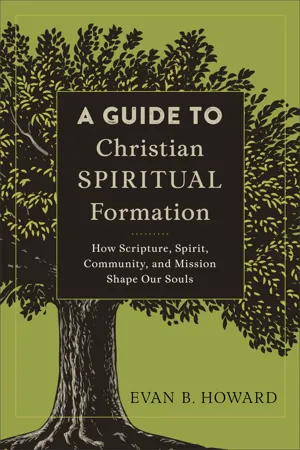
A Guide to Christian Spiritual Formation
How Scripture, Spirit, Community, and Mission Shape Our Souls
- 288 pages
- English
- ePUB (mobile friendly)
- Available on iOS & Android
eBook - ePub
A Guide to Christian Spiritual Formation
How Scripture, Spirit, Community, and Mission Shape Our Souls
About this book
Evan Howard, a noted authority on Christian spirituality, provides a holistic, accessible, and informed introduction to Christian spiritual formation written from a broadly evangelical perspective. Howard joins Scripture with themes of community, spirit, formation, and mission in a single integrative guide. The book includes helpful features such as figures, charts, chapter overviews, and formation-focused questions. Its evangelical-ecumenical and global perspectives will appeal to a wide audience. Resources for professors and students are available through Baker Academic's Textbook eSources.
Information
Topic
Theology & ReligionSubtopic
Christian MinistryPart One
The Basics
1
Christian Spiritual Formation
Overview
In this chapter, we will make our first acquaintance with the notion of Christian spiritual formation. After hearing a few stories about increasing interest in this practice, we will examine the general concept of spiritual formation: where it came from, what it has meant over the centuries, and what it is becoming. We will see that, particularly today, the ideas of formation, community, and mission are intertwined, making a tidy definition of Christian spiritual formation difficult to establish. We will then examine the key terms formation, spiritual, and Christian in order to bring us one step closer to a definition of Christian spiritual formation. We will compare a few common definitions, which vary in how they address key elements of Christian spiritual formation. Then we will venture to create our own definition, which will guide our basic understanding of the topic through the course of this book. Finally, with this definition in mind, we will preview the upcoming chapters.
Spiritual Formation Matters
Christians of all stripes agree: the practice of spiritual formation matters. Without it—we are beginning to learn—church, and even the Christian faith, simply does not work.
Take Willow Creek Community Church. The assumption was that increased participation in church activities—small groups, weekend worship services, and volunteering—increases a person’s love of God and others. “That’s what we believed at Willow Creek,” recounts researcher Greg Hawkins. Willow Creek, one of the largest churches in the United States and a leader among megachurches, had invested much in this assumption. Dozens of people administrated the parking lots each Sunday morning. Superb music was performed at gatherings. No expense was spared in making Willow Creek activities both attractive and relevant. Hawkins and the research team were hoping to discover, through their 2003 self-study, which activities produced the most spiritual growth.
What they discovered through their interviews, however, was surprising. Merely increasing participation in church activities barely moved people to love God and others. This naturally led them to explore the further question, How do people grow spiritually? Their findings regarding the needs for ongoing spiritual growth (published in Move: What 1,000 Churches Reveal about Spiritual Growth) led the Willow Creek Association of churches to reshape their entire approach to ministry—no small task for a religious association involving tens of thousands of people.1
Spiritual formation matters.
A flame of interest in spiritual formation is spreading globally through the Vineyard, an association of charismatic evangelical churches that grew in size and popularity in the 1980s with increased interest in spiritual gifts such as healing.2 As many pastors and leaders in this movement will testify, it is one thing to experience showers of God’s blessing. It is another to dig deep wells of spirituality that can quench our thirst in downpour or in drought. In the 1990s, some key leaders discovered fresh means of walking in the Spirit. By 2002, Judy Davids, a pastor and counselor, had pioneered Pastors’ Sabbath Retreats, a vehicle that provided rest and taught balanced living to many Vineyard leaders. Pastor David Nixon had founded Sustainable Faith, an organization that promotes spiritual direction training throughout the Vineyard. In 2008, pastor Steve Summerell presented some of the insights from his doctoral thesis, “Overcoming Obstacles to Spiritual Formation in the Lives of Vineyard Pastors,” to a regional conference of Vineyard leaders.3 Mark Fields, director of the Vineyard’s Missions Task Force, attended that presentation and invited Summerell to lunch. Fields shared his own story of burnout and ultimately invited Summerell to join him on a trip to Nepal and present some of his material to leaders there. Thus was born the Vineyard’s global effort known as Caring for Leaders. Leaders from Russia, Indonesia, Chile, Brazil, and the Philippines, among other countries, all eagerly welcomed training in spiritual formation and were refreshed.
By then, however, Todd Hunter, once president of Vineyard USA, had become an Anglican. In his memoir, The Accidental Anglican, Hunter recounts how in 1979, at age twenty-three, he moved to West Virginia to start a Calvary Chapel church that later became a Vineyard congregation.4 By 1995, Hunter had helped plant several Vineyard churches and was acting as national coordinator for the organization. By 2005, he had moved on from that position to foster creative church planting through a group called Allelon and through the Alpha Course. It was in this season of reimagining that Hunter first thought, “Someday I would be saying daily prayers with a group of Christians who were serious about the twin tracks of following Jesus: (1) spiritual formation into Christlikeness (2) for the sake of others.”5 Hunter was ultimately invited into the Anglican community. Under the influence of theologians such as J. I. Packer and John Stott, he found that his interests in evangelical faith and spiritual formation had a long history in the Anglican tradition and that Anglicanism was “a huge treasure chest of tools for contemporary evangelism and spiritual formation.”6 He was formally invited to help plant an Anglican congregation in California, ultimately confessing to a respected elder, “I think the Holy Spirit may be calling me to do this.”7 Ultimately, in rather quick succession, Hunter was ordained as a priest and later as a bishop. In a companion book to his memoir, Giving Church Another Chance, Hunter uses the framework of a typical Anglican worship service as a way of presenting “new meaning in [traditional] spiritual practices.”8 Hunter is one among a growing community of Christians exploring and reappropriating liturgical traditions.9
Again, my point is this: spiritual formation matters. I hear Christians discussing it in many different circles. As we will see below, evangelical churches and institutions of higher education are making spiritual formation a subject of study, even hiring pastors of formation and redesigning training programs. Spiritual formation is on our screen, so to speak, these days.
I will go further. I believe that Western culture in general is beginning to acknowledge the need for and importance of spiritual formation. Indeed, perhaps the recent evangelical interest in spiritual formation indicates not a fad but rather a crisis. Recent surveys of young “outsiders” (people who are not a part of the Christian community) and young “leavers” (people who no longer consider themselves part of the Christian community) point to the lack of formation among Christians as a key reason for their distancing themselves from the faith. Barna Research Group president David Kinnaman urges Christians that “to embrace the perception that we are focused only on converts, we have to embrace a more holistic idea of what it means to be a Christ follower. This requires us to focus our attention on spiritual transformation—or spiritual formation, as some describe it. In the last two years, we have completely re-engineered the Barna organization around this concept—that the church must become a catalyst and environment for genuine and sustainable transformation.”10
Similarly, in response to findings regarding the wave of young adults leaving Christianity, Kinnaman concludes: “The dropout problem is, at its core, a faith-development problem; to use religious language, it’s a disciple-making problem. . . . Like a Geiger counter under a mushroom cloud, the next generation is reacting to the radioactive intensity of social, technological, and religious changes. And for the most part, we are sending them into the world unprepared to withstand the fallout.”11
Christian spiritual formation matters. It matters to those who are leaving the church. It is beginning to matter to those of us within the church. And it matters that it matters. If it didn’t matter, we might really be in trouble.
What Is Spiritual Formation?
But just what is this spiritual formation that matters so much? Actually, this is not an easy question to answer. Each of these words—spiritual and formation—has been used in different ways at different times; as a result, the phrase spiritual formation means slightly different things to different people.
Christians’ use of formation has origins in the writings of the New Testament. In Galatians 4:19, for example, Paul uses the imagery of childbirth to expresses his intense desire for the Galatian church’s growth, stating that he is suffering “the pains of childbirth” until “Christ is formed in you.” In Ephesians, Paul uses the imagery of a building to communicate the church’s formation in Christ. He speaks of Christ as the cornerstone of this ongoing construction (and formation) project. “In him,” Paul declares, “the whole building is joined together and rises to become a holy temple in the Lord. And in him you too are being built together to become a dwelling in which God lives by his Spirit” (Eph. 2:21–22). The author of the Epistle to the Hebrews describes Christian formation as a development of faith (“Let us draw near . . . with the full assurance that faith brings,” 10:22), hope (“Let us hold . . . to the hope we profess,” 10:23), and love (“Let us . . . spur one another on toward love and good deeds,” 10:24). For the author of Hebrews, our ongoing formation—which entails securing our roots and strengthening our growing connection to Christ—is brought about when we exercise the fundamental virtues of our character: faith, hope, and love. And as we see in these passages, our formation is something that the Spirit works in us through the very life of the church (e.g., “spur one another”). Similarly, 1 Peter uses the metaphors of newborn development (“grow up in your salvation” through “spiritual milk,” 2:2) and construction (“being built into a spiritual house,” 2:5) to communicate this desire for formation into Christ.
The theme of formation, with all its rich imagery, was picked up and developed throughout the history of the Christian church. Thus Irenaeus in the second century speaks of the Creator forming us for the sake of growth.12 We’re formed for the sake of formation. Augustine speaks of our growth as a purification of our minds, so that we can increasingly appreciate our relationship with God. In his treatise On Christian Doctrine, he urges his readers to “consider this process of cleansing as a trek, or a voyage, to our homeland.”13
The word formation acquired a particular meaning in reference to nurturing believers who made special commitments to God: the training of nuns, monks, and priests.14 For example, one nun might be placed in charge of the formation of young trainees (often called novices) at a convent. The novice mistress’s job was to guide novices into their new life as nuns. It involved education and character training. But most importantly, her work was to facilitate the development of young novices’ living relationship to God. Without this living relationship, none of the other training made any sense. Here spiritual formation refers to consciously fostering a living relationship with God in the context of a religious community.
A similar process was developed for training parish priests. For example, regarding pastoral trainees in seminary, the “Decree on Priestly Formation” (Optatam Totius) from the Second Vatican Council (1965) urges,
Spiritual formation should be closely linked with doctrinal and pastoral training. Especially with the help of the spiritual director, such formation should help seminarians learn to live in familiar and constant companionship with the Father, through Jesus Christ His Son, in the Holy Spirit. . . . They should be taught to look for Christ in many places: in faithful meditation on God’s word, in active communion with the most holy mysteries of the Church, . . . especially the poor, the young, the sick, the sinful, and the unbelieving.15
Interest in spiritual formation spread from Roman Catholic institutions to Protestant circles in the 1960s and 1970s. In 1964, Asbury Seminary received a grant to found the first Department of Spiritual Formation.16 Other schools followed suit. Wheaton College voted to form the Department of Formation and Ministry in 2003. Talbot School of Theology’s Institute for Spiritual Formation has been offering advanced programs in spiritual formation for years. Dallas Theological Seminary now offers a doctorate of ministry degree with an emphasis in spiritual formation. Moody Bible Institute also advertises a certificate in spiritual formation. A wide range of Protestant groups began to experiment with academic programs and practical training centers in spiritual formation. And during this season, the meaning of spiritual formation itself was blurred. Often the term formation was not comprehended within an established faith culture like it had been in monastic or priestly circles; rather, it communicated a nexus of practices, relationships, events, and such initiated by a spiritual seeker. Similarly, the term spiritual at times indicated not, as described above, “companionship with the Father, through Jesus Christ His Son, in the Holy Spirit,” but rather the development of the depths of the human soul—our spirit.
A landmark publication amid developing interest in spiritual formation was Richard Foster’s Celebration of Discipline, released in 1978.17 Within a decade, Foster, along with fellow author Dallas Willard and others, had founded Renovaré, an organization dedicated to the promotion of spiritual formation. By 1990, one could identify spiritual formation movements influencing a wide range of Christian circles. But by then spiritual formation meant whatever each religious circle wanted it to mean.
The Christian Scriptures use a rich array of metaphors to describe ou...
Table of contents
- Cover
- Title Page
- Copyright Page
- Contents
- Preface
- Part One: The Basics
- Part Two: The Elements
- Part Three: The Practice
- Part Four: The Ministry
- Epilogue
- Notes
- Scripture Index
- Subject Index
- Back Cover
Trusted by 375,005 students
Access to over 1.5 million titles for a fair monthly price.
Study more efficiently using our study tools.
Frequently asked questions
Yes, you can cancel anytime from the Subscription tab in your account settings on the Perlego website. Your subscription will stay active until the end of your current billing period. Learn how to cancel your subscription
No, books cannot be downloaded as external files, such as PDFs, for use outside of Perlego. However, you can download books within the Perlego app for offline reading on mobile or tablet. Learn how to download books offline
Perlego offers two plans: Essential and Complete
- Essential is ideal for learners and professionals who enjoy exploring a wide range of subjects. Access the Essential Library with 800,000+ trusted titles and best-sellers across business, personal growth, and the humanities. Includes unlimited reading time and Standard Read Aloud voice.
- Complete: Perfect for advanced learners and researchers needing full, unrestricted access. Unlock 1.5M+ books across hundreds of subjects, including academic and specialized titles. The Complete Plan also includes advanced features like Premium Read Aloud and Research Assistant.
We are an online textbook subscription service, where you can get access to an entire online library for less than the price of a single book per month. With over 1.5 million books across 990+ topics, we’ve got you covered! Learn about our mission
Look out for the read-aloud symbol on your next book to see if you can listen to it. The read-aloud tool reads text aloud for you, highlighting the text as it is being read. You can pause it, speed it up and slow it down. Learn more about Read Aloud
Yes! You can use the Perlego app on both iOS and Android devices to read anytime, anywhere — even offline. Perfect for commutes or when you’re on the go.
Please note we cannot support devices running on iOS 13 and Android 7 or earlier. Learn more about using the app
Please note we cannot support devices running on iOS 13 and Android 7 or earlier. Learn more about using the app
Yes, you can access A Guide to Christian Spiritual Formation by Evan B. Howard in PDF and/or ePUB format, as well as other popular books in Theology & Religion & Christian Ministry. We have over 1.5 million books available in our catalogue for you to explore.