A historical analysis of the General Strike of 1919 in Seattle
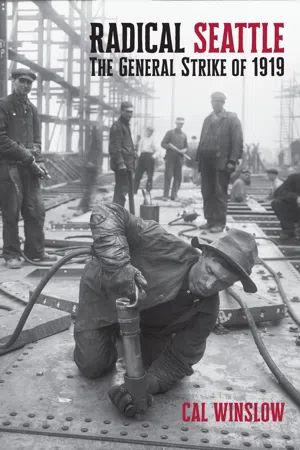
On a grey winter morning in Seattle, in February 1919, 110 local unions shut down the entire city. Shut it down and took it over, rendering the authorities helpless. For five days, workers from all trades and sectors – streetcar drivers, telephone operators, musicians, miners, loggers, shipyard workers – fed the people, ensured that babies had milk, that the sick were cared for. They did this with without police – and they kept the peace themselves. This had never happened before in the United States and has not happened since. Those five days became known as the General Strike of Seattle. Chances are you've never heard of it. In Radical Seattle, Cal Winslow explains why.
Winslow describes how Seattle's General Strike was actually the high point in a long process of early twentieth century socialist and working-class organization, when everyday people built a viable political infrastructure that seemed, to governments and corporate bosses, radical – even "Bolshevik." Drawing from original research, Winslow depicts a process that, in struggle, fused the celebrated itinerants of the West with the workers of a modern industrial city. But this book is not only an account of the heady days of February 1919; it is also about the making of a class capable of launching one of America's most gripping strikes – what E.P. Thompson once referred to as "the long tenacious revolutionary tradition of the common people." Reading this book might increase the chance that something like this could happen again – possibly in the place where you live.
- English
- ePUB (mobile friendly)
- Available on iOS & Android
eBook - ePub
About this book
Information
Subtopic
Business GeneralIndex
Social Sciences1. THE UNION’S INSPIRATION
On February 6, 1919, Seattle’s workers, all of them, struck. In doing so they literally took control of the city. They struck in support of shipyard workers, some thirty-five thousand, then in conflict with the city’s shipyard owners and the federal government’s US Shipping Board.
Seattle’s Central Labor Council (CLC), representing 110 unions, all affiliated with the American Federation of Labor (AFL) and all craft unions, called the strike. They brought the city to a halt—a strange silence settled on the normally bustling streets, and on the waterfront where “nothing moved but the tide.”1 The CLC’s Union Record reported sixty-five thousand union members on strike. It was a general strike, the first of its kind in the United States. Perhaps as many as one hundred thousand working people participated.
The city’s authorities were rendered powerless—there was indeed no power that could challenge the workers. There were, of course, soldiers in the city and many more at nearby Camp Lewis, not to mention thousands of newly enlisted armed deputies, but to unleash these on a peaceful city? The regular police were reduced to onlookers; the generals hesitated.
Rank-and-file workers, union by union, elected the strike leadership, a strike committee. The strike committee elected an executive committee. Meeting virtually nonstop, they ensured the health, welfare, and safety of the city. Garbage was collected, the hospitals were supplied, babies got milk, and the people were fed, including some thirty thousand a day at the strikers’ kitchens.
The streets were safe, rarely safer, patrolled by an unarmed labor guard of workers. It was reported that crime abated. Nevertheless, the rich, those who could not or would not escape to Portland or California, armed themselves. The Seattle Star asked, “Under which flag?”–the red, white, and blue or the red. The mayor, Ole Hanson, knowing well that this was not the case, claimed the latter and warned that a revolution was underway. The AFL piled on, denouncing the strikers and sending emissaries by the hundreds.
The General Strike, however, was not a revolution. It was in support of the city’s shipyard workers. Still, never had there been anything quite like it, not in the United States. Moreover, these strikers left their jobs amid the great strike wave of the First World War years and an international crisis that in fact was in some places revolutionary—a crisis evolving in the shadow of revolution in Russia. It was no wonder, then, that revolution was in the air—terrifying some, inspiring others. Then, too, no one knew for certain just how far this strike might go. The strike was simple and straightforward for many, a powerful statement of solidarity and nothing more. But others did indeed want more: all-out victory for the shipyard workers, for example. Some wanted much more, but surely no one could know, not on that cold February morning, not with any certainty, just what lay ahead.
THE STRIKE EXPOSED A WIDENING CRISIS then confronting the working-class movement, in which Seattle would play a central role. At stake were not just shipyard issues but the nature of the labor movement as it existed. Its very form was challenged, as well as its values, actions, tactics, and goals, both long term and short. The fundamental issue was craft unionism versus industrial unions. Millions of workers seemed ready to abandon craft unions in favor of industrial unionism: unions organized by industry, not craft or job. Industrial unionism meant that the power of workers was in the workplace, not at the ballot box or in political action. It also reckoned that workers’ power would be expressed in the strike, including, for some, the general strike. This was the program of the IWW, the One Big Union (OBU) movement, in well-established organizations such as the United Mine Workers of America (UMWA) and the Western Federation of Miners (WFM), and even among dissidents within the Socialist Party, which was founded as the embodiment of parliamentary democracy. This was anathema to the AFL’s leadership. Organized in 1886, the AFL insisted it alone could be the representative of American workers. Yet the rift had opened between even its most loyal affiliates; industrial unionism had become a current within the AFL itself.
Nowhere, perhaps, was this as true as in Seattle. Seattle’s trade unionists were in craft unions, some 120 of them, organized by the job and divided by lines of jurisdiction. The history of Seattle labor in those years was the struggle to change this. And surely to the dismay of the officers of the AFL’s national unions, it was in many ways successful. Its workers sought common contracts, common strikes, common conditions, and common politics. They insisted that the power of the strongest workers be available for the weakest. Thus, the sympathy strike, or at least the threat of it. In these years, the CLC routinely used this threat in bargaining. The national officers of the AFL supported craft unions with strict jurisdictional divides. They opposed sympathy strikes, denounced any discussion of the general strike, and considered IWW members to be dual unionists. Seattle, then, was different. In Seattle, the AFL’s red line of demarcation faded, obscuring the divides between Seattle’s AFL, its socialist leaders, the IWW, and an array of independent radicals and organizations. Strikes and sympathy strikes underpinned union power; inevitably, this included the general strike, putting its power, if only implicitly, on the table.
In 1919, the movement to free Thomas Mooney came to a head. Mooney along with Fred Billings were San Francisco trade unionists framed in the aftermath of the deadly 1916 Preparedness Day bombing, and were serving life sentences. It was an international movement but in few places was it as inspired as in Seattle. “It lies within your power to get him [Mooney] out of there, but to do so you must exercise a power that you do not realize you possess,” roared Kate Sadler, speaking at a street meeting of thousands.2 The “power” she referred to was the general strike. Sadler was Seattle’s best-known Socialist, the workers’ Joan of Arc. She led some forty Seattle delegates to Chicago in January to attend a national labor convention addressing the Mooney issue. There, before one thousand delegates, Sadler would defy the conference leadership, appealing with her delegation for a May Day general strike to free Mooney.3 To no avail. The “reds” were defeated. There would be no general strike, and Mooney and Billings would remain imprisoned.
Whether the worker on the street in Seattle was indeed aware of the power alluded to by Sadler remains somewhat unclear, yet the returning delegates found the shipyard workers on strike and a movement that was itching for a fight. Seattle’s unions represented the city’s tens of thousands of workers, supported a daily, union-owned newspaper, the Union Record, and a score of cooperative enterprises: markets, butchers, barbers, and a laundry. Seattle was a closed-shop town, unique among American cities. On street corners, soap box orators abounded, as did socialist newsstands and newspapers. Sadler was far from the only incendiary. The Socialist Party, left-wing and working class, was entrenched in a workers’ movement that widely supported the idea of workers’ power. “I believe that 95% of us agree that the workers should control industry,” said Harry Ault, the editor of the Union Record.4
Seattle was also the regional center of the IWW. The Wobblies championed industrial unionism. It was for them foundational, the indispensable element in their outlook. Though always a minority, the Wobblies would everywhere shape the discussion of industrial unionism, in theory and practice, and of the general strike as well. Speaking in New York in 1911, Bill Haywood, the future IWW leader, then still a Socialist Party member, insisted that the question was “whether or not the general strike is an effective weapon for the working class.”5 He paid tribute to the Paris Commune, referred to the theorists of the movement, and apologized for not being a “better theorist” himself. Then Haywood turned his attention to Colorado, where he had been a miner, and the bitter experience at Cripple Creek. The workers there had not been “thoroughly organized.” That is, they were not organized in an industrial union and without industrial unionism, he said, the general strike was not possible: “I want to urge [this] upon the working class: to become so organized on the economic field that they can take hold of and hold the industries in which they are employed.” Political power, he argued, came through industrial organization. “The industrial organization is capable not only of the general strike, but prevents the capitalists from disfranchising the worker, it gives the vote to women. It re-enfranchises the black man and places the ballot in the hands of every boy and girl employed in a shop, makes them eligible to take part in the general strike, makes them eligible to legislate for themselves where they are most interested in changing conditions, namely in the place where they work.”6
Haywood and the IWW claimed the general strike as their own while denying any association with the strictly defined syndicalist tradition. Neither were they anarchists, let alone romantically attracted to fantasies of violence and martyrdom—though certainly they had their martyrs. Solidarity was their mantra, folded arms their power. The general strike was about workers’ power in the here and now, in the future as well, but beginning today. Haywood projected three types of general strike—a general strike in industry, a general strike in a community, and a national general strike—contending that each remained untried.
Still, in theory, the IWW insisted that the general strike was its ultimate weapon. The general strike was the instrument with which “the capitalist system will be overthrown.” Rarely more precise than this, the Wobblies believed that when the day came “control of industry would pass from the capitalists to the masses and the capitalists will vanish from the face of the earth.” The workers would then possess the machinery of production and distribution, enabling them to create “a new society without poverty, police, jails, armies, churches … blessed with freedom and abundance.”7 Haywood’s fixation, however, remained on the practical and immediate utility of the general strike to class struggle. He routinely referred to the question “[Is] the general strike an effective weapon for the working class?”—in the immediate sense, in the class struggle. In fact, simply the threat of a general strike terrified the authorities. In the 1910s, such threats were not unusual. They came mostly from the IWW, being issued, however, not as calls to storm the gates. On the contrary, they were responses to practical crises: how to win a strike or how to defend the organization. These strikes failed to materialize. Neither the threat to strike to keep the United States out of the war, nor the threats to strike to free Mooney and other political prisoners would be put to the test. The closest the IWW came to leading a general strike was during the 1917 timber strike in the Northwest. There some fifty thousand loggers and millhands struck for the eight-hour day and won. The full impact of this was considerable, certainly in Seattle and the Pacific Northwest.
Seattle’s trade unionists lived through this strike and many more. They understood that the general strike—a potential weapon but not necessarily the ultimate one—was in their arsenal. The literature they read tells us this. They were aware of the Chartists and the Commune, the Belgian strikes, and the 1905 Russian strike. Six times between 1900 and 1918 the CLC voted in favor of a general strike—each time in disputes with the employers. Each time settlements rendered the threat immaterial. The hysteria of the authorities aside, the CLC and the IWW understood strikes in terms of immediate, short-term reforms: the general strike in the woods began with demands for clean bedding, showers, and decent food in the logging camps, then the eight-hour day. This was the path to power, in both the short and long term; the new society would be built piecemeal in struggles in the shell of the old. The CLC’s view was much the same as the IWW’s, though the long term was longer. Was, then, the general strike an effective weapon? In the forests? Yes, it seemed. In Seattle? A strike going beyond a work stoppage, beyond a single industry, had never been tried in a city. Not until 1919. No one knew.
NOVEMBER 11, 1918. THE WAR WAS FINISHED. There were wild celebrations everywhere, in France, Britain, and the United States, spontaneous demonstrations of relief and happiness. Millions took to the streets of Paris and New York. In London, “a primitive jamboree” ensued, with crowds roaring, cheering, drinking, copulating in the shadows. In Brest, in Brittany, where the American soldiers first disembarked, the city was “wild with joy,” factory sirens howling, the ships’ whistles screaming in the harbor. The American soldiers still there were hugged and kissed. On November 7, the Seattle Star had pronounced, “War Is Over!” At once, people took to the streets. In the morning, the mayor was awakened to find the streets already filled, his planned proclamation of a “holiday” irrelevant. Makeshift bands appeared, people banging garbage can lids, lunch buckets, car horns blasting. Then came the sailors, ordered out to make the celebration official and properly patriotic. Then the shipyard owners closed the yards, foremen shepherded the men into the streets, swelling already huge crowds. The entire length of Second Avenue became gridlocked.
“The war to end all wars,” the patriotic papers repeated without a blush. Ten million lost in the slaughter on the Western Front, 36 million casualties. In Central and Eastern Europe, there were millions more dead, vast swathes of devastation, and the heart of the continent in ruins. New armies emerged, this time of scavengers and homeless, creatures without hope. The Seattle Star featured a half-page, triumphant Jesus, captioned “Peace on Earth.” Then came the mindless boastings of victory and babble about “sacred unions,” “homes for heroes,” and “democracy at full tilt.”
The workers of Seattle had never really supported the war, unless, of course, one reduces it to “supporting the troops,” the mantra in all wars. The Union Record’s response to the war’s end was rather more subdued. News from the front competed with accounts of “revolution” in Germany and the shortcomings of the wage awards promised to the shipyard workers.8 Still, workers celebrated, especially if it meant an end to long hours, short pay, and conscription, on the one hand, or charges of “sedition” and “criminal syndicalism,” the red squads, raids, prison sentencess on the other. The death toll was high: of the nearly five million Americans who served in the First World War, 116,000 were killed. The Battle of Meuse Argonne alone took the lives of 26,000.
The “peace,” however, was short-lived. The same day the Seattle Star cried out, “War Is Over!” it reported that sailors in Kiel, the home of the Kaiser’s high seas fleet, had seized the ships. “The crew of the dreadnoughts Kaiser and Schleswig mutinied and waved red flags yesterday morning. They arrested their officers, 20 of whom were shot…. The sailors threaten to blow up the ships if they are attacked.”9 Soldiers in the town’s garrison had joined them, and the city was effectively governed by a council of sailors, soldiers, and workmen. Thousands more were soon marching with red flags, and the revolt was spreading. There was street fighting in Hamburg, mutinies spreading. “Several garrisons in Holstein have deserted and are reported marching on Kiel, waving red flags.”10 The revolution in the West, it seemed, had begun.
In the winter of 1918, much of Seattle—the schools and most public places—was closed, as a result of Spanish influenza. Fifteen hundred were dead already; it was unclear if the epidemic had ended. Still, the first loggers were drifting back. They joined others—wandering, homeless men on the city’s mean streets, waiting for work to resume. This was ordinary in Seattle’s winter. Now, however, newcomers appeared, some still in uniform, wanting work. The Union Record reported that peace abroad was bringing hunger at home. A union representative from the Metal Trades Council told reporters that he had been approached “by 15 soldiers in just one night, all for bed and board.”11
The paper foresaw unemployment and “bread lines coming.” “It looks as if that move for the six-hour day or even the four-hour day, in order to pass the jobs around, may be needed in a hurry, right here in Seattle.”12 The Machinists of Hope Lodge responded by ruling that “no member shall under any circumstances be allowed to work more than eight hours during a current work day, or more than 44 hours in a working week.” They proposed “a shortening of the work day policy as palliative to unemployment, for civilians and discharged service men alike, as a result of the large number of men suddenly thrown on the labor market.” The Lodge also adopted “a clause for their new working agreements providing that when conditions arise in any plant whereby men are to be laid off, that in...
Table of contents
- Cover
- Title Page
- Copyright
- Contents
- Introduction
- 1. The Union’s Inspiration
- 2. Two Cities
- 3. The Timber Beast
- 4. Hold the Fort
- 5. A Union Town
- 6. Left, Right, and Center
- 7. The War at Home
- 8. Winter in Seattle
- 9. Five Days That Matter
- 10. Soldiers of Discontent
- Acknowledgments
- Notes
- Index
Trusted by 375,005 students
Access to over 1.5 million titles for a fair monthly price.
Study more efficiently using our study tools.
Frequently asked questions
Yes, you can cancel anytime from the Subscription tab in your account settings on the Perlego website. Your subscription will stay active until the end of your current billing period. Learn how to cancel your subscription
No, books cannot be downloaded as external files, such as PDFs, for use outside of Perlego. However, you can download books within the Perlego app for offline reading on mobile or tablet. Learn how to download books offline
Perlego offers two plans: Essential and Complete
- Essential is ideal for learners and professionals who enjoy exploring a wide range of subjects. Access the Essential Library with 800,000+ trusted titles and best-sellers across business, personal growth, and the humanities. Includes unlimited reading time and Standard Read Aloud voice.
- Complete: Perfect for advanced learners and researchers needing full, unrestricted access. Unlock 1.5M+ books across hundreds of subjects, including academic and specialized titles. The Complete Plan also includes advanced features like Premium Read Aloud and Research Assistant.
We are an online textbook subscription service, where you can get access to an entire online library for less than the price of a single book per month. With over 1.5 million books across 990+ topics, we’ve got you covered! Learn about our mission
Look out for the read-aloud symbol on your next book to see if you can listen to it. The read-aloud tool reads text aloud for you, highlighting the text as it is being read. You can pause it, speed it up and slow it down. Learn more about Read Aloud
Yes! You can use the Perlego app on both iOS and Android devices to read anytime, anywhere — even offline. Perfect for commutes or when you’re on the go.
Please note we cannot support devices running on iOS 13 and Android 7 or earlier. Learn more about using the app
Please note we cannot support devices running on iOS 13 and Android 7 or earlier. Learn more about using the app
Yes, you can access Radical Seattle by Cal Winslow in PDF and/or ePUB format, as well as other popular books in Social Sciences & Business General. We have over 1.5 million books available in our catalogue for you to explore.