In October 1918, war-weary German sailors mutinied when the Imperial Naval Command ordered their engagement in one final, fruitless battle with the British Royal Navy. This revolt, in the dying embers of the First World War, quickly erupted into a full scale revolution that toppled the monarchy and inaugurated a period of radical popular democracy. The establishment of the Weimar Republic in 1919 ended the revolution, relegating all but its most prominent leaders to a historical footnote. In A People's History of the German Revolution, William A. Pelz cuts against the grain of mainstream accounts that tend to present the revolution as more of a 'collapse', or just a chaotic interregnum that preceded the country's natural progression into a republic. Going beyond the familiar names of Karl Liebknecht, Rosa Luxemburg or Clara Zetkins, Pelz explores the revolution from the bottom up, focusing on the active role that women, rank-and-file activists, and ordinary workers played in its events. Rejecting the depiction of agency as exclusively in the hands of international actors like Woodrow Wilson or in those of German elites, he makes the compelling case that, for a brief period, the actions of the common people shaped a truly revolutionary society.
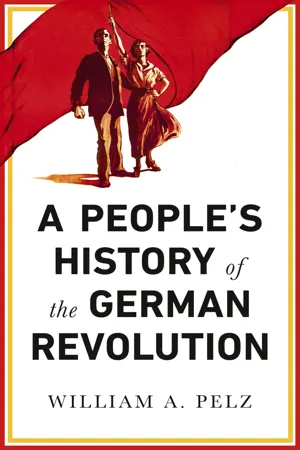
- 208 pages
- English
- ePUB (mobile friendly)
- Available on iOS & Android
eBook - ePub
A People's History of the German Revolution
About this book
Information
1
Industrialization and the Emergence of the German Working Class
For centuries, “Germany” was little more than a vague geographical expression for any number of distinct, and often mutually hostile, petty states in central Europe. These countries may have all spoken one variations of German but were typically satellites orbiting around greater empires. To the west, German territories, like the Rhineland, looked to France and incorporated aspects of the greater nation’s culture from everyday expressions to wine. The city of Hamburg was a trading partner of Great Britain and so looked to the north for both commerce and culture. Bavaria shared her Catholic faith and much of her foreign policy with the Austrian Empire while the Northeastern kingdom of Prussia had a King who was the vassal of the Russian Czar.
Well into the nineteenth century, most of these people identified with whichever regional entity they were born to; they thought of themselves as Saxons, Hessians, Bavarians, or Prussians rather than as Germans. As mentioned above, the German language varied greatly in practice, the basic root language was everywhere modified, often with a bewildering assortment of local slang and manifold pronunciation. Even in the twenty-first century, one may purchase Austrian-German phrasebooks that, if sold largely in jest, fittingly show how variant “German” can be.
In 1871, a German nation-state was created with the unification of German-speaking lands, though this still excluded Austria and German portions of Switzerland. Historians often credit Prussian leader Otto von Bismarck for cleverly engineering this unification; but this was only possible as a result of a series of historical developments. A growing class of capitalists clamored for the economic advantages unification would bring. As Capitalism emerged in numerous German states, it transformed masses of urban plebeians and erstwhile peasants into a class that could only survive by selling its labor power, that is, a working class. At the same time, the structures and institutions left from feudalism most notably the guild system—rotted, later to be swept away forever. While freed from the old feudal fetters, the common people also lost many protections they had grown to depend on: extensive church charity, freedom to collect wood from the common lands, guilds that ensured that at least some artisans could make a good living.
This transformation was uneven and occurred within specific historical confines. Germany, unlike England or France, lacked the experience of a unified feudal nation-state. The division of the German populace into many petty and not so petty principalities meant that the rising middle class or bourgeoisie, as the French would say, struggled for both national unity and the overthrow of feudal productive relationships. This was a mighty task, which the good burghers proved totally incapable of achieving. Their failure left more room for common people lower in the social hierarchy while paradoxically giving the old feudal lords a chance to reinvent themselves as nationalists.
In 1830, the German bourgeoisie led the masses in an attempt to forge a nation-state that would serve their material interests. Unlike their French and English counterparts, the capitalists of Germany were still living in societies abounding in feudal privileges, rights and restrictions. The German bourgeoisie was relatively poor and dispersed by the standards of their neighbors to the West—a situation that put would-be revolutionaries at a distinct disadvantage. Moreover, the separation of the nation into numerous states combined with an unfortunate geographic position, which limited opportunities for Atlantic trade, left the bourgeoisie unable to establish industrial and commercial centers comparable to Lyons, Paris, Manchester or London.
Thus, even though the economic growth of Germany proceeded almost without interruption after 1815, the middle class suffered from its inability to conquer the political supremacy so necessary for its expansion. Of course, the governments of Germany were aware of the contribution the capitalists made to their kingdoms and therefore granted some reforms like the Prussian Tariff of 1818. In fact, a pattern emerged during the struggle between feudal lord and capitalist, which the radical Frederick Engels concisely summed up: “Every political defeat of the middle class drew after it a victory on the field of commercial legislation.”1 Though common people often lived through the same social change and economic growth, they shared unequally in the rewards.
This situation continued from 1830 to 1848, by which time capitalism had grown to sufficient strength that it could no longer sit idly and watch its most important interests hampered by all manner of feudal fetters. At the same time, the common people compared their lot unfavorably with that of the French and of the British. As is so often, the spark that ignited the situation came from abroad. On February 24, 1848, the Parisian masses drove King Louis Philippe out of town, abolished the monarchy and proclaimed a republic.
Within a few weeks, on March 13, Vienna erupted as well, breaking the power of their old regime. This event was quickly imitated in Berlin where an uprising broke out on March 18. In the capitals of the smaller German states similar revolts took place. Although details varied from place to place, the middle-class parties in all the states argued for national unity, constitutional rule and other reforms of a democratic nature. In each German state these revolts were suppressed and the revolution was finally crushed by the end of 1849.
The role of the common people in the drama of 1848–9 remains a matter of great controversy. This results in part from a lack of reliable sources from that time period. In fact, the lack of clear indications of the thoughts and feelings of common people who did not leave the numerous written records of the elites plagues those who seek to write people’s history. In any event, the debacle of 1848–9 postponed the unification of Germany and thus allowed the continuation of regionalism.
With the ultimate unification of Germany at the end of the Franco-Prussian War up until the outbreak of World War I, a politically unified nation-state quickly transformed itself into a major industrial power. This rapid technological change created a large and increasingly restless working class. That this new class was created in less than half a century, as opposed to the much longer transition in Great Britain, meant that German society became more polarized than other nations.
To explore these developments, a discussion is needed about the objective conditions of German labor in terms of living standards, lifestyle and so on. This assessment of objective conditions will be balanced through consideration of subjective narratives, that is, voices of workers who lived in that historical period. This examination will not limit itself to the stereotypical male industrial worker. Rather, it will survey male and female and all those workers who lived from labor rather than property, regardless of the trade.2
Many of the problems German workers faced a century and more ago do not sound so remote or different to those that workers face today. One of the glaring omissions many make is to overlook the number of individuals working in the service industry. In an era before the almost countless mechanical devises that simplify everyday tasks, the better-off relied on servants to provide comfort in the form of meals, serving coffee, cleaning clothing and so on. These jobs were different from those in the factory or the mining pit but not necessarily better.
Doris Viersbeck, a cook and housemaid in Hamburg in the last decades of Imperial Germany, has detailed the systematic abuse she was subjected to in many wealthy homes. Although she had to rise at 6 a.m. every morning, Doris was repeatedly awoken in the middle of the night to prepare fresh coffee for her insomniac master. Cursed, threatened and bullied by employers, despite working in what may have appeared a welcome alternative to factory labor, she describes a hellish situation. In her autobiography, she pleads, “I just wanted to be treated like a human being.”3
The resentment felt among women “in service” sometimes expressed itself in peculiar ways. Responding to questions from a pastor in 1909, a woman we know only as “Frau Hoffmann” put forth an unusual theory on the difference between the rich and servants. “There are a lot more pretty faces among the servants than in the upper classes,” this retired maid argued, because the “upper classes don’t get out in the air enough and they don’t eat everything. Many of them have clumpy faces. Some have a nose like a fist.”4
Another woman, whose name we don’t know, went to work packing shoes in a factory where she found a co-worker who was pregnant with the unacknowledged child of a higher factory functionary. The man now rejecting his former lover, “was looking for another victim for his lust; his eyes fell on me, but he didn’t have much luck because I bluntly brushed him off.”5 As a result, she was fired and back on the streets looking for work.
Although it was difficult to organize female factory workers, it was far from impossible. While more conservative male workers confidently predicted that women would never become an important part of the work force, history has proven them wrong. Women remained neither completely marginal nor impossible to organize as the rapid expansion of female trade unions from under seven thousand in 1895 to over a million in 1919 shows.6
Returning to our example of the discharged woman above, she later decided to become a barmaid only to find that she was subject routinely to sexual harassment from male customers. “Often I cried bitterly after the customers were all gone because I had to put up with so much … [many asked] ‘where do you live? Can I come and visit you?’ And then they would try to kiss me or otherwise fondle me.”7 That her situation was far from unique among barmaids was of scant comfort.
The objection could be made that these accounts mainly came from women members of, or at least sympathetic to, German socialism. Yet, the culture of sexual predation that proletarian females suffered at the hands of the upper class is documented by middle-class, religious and anti-socialist sources. A social reformer and early bourgeois feminist, Minna Wettstein-Adelt spent three and a half months working in four different factories in Chemnitz, Saxony. She was shocked to find that working-class accusations against men of her class were justified.
The middle-class reformer noted the fanatical hatred of “ink wipers” as the factory women dubbed clerks and businessmen working in offices. As one 30-year-old woman told her, a proper factory girl “does not associate with any damned ink licker … better the direst, blackest worker than such a vile loafer and toady!” Working beside such women, Wettstein-Adelt came to share “their sentiments wholeheartedly.” It is young businessmen who “if a working girl refuses to give herself willingly to them, they use intrigue, slanderous remarks to the director, malicious suppression and harassment.” The conservative female author then sighs that this pushes working women into the arms of Social Democracy since these men treat the “girls better, more politely and more humanely than others.”8 Of note is the fact that the Social Democrats were also among the earliest advocates of the legalization of homosexuality.9
It would be mistaken to think that unsolicited sexual advances were only a female problem. Male food servers experienced this sort of unwanted sexual harassment as well. Franz Bergg, a waiter at an expensive restaurant and casino near Danzig at the end of the nineteenth century, recalls the “not infrequent” instances of sexual stalking of waiters by “men who in t...
Table of contents
- Cover
- Title
- Copyright
- Contents
- Foreword
- Introduction: What German Revolution?
- 1. Industrialization and the Emergence of the German Working Class
- 2. The Rise of Popular Radicalism
- 3. War, Suffering and Resistance
- 4. The Road to the November Revolution
- 5. The Kaiser Goes, the Generals Remain
- 6. Provocation, Revolt and Repression
- 7. Women in the War and the Revolution
- 8. Death Agony of the Revolution
- Conclusion
- Notes
- Index
Trusted by 375,005 students
Access to over 1.5 million titles for a fair monthly price.
Study more efficiently using our study tools.
Frequently asked questions
Yes, you can cancel anytime from the Subscription tab in your account settings on the Perlego website. Your subscription will stay active until the end of your current billing period. Learn how to cancel your subscription
No, books cannot be downloaded as external files, such as PDFs, for use outside of Perlego. However, you can download books within the Perlego app for offline reading on mobile or tablet. Learn how to download books offline
Perlego offers two plans: Essential and Complete
- Essential is ideal for learners and professionals who enjoy exploring a wide range of subjects. Access the Essential Library with 800,000+ trusted titles and best-sellers across business, personal growth, and the humanities. Includes unlimited reading time and Standard Read Aloud voice.
- Complete: Perfect for advanced learners and researchers needing full, unrestricted access. Unlock 1.5M+ books across hundreds of subjects, including academic and specialized titles. The Complete Plan also includes advanced features like Premium Read Aloud and Research Assistant.
We are an online textbook subscription service, where you can get access to an entire online library for less than the price of a single book per month. With over 1.5 million books across 990+ topics, we’ve got you covered! Learn about our mission
Look out for the read-aloud symbol on your next book to see if you can listen to it. The read-aloud tool reads text aloud for you, highlighting the text as it is being read. You can pause it, speed it up and slow it down. Learn more about Read Aloud
Yes! You can use the Perlego app on both iOS and Android devices to read anytime, anywhere — even offline. Perfect for commutes or when you’re on the go.
Please note we cannot support devices running on iOS 13 and Android 7 or earlier. Learn more about using the app
Please note we cannot support devices running on iOS 13 and Android 7 or earlier. Learn more about using the app
Yes, you can access A People's History of the German Revolution by William Pelz in PDF and/or ePUB format, as well as other popular books in History & World History. We have over 1.5 million books available in our catalogue for you to explore.