A revealing look at how death and burial practices influence the living
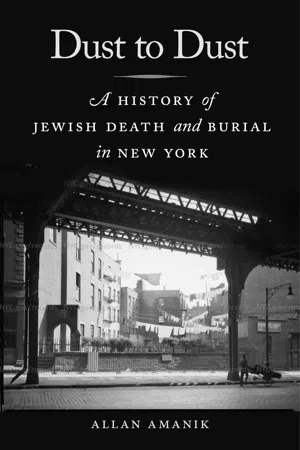
Dust to Dust offers a three-hundred-year history of Jewish life in New York, literally from the ground up. Taking Jewish cemeteries as its subject matter, it follows the ways that Jewish New Yorkers have planned for death and burial from their earliest arrival in New Amsterdam to the twentieth century.
Allan Amanik charts a remarkable reciprocity among Jewish funerary provisions and the workings of family and communal life, tracing how financial and family concerns in death came to equal earlier priorities rooted in tradition and communal cohesion. At the same time, he shows how shifting emphases in death gave average Jewish families the ability to advocate for greater protections and entitlements such as widows' benefits and funeral insurance. Amanik ultimately concludes that planning for life's end helps to shape social systems in ways that often go unrecognized.
- English
- ePUB (mobile friendly)
- Available on iOS & Android
eBook - ePub
About this book
Information
1
Toward a Market and Family Alliance
Community, Kin, and Social Control in New York’s Early Jewish Graveyards, 1656–1830
It was an odd scene at the Jews’ graveyard when Henry Phillips, alone, laid his son to rest. No procession, no ceremony, and no gathering of local Jews accompanied him. Phillips acted quickly, just three hours after telling synagogue leaders of the boy’s death. He buried his son on his own because trustees would have refused him otherwise. Phillips had strong convictions and a history of challenging authority. Had he predicted his son’s death, he may have paid his synagogue dues, already £4.17 in arrears. Without that contribution, however, he had forfeited interment rights for himself and his family. Trustees agreed to the burial only if they could settle all debts after interment. Torn between independence and duty to his son, Phillips chose a third route. Alone, he carried the boy to the yard, dug a grave by hand alongside its fence, and gave up his child without surrendering to communal elites.1
Henry Phillips’s dilemma took place in 1795, but the Jews’ burying place by the Fresh Water Pond had long served as a site of social protest or control among congregants and trustees. The yard remained New York’s only consecrated Jewish burying ground for more than a century. In the absence of any alternative, and as it was one of the few exclusively Jewish spaces that most New York Jews would not yet willingly forfeit, synagogue leaders who controlled the yard enjoyed significant leverage over their community. Although the Phillips case hinged on communal contribution, family debt represented just one question defining New York’s early Jewish burial enterprise. Who met leaders’ standards of moral or physical purity? Whose body required ritual or social exclusion from the burial ground? How should the community treat the intermarried or their children? What about the poor, the stranger, suicides, or victims of disease? How best to organize the dead, highlighting deviance among those who transgressed communal expectations while erasing social and economic difference among those who had not? Finally, and perhaps of greatest consequence, could trustees abandon an old and strict commitment to chronological burial so that families might gather their loved ones together? Between the early eighteenth century and the middle of the next, Jewish New Yorkers engaged these questions every time the need arose to lay a Jew to rest. The decisions they made, the tensions they raised, and the responses they inspired among synagogue elders and affiliated families revealed the inner workings and worries of early New York Jewry. But as the synagogue’s small cohort of leaders attempted to enforce traditional norms by control of the graveyard, congregants pushed back on that authority. In the process, they tested the limits of individualism, popular will, and evolving ideals around the family in early American society. Family will especially resonated, since most burial policies, whether intentionally or not, elevated collectivism and communal cohesion over family sentiment and the interment rights of members and their dependents. That dynamic positioned the graveyard as a key site to reinforce old social structures or to work out communal debates that would ultimately drive change among New York Jewry.
New civic and social freedoms that Jews enjoyed in North America only further influenced that process—perhaps nowhere more than in early New York. While a separate Jewish burial enterprise took root when Jews first arrived to New Amsterdam, the shift to English rule made that bastion of particularity all the more consequential. English pragmatism only expanded civic and social opportunity. Eighteenth-century Jewish and Christian New Yorkers forged rich ties of leisure, trade, and in some instances, even marriage. New fluidity challenged cohesive communal bonds in nearly unprecedented ways. If social and political limits in Europe had encouraged greater deference to communal authority, opportunities in New York made Jewish exclusivity far more voluntary. Synagogue leaders struggled to temper blurring boundaries within an ever-porous social setting. Demographics also mattered, as the small and still-developing Jewish center depended on peripatetic Jewish merchants for its size, infrastructure, and future. Those circumstances limited the kind of continuity that Jewish leaders would have preferred. In this context, New York’s early Jewish graveyards represented natural strongholds with which to foster communal bonds while strengthening social and religious boundaries among the living. By emphasizing ties between interment rights and religious observance, endogamous marriage, or financial contributions, elders hoped to limit expanding avenues that might lead local Jews too far beyond the communal fold.
That strategy met its limit, though, by challenging family interests. Inasmuch as elders stressed community in death, their privileging of the collective failed time and again to honor family concerns. When they conditioned burial on the settlement of unpaid fees, they jeopardized a surviving member’s grave as much as the fate of his loved ones’ remains. When they denied burial due to a marriage out of the community, they denied whole families the security of a grave awaiting them, thus encouraging Christian spouses to raise their children in their own church congregations, which would not deny them pivotal life-cycle rites if baptized. Finally, and most far-reaching, when the synagogue insisted on organizing its burying place sequentially by the order of decease, it denied members’ growing desire to bury among families so that loved ones might rest alongside one another or take comfort in a symbolic reunion sometime in the future. New York Jews accepted most of these policies over the eighteenth century, but by the decades surrounding the American Revolution, they challenged them in greater numbers. On the one hand, they drew on changing conceptions of the family and popular will emerging in the early republic. On the other, they acted on their own sentimentality and frustrations with overseas trade that rendered the long-term separation of spouses, siblings, parents, and children a normative Jewish experience.
Although congregants invoked family sympathy and obligation more frequently into the early nineteenth century, trustees still resisted any formal or far-reaching concession. The give-and-take that played out in these debates reflected an ongoing legacy of family and community as the key pillars in the city’s Jewish burial system. At the same time, the financial solutions that members devised to circumvent these policies—whether offering extra payments to the synagogue to bury family together or making creative use of city fines to bury in outlawed areas of New York that already contained loved ones’ graves of past generations—laid the foundation for market forces to shape Jewish burial in the city for decades to come. Those strategies allowed congregants to sidestep restrictive policies and win, at least in part, the privilege of family burial. These innovations also marked an early alliance between family and finances in New York Jewish burial. They also provided households with new avenues to gain some say over synagogue policies and one of the most important provisions sustaining affiliation. Because community and kin proved to be contentious issues when planning for death during much of the eighteenth century, the graveyard became a natural site for that rivalry to play out. By extension, the unraveling of that system by the century’s end set the stage for the first great infusion of monetary considerations in New York’s Jewish funerary sphere, which in turn has shaped developments into the present day.
“Inasmuch as They Did Not Wish to Bury Their Dead . . . in the Common Burying Ground”
That the city’s Jewish graveyard assumed any of these outsized influences rested in the fact that Jews and their earliest Christian counterparts refused to bury together. Indeed, a separate Jewish burial system was established on Manhattan Island in 1656, just two years after a now-famous handful of Jewish refugees first arrived there following Dutch Brazil’s surrender back to Portuguese control. Although most did not stay long, subsequent Jewish contemporaries saw potential in New Amsterdam. Dutch Caribbean trade, ruled by the Dutch West India Company, which oversaw American and African colonial interests, grew in the 1650s, and an increasing network of Sephardic (Spanish Portuguese) Jewish merchants underwrote its expansion by settling across West India Company colonies.2 Even though New Amsterdam’s leadership initially attempted to reject the Jewish newcomers, the appeals of influential Jewish shareholders in the Dutch West India Company allowed them to remain, and the colony’s director general, Peter Stuyvesant, grudgingly granted them rights of residence and trade.3 As Jews of increasing stature followed, they pressed to uphold and expand those privileges. Beyond day-to-day protections, however, they understood too that for any long-term settlement, Jews would also have to secure a separate place to bury.
Although neither Christian Dutch nor Jewish colonists would have imagined burying together, the creation of a separate Jewish burying place happened only after strained negotiations. In July 1655, a trio of prominent merchants, Abraham de Lucena, Salvador D’andrada, and Jacob Cohen Henriques, petitioned New Amsterdam’s council for the right “to purchase a burying place for their nation.”4 No Jewish settler had died when they made that request, but they acted in advance since they had few other options. At the time, the colony maintained only one common burying ground, which served Christian Europeans. Jews, however, could not bury there since religious law forbade them to mix the dead across faiths. Likely hoping to discourage permanent settlement, Stuyvesant and colonial authorities simply postponed any decision to grant a Jewish graveyard.5 The council only recorded it “inasmuch as they did not wish to bury their dead (of which as yet there was no need) in the common burying ground.” Gambling that the Jews might depart before a death occurred, the council ruled that “when the need and occasion therefor arose,” they would grant the fledgling community “some place elsewhere of the free land belonging to the Company.” The Dutch lost that wager in February 1656. Likely facing the first Jewish death, the trio returned, and the council finally conceded “a little hook of land situated outside of this city for a burial place.”6 Though officials initially rejected several early Jewish petitions, such as rights to militia service, property holding, and expanded trade, authorities ultimately granted piecemeal protections fairly quickly. A dedicated Jewish graveyard not only represented the first communal and public space that Jews created in North America but counted among several legal, social, and religious privileges that paved the way for long-term settlement in the colony. It also set an important precedent that—perhaps even more than with other philanthropic needs—early Jews would depend on communal elites and collective maneuvering to fulfill basic funerary needs.
That situation spoke to the complex status of Jewish colonists as social and religious outsiders in a church-centered society. Indeed, Jewish separation after death stood out under Dutch rule as a rare and perhaps the only case of a European group not burying in the common ground. In 1628, shortly after Dutch settlers arrived on the island, they established a common yard for burial on Heerestraet, land later bound between Exchange Place and Morris Street west of Broadway.7 Most other Europeans buried there, since they were not allowed to establish their own churches or churchyards. That ban was part of a broader strategy to foster a uniform Calvinist society by preventing religious competition and forcing European colonists to affiliate with the Reformed Church. Indeed, until New Amsterdam came under English control in 1664, the Dutch Reformed Church remained the only option for public worship or performance of life-cycle rites. Church leaders welcomed any to pray, marry, or baptize without requiring Dutch descent. They hoped to promote Reformed doctrine and forge new ties among Europeans of diverse national backgrounds.8 French Protestants, for instance, engaged the church early on in their tenure. After Stuyvesant repeatedly thwarted Lutherans of mixed European origin from bringing a minister or holding meetings for private services, they too looked to the colony’s existing church infrastructure. They “reluctantly attended worship on occasion and brought their children there to be baptized by Reformed clergymen and educated by Reformed schoolmasters.”9 Even English settlers had no alternative, marrying and baptizing through the church even though most never became members.
Without independent congregations or surrounding churchyards, the colony’s European Christians buried in its common ground. Most may have preferred to set up their own communal burying places, but they only did so only after the transition to English rule. With that shift, congregations could establish independent churches and, on acquiring communal property, quickly and commonly set aside land for burial.10 In Dutch New Amsterdam, however, interment either took place beneath the floorboards of the Reformed Church, an honor for the well-to-do, outside with those of limited standing, or within the common yard. Local authorities even appointed churchwardens to care for the graveyard. The court also designated sextons and precentors as gravediggers and aansprekers (those spreading news of recent deaths) to tend to funeral needs. Even after New Netherland transitioned to English rule, Dutch authorities still maintained some say over Christian funerals.11 In all, the system centered on and served Protestant communities in the hopes of rendering death, like other life-cycle needs, a tool to transcend denominational or cultural differences dividing European settlers.
Despite regional or linguistic diversity among English-, French-, Dutch-, or German-speaking Protestants, at least theologically, Anglicans, Huguenots, Calvinists, and Lutherans had far more in common with one another than their Jewish counterparts in their laws or traditions governing burying spaces. Indeed, until the 1680s, when these communities could establish independent churches and burying grounds, they felt few ritual misgivings about burying their dead side by side. In some cases, they even exchanged cemetery land when they began establishing independent churchyards. Portions of the old common yard, for instance, passed among Lutherans and Anglicans in the 1670s and 1680s. Lutherans set up a church and churchyard in close proximity to it, and the English settlers who founded Trinity Parish also buried there beginning in 1682. The Lutheran church even sold some of its property to Trinity in 1697 when the latter received its charter, including some extra land in exchange for the “liberty of burying their dead in the [Episcopal] church yard.”12 Even by the early 1780s, since New York City had still not consecrated a Catholic church or burying place, Trinity buried Catholic and Irish individuals alongside Dutch and English Protestants.13
Jewish settlers, of course, could ill fit into that system. In the absence of conversion, which few Jews would have imagined, the Dutch could no more bury a Jew in the colony’s common ground than most Jews would have desired to rest in consecrated Christian space. The symbolism of a Jewish yard on the colony’s physical and social landscape not only signaled a pragmatic difference but also reflected Jews’ complex status under Dutch rule. A devout Calvinist, Stuyvesant sought to elevate the Dutch Reformed Church, particularly by avoiding competition among other Protestant denominations. As Joyce Goodfriend has argued, given the population’s heterogeneity, he also sought to fold in those groups that he considered ethnically, linguistically, and religiously prime candidates to bolster the colony’s meager Dutch numbers.14 Although the West India Company forced Stuyvesant’s hand in allowing Jews to settle, he did succeed in relegating most of their religious life to private and unseen spheres. That earliest Jewish graveyard, nestled just beyond the colony’s physical border, embodied their marginality. It also foreshadowed the distinct foundations they would carve for Jewish life and spaces over the coming centuries, negotiating communal provisions in a church-centered colonial society.
“My Body to the Earth to Be Decently Buried among the Jews”
The colony’s next Jewish burying place was established in 1682 when New York’s most renowned Jewish resident, Joseph Bueno de Mesquita, purchased land in trust “for a Jew Burying Place, with free Liberty of a passage from the Highway thereto to carry their Dead.”15 By then, the colony extended beyond the land a mile and a half from Manhattan’s southern tip that the Dutch had occupied. As New York became an important port of English exchange among the mainland and Caribbean colonies, new Jewish traders arrived and established new communal structures. By the 1680s, with nearly one hundred Jews residing in the colony, they began to gather for private worship.16 Not coincidentally, they also sought new land for burial. New York’s growth since the 1650s had likely eclipsed the earliest Jewish yard, leading the fledgling community to seek a new site in which to bury. Bueno’s stature rendered him a communal leader u...
Table of contents
- Cover
- Title Page
- Copyright Page
- Dedication
- Contents
- Introduction: Ashes to Ashes, Dust to Deeds
- 1. Toward a Market and Family Alliance: Community, Kin, and Social Control in New York’s Early Jewish Graveyards, 1656–1830
- 2. Acts of True Kindness: To Tend the Dead, to Foster Fraternalism, 1785–1850
- 3. “Carry Me to the Burying Place of My Fathers”: Rural Cemeteries, Family Lots, and a New Jewish Social Order, 1849–80
- 4. Wives and Workingmen: Protecting Widows and Orphans, Affirming Husbands and Fathers, 1840–1940
- 5. “Fine Funeral Service at Moderate Costs”: New York’s Jewish Funeral Industry, 1890–1965
- Conclusion: To Be Buried among Kin, To Be Buried among Jews
- Epilogue
- Acknowledgments
- Notes
- Bibliography
- Index
- About the Author
Trusted by 375,005 students
Access to over 1.5 million titles for a fair monthly price.
Study more efficiently using our study tools.
Frequently asked questions
Yes, you can cancel anytime from the Subscription tab in your account settings on the Perlego website. Your subscription will stay active until the end of your current billing period. Learn how to cancel your subscription
No, books cannot be downloaded as external files, such as PDFs, for use outside of Perlego. However, you can download books within the Perlego app for offline reading on mobile or tablet. Learn how to download books offline
Perlego offers two plans: Essential and Complete
- Essential is ideal for learners and professionals who enjoy exploring a wide range of subjects. Access the Essential Library with 800,000+ trusted titles and best-sellers across business, personal growth, and the humanities. Includes unlimited reading time and Standard Read Aloud voice.
- Complete: Perfect for advanced learners and researchers needing full, unrestricted access. Unlock 1.5M+ books across hundreds of subjects, including academic and specialized titles. The Complete Plan also includes advanced features like Premium Read Aloud and Research Assistant.
We are an online textbook subscription service, where you can get access to an entire online library for less than the price of a single book per month. With over 1.5 million books across 990+ topics, we’ve got you covered! Learn about our mission
Look out for the read-aloud symbol on your next book to see if you can listen to it. The read-aloud tool reads text aloud for you, highlighting the text as it is being read. You can pause it, speed it up and slow it down. Learn more about Read Aloud
Yes! You can use the Perlego app on both iOS and Android devices to read anytime, anywhere — even offline. Perfect for commutes or when you’re on the go.
Please note we cannot support devices running on iOS 13 and Android 7 or earlier. Learn more about using the app
Please note we cannot support devices running on iOS 13 and Android 7 or earlier. Learn more about using the app
Yes, you can access Dust to Dust by Allan Amanik in PDF and/or ePUB format, as well as other popular books in History & Jewish History. We have over 1.5 million books available in our catalogue for you to explore.