eBook - ePub
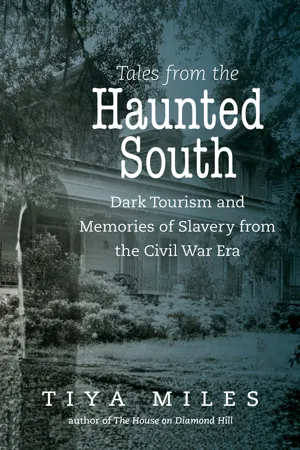
Tales from the Haunted South
Dark Tourism and Memories of Slavery from the Civil War Era
- 176 pages
- English
- ePUB (mobile friendly)
- Available on iOS & Android
eBook - ePub
About this book
In this book Tiya Miles explores the popular yet troubling phenomenon of "ghost tours," frequently promoted and experienced at plantations, urban manor homes, and cemeteries throughout the South. As a staple of the tours, guides entertain paying customers by routinely relying on stories of enslaved black specters. But who are these ghosts? Examining popular sites and stories from these tours, Miles shows that haunted tales routinely appropriate and skew African American history to produce representations of slavery for commercial gain. "Dark tourism" often highlights the most sensationalist and macabre aspects of slavery, from salacious sexual ties between white masters and black women slaves to the physical abuse and torture of black bodies to the supposedly exotic nature of African spiritual practices. Because the realities of slavery are largely absent from these tours, Miles reveals how they continue to feed problematic "Old South" narratives and erase the hard truths of the Civil War era. In an incisive and engaging work, Miles uses these troubling cases to shine light on how we feel about the Civil War and race, and how the ghosts of the past are still with us.
Information
1: Molly and Matilda
Old Savannah Specters
How do we reckon with what modern history has rendered ghostly?
—Avery Gordon, Ghostly Matters (1997)
Missing without a Trace: The Search for Molly
I don’t believe in ghosts—not really, not rationally. But this did not stop me, on a damp winter night in 2012, from going in search of one. I had spent the afternoon alongside sundry strangers viewing historic homes on Savannah’s graceful squares—grand abodes for cotton barons built in the Federal, Georgian, and Greek Revival styles back when Savannah had flourished from wealth begotten by slave labor. The homes were pristine inside and out—buffed and smooth, ringed by gardens, and stocked with fine antiques. But one structure, despite its imposing facade and impressive historic marker, had appeared to be in serious decline. The burnt-orange paint on the home’s exterior peeled in ragged patches. The veranda facing the western side street lay littered with the detritus of a home renovation gone awry—forgotten raw plank boards, half-sealed paint cans, and an old radiator pushed haphazardly against the exterior wall. The foliage around the perimeter straggled about, overreaching the property line. It was here, in this faded structure known as the Sorrel-Weed House, where I had heard the story that compelled my return. It was the story of Molly, an abused black slave who was said to haunt this house of old deep in the heart of a modern city.
I returned to the historic district late that night and stood sequestered in the stucco-walled courtyard between the Sorrel-Weed main house and carriage house. All was quiet. The soles of my shoes pressed into slave-made Savannah “brown bricks.” I could not see out into the darkened city streets beyond. It was as though I had been transported into the temporal moment of the antebellum mansion whose 15,000 square feet of elegant bulk loomed over me. The corner estate cut so far into its block on Madison Square that it made the adjacent Victorian townhomes seem to yield, leaning ever eastward into the evening skyline.
My tour guide, a young white man, commented on how odd it was that I was the only customer that night. With his rumpled hair, loose blue jeans, and unkempt belt strap dangling from the waist, he brought to mind the character Shaggy from the children’s mystery cartoon Scooby Doo. Nevertheless, I handed over my prepurchased ticket and followed him up to the second story of the carriage house formerly used as slave quarters. The faint glow of street lamps barely penetrated the chamber at the top of the stairs. The guide left the lights off and launched into the tale of the house. He recounted the saga of the Caribbean-born patriarch, Francis Sorrel, and his “affair” with his black Haitian “servant girl” Molly; of his wife Matilda’s discovery of the affair and resulting suicide; of Molly’s murder in the carriage house, likely at the hands of her master; and of the ghosts of Molly and Matilda that lingered on the grounds.
The guide followed his narration of sexual impropriety, slavery, suicide, and murder with a DVD clip from the Syfy Channel’s popular reality show series Ghost Hunters. The clip featured the ghost hunting team of The Atlantic Paranormal Society, or TAPS, investigating the Sorrel-Weed carriage house. Using high-tech electronic equipment, the TAPS team had captured on tape the heavily accented ghostly scream of a woman being attacked. The TAPS investigators reported on the show that no other woman—no living woman—had been present at the time when the spectral voice was captured. The show featured footage of investigators interviewing individuals with firsthand knowledge of the home in order to pinpoint the source of the voice. A carpenter who had stayed in the carriage house while working on renovations said he had heard a female voice calling his name at night and expressed disgust upon hearing the woman caught on audiotape, whom he presumed to be “the slave girl that was raped up in the carriage house.” The owner of the home said the tape supported “historical facts” that he was aware of regarding Francis Sorrel’s “affair” with his “servant-slave” and that the sound on tape was “most probably” that slave woman “being beat.” The Sorrel ghost story was becoming more gruesome in this mass-culture medium, with the tour guide’s euphemistic description of an “affair” morphing into violent rape in the televised version of events.1
The guide stopped the DVD and announced that it was time for us to enter Molly’s bedroom, the place where the “affair” had occurred and where she had been murdered. Objects were known to move in that room without human intervention, he told me. Furniture was sometimes mysteriously rearranged. My guide confided that he himself had felt the presence of Molly’s spirit in the upper rooms of the slave quarters. I stood outside Molly’s door, glimpsing the masked white walls, thick wood beams, and empty space pregnant with connotation. I did not cross over the threshold. The guide stood behind my back, urging me to enter. When I continued to hesitate, he told me psychics who had taken his tour had seen the figure of a black woman smiling in the shadows. The ghost of Molly, his words implied, approved of this tour, so why was I resisting? But when I still refused to enter the room out of what I felt was respect for Molly, my tour guide changed course, leading me outside.
As we reached the bottom of the carriage house steps, he said he had a treat for me. He would take me into the root cellar below the carriage house, a space that was never included on tours and had not been altered in the renovation of the building. A shot of anxiety ran down my spine, the anxiety that women walking alone on the streets at night know only too well. In the Ghost Hunters clip, the owner of the Sorrel-Weed House had said he found precious objects related to the home’s history in that cellar. What might I find there, if I dared to look? Should I go down below with this man when only a taxi driver knew my whereabouts? My desire to know more about Molly and her life in this place warred with my sense of personal safety. The door to the cellar dug into the ground, yielding only to darkness beyond it. I did not have the courage to enter. I was a free person, and so I said no. The guide shook his head as though he could not fathom what manner of ghost tourist I was, passing up the chance to stand in Molly’s room and experience the dank root cellar. Exasperated, the tour guide led me, then, into the bowels of the big house.
By the time I encountered the mansion’s basement, I was on edge. The surroundings did nothing to soothe me. The basement was like an eerie stage, with black cloths suspended from ceilings, separating main rooms from anterior compartments hidden from the eye. A mounted television monitor revealed, via video feeds and blinking lights, various shadowy corners of the space. The guide asked if I had brought along my recorder to capture EVPs. At the time, I didn’t yet know what an EVP was. I stood in the center of the largest room of the basement, clutching my bag to my chest. His long sigh told me that I was a disappointment. He soon gave up, led me into the main floor of the house, flipped on the lights, and allowed me the freedom to walk about as I wished. My recalcitrance had gotten the best of both of us, unexpectedly yielding a nearly unfettered private tour. I asked if I could step onto the veranda that I had seen from the street. He said it was off-limits to the public, but he indulged me anyway. I ducked outside through an oversized window in Francis Sorrel’s library, since there was no door leading directly out to the porch. The guide did not follow, granting me precious solitude that made me rethink my view of him. It was there, tucked into the hip of the house, beneath the side eaves and protective overgrowth of shrubbery, that I could finally breathe that night, releasing suppressed anxiety, taking in the solemn feel of the old house and its history. I breathed in the thought of Molly, a slave girl, saddened by the travesty of her lived experience and angered by the fate of her afterlife. It seemed that she might be trapped on these grounds forever, always a slave in someone’s service.
I cannot tell you that I felt Molly’s presence in the stillness of that night, but I can tell you that I felt a kind of call. I felt a call to search for evidence of Molly’s life in the archival rubble of urban slavery, to tell her story and redeem her spirit from the commercialized spectacle of bondage that I had witnessed. I pledged in the dark to restore her memory and her dignity, if I possibly could. But Molly would prove to be elusive, illusory, a phantom in the historical record as well as in the mansion. After that first trip to Savannah in 2012, I began my search for her with a survey of historical documents, fully expecting that the papers and records of nineteenth-century Savannah would allow me to re-create the contours of Molly’s life. Because Molly was owned as an object, a person who had lived as the possession of another, she was most likely to appear in the records of her owner, Francis Sorrel: his business papers, his slave lists, his bills of sale for human property, his census listings, his personal letters, his ledger or account books, and so on. Matilda Anne Moxley Sorrel was also someone in whose written records Molly might be found. Molly was a domestic slave whose primary duties would have been the care of Matilda and her children, the upkeep of the manor house, and the preparation and service of meals and refreshments. As mistress of this stately home, Matilda would have been the manager of Molly’s labor. Matilda would have instructed and reprimanded Molly, overseen and punished her, and complained about or praised Molly in letters to her friends or relatives back home. Wives of philandering slaveholders, often referred to in African American literature studies as the recurring “jealous mistress” character type, had a tendency to write about black women in personal diaries and letters, even to the point of confessing and bemoaning illicit sexual relations between their husbands and female slaves.2
I found that the prominent Sorrel family had left a traceable, though not extensive, set of records. Most of these records were housed in the Georgia Historical Society located not far from the Sorrel home in historic Savannah. Personal letters between the family and close friends preserved at the National Archives in Washington, D.C., also provided access to the Sorrel family members’ lives. So did letters written about prominent Savannahians by one of their own, Mayor Charles Jones, which are gathered in the published collection Children of Pride. A Civil War memoir by Francis and Matilda’s most famous son, Confederate brigadier general Moxley Sorrel, also includes brief memories of his parents’ lives.3
As it turns out, however, none of the Sorrel family’s publicly available records mention a slave named Molly or a relationship between Francis and a female slave or a murder committed in the carriage house. While an interracial sex-suicide-murder scandal like this one is something the family might have worked hard to conceal, it seems likely that dramatic double deaths within a two-week period on the grounds of a high-profile estate would have appeared somewhere in the public record of close-knit Savannah society—in a newspaper story or letter by members of the Sorrel social set or in a memoir or diary of Madison Square residents. Certainly, the untimely death of Matilda Sorrel due to “concussion to the brain” does appear in the historical record.4
But there is not a trace of Molly. I found no indication that Francis Sorrel ever owned a woman named Molly or had a sexual relationship with a slave leading to two deaths. It is possible that I missed something, but I doubt it. It is possible that the current homeowners and ghost-tour guides have secret evidence, but I doubt that too. More likely, most likely, the story was fabricated. When I sought the aid of an archivist at the Georgia Historical Society in solving the mystery of Molly, I received a letter saying this:
I would caution anyone to take what they hear on a tour with a grain of salt unless they also provide the documentation to sustain it. The only mention of an affair between Francis Sorrel and anyone else has been in relation to the ghost tour at the house. I have found no documentation at all mentioning an affair. Matilda Ann D. Sorrel did die from injuries sustained in a fall on March 27, 1860. Her death is not listed as a suicide, and she is buried in Laurel Grove Cemetery in the family plot. . . . There is no mention in any papers or family histories of the subsequent death of anyone connected with the Sorrel family. . . . From all accounts Francis Sorrel was a well-respected man in Savannah with no suspicion on him.
The meaning of the letter was plain. The archivist thought me naive. Perhaps she also sought to protect the reputation of a leading Savannah family from further ignominy, but this did not discount her implicit critique.
And maybe the archivist was right. Maybe I had been naive and overly reactive in the aftermath of my intense reaction to the Sorrel-Weed House tours. It turned out that Molly really was a kind of ghost, a figment of human imagination. Although many young women like her surely existed in antebellum Savannah and the torturous rice plantations of the surrounding countryside, this Molly was not among them. Someone had concocted her story of racial and sexual exploitation as a titillating tourist attraction. And now I wanted to know why.
If I could not find Molly, I would search for the reasons why she was invisible in the historical record yet hypervisible on the Savannah ghost-tourism scene. And this search led me to a host of other questions. Why were ghost stories about African American slaves becoming popular in the region at all? And why were so many of these ghosts women? What themes prevailed in slave ghost stories, and what social and cultural meanings can we make of them? What “product” was being bought and sold, enjoyed and consumed, in the contemporary commercial phenomenon of southern ghost tourism?
Graveyard Dust and Voodoo Queens: The Making of Spooky Savannah
In Savannah, Georgia, a sleepy city by the sea, tourism surged with the publication of a true-crime tell-all known by locals as “The Book.”5 First published in 1994, Midnight in the Garden of Good and Evil, by journalist John Berendt, was a number 1 national bestseller for more than four years.6 Midnight was a combination travelogue and true-crime exposé interwoven with Berendt’s first-person story of life in his quaint, adopted town. As a part-time resident of Savannah for over eight years, Berendt came to know the insular city’s most colorful personalities. He profiled figures such as the well-heeled antiques collector Jim Williams and transgendered African American nightclub performer Lady Chablis in a suspenseful retelling of a murder investigation and the dramatic courtroom battles that followed. Berendt’s account of the 1981 shooting death of young, brash Danny Hansford allegedly at the hands of his lover and employer, the older and sophisticated Jim Williams, combined true crime with the atmospheric setting of the moss-cloaked coastal South. Central to Berendt’s characterization of Savannah as a fascinating city stuck in the past was his representation of Voodoo. The title of his book referred to the cemetery, or conjurer’s “garden,” where African American “witch doctor” and “Voodoo priestess” Minerva assisted Jim Williams in his legal defense through the use of Voodoo rituals. Williams reportedly told Berendt, “Whether you know it or not, you are in the heart of voodoo country. The whole coastal area has been loaded with it since the slaves brought voodoo with them from Africa.” Minerva, Williams goes on to explain, was continuing the practice of her “common-law” husband, the locally notorious but by then deceased “root doctor” Dr. Buzzard. Minerva lived in a “wooden shanty” painted “haint blue” to “ward off evil spirits.” She appointed midnight as the time for doing magic in the “flower garden” and informed Jim Williams that the spirit of the dead boy was “workin’ hard against him.”7 Jim Williams was convicted twice of murder in the 1980s, but the Georgia Supreme Court overturned his convictions for procedural reasons. After judges declared a mistrial in a third go-around due to a hung jury, Williams’s fourth trial was moved to a different venue. A jury in Augusta acquitted him of the crime and made him the only person ever to be tried four times for murder in the state of Georgia. Williams attributed his release to Minerva’s spiritual interventions, only to die of pneumonia seven months after his acquittal in January 1990.8 Berendt’s book about the legal case and evocative setting put Savannah, a town formerly off the beaten track, on the map of alluring American places. In a New York Times review of the book in 1994, Glenna Whitley con...
Table of contents
- Cover Page
- Title Page
- Copyright Page
- Dedication
- Contents
- Illustrations
- Preface
- Introduction
- 1: Molly and Matilda
- 2: Madame Lalaurie
- 3: Chloe and Cleo
- Conclusion
- Notes
- Acknowledgments
- Index
Trusted by 375,005 students
Access to over 1.5 million titles for a fair monthly price.
Study more efficiently using our study tools.
Frequently asked questions
Yes, you can cancel anytime from the Subscription tab in your account settings on the Perlego website. Your subscription will stay active until the end of your current billing period. Learn how to cancel your subscription
No, books cannot be downloaded as external files, such as PDFs, for use outside of Perlego. However, you can download books within the Perlego app for offline reading on mobile or tablet. Learn how to download books offline
Perlego offers two plans: Essential and Complete
- Essential is ideal for learners and professionals who enjoy exploring a wide range of subjects. Access the Essential Library with 800,000+ trusted titles and best-sellers across business, personal growth, and the humanities. Includes unlimited reading time and Standard Read Aloud voice.
- Complete: Perfect for advanced learners and researchers needing full, unrestricted access. Unlock 1.5M+ books across hundreds of subjects, including academic and specialized titles. The Complete Plan also includes advanced features like Premium Read Aloud and Research Assistant.
We are an online textbook subscription service, where you can get access to an entire online library for less than the price of a single book per month. With over 1.5 million books across 990+ topics, we’ve got you covered! Learn about our mission
Look out for the read-aloud symbol on your next book to see if you can listen to it. The read-aloud tool reads text aloud for you, highlighting the text as it is being read. You can pause it, speed it up and slow it down. Learn more about Read Aloud
Yes! You can use the Perlego app on both iOS and Android devices to read anytime, anywhere — even offline. Perfect for commutes or when you’re on the go.
Please note we cannot support devices running on iOS 13 and Android 7 or earlier. Learn more about using the app
Please note we cannot support devices running on iOS 13 and Android 7 or earlier. Learn more about using the app
Yes, you can access Tales from the Haunted South by Tiya Miles in PDF and/or ePUB format, as well as other popular books in History & American Civil War History. We have over 1.5 million books available in our catalogue for you to explore.