2022 Anthropology of Tourism Interest Group Nelson Graburn Prize, winner
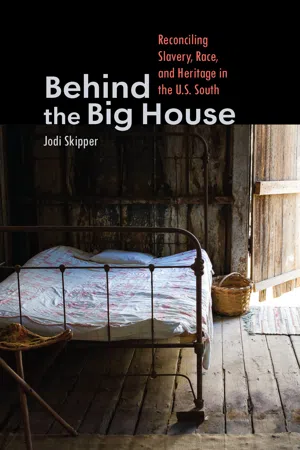
When residents and tourists visit sites of slavery, whose stories are told? All too often the lives of slaveowners are centered, obscuring the lives of enslaved people. Behind the Big House gives readers a candid, behind-the-scenes look at what it really takes to interpret the difficult history of slavery in the U.S. South. The book explores Jodi Skipper's eight-year collaboration with the Behind the Big House program, a community-based model used at local historic sites to address slavery in the collective narrative of U.S. history and culture.
In laying out her experiences through an autoethnographic approach, Skipper seeks to help other activist scholars of color negotiate the nuances of place, the academic public sphere, and its ambiguous systems of reward, recognition, and evaluation.
eBook - ePub
Behind the Big House
Reconciling Slavery, Race, and Heritage in the U.S. South
- English
- ePUB (mobile friendly)
- Available on iOS & Android
eBook - ePub
About this book
Information
1
Thank You, Cousin Geneva!
I am a Black woman and a southerner who has lived or worked in nine southern states. I grew up in Lafayette, Louisiana, from the late 1970s to the early 1990s nurtured by a supportive Black Creole community living with the vestiges of slavery, apartheid segregation, and the internalized racism stemming from the historical White male possession of Black female bodies who produced lighter bodies, and lighter bodies, sometimes socialized to think of themselves as superior to darker bodies. Still, I knew that I mattered to that loving-hating Black Creole community. I also felt like I didn’t matter in a White supremacist community, in which those who were not Cajun (meaning White) had no history. After eight years of working intimately with a group of people in North Mississippi, representing the experiences of enslaved people who didn’t seem to matter in interpretations at historic sites, I was compelled to critically think about how my identity as a descendant of countless enslaved people and my experiences as a Black woman, as a U.S. southerner, and as an activist anthropologist could influence how I do academic work in ways that make that work accessible to racially diverse communities. That reflection begins with understanding my early racial formation tied to Louisiana Cajun and Creole identities.
I knew that “the Cajun (‘White’) identity” was “privileged and promoted at the expense of” my Black Creole identity.1 I experienced a time of Cajun revival, which began around my birth. I watched it flourish, and I felt excluded. I was confused and angered by what seemed to be this privileged place in society. I despised being underrepresented. At the same time, I experienced a counternarrative of Creole zydeco festivals, restaurants, newsletters, and grassroots organizations designed to make those like me more visible. At the time, this collection of events and perspectives didn’t have a name; it just was. It’s something that scholars like Alexandra Giancarlo have now studied and named a cultural Creole renaissance. I did not know that it was intentional.
I struggled through elementary school narratives of Belizaire the Cajun, Clovis the Cajun Crawfish, and French yule logs at Christmastime. I felt too dark to be a teacher’s pet or to carry the Virgin Mary’s crown during church celebrations. The latter seemed reserved for light-skinned Creole kids. Being the exceptionally smart kid of uneducated parents did not help. Still, I was nurtured by a supportive community of adult relatives and friends who understood the value of supplementary education. Ms. Rose invited me over for arts and crafts projects. Cousin Janet took me to the public library club with her kids, and Cousin Geneva introduced me to an African diaspora.
I was in a French immersion program in my local public school when our bilingual teacher, Cynthia Dupuis, had us volunteer at the burgeoning Festival International de Louisiane, an “international music and arts festival . . . with a special emphasis on the connection between Acadiana and the Francophone world.”2 Although I don’t recall what I did as a volunteer, I do remember the U.S. flag–inspired short sets that my friend Kim Auzenne and I wore. I guess that I thought it appropriate to represent the U.S. at an international festival.
My mom’s first cousin, Geneva, seemed to have something else in mind. What I remember most is the phone call that she made to my mom one night during the festival. Through my mom’s intermittent responses, I vaguely understood an invitation for my sister and me to come to her house to visit—did she say Tahitians? With excitement, I relayed that message to my sister, also eager about the opportunity to engage folks from another country, something we rarely did.
When we arrived at Cousin Geneva’s house, I realized that her invited guests were not Tahitians but Haitians, people I had never heard of who were, surprisingly, Black. My excitement waned. I don’t recall if I was less excited because they were Black and, therefore, not something new or because they were too much like me and thus victims of my internalized racism. Geneva introduced us to two young women along with a sprightly gray-haired woman from a place called Martinique. They all began to sing beautifully in Creole variations of French. What Cousin Geneva knew is that Black was bigger than my small world, and that I should know that. What she also knew was that there was an African diaspora of Black bodies, disconnected by a vicious slave trade, longing to be reconnected. What she knew is that the French festival would be accessible to them but that she, as a “standard” French-speaking Black woman, could make them most comfortable. Cousin Geneva introduced me to an African diaspora and, unknowingly, in that moment, I began to love myself and wanted those like me to do the same.
For the next several years, however, I continued to struggle. My newfound love for myself and for others like me meant holding those unlike me, White people, accountable and keeping them distant. I was geographically segregated from them, growing up in a post-1960s White flight neighborhood on what was then (and still is) the Black side of town. I was emotionally segregated from them in my high school with its 51:49 percent Black:White ratio. I had my last White friend in the third grade, when we seemed to become more racially cliquish, and I had no White friends in high school.
I was an angry Black woman who articulated that rage through Texas gangster rap. I was too ignorant to recognize its misogyny. Those women were not me, but the racism the lyricists expressed was my experience. I carried that experience through high school and then to Grambling State University, a historically Black institution in the northern part of the state. I had never felt like I quite belonged in Lafayette. I was too dark in skin shade, too activist, and too sick of what seemed to be too few collective responses to blatant racism. I was reluctant to change, so I left after what I choose to remember as an experimental summer session at what was then the University of Southwestern Louisiana, a historically White institution in the city.3 I had poor experiences in my courses, one English and one history. The English professor trashed my work as “overly cryptic,” and I spent countless minutes debating the history professor about whether or not Thomas Jefferson had fathered Sally Hemings’s children. The professor thought that it was not only unlikely but impossible. “What if I tried to make you related to Louis XIV?” he sarcastically asked. I, on the other hand, didn’t find that possible connection illogical, because I was raised with a disproportionately large number of Black people with blond hair and blue eyes. Five out of the seven Black students enrolled in that history class dropped. I defiantly stayed but had no interest in continuing my education at a historically White institution.
Discovering History as a Discipline
I found some sense of security at Grambling State University in northern Louisiana. There I was not too dark, and there were plenty of other students on the front lines making their grievances known to the administration and to the rest of the world. I didn’t feel like I had to fight. I could also express a sense of self, centered on my blackness, one that I didn’t have to repeatedly question. On the other hand, I was too Catholic and too country compared to the nearly 40 percent out-of-state student population, many from large urban centers outside the South. It was 1994, and many of us across U.S. regions had a cultural college experience against the backdrop of a new postapartheid era in South Africa, the widely televised O. J. Simpson trial, the impact of the Five-Percent Nation’s influence on hip-hop culture and music, and A Different World, a television series based on a fictional historically Black college.4 Grambling also had an Afrocentric bookstore, Black to Basics, which gave me access to “third eye” books on African and African American history and culture.5 I so relate to how Ta-Nehisi Coates features Howard University as a contradiction to his middle and high school experiences in West Baltimore.6
In high school my friends and I, all Black, worked hard to make grades that would give us the best opportunities, but we were nevertheless largely excluded from institutional recognition. I received the first scholarship award letter my senior year, but the scholarship awards were not announced until a White student got one. I don’t know if that was intentional, but it felt that way. My best friend in high school had the highest GPA in the school but was not the class valedictorian. A White student, the class salutatorian, was placed at the head of the class at our graduation after school administrators decided that well-roundedness, not GPAs, determined that status. I vowed to boycott graduation but walked because my friend did. She felt that she would get her just due in life; I felt like we had to fight for it. I loved my people in Lafayette, people like my friend, but I hated how institutions like my high school excluded me.
At Grambling, I began as a broadcast journalism major but shifted my major to history after an instructor recognized an interest in the subject that I did not know I had, even with the time I spent at Black to Basics. Through class-instructed research projects, I began to examine texts on Louisiana Creoles of color, eventually coming across Robert Maguire’s research on postplantation societies in Louisiana, where he did his PhD work.7 I contacted Bob, who sent me an envelope filled with research manuscripts. This was not the Cane River Creole community in Natchitoches Parish, with which I had become most familiar through the available literature, but rather a community of familiar names, places, and descriptions in St. Martin Parish, my family’s ancestral community. I was amazed to see descriptions of my people in academic writing.
Around the same time, I watched an interesting documentary on the architecture of slave dwellings and the ingenuity of the enslaved persons who built them. By that time, I was familiar with archival and secondary research on historical communities but less so with the potential of material culture to help me understand Black lives. I recall a segment of the documentary showing the significance of chimneys formed of wood and mud on the most modest slave cabins, which were often susceptible to tumbling down or catching fire. That was important because they could easily be knocked down and replaced if they caught fire. This was around the time that John Michael Vlach’s Back of the Big House: The Architecture of Plantation Slavery was published. The program might have been a spotlight on that. I just don’t remember. The architectural creativity seemed so simple yet so complicated. I wanted to know more.
At the time, I was influenced by Afrocentric perspectives on Egyptology and thought that classical archaeology would be a good fit for graduate study. That changed, after watching the documentary, and I began looking into plantation archaeology programs. I knew no archaeologists and was ignorant about how to find one, so I did a rudimentary internet search that showed several plantation archaeology projects related to faculty at Florida State University. I applied to their M.A. in anthropology program in 1998 and was accepted.
Managing Cultural Resources
I became a student of Rochelle Marrinan’s, whose focus was Spanish mission archaeology, but she gave me the flexibility to examine a later antebellum-era occupation of the O’Connell Spanish mission site near Tallahassee as my thesis research. Through historical documents and material culture, I was able to examine the history of a slave-owning family and some members of their enslaved community. I simultaneously worked as a curatorial assistant and archaeological technician at the Southeast Archeological Center, a National Park Service entity, conducting research that included slave plantation sites in Georgia and Florida and one Civil War site in Mississippi. My work with the Park Service also included cowriting a Cultural Resource Management plan for prehistoric and historic sites at the Timucuan Ecological and Historic Preserve in Jacksonville, Florida. This wealth of experience as a graduate student gave me less-restricted access to how archaeological research intersects with historic preservation management at local, state, and national sites.
Through Cultural Resource Management projects, archaeologists help federal and state agencies identify and evaluate archaeological and historic sites, protect them from disturbance and destruction, and assist with investigating and recording those that cannot be saved. This work, performed in compliance with state and federal laws, offered me diverse training in collections management and excavation techniques. What I did not have was the ability to explain and understand the institutional dynamics at work when a Black park ranger in Florida chastised colleagues for not being sensitive about the need to have people of color in their marketing materials or when a White Mississippi park manager flippantly asked us to “help him find the slaves.” As a Black woman and a southerner, I clearly understood why I felt uncomfortable when a Georgia news journalist used my photo to represent an entire excavation of slave dwellings and when I ate with colleagues at a restaurant in Corinth, Mississippi, with Confederate battle flags on the walls and ceiling. I always ordered what at least one White colleague did to lessen the chances of my meal being tampered with. I swore that I would never go back to North Mississippi. I also clearly understood why I was so relieved to have a White male colleague sensitive enough to understand that not every bathroom along the route from Jacksonville to Tallahassee was safe for me to use. He once apologized for not asking if I felt safe before parking the car in a random convenience store lot. I appreciated his gesture.
Representing the Past
As a doctoral student at the University of Texas at Austin, I expanded my Cultural Resource Management experience by working with private environmental firms to help conduct archaeological testing throughout Texas. My experience in Texas, from 2002 to 2010, was quite different from my experience in Florida in that those doing historical archaeology in Texas were influenced by public archaeology and public history practice as well as by cultural representations in museum studies. Archaeologists like Maria Franklin focused on how modern communities and individuals affected and are affected by archaeology and on the necessary role that archaeologists should play in considering and being reflexive about that. This reflexive approach “acknowledges and accommodates subjectivity, emotionality, and the researcher’s influence on research, rather than hiding from these matters or assuming they don’t exist.”8 Later, as my dissertation adviser, Maria helped me develop a dissertation project that did all those things.
I was also influenced by an academic wealth of African diaspora cultural anthropologists, who supplemented the structured four-fields approach to anthropology that I learned at Florida State with one that made me think more about who I was in a broader African diaspora. I was not essentially a Black woman but a racialized and gendered body to be interrogated repeatedly. Blackness was not a given, and neither was womanhood. That understanding permeated how I think about myself as well as how I think about myself in relation to others. Those identities are also cultural and political choices, which have effects on how I see others and how I am seen. That was and still is not traditional archaeological training. More traditional archaeological approaches “promote an erasure of the body from the process and product of research,” especially when the researched community is distanced from identifiable descendants.9 That training makes it easier to ignore the human impacts of the research.
Other Texas faculty like Pauline “Polly” Turner Strong and Martha Norkunas introduced me to the politics of representation and museum studies. In one graduate course, Polly asked that students collaborate on an exhibition in which we would determine a common theme and create displays around that theme. Our theme was titled “DISORIENTATION: Exploring Technologies of Proximity and Distance.” I did not keep notes that would capture the meanings behind that exhibit but remember that collaborative effort as one of the best bonding experiences I have had in a classroom. I connected with the other students and became invested in our success.
Inspired by Atlanta’s Without Sanctuary: Lynching Photography in America exhibition, I wanted exhibit visitors to feel the impact of witnessing lynchings by hanging actual photographs of lynchings from the ceiling. I do not recall Polly’s specific critique of my proposal, but it might have been some academic version of catching more flies with honey than vinegar. I shifted to a display of a wooden chair draped with a baby girl’s dress to represent the 1918 lynching of Mary Turner, a thirty-three-year-old Black woman lynched after she objected to her husband’s lynching. One member of the Georgia mob “cut her stomach open and her unborn child dropped to the ground where it was reportedly stomped on and crushed by a member of the mob.”10 She was murdered because she dared to hold a White lynch mob accountable. The wooden chair and dress represented the spaces that Turner and her child would never occupy.
Polly’s class was about representation. I chose Turner because she was a lynched Black woman carrying a lynched child, two demographics underrepresented in America’s historical lynching memory. That collaborative class experience taught me that representations of the past do not have to be literal or explicit to have a powerful effect. In addition, Martha Norkunas offered students opportunities to do community-based historic preservation work with state-supported funding. She created the Project in Interpreting the Texas Past, through which I helped develop educational posters on the Civilian Conservation Corps in Texas.
Also through Martha, I became a sch...
Table of contents
- Cover
- Title Page
- Copyright
- Dedication
- Contents
- Foreword
- Acknowledgments
- Introduction
- 1. Thank You, Cousin Geneva!
- 2. Heritage Tourism in Mississippi
- 3. The Behind the Big House Program
- 4. Reconciling Race
- 5. Academic Values and Public Scholarship
- Epilogue: What to Throw Away and What to Keep
- Appendix A: Historic Site Evaluation
- Appendix B: Small-Group Discussion Questions
- Notes
- Bibliography
- Index
- Series List
Trusted by 375,005 students
Access to over 1.5 million titles for a fair monthly price.
Study more efficiently using our study tools.
Frequently asked questions
Yes, you can cancel anytime from the Subscription tab in your account settings on the Perlego website. Your subscription will stay active until the end of your current billing period. Learn how to cancel your subscription
No, books cannot be downloaded as external files, such as PDFs, for use outside of Perlego. However, you can download books within the Perlego app for offline reading on mobile or tablet. Learn how to download books offline
Perlego offers two plans: Essential and Complete
- Essential is ideal for learners and professionals who enjoy exploring a wide range of subjects. Access the Essential Library with 800,000+ trusted titles and best-sellers across business, personal growth, and the humanities. Includes unlimited reading time and Standard Read Aloud voice.
- Complete: Perfect for advanced learners and researchers needing full, unrestricted access. Unlock 1.5M+ books across hundreds of subjects, including academic and specialized titles. The Complete Plan also includes advanced features like Premium Read Aloud and Research Assistant.
We are an online textbook subscription service, where you can get access to an entire online library for less than the price of a single book per month. With over 1.5 million books across 990+ topics, we’ve got you covered! Learn about our mission
Look out for the read-aloud symbol on your next book to see if you can listen to it. The read-aloud tool reads text aloud for you, highlighting the text as it is being read. You can pause it, speed it up and slow it down. Learn more about Read Aloud
Yes! You can use the Perlego app on both iOS and Android devices to read anytime, anywhere — even offline. Perfect for commutes or when you’re on the go.
Please note we cannot support devices running on iOS 13 and Android 7 or earlier. Learn more about using the app
Please note we cannot support devices running on iOS 13 and Android 7 or earlier. Learn more about using the app
Yes, you can access Behind the Big House by Jodi Skipper in PDF and/or ePUB format, as well as other popular books in History & African American History. We have over 1.5 million books available in our catalogue for you to explore.