This "incredible addition to the feminist canon" brings together the most inspiring, creative, and courageous voices concerning modern women's issues (Jessica Valenti, editor of
Yes Means Yes).
In this groundbreaking collection, more than fifty cutting-edge feminist writers—including Melissa Harris-Perry, Janet Mock, Sheila Heti, and Mia McKenzie—invite us to imagine a world of freedom and equality in which:
An abortion provider reinvents birth control . . .
The economy values domestic work . . .
A teenage rock band dreams up a new way to make music . . .
The Constitution is re-written with women's rights at the fore . . .
The standard for good sex is raised with a woman's pleasure in mind . . .
The Feminist Utopia Project challenges the status quo that accepts inequality and violence as a given, "offering playful, earnest, challenging, and hopeful versions of our collective future in the form of creative nonfiction, fiction, visual art, poetry, and more" (
Library Journal).
eBook - ePub
The Feminist Utopia Project
Fifty-Seven Visions of a Wildly Better Future
- 360 pages
- English
- ePUB (mobile friendly)
- Available on iOS & Android
eBook - ePub
The Feminist Utopia Project
Fifty-Seven Visions of a Wildly Better Future
About this book
Information
Topic
Scienze socialiSubtopic
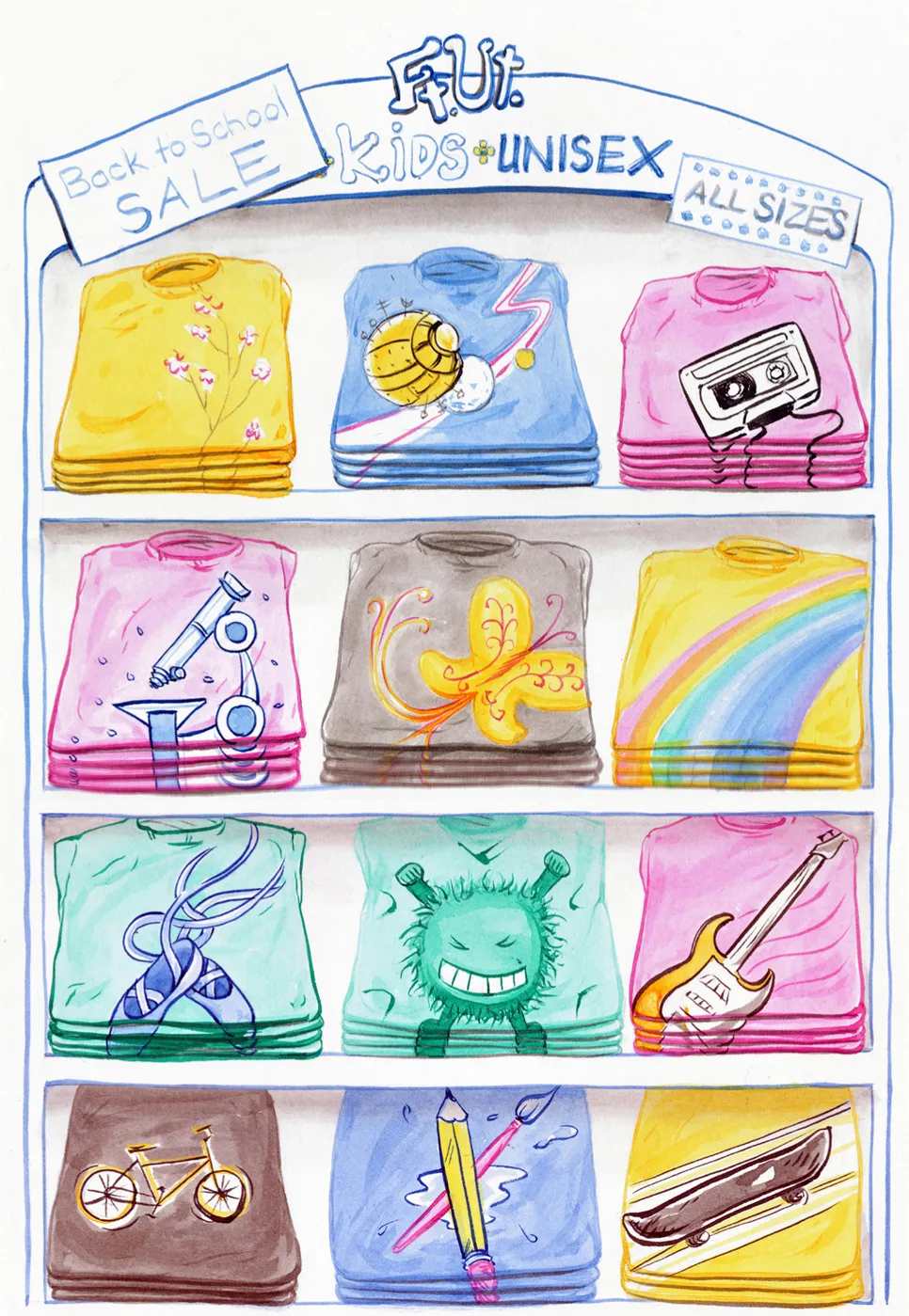
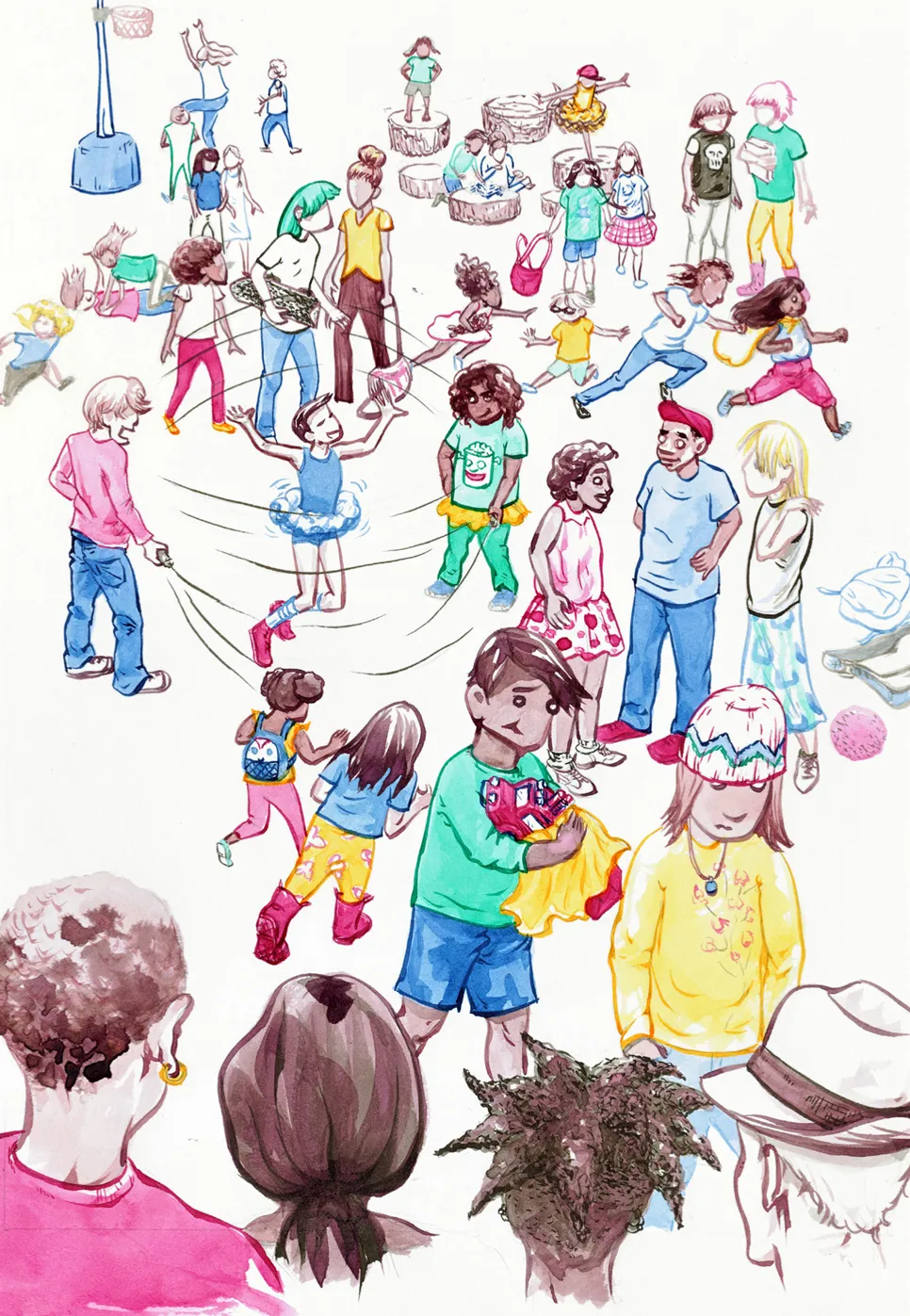
Antropologia culturale e socialeBack to School 1 and 2
TYLER COHEN
Tyler Cohen is a cartoonist who works with multiple voices: surrealism, true vignettes, and journalistic bits about language. She mixes all three in the Primahood comic books—an emotional journey through being a feminist mother of a young daughter and an engagement with questions as to what is female. Her work has been published in QU33R, from Northwest Press, and on Mutha Magazine online. Forthcoming is a collaboration with her sister (the writer Kerry Cohen) about female friendships (mostly the bad ones) from childhood to adulthood–coming in 2015 from Hawthorne Books. Tyler Cohen lives in San Francisco and works as a freelance artist, teacher, and designer. You can find her work at primazonia.com and tylerzonia.tumblr.com.
Not a Favor to Women
The Workplace in a Feminist Future
ELLEN BRAVO
Anna couldn’t hold her head up. She’d known what Mr. Luchsinger would say when she tried to call in sick: “If you don’t come in, don’t come back.”
The rent was overdue and the baby needed a new inhaler. So Anna dragged herself in to Klondike Pharmaceuticals. But between the sinus infection and the chemicals in the floor wax, she couldn’t help curling up on the rag pile in the janitors’ supply closet—really, she just meant to take five.
When Anna awoke and pushed open the closet door, the first thing she noticed was the scent. Instead of the harsh chemicals that left her throat too raw to swallow, the air smelled fresh, like that park with the willow trees where her dad took her one Sunday.
The next thing she noticed was the calendar: March 8, 2063. Whose idea of a joke was this?
Two women were wheeling a cart down the hall. One side sported shiny chartreuse letters that read: “Green and Clean Co-Op.” Instead of the drab gray uniform Anna was wearing—her coworker Jerome called it “prison garb”—these women were decked out in bright colors. Neither looked familiar.
“Hey,” Anna said. “Did Luchsinger bring you in from another shop?”
“Who’s Luchsinger?” The woman who asked had silver hair, but she looked really strong and fit.
“Head honcho for Lux Cleaners.”
The older woman turned to her coworker, who appeared to be in her late twenties and four or five months pregnant. “We read about them last month in our history circle. Fifty years ago, they had the maintenance contract here.”
“Hey, chica,” the other woman said to Anna. “I’m Silvia and this is Marion. Come to the break room with us. You look like you just saw a ghost.”
The two led Anna to a spacious room at the end of the floor. Inside were clusters of people talking and laughing. Anna didn’t know which was more surprising—the number of women in lab coats, the realization that most weren’t Caucasian, or the fact that scientists and custodians sat at the same tables. Colorful paintings covered the walls. She heard unmistakable toddler squeals next door.
Marion took her elbow and led her to a round table in the corner. “I read about other cases just like yours,” Marion said. “What year did you fall asleep?”
If this was a dream, Anna didn’t want to wake up.
“2013.”
Silvia grinned and pointed to the nametag hanging around Anna’s neck. “Welcome, Anna. You can take that off. Everyone here learns each other’s name at our weekly get-togethers.”
No one but the other janitors had ever known Anna’s name. She’d often wondered if the scientists even saw her.
Marion crossed the room to a long table stacked with food and brought back a plate of salad and a tall glass of water. Anna fumbled in her pocket for her change purse.
“There hasn’t been a charge for lunch in thirty years,” Marion said as she took her seat. “So, you must have been here when the company got caught in that scandal.”
Anna nodded. Klondike Pharmaceuticals was charged with hiding a study that showed its famous—and highly profitable—diabetes drug caused damaging side effects.
“Those days are gone,” Marion said. “Each team takes responsibility for quality control; it’s part of their assessment portfolio.”
“What about the cost?” Anna pictured her cousin, skeletal from AIDS. No miracle drugs for the uninsured.
Marion drew their attention to a poster on the wall. “Ever since Congress passed Medicare for All, the cost of drugs is minimal. The government subsidizes research. You remember all those lobbyists Klondike used to hire?”
“What’s a lobbyist?” Silvia asked.
Marion explained how giant corporations spent millions on people whose job was to pad campaign funds and distribute so-called studies that proved whatever the lobbyists were pushing was necessary and beneficial.
“Suits,” Anna said. “That’s what we called them,” shivering as she remembered one who asked for directions while pinning her against the wall. “What happened to those guys?”
Marion threw her head back and laughed. “Look at the display in the library. That’s one of the few job categories that’s plummeted in the last decade.”
A library! Anna couldn’t believe it.
“I can’t imagine how you folks survived,” Silvia said. Her hand moved to the soft swell of her belly under her tunic. “The history team told us all about it last month—how custodial workers were hired by a subcontractor, shifts were always changing, piss poor pay, no benefits, having to work sick—unbelievable.”
“The history team?”
“Oh, you can participate in all sorts of teams,” Marion said. “We have the usual: history, culture, music, art.” She pointed to the walls. “That’s who picks out the paintings we purchase.”
“We.” Anna rolled the word around on her tongue like a delicacy. “But none of the people I knew had time to be on a team.”
Now it was Silvia’s turn to let out a lovely peal of laughter. “That’s because you worked your butt off, sister. Since the workweek was reduced to thirty hours, we all have lots more time to do things we love.”
“Sometimes team members lead on-the-job training sessions,” Marion added. “Like Damien and Sharla—they did a series on the history of racial injustice. Or someone might lead a language class.”
“You mean for immigrants who want to learn English?” Anna asked.
“Sometimes,” Marion said. “But people today move pretty freely between borders. So mainly the classes are for those who want to learn new languages—mostly Spanish, maybe a little Greek or Swahili before your sabbatical.”
Anna almost choked on her beets as they described the sabbatical available after seven years.
“How can you pay your rent with only thirty hours a week?” she asked.
“Oh, that’s full-time pay,” Silvia said. “The way we work, everyone is more efficient. No surprise—rested workers do a better job. Virtually everyone who wants to be is employed. And most people own homes.”
While Anna finished her salad, Silvia explained how the unions worked with managers to set up a series of co-ops for all the nonscientific functions in the workplace. Workers were actually owners of their sections and made all the decisions.
“Next you’re going to tell me everyone makes the same pay and there’s no have’s and have not’s,” said Anna.
“There are plenty of have’s,” Marion said. “But thanks to the changes in the laws, tax dollars no longer get sucked into corporate welfare. And they also aren’t needed for stuff like food stamps—not since we passed the thriveable wage law. The co-ops all have seats on corporate boards, so that keeps the top-pay in line. At most it’s no more than twenty times the average worker’s wage.”
Anna pointed at a group of women scientists. “There used to be so few women here,” she said. “How did this happe...
Table of contents
- Cover
- Title Page
- Copyright
- Dedication
- Contents
- Introduction
- Reproductive Supporters
- Dispatch From the Post-Rape Future
- Dispatches from a Body Perfect World
- My Own Sound
- A List of Thirty-Three Beautiful Things to Wear on Your Breasts
- Our Bodies, Us
- Dispatch from Outside the Girl Talk Incubator
- Interview with Jessica Luther
- Interview with Melissa Harris-Perry
- Feminist Constitution
- Flag for the United Nations of Magical Girls
- The New Word Order
- Justice
- Interview with Lauren Chief Elk
- Not on My Block
- Raising Generation E (For Empathy)
- If Absence Was the Source of Silence
- What Would a Feminist Utopia Look Like for Parents of Color?
- I Don’t
- Let Him Wear a Tutu
- Interview with Ileana Jiménez
- Interview with Cindy Ok
- Learning Our Bodies, Healing Our Selves
- Feminist Utopia Teen Mom Schedule
- New Rites of Transition
- Renouncing Reality
- What Will Children Play with in Utopia?
- Back to School 1 and 2
- Not a Favor to Women
- Less Work, More Time
- Imperfectly
- Description of a Video File From the Year 2067 to be Donated to the Municipal Archives from the Youth Voices Speech Competition
- Working Utopia
- Interview with Sovereign Syre
- Embroidering Revolution
- Equity Eats
- Interview with Miss Major Griffin-Gracy
- An Unremarkable Bar on an Unremarkable Night
- Lesbo Island
- Noisy Utopia
- Finding an Erotic Transcendence
- Sliding Doors
- Interview with Judy Rebick
- Welcome to Arcadia
- Interview with Mia McKenzie
- Beyond Badass
- Interview with Chloe Angyal
- Poems for Past Lovers 1-3
- Interview with Suey Park
- Crazy Bitches
- No Escape Hatch
- The Day without Body Shame
- Queer in Public
- The Free Girl Who Is Everything
- When God Becomes a Woman
- Seven Rituals from the Feminist Utopia
- Interview with Harsh Crowd
- Imperfect Categories
- Sightings of Utopia
- About the Editors
- Also Available from Feminist Press
- About Feminist Press
Trusted by 375,005 students
Access to over 1.5 million titles for a fair monthly price.
Study more efficiently using our study tools.
Frequently asked questions
Yes, you can cancel anytime from the Subscription tab in your account settings on the Perlego website. Your subscription will stay active until the end of your current billing period. Learn how to cancel your subscription
No, books cannot be downloaded as external files, such as PDFs, for use outside of Perlego. However, you can download books within the Perlego app for offline reading on mobile or tablet. Learn how to download books offline
Perlego offers two plans: Essential and Complete
- Essential is ideal for learners and professionals who enjoy exploring a wide range of subjects. Access the Essential Library with 800,000+ trusted titles and best-sellers across business, personal growth, and the humanities. Includes unlimited reading time and Standard Read Aloud voice.
- Complete: Perfect for advanced learners and researchers needing full, unrestricted access. Unlock 1.5M+ books across hundreds of subjects, including academic and specialized titles. The Complete Plan also includes advanced features like Premium Read Aloud and Research Assistant.
We are an online textbook subscription service, where you can get access to an entire online library for less than the price of a single book per month. With over 1.5 million books across 990+ topics, we’ve got you covered! Learn about our mission
Look out for the read-aloud symbol on your next book to see if you can listen to it. The read-aloud tool reads text aloud for you, highlighting the text as it is being read. You can pause it, speed it up and slow it down. Learn more about Read Aloud
Yes! You can use the Perlego app on both iOS and Android devices to read anytime, anywhere — even offline. Perfect for commutes or when you’re on the go.
Please note we cannot support devices running on iOS 13 and Android 7 or earlier. Learn more about using the app
Please note we cannot support devices running on iOS 13 and Android 7 or earlier. Learn more about using the app
Yes, you can access The Feminist Utopia Project by Alexandra Brodsky, Rachel Kauder Nalebuff, Alexandra Brodsky,Rachel Kauder Nalebuff in PDF and/or ePUB format, as well as other popular books in Scienze sociali & Antropologia culturale e sociale. We have over 1.5 million books available in our catalogue for you to explore.