A unique handbook providing a set of good practice standards for both producers and consumers of Halal food
This accessible, authoritative book covers all aspects of Halal from its origins through to how we expect Halal to develop in the coming years. It explains what Halal is, where it came from, how it is practiced, and by whom. In addition to putting Halal in a religious and cultural context, the book provides practical standards for those working in the Halal trade. It explains why there are so many different interpretations of Halal and why this needs to be resolved if international trade is to be developed.
Each chapter in The Halal Food Handbook is written by leading experts in their particular field of study. The first one discusses how regulatory bodies have failed to stem the miss selling and adulteration of Halal foods. The next chapters cover the slaughter process and issues around good practice. The book then looks at regulators—covering Sharia law, UK national laws, and the EU—and outlines the legal framework for enforcing the law. It also compares and contrasts different types of religious slaughter for faith foods; examines attempts to set an international standard for trade; and discusses pork adulteration in Halal foods. The final chapter covers other aspects of Halal, including cosmetics, tourism, lifestyle, and banking, and finishes with a look at what the future holds for Halal.
Written and edited by leading international experts in Halal who are backed by the Muslim Council of Britain
Presents a set of good practice standards for both producers and consumers of Halal food
Covers the complexity of the political, legal, and practical dimensions of Halal food production
The Halal Food Handbook will appeal to a wide audience, including abattoirs, manufacturers, retailers, regulators, academics, public bodies catering for Muslims, and the broader Muslim community.
Independent Public Health & Environment Consultant, London, UK
1.1 Introduction
1.1.1 Basic Terms
The editors appreciate this book is aimed at a wide cross‐section of readers, from the devout Muslim practitioner to those who are interested in learning about halal but may know little about the religious context behind it. To aid readers who may be non‐Muslim or non‐Arabic speakers, we first lay out a few basic Arabic terms:
Quran: means ‘recitation’ in Arabic and is the literal word of God recited to the Prophet Mohammed (peace be upon him “pbuh”) (pbuh) in Arabic by the Angel Gabriel.
Sura: a chapter of the Glorious Quran
Hadith: means ‘traditions’ in Arabic and is a written record of Mohammed's (pbuh) life and thoughts.
Shariah: means ‘legislation’ in Arabic and provides the moral code and religious law for Muslims.
Halal: means ‘lawful, allowed or permitted’ in Arabic.
Haram: means ‘prohibited and unlawful’ in Arabic.
Makrooh: means ‘disapproved, disliked, hated or detested’ in Arabic.
Mushbooh: means ‘doubtful or questionable’ in Arabic.
Tayyab: means ‘wholesome or fit for consumption’ n Arabic.
1.1.2 What is Halal?
To understand halal and its importance to Muslims, one must first understand something about Islam. Every day a quarter of the earth's population is called to prayer five times a day. From Indonesia to Bangladesh, from Nigeria to Morocco, from Egypt to the USA, no matter where in the world Muslims live, whether alone or with others, they are daily united with fellow believers in this common experience through which each Muslim is required to express devotion to God. These five obligatory prayers take place at daybreak, midday, mid‐afternoon, evening, and at sunset while facing Makkah, the holiest city of Islam. Prayer is always done in Arabic regardless of the worshiper's native tongue.
Much as Islam prescribes the time and nature of worship, it also provides a set of standards by which Muslims are required to live their lives. At the core of these standards are the five pillars of Islam, which are:
Shahadah, the declaration of faith
Salah, the five daily prayers
Zakah, an obligation to give 2.5% of your savings to the poor each year
Sawm, fasting during the ninth Muslim month, Ramadan
Hajj, the pilgrimage that must be made once in every Muslim's lifetime to the Holy City of Makkah in Saudi Arabia. This takes place during the twelfth Muslim month.
A Muslim who believes in God and accepts his works as revealed by the Prophet Mohammed (pbuh) is also required to carry out a set of duties and obligations that impact on every aspect of life. It is only by adhering to this set of instructions that have been clearly laid out by God that you can practice the faith or call yourself a Muslim.
In Arabic, the word halal means lawful or permissible. To the non‐Muslim, it is a word that is often exclusively associated with the foods that Muslims are allowed to eat, but in reality it is a term that describes everything that it is permissible for a Muslim to do, both in deed and thought. Halal impacts every aspect of a Muslim's life, from the clothes that can be worn to attitudes towards work, from relations between men and women to the treatment of children, from the way business is carried out to the treatment of a fellow Muslim, the principal of halal must be applied. Financial products, holidays, sports, films, even how you play a game of chess can be either halal, permissible, or the opposite, haram, unlawful. Haram covers everything that is prohibited for a Muslim. Haram in this sense is just as important as the principles of halal. Its importance to Muslims is due to the Islamic belief that everything put on this earth by God is here for our benefit unless he or she has specified otherwise. In practical terms, this means that everything is halal or permissible unless God has specifically stated that it is not, which is when it becomes haram.
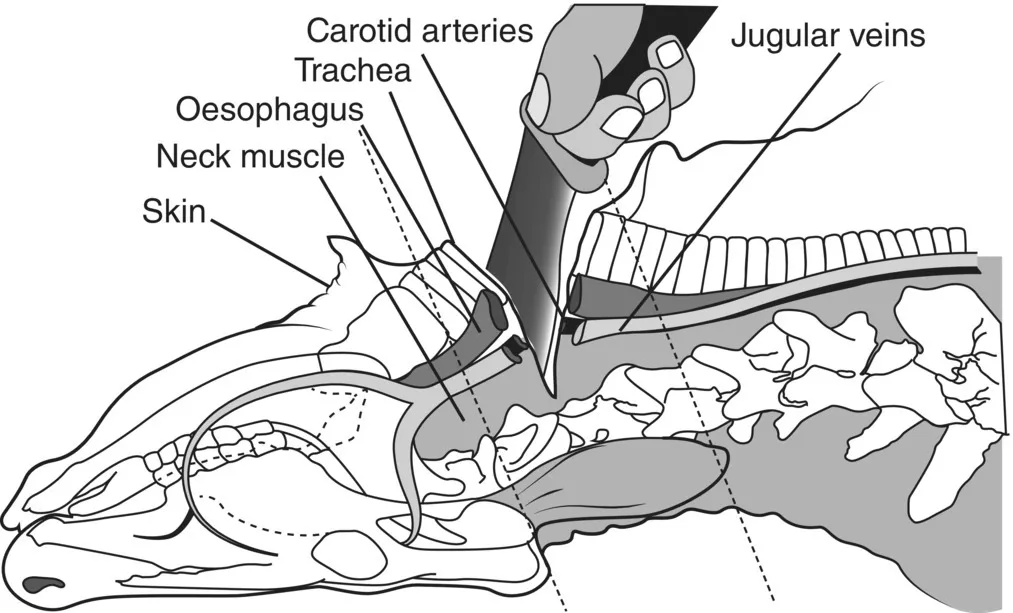
Figure 1.1 Slaughtering of cattle showing proper swift cut.
Source: The London Central Mosque Trust and the Islamic Cultural Centre.
But sometimes things are not that clear‐cut. In addition to halal and haram, there are two other terms that are used to describe whether a deed or thought should be permitted. Makrooh is a term meaning disapproved of, disliked, hated or detested. While a lesser sanction than haram, which is something that is prohibited, it is used to describe an action or deed that is described negatively. The other term that is commonly used is mushbooh, which is an action or deed that is doubtful or questionable. In relation to food, something is mushbooh when there is no consensus about whether it is halal or haram. In such cases, it may be wise to avoid the food item in question.
Understanding what is haram and what is halal, and that which is in between, lies at the core of a Muslim's faith. The reason Muslims believe so profoundly in these distinctions is that they have been laid down in Arabic in the Holy Quran, which for a Muslim is the literal word of God.
1.1.3 Halal and the Holy Quran
The first place a Muslim turns to understand what is halal and what is haram is the Holy Quran. In Arabic Quran means ‘recitation’. Over a period of 23 years from Mohammed’s (pbuh) 40th year to his death in 632, the angel Gabriel visited Mohammed (pbuh) and recited in Arabic the word of God. These recitals were later written down in Arabic to...
Table of contents
Cover
Table of Contents
About the Editors
Notes on Contributors
Acknowledgements
In the name of Allah the Beneficent the Merciful: Foreword
Introduction
Part I: What is Halal
Part II: Animal Welfare and Slaughter
Part III: Halal Ingredients and Food Production
Part IV: Halal Standards, Procedures, and Certification
Part V: Food Law, Regulations, and Food Fraud
Part VI: Halal vs Kosher
Part VII: Halal in Different Countries
Index
End User License Agreement
Trusted by 375,005 students
Access to over 1.5 million titles for a fair monthly price.
Study more efficiently using our study tools.
Frequently asked questions
Yes, you can cancel anytime from the Subscription tab in your account settings on the Perlego website. Your subscription will stay active until the end of your current billing period. Learn how to cancel your subscription
No, books cannot be downloaded as external files, such as PDFs, for use outside of Perlego. However, you can download books within the Perlego app for offline reading on mobile or tablet. Learn how to download books offline
We are an online textbook subscription service, where you can get access to an entire online library for less than the price of a single book per month. With over 1.5 million books across 990+ topics, we’ve got you covered! Learn about our mission
Look out for the read-aloud symbol on your next book to see if you can listen to it. The read-aloud tool reads text aloud for you, highlighting the text as it is being read. You can pause it, speed it up and slow it down. Learn more about Read Aloud
Yes! You can use the Perlego app on both iOS and Android devices to read anytime, anywhere — even offline. Perfect for commutes or when you’re on the go. Please note we cannot support devices running on iOS 13 and Android 7 or earlier. Learn more about using the app
Yes, you can access The Halal Food Handbook by Yunes Ramadan Al-Teinaz, Stuart Spear, Ibrahim H. A. Abd El-Rahim, Yunes Ramadan Al-Teinaz,Stuart Spear,Ibrahim H. A. Abd El-Rahim in PDF and/or ePUB format, as well as other popular books in Technology & Engineering & Food Science. We have over 1.5 million books available in our catalogue for you to explore.